Reconstructing how decades of legal decisions, delegated access, and operational exceptions shaped the security boundaries of Denmark’s national population register.
An analysis based on publicly available information as of October 9, 2026
Abstract
In September 2026, unauthorized actors exploited a Danish private company’s legitimate access to the Central Person Register (CPR), obtaining access to personal information concerning approximately 8.8 million registered individuals. The activity continued for around ten days and was discovered on October 2, reportedly after an unusually large invoice drew attention to the volume of queries.
The attackers’ identity, initial entry point, and the particular CPR service used remain unknown. The Danish authorities have not established that the central register itself was compromised through administrative access. The confirmed incident instead involved the misuse of an access capability legitimately granted to an external organization.
CPR’s history reveals two consequential double standards. Bulk data provision and individual lookups developed under different supervisory expectations, although repeated individual queries could produce results comparable to large-scale extraction. Public self-service access was subsequently subjected to stronger identity-verification requirements, while employee-assisted queries and company-operated integrations continued under different authorization arrangements.
These distinctions had legitimate administrative purposes. Their interaction, however, created a potential problem: an authorized company application could execute large numbers of individual lookups without necessarily applying the identity-binding requirement imposed on public self-service users.
This article examines how these arrangements developed, how they are represented in the documented system architecture, and how the resulting differences between intended restrictions and operational authority could be exploited. A 2012 warning, a 2017 regulatory finding, and a documented 2025 incident provide evidence of related risks and failures. Whether the same mechanism directly caused the September 2026 breach remains unconfirmed.
1. Timeline of the Incident
On October 5, 2026, Denmark’s Ministry of Research, Education and Digitalisation and the CPR administration announced extensive unauthorized access to the country’s national population register. According to the government, the attackers had misused a legitimate lookup entitlement held by a Danish private company, reaching names, addresses, CPR numbers, and other personal details relating to approximately 8.8 million registered individuals. The reported access arrangement was intended for private-sector use; the authorities have not described the incident as a compromise of a national registry administrator.
| Date | Event |
|---|---|
| September 2026 | Unauthorized queries occur through a private company’s legitimate CPR access. |
| Approximately ten days in September | The activity continues before detection. |
| October 2 | CPR administration identifies irregular September activity. |
| October 3–4 | Authorities investigate the extent of the incident. |
| October 4 | CPR administration notifies the Danish Data Protection Agency, Datatilsynet. |
| October 5 | The government announces unauthorized access concerning approximately 8.8 million registered individuals. |
| October 6 | Officials explain that an unusually large invoice prompted the discovery. |
| October 9 | Ritzau reports Politiken’s interview with a person claiming responsibility, including a claim that the password was 123456. The account remains unverified. |
The figure of 8.8 million should not be confused with Denmark’s current population. CPR contains approximately 11 million registered individuals, including people who have died, emigrated, or otherwise remain recorded in the system.
The discovery mechanism is particularly significant. During an October 6 press briefing, ministry official Mikkel Leihardt explained that the affected company was relatively small and had generated an unusually expensive invoice. CPR services charge for certain transactions, and the unexpected billing amount revealed a level of activity inconsistent with the company’s ordinary usage.
Digitalisation Minister Christina Egelund separately acknowledged that the safeguards surrounding the company’s access had been inadequate and that suspicious activity lasting around ten days should have triggered an earlier warning. The CPR administration suspended the company’s access, notified the data-protection regulator, and began investigating the incident with the police and other authorities.
As of October 9, neither the affected company nor an attacker had been identified by the authorities. On that date, Ritzau summarized Politiken’s interview with a person claiming responsibility. The person claimed that access was obtained using the password 123456, allegedly a leaked former employee’s credential. According to Ritzau, Politiken received a file of CPR numbers. The claimant’s identity, the password’s role, and the precise entry route have not been independently established by the authorities. The public report does not identify the CPR product involved.
The confirmed starting point for analysis is an external organization whose legitimate access was used for unauthorized queries. The still-unverified password account may help explain how someone obtained that authority, but the publicly available evidence does not yet show which company system or CPR product they used.
Sources: Ministry, October 5; CPR Administration, October 5; Ritzau, October 5; Ritzau, October 6.
2. What Was Actually Accessed?
An attacker claim has now been reported, but it is not an independently verified reconstruction of the intrusion. The available material does not establish a named threat actor, a verified leak-site posting, or evidence that a complete dataset was subsequently sold or published. Ritzau’s account of the file received by Politiken is a new observation, but it does not establish that the claimant’s proposed access method is correct.
The strongest evidence comes from the CPR administration, the ministry’s October 5 statement, and Datatilsynet. The CPR administration reported access to names, addresses, CPR numbers, and other information concerning approximately 8.8 million individuals. The ministry stated that the activity remained within the categories of information accessible to private companies.
The administration further reported that the unauthorized access did not include the protected names and addresses of individuals registered for name-and-address protection. That statement concerns the protected fields, not necessarily every other attribute associated with those individuals.
Datatilsynet described the incident somewhat differently. According to its October 5 announcement, the notification concerned a very large number of automated queries intended to identify valid CPR numbers.
This distinction matters because validating an identifier and retrieving a previously unknown identifier are not necessarily the same operation. CPR administration’s description of private-sector disclosure lists permitted attributes without CPR numbers. Its guidance on register access, pp. 4–5 says that CPR numbers are not newly disclosed to private recipients. The guidance also describes a narrower operational case: when a company has already supplied a person’s number to establish a subscription, that number can be returned with the delivery to ensure correct identification. That return is not evidence that CPR supplied an identifier the company did not already know.
Some CPR lookup products allow a recipient to submit information identifying an individual and receive a response concerning that individual. Depending on the product, the request may use a CPR number, or a combination of name, address, and date of birth. If an actor already possesses a candidate CPR number, a response confirming its validity can supply new information without disclosing a previously unknown number; associated personal attributes could also let the actor verify or enrich an existing dataset.
Conversely, a lookup based on other identifying information could reveal a different kind of association. The government’s statement that CPR numbers were among the information accessed must therefore be read alongside the private-sector rule and Datatilsynet’s account of identifier validation. The attackers may have validated candidate numbers already in their possession, or a different input and response path may have exposed associations they did not previously know. The public record does not identify which inputs the September attackers supplied, which CPR product handled them, or precisely which attributes were returned. The 2018 subscription example cannot be generalized to every 2026 lookup service.
| Reported information | Evidentiary status |
|---|---|
| Approximately 8.8 million registered persons affected | Confirmed by CPR administration |
| Names, addresses, CPR numbers, and other information | Categories identified by the government |
| Large-scale automated queries intended to identify valid numbers | Described by Datatilsynet |
| Previously unknown CPR numbers returned to the attacker | Not established |
| Candidate CPR numbers validated or enriched | Plausible; inputs and responses not disclosed |
| Misuse of a private company’s legitimate access | Confirmed |
| Direct administrative compromise of the central register | Not established |
| Complete export of the underlying registry database | Not established |
| Subsequent publication or sale of the acquired information | Not established |
Even a dataset consisting primarily of validated identities could be consequential. CPR numbers are identifiers used throughout Denmark’s public administration and private economy. They are not equivalent to passwords, and possession of a CPR number does not itself defeat MitID, Denmark’s national electronic identity system.
The risk arises when another organization treats knowledge of identifying information as evidence that a person is entitled to act on the corresponding account. A caller who knows a person’s name, address, and CPR number may be able to identify the correct customer record and answer questions used by an inadequately designed support process. The consequences could include unauthorized changes to account details, disclosure of private information, or fraudulent service requests.
The distinction is between identifying a person in a database and authenticating the person making a request. The Danish Agency for Societal Security warned organizations about precisely this risk after the incident. No reliable public evidence examined here establishes the number of subsequent fraudulent transactions, if any. The implications of the breach therefore depend not only on what was obtained from CPR, but also on how that information is trusted elsewhere.
Source: Datatilsynet, October 5.
3. CPR and the Historical Formation of Two Double Standards
3.1 From Administrative Register to Private-Sector Infrastructure
The Central Person Register began operating on April 2, 1968. Its original purpose was to establish a consistent national population record and a common personal identifier for public administration. The expansion of electronic information processing, taxation, and social-security administration made it increasingly important for different government organizations to identify the same individual reliably.
CPR was consequently not merely a repository of personal information. It also became a mechanism for distributing authoritative information between organizations. Private-sector use was initially treated more cautiously.
The CPR administration’s historical account, pp. 15–16 records that the early institutional bodies were reluctant to make the personal identifier broadly available to private organizations. That position changed as commercial institutions acquired administrative obligations that depended on accurate population information. Financial institutions’ tax-reporting requirements strengthened the case for cooperation with the national register in 1977, and legislation in 1978 established a more formal framework for private access.
At that time, bulk information provision was subject to a significant restriction: a company generally needed to identify the relevant persons in advance and have a concrete legal relationship with them. A bank could therefore have a legitimate reason to maintain the current address of an existing customer, without gaining a general entitlement to use the national population register to identify new commercial prospects.
The restriction changed with the CPR Act that entered into force on July 1, 2000. The general requirement for a concrete legal relationship was removed from the relevant bulk-provision framework, and the categories of private organizations eligible for information were expanded. Requirements concerning lawful processing, purpose, and identification of the relevant persons continued to apply, but the framework supported broader use.
The CPR administration’s own historical account describes active promotion of the newly available services to private organizations in the years following the reform, continuing until 2006. Private CPR access was therefore an explicit administrative and legislative choice, rather than an accidental legacy of outdated software. By 2009, the register was distributing more than 150 million person-record entries annually through extracts, together with approximately 35–40 million through online services.
Those figures establish that large-scale processing had become an ordinary function of the national information infrastructure, increasing the importance of controls over which people each recipient could reach. They do not establish whether the affected company’s September activity resembled its normal use.
Source: CPR Administration, Udviklingen på CPR-området frem til 2009, especially pp. 28–29.
3.2 The First Double Standard: Bulk Provision and Individual Lookups
In 2005, Datatilsynet investigated CPR’s provision of personal information to private companies in two decisions dated May 18 and June 22. The first concerned bulk delivery under Section 38 of the CPR Act: a company received information about a defined group of individuals through extracts or continuing subscriptions. Datatilsynet held that CPR administration retained responsibility for the lawfulness of this provision and could not ignore evidence that a recipient lacked entitlement. In practice, however, CPR administration relied substantially on the requesting company’s account of its purpose and proposed delivery rather than verifying every claimed relationship with the individuals concerned.
The second decision concerned CPR Søg, a browser-based service for individual lookups under Section 39. Because these lookups concerned already identified persons and generally returned limited current information, principally unprotected names and addresses, Datatilsynet assigned CPR administration responsibility for granting access but not, under the data-protection law then in force, for examining the lawfulness of every later query. The recipient company remained responsible for its individual collection and further processing.
The distinction reflected the different forms of delivery: bulk provision selected a population in advance, while each individual lookup returned limited information about a specified person. Yet electronic lookups could be repeated automatically, allowing an authorized integration to reach many people through successive requests. CPR administration’s 2009 figures already showed tens of millions of online person-record deliveries annually, so the relevant tension was not a failure to anticipate automation. It was that bulk provision and individual queries were evaluated through different supervisory arrangements, while repeated individual queries could collectively produce an information set comparable to a bulk delivery. A control applied to each transaction does not necessarily limit the cumulative population reached.
This is historical evidence of a division in supervision, not proof that the 2026 attackers used Section 39 to evade Section 38. The 2005 individual-lookup decision concerned CPR Søg under a pre-GDPR framework, whereas the June 2026 private-sector Datafordeleren terms expressly invoke Section 38. The continuing question is who checks the legitimacy of each selected person; the legal route and actual service restrictions in September 2026 still require incident-specific evidence.
Sources: Datatilsynet, May 18, 2005; Datatilsynet, June 22, 2005.
3.3 The Second Double Standard: Self-Service Authentication and Delegated Queries
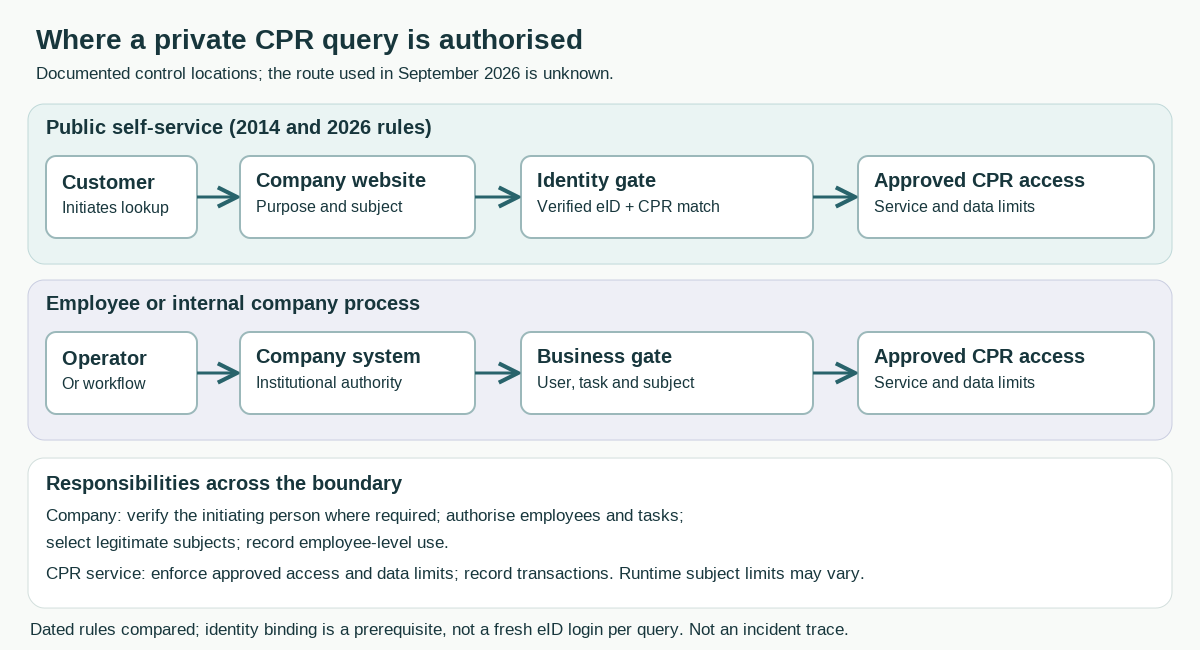
The second distinction emerged from commercial applications. In May 2012, CPR administration warned companies using CPR Direkte in customer-registration websites after reports that a telecommunications site might let third parties test combinations of valid CPR numbers and names repeatedly. A public user could supply details to the company’s application, which would submit a query through its authorized CPR connection and disclose the verification result. The user did not authenticate directly to CPR; the company exercised its own access on that person’s behalf.
From October 2014, publicly accessible self-service applications had to authenticate the user with NemID, the national electronic identity system then in use, and use the PID-CPR Match service to verify that the supplied CPR number matched that authenticated identity before querying CPR. The announcement allowed a company to issue its own credentials for later use after the initial NemID verification; it did not require a fresh national identity check for every query. It also specified that CPR Direkte itself would not need a technical change and that employees could continue to perform manual lookups while serving customers, including in physical stores.
That difference served distinct operational needs, but its enforcement location matters. The stronger check applied in the company’s public workflow, while its authorized registry integration remained available for other legitimate operations. The 2026 private-sector Datafordeleren terms retain a national identity check, using NemID or MitID and PID-CPR Match, when a publicly accessible self-service site initiates a lookup. The public and company-operated routes are therefore governed by different identity-verification requirements while retaining access to substantially similar registry information. If another company function could invoke the integration without adequate checks on the user and the person whose record was requested, the public workflow’s protection would not necessarily constrain it. This is the delegated-access boundary relevant to the later cases, not evidence that the 2026 attackers used any particular application function.
Source: CPR Administration, August 2014.
3.4 Modernisation Without Eliminating Delegated Access
CPR underwent substantial technical modernization during the following decades. A major replacement introduced a modernized system in October 1991, based on technologies including DB2, Natural, and CICS. Later development gradually replaced Natural components with Java.
The administration’s 2025 annual report records that the Java-based CPR Direkte entered production on April 30, 2025. Existing customers generally required little or no local adaptation. The same report also documents multifactor authentication for CPRWeb.
These changes modernized the technology while retaining system-to-system integrations for legitimate private organizations. As a result, the external application still had to determine which employees or customers could use the company’s authorized access. The durable feature was the division of responsibility: the state granted an organization information-access capabilities and relied partly on that organization to control their individual use, an arrangement that survived several generations of technology.
Source: CPR Administration, Annual Report 2025.
4. Reconstructing the Architecture
4.1 The Central Register and Its Distribution Interfaces
CPR is not a single database directly queried by every external organization. Its documented architecture distinguishes the authoritative register, interactive search products, system-to-system integrations, file extracts and subscriptions, and the Datafordeleren distribution platform.
| Component | Documented function |
|---|---|
| Central CPR register | Authoritative population records updated through public registration authorities |
| CPRWeb | Interactive lookup by individually authorized users |
| CPR Direkte | Program-to-program queries from customer systems |
| CPR Services | Structured system-to-system services |
| Status extracts | Delivery of information concerning defined groups of people |
| Change extracts and subscriptions | Continuing delivery of updates about subscribed individuals |
| Datafordeleren | Distribution of CPR-derived information through services including REST and GraphQL |
An organization querying Datafordeleren obtains CPR-derived information through a distribution environment, without necessarily accessing the authoritative CPR store directly. CPRWeb and automated company integrations can also reach related information, although they use different authentication and authorization arrangements. Because the public record does not identify which product was used during the September intrusion, those distinctions must remain visible in any reconstruction of the attack.
4.2 Where Identity and Authorization Are Actually Enforced
The June 16, 2026 private-sector terms for Datafordeleren provide a particularly useful description of authorization responsibilities. A company applying for access must specify its intended purpose. CPR administration examines the proposed delivery to ensure that the persons and attributes covered do not exceed what is necessary for the task.
For system-to-system access, the customer normally receives a Datafordeleren user profile associated with a certificate authorized to access CPR data. The customer must control the profile and certificate, designate a security officer, and authorize only employees who require the integration for their work.
The company must also identify individual employees through its internal systems and associate their CPR queries with personal authorization codes. The terms explicitly explain that Datafordeleren normally records the profile and certificate belonging to the communicating program, while the individual employee’s activity is recorded by the customer. This arrangement divides the authorization process between two organizational domains.
| Decision | Principal enforcement or responsibility |
|---|---|
| Which company may receive CPR information? | CPR access approval |
| Which services and information categories may it receive? | Approved grants and service restrictions |
| Which employee or business process may use the connection? | Company-side authorization |
| Why may a particular person be queried? | Business purpose, relevant company records, and applicable service-side restrictions |
| Who can relate an individual query to an employee’s task? | Primarily the company’s operational records |
Consider a financial institution that uses CPR to update customer addresses. The institution’s access may be authorized for that legitimate purpose. Its backend application can submit identifying information and retrieve permitted attributes. But the fact that a query comes from the institution’s certificate does not itself prove that the queried individual is one of its customers or that the institution still has a lawful reason to process that person’s information.
Those are additional facts, often represented in the institution’s business records. The 2026 terms require CPR administration to consider population scope during access approval, but leave unclear whether and how the approved scope is checked for each request. The practical question is whether the service or the company’s application prevents a query when the person falls outside the approved task.
4.3 Search Capabilities and the Reachable Population
Private-sector CPR services offer several ways to identify a person. CPR Direkte supports programmatic searches, while Datafordeleren’s CustomPrivateSectorPerson GraphQL service provides a structured view of permitted CPR-derived information. Its September 2026 documentation describes searches by CPR number, name and address, or name and date of birth. A CPR-number request can contain up to 100 numbers; the other described searches ordinarily identify one person at a time.
These capabilities support normal business processing and do not themselves imply unauthorized access, but they also allow repeated or grouped retrieval of individual records. The GraphQL documentation describes restrictions on returned data, including current-data limitations and exclusion of protected names and addresses from ordinary responses. Such restrictions address which attributes a company may receive. They do not, by themselves, establish that every person named in a request belongs to the company’s legitimate business population. An application may therefore need a separate check on whose record may be queried.
The ministry reported a very large affected population in September while stating that the information accessed remained within categories available to private organizations. That combination makes the scope of people reachable through the actual service and company workflow an important issue to investigate; the public record does not show which search function the attackers used.
Source: Datafordeleren, private-sector GraphQL documentation, September 2026.
4.4 The Monitoring Boundary
The same division of responsibility appears in logging and review. The 2026 Datafordeleren terms provide transaction statistics and log-search facilities while requiring the company to keep employee-level records for system-to-system queries. They also require periodic review of permissions and usage at intervals no greater than three months, with monthly transaction statistics provided to the responsible security officer.
The resulting records describe different parts of each operation. The distribution platform can show that an authorized company profile performed a search, whereas the company can identify the employee or process involved and the business task that was supposed to justify it. Both may be needed to distinguish a legitimate high-volume job from unauthorized collection: high aggregate use is normal for CPR, and volume alone does not establish whether the selected people fell within a company’s lawful purpose.
Billing revealed unusually extensive use by the affected company in September. That shows the transactions became visible in accounting records, but it does not establish whether security alerts were absent, ignored, or ineffective earlier in the activity. Logging, authorization review, and timely intervention must therefore be assessed separately.
Source: CPR Administration, private-sector Datafordeleren terms, June 16, 2026.
5. How the Two Double Standards Could Be Exploited
The two historical distinctions have different relationships to the 2026 incident. The 2005 decisions show that bulk provision under Section 38 and individual CPR Søg lookups under Section 39 carried different supervisory expectations. They are evidence of how responsibility for selecting legitimate subjects was historically divided, not proof that the attackers used a Section 39 route; the 2026 private-sector Datafordeleren terms expressly invoke Section 38. The 2014 self-service rule is closer to the present authorization boundary because it required verification of the public user while leaving employee-assisted lookups to company procedures, a division also reflected in the 2026 terms.
5.1 The Company Application as an Alternative Access Path
A business application that submits CPR queries under an authorized company identity is one possible route to investigate. An attacker would not necessarily need administrative access to CPR or possession of the company’s integration certificate: if a lower-privileged or unauthorized user can cause the application to submit a request, its backend may perform the lookup through the normal institutional connection. The user’s permission to operate the application and the backend’s broader ability to obtain CPR information are different authorities. The application must determine whether that user may invoke the connection for the particular person being queried.
The 2012 CPR warning concerned a commercial website that could potentially reveal the result of CPR identity validation to a third party through repeated inputs. The subsequent self-service authentication requirements addressed that public route, while the authorized integration remained available for other legitimate company processes. The fact that a public workflow was protected therefore would not, by itself, establish that every other function using the same company connection applied equivalent checks.
The December 2025 Danløn incident provides a concrete example of this boundary. Danske Lønsystemer disclosed 89,100 unauthorized CPR lookups through demo accounts and stated that the actors already possessed the CPR numbers they queried; it reported no evidence of broader unauthorized access to its operational systems or customer data. The problem was an application-level capability made available to accounts that should not have enabled the activity. This case does not identify the September 2026 entry point, but it shows how a valid company integration can be misused through a lower-trust application function without a general compromise of CPR or the company’s infrastructure.
Sources: CPR Administration, May 2012; Danske Lønsystemer, December 15, 2025.
5.2 When the Application Can Query More People Than Its Business Purpose Allows
The next boundary concerns the population selected for queries. A company may need current addresses for many customers or employees, but it must distinguish those people from others outside the relevant business relationship. If its application selects query subjects from company records, both the records and the function that selects them become part of authorization. A failure there can permit queries about outsiders even when CPR authentication and field restrictions operate as intended.
Datatilsynet documented such a population mismatch in its April 2017 EASY-P decision. The vocational-education system had serious access-control weaknesses, including functionality reachable from an open institutional wireless network and an authentication check that could be bypassed by changing a URL path. Its CPR search accepted a personal number and returned a name without restricting the search to the students within the application’s legitimate business population, so Datatilsynet called for that restriction. The decision did not establish that the function was exploited to obtain CPR data and left open whether the search contacted CPR directly; its relevance here is the documented gap between an application’s intended population and the people its search would accept.
Together, EASY-P and Danløn illustrate two different controls: who may invoke a lookup, and whose record that user or process may query. If both fail, an authorized company integration can collect information far beyond its legitimate business population. The possible scale still depends on the approved connection’s reach, the chosen CPR service’s restrictions, the rate and duration of queries, and monitoring that might interrupt them.
Source: Datatilsynet, EASY-P decision, April 24, 2017.
5.3 Reconstructing the September 2026 Activity
The attackers used a private company’s legitimate CPR access for unauthorized queries affecting approximately 8.8 million registered individuals. The ministry stated that the information categories remained within those available to private companies, while Datatilsynet described automated queries intended to identify valid CPR numbers. Together, these observations are compatible with large-scale misuse of a delegated lookup capability, but they do not show how the attackers first exercised it. Three routes warrant comparison because each crosses a different authorization boundary.
| Possible route | Authority exercised | Records that could distinguish it |
|---|---|---|
| Customer-facing application | A user causes the company’s backend to query CPR | Application requests and user sessions correlated with CPR transactions, including which identity and subject checks ran |
| Employee account or internal workflow | A company user or process invokes the approved integration | Employee authorization, task, and internal query records correlated with CPR transactions |
| Direct use of integration credentials | The company connection is used outside its normal application workflow | Certificate or profile activity and network-origin records without matching authorized application or employee activity |
The routes are alternatives, not observed stages of one attack. The affected company might also have held a wider approved population scope than expected, or the selected service might have enforced restrictions that changed what each route could reach. The reported 123456 password claim would, if verified, make credential-based entry a more concrete hypothesis, but the allegation that it belonged to a former employee does not establish whether it opened a public application, an internal account, or a CPR connection. Direct integration access would additionally depend on any certificate and network-origin restrictions and would not show a bypass of the public self-service workflow.
The entry route also does not settle what happened to CPR numbers. Request and response records could show whether the attackers submitted candidate numbers for validation or obtained previously unknown associations through another search path. Together with the company’s approved scope and per-person authorization rules, those records would distinguish an actual breach mechanism from the historically documented risks discussed here. They have not been made public.
5.4 Related Entitlement Boundaries
Two further records illustrate how an approved entitlement can outlive or extend beyond its business justification. In 2005, Datatilsynet examined Experian’s role as a CPR subscriber for approximately 2.5 million people and a processor acting for other organizations. It accepted the intermediary model while requiring better transparency about the ultimate recipients. In 2016, CPR administration warned that some recipients were not systematically deleting subscriptions after the need for updates ended.
These are supplementary examples of role and duration controls. Neither is established as part of the September 2026 attack, whose central issue remains the authority used to query a very large population.
5.5 What the Two Double Standards Explain
The first double standard concerns scale: repeated individual queries can reach a population comparable to a bulk delivery. The second concerns delegated authority: the public self-service rule introduced in 2014 and retained in the 2026 terms binds a user to a CPR number through national identity verification, whereas employee-assisted and company-operated routes rely on the company’s checks over users, tasks, and the people queried. The 2012 warning, 2017 EASY-P finding, and 2025 Danløn incident document distinct points at which those company-side controls were questioned or failed. Together, the two distinctions expose one failure condition: a valid company connection can be invoked without authority for a particular person and repeated across people outside the approved task. The central service might still authenticate the company and restrict the fields returned while the cumulative population reaches the scale of a bulk delivery. Whether that condition existed in September 2026 depends on the affected company’s authorization rules, approved service scope, and transaction records.
6. Conclusion
The 2026 incident involved unauthorized use of a private company’s legitimate CPR access on a national scale. The newly reported password claim may clarify the entry point, but it has not established which product was used or how the affected company’s permissions were exercised.
The historical record explains why those details matter. Access approval, user authentication, the selection of legitimate subjects, field restrictions, and monitoring are separate controls owned by different participants. A technically valid query can still reach a person outside the company’s proper business population if those controls do not meet at the point of use.
The effective boundary is the one that constrains what an authorized intermediary may actually do. Establishing whether the September attackers crossed the company-side boundary described here requires the transaction records, the approved population scope, and the affected company’s authorization evidence.
References
Incident and reporting
- CPR Administration — Extensive Unauthorized Access to CPR Information, October 5, 2026
- Datatilsynet — Statement Concerning CPR Lookups, October 5, 2026
- Ritzau — Minister’s Remarks on the Ten-Day Incident, October 5, 2026
- Ritzau — Discovery Through an Unusually Large Invoice, October 6, 2026
- Agency for Societal Security — Identity Verification After the CPR Breach, October 6, 2026
- Ritzau — Report on Politiken’s Interview and Password Claim, October 9, 2026
- Ministry of Research, Education and Digitalisation — Unauthorized CPR Access, October 5, 2026
Historical and regulatory records
- CPR Administration — CPR: Denmark’s Population Register, 1991, pp. 15–16
- CPR Administration — Development of the CPR System Through 2009
- Datatilsynet — CPR Disclosure to Private Companies (I), May 18, 2005
- Datatilsynet — CPR Disclosure to Private Companies (II), June 22, 2005
- CPR Administration — CPR Direkte on Commercial Websites, May 30, 2012
- CPR Administration — NemID and CPR Verification Requirements, August 2014
- CPR Administration — Creation and Deletion of Person Subscriptions, May 17, 2016
- Datatilsynet — Insufficient Security in EASY-P, April 24, 2017
- Danske Lønsystemer — Unauthorized CPR Queries Through Demo Accounts, December 15, 2025