How Dodo Pizza’s franchise contracts, shared technology, and delegated access frame a cross-border breach and an alleged market for stolen customer data.
Incident Analysis · Cybercrime Economics · Franchise Systems · Data Governance · Access Control
Analysis based on publicly available information as of October 18, 2026.
Abstract
On October 14, 2026, Moscow’s Tverskoy District Court placed Denis Alekseevich Fridman under house arrest in connection with an alleged cyberattack against Dodo Pizza. Russian investigators accused him of unlawfully obtaining customer information and transferring it to other people for payment. Media reports associated the case with DataSuckers, a group that had claimed attacks against businesses in Russia and Ukraine, and described an archive containing billions of records allegedly offered for sale. The court confirmed the charge and preventive measure, but not the reported data volumes, financial transactions, or full membership of the group. [1][2][3]
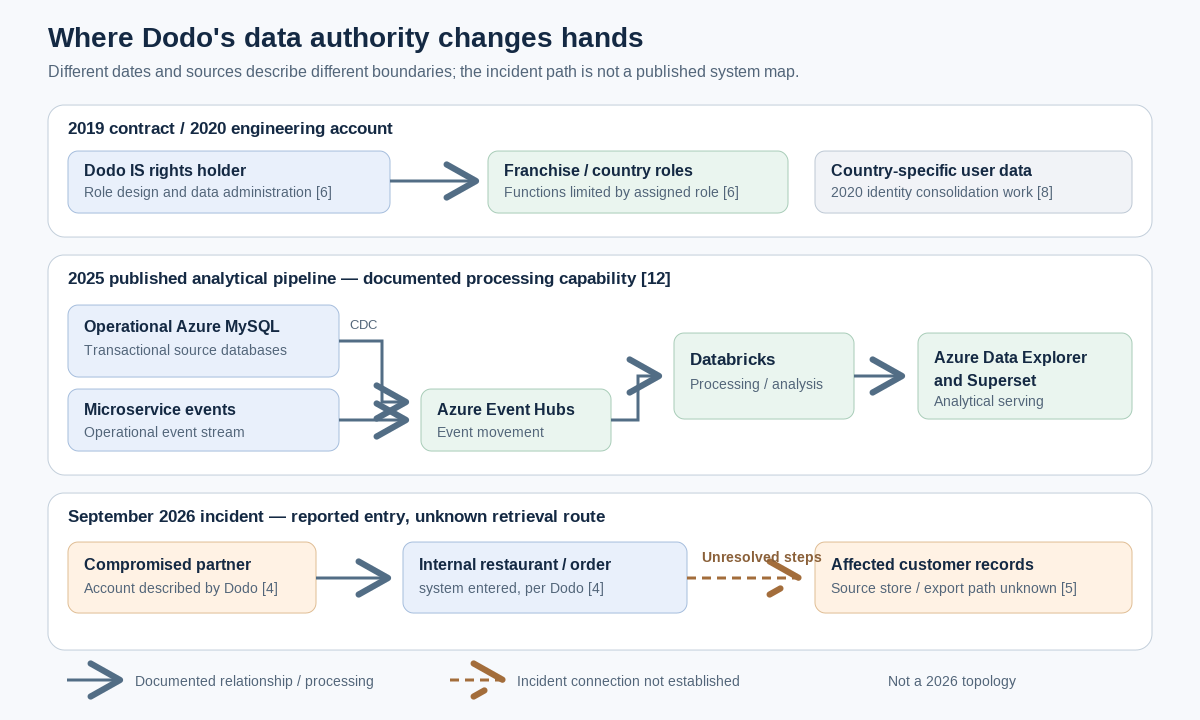
Dodo Pizza had disclosed unauthorized access in late September. In a statement published by Kazakhstani media on September 30, the company identified a compromised account belonging to one of its partners as the means of entry into an internal system handling restaurant operations and orders. Names, telephone numbers, delivery addresses, birth dates, and order histories may have been affected. The company stated that payment-card information had not been exposed. [4]
The consequences were not confined to Russia. Belarus’s National Center for Personal Data Protection reported that a Dodo Pizza IT system outside Belarus had been attacked, exposing customer information from several countries, including Belarus. The regulator also identified Pizza Star LLC as a recipient of Belarusian citizens’ personal data within the franchise arrangement. It did not identify the precise compromised database or reconstruct the subsequent data transfers. [5]
The company’s published records help explain why these distinctions matter. Dodo Pizza operates through legally separate franchise businesses connected by Dodo IS, a software platform supporting restaurant operations, ordering, accounting, and analytics. A 2019 Dodo IS agreement allocated administration and analysis of program data to the software rights holder, defined country-level administrative roles, and gave the rights holder broad contractual rights concerning information entered into the program. More recent engineering disclosures describe country-specific operational environments connected to common software and analytical infrastructure. [6][7][8]
The criminal market gives those records a second purpose. People claiming to represent DataSuckers have described a business built around stealing large databases and selling them to a small number of purchasers, including services that search for information about individuals. Russian investigators alleged a compensated transfer of Dodo customer information; the buyer and subsequent distribution have not been independently verified. [2][9]
This investigation follows information created for a restaurant transaction through the franchise’s shared platform and into an alleged sale outside it. The contracts and system design explain who could administer and process the records; the criminal-market evidence explains why a copy could have value to someone with no part in serving the customer. The precise path from the compromised partner account to the exposed records remains unknown.
1. Incident Overview
1.1 The intrusion, the disclosures, and the arrests
The Dodo Pizza incident occurred during a series of attacks publicly attributed to DataSuckers. On September 15, the group claimed to have compromised the infrastructure of Tez Tour, a travel operator serving Russian-speaking markets. Tez Tour acknowledged an attack against its website but disputed the group’s claims concerning the compromise of customer and business information. [10]
Dodo Pizza disclosed an attack on its IT infrastructure on the evening of September 28, according to Kommersant. The company later said its security team had detected and blocked the attack, investigated the affected systems, and notified the relevant authorities. Its public description distinguished possible exposure of customer information from payment-card data, which the company said it did not store. [3][4]
On September 30, Digital Business Kazakhstan published a company statement containing a more specific explanation of the intrusion. Dodo said that the attackers had used a compromised account belonging to one of its partners and entered an internal IT system that processed restaurant operations and orders. The company also reported that some application sessions had been terminated as part of its response. [4]
That statement establishes an entry point in the company’s account of the incident. It does not establish how the account was compromised, what permissions it possessed, or whether the attackers subsequently acquired additional credentials.
Belarus’s National Center for Personal Data Protection separately reported that a Dodo Pizza IT system outside the country had been attacked and that personal information relating to customers from multiple countries had been exposed. Its public description named categories including customer names, addresses, email addresses, telephone numbers, dates of birth, and order contents. [5]
The criminal investigation became public on October 14. Moscow’s Tverskoy District Court announced that Fridman had been placed under house arrest until December 8 under Article 272.1, Part 3, of the Russian Criminal Code. Interfax reported a law-enforcement allegation that he had obtained Dodo Pizza customer data and transferred it to third parties in exchange for payment, with the information intended for publication through Telegram. [1][2]
Kommersant published a broader account of the suspected operation, including alleged associates, exposed GitHub credentials, cloud storage access, and the sale of a large database. Those details came from reporting about the investigation rather than the court’s published ruling. [3]
1.2 What was allegedly stolen?
Kommersant reported that the attackers had accessed approximately 3.7 TB of information, comprising an estimated 33 billion records. The alleged contents included information on more than 860 million orders spanning roughly 15 years, 68 million customer records, 171 million delivery-address records, and 431,000 employee records. [3]
These figures do not measure the same things. A customer record is not necessarily a unique individual, multiple addresses may belong to one customer, and an order can generate numerous operational or historical records.
Moreover, the named categories account for only a small portion of the reported total. If the figures are approximately correct and additive, much of the alleged archive consists of other kinds of records. These could include transactional details, event histories, operational observations, or other business data, although no verified archive manifest has been released.
The scale also remains contested. Dodo acknowledged possible exposure of some customer information but did not publicly validate the attackers’ larger record counts. No independently authenticated copy of the complete archive or corresponding forensic inventory was available for this investigation.
The reported numbers are therefore useful as claims to investigate, not as established measures of the breach.
2. Attack Timeline
| Date | Documented event | Evidentiary status |
|---|---|---|
| September 15 | DataSuckers claims an attack against Tez Tour | Attackers’ claims; website attack acknowledged by company |
| September 28 | Dodo Pizza discloses an attack on its IT infrastructure | Disclosure date reported by Kommersant; intrusion date not established |
| September 30 | Dodo describes intrusion through a compromised partner account | Company statement reproduced by Digital Business |
| Late September–early October | Belarusian regulator reports cross-border customer-data exposure | Official regulatory statement |
| October 5 | DataSuckers claims an attack against Ukraine’s ATB and demands cryptocurrency | Public extortion message; scale of theft disputed |
| October 11 | DataSuckers channel says operations continue with less public activity | Group statement, not independent evidence of ongoing intrusions |
| October 14 | Moscow court orders Fridman’s house arrest | Official judicial announcement |
| October 14–16 | Media report further detentions and an account contacted by Syndicate says the DataSuckers brand ended on October 11 | Investigation reporting and an unverified account statement; not findings of guilt or proof that activity ended |
The public record therefore contains three different types of evidence: victim-company disclosures, official judicial and regulatory actions, and claims concerning the attackers’ technical activities and commercial transactions. The first two provide important independently attributable facts. The third requires additional verification.
3. The Franchise That Shared Its Infrastructure
3.1 Independent restaurants, common software
Dodo Pizza’s franchise model combines commercial decentralization with extensive technological integration.
Individual franchisees operate restaurants, employ staff, manage local business activities, and generally receive payments for their own sales. Dodo Engineering’s published explanation of online payments describes a structure in which franchisees maintain their own financial relationships rather than relying on headquarters to collect and redistribute every customer payment. [11]
Yet these independent businesses use Dodo IS, the software developed to support much of the restaurant network’s operations.
Dodo’s engineering materials describe systems for receiving orders, coordinating restaurant production, organizing employee shifts, handling delivery, integrating payments, managing operational information, and generating performance reports. The same technology platform can support businesses that remain legally and financially separate.
This division is central to the franchise’s economic model. Restaurant operators obtain capabilities that would be costly to develop individually, while the franchise can introduce common operational standards and compare performance across locations.
The arrangement also means that a restaurant’s legal relationship with a customer does not describe every technical relationship involved in processing the order.
The customer may purchase food from one legal entity, interact with an application operated by another entity, use a payment provider that processes the financial transaction, and generate operational records subsequently used by the common platform for reporting or analysis.
The software does not erase those distinctions. It connects them.
3.2 The Dodo IS agreement expressly concentrated data administration
An important primary document is the Dodo IS user agreement published for Belarus, effective November 13, 2019. The document defines Dodo IS as a cloud-based computer program with an associated database accessible through authenticated online services. [6]
Section 1.1.1 describes information about products, restaurants, employees, consumer orders, and other business processes. It also identifies the rights holder as the maker of the program database and owner of the associated exclusive database rights.
Its treatment of administration is unusually explicit:
Данные Программы могут вноситься как Правообладателем, так и Пользователем, но администрируются и анализируются только Правообладателем
In English, information can be entered by both the rights holder and users, but administration and analysis are assigned to the rights holder alone.
This does not prove that every data-processing operation was technically performed by one company. It does show the authority structure described in the published agreement: franchise participants supply business information to software whose database administration and analysis are contractually associated with the platform rights holder.
The same agreement defines a partner of the rights holder as a legal entity or sole proprietor granted access to the software with the rights holder’s consent. It is a formal category within Dodo’s historical franchise software arrangements, not merely an informal description of a technology vendor.
The agreement also defines a hierarchy of user roles.
| Role in the 2019 agreement | Described responsibility |
|---|---|
| Restaurant administrator | Restaurant settings, menu, delivery area, promotions |
| Office manager | Employees, shifts, staffing, restaurant performance |
| Central administrator | Country-level organizational structure, delivery, customers, personnel, accounting, and event administration |
| Central office manager | Reports and performance metrics for restaurants within a country |
| Franchise central office manager | Restaurant reports and performance metrics |
| Developer | Management of new or experimental Dodo IS functions |
| Accountant | Limited financial and personnel reports within a partner’s restaurants |
Sections 3.12 and 3.13 provide that the rights holder determines the number of roles granted to a user and may change role names and functions unilaterally. [6]
These provisions reveal two forms of authority. Franchise employees are assigned functions reflecting their operational responsibilities, while the software rights holder retains contractual control over the role structure through which those responsibilities are exercised.
Section 8.3 goes further. It states that information entered into the program is transferred to the rights holder, which is contractually permitted to use that information for broadly stated purposes.
That clause must be read alongside the agreement’s other restrictions. Section 4.5.6 prohibits users from extracting and subsequently using program database materials outside their assigned role functions without written permission. Section 5 addresses processing and protection of users’ personal information under applicable law.
The agreement therefore does not simply grant unlimited rights to every participant. It distinguishes the broad contractual position of the platform rights holder from the limited functions assigned to individual users.
Nor does ownership of database-related intellectual property automatically establish unrestricted rights over the personal information of restaurant customers. Privacy obligations, lawful purposes, controller and processor relationships, and national restrictions remain separate questions.
There is also a temporal limitation: the document dates from 2019. It cannot establish that identical contract terms, legal entities, or access-control implementations remained in force in September 2026.
Nevertheless, it is important evidence of how the platform’s business relationships were organized. Dodo did not present its software merely as a neutral storage service separately administered by every franchisee. The published agreement placed database administration, analysis, and the structure of user permissions within the authority of the software rights holder.
3.3 Belarus shows how the legal relationships become difficult to trace
The September incident offers a concrete test of this arrangement.
Belarus’s National Center for Personal Data Protection stated that an attack against a Dodo Pizza IT system outside Belarus caused the exposure of customer information from several countries. Its announcement also stated that Belarusian citizens’ personal data had been transferred to Pizza Star LLC within the franchise network under the relevant user agreement. [5]
The wording identifies Pizza Star as a recipient of information. It does not identify the complete chain of subsequent recipients, the actual storage location of the affected records, or the entity whose system was ultimately compromised.
This distinction prevents a simple reconstruction in which a Belarusian franchisee necessarily sent its customer database directly to a Russian headquarters server. The regulator’s statement confirms a cross-border breach and a franchise-related transfer relationship, but does not connect every stage between them.
The business structure nevertheless creates distinct responsibilities.
A restaurant selling a meal may be responsible for its transaction with the customer. The operator of the customer application may manage the customer account. The software rights holder may control platform functions and administrative permissions. A separate infrastructure provider may operate the systems in which records are stored or processed.
Some of those responsibilities can overlap, but they cannot be assumed to belong to the same legal entity merely because the customer sees the Dodo Pizza brand.
Belarus had already experienced another Dodo-related personal-data incident earlier in 2026 involving Pizza Star, followed by regulatory corrective action. [14] That earlier incident should not be confused with September’s attack against a foreign IT system. The two cases instead illustrate that oversight of a national franchise operator and security of the broader international platform can become separate regulatory matters.
4. Architecture and Access Boundaries
4.1 What authority did the compromised partner possess?
The most concrete technical fact reported by Dodo is the use of a compromised partner account to reach an internal system processing restaurant operations and orders.
The company did not identify the partner.
This omission matters because different kinds of partners require different forms of access. A franchisee may need to manage orders and staff at its own restaurants. A marketing provider may need permission to contact selected customers. An integration developer may need access to particular API functions. A contractor responsible for maintaining infrastructure may legitimately possess broader operational privileges.
Dodo’s historical agreement uses the term partner for entities authorized to use Dodo IS in defined commercial relationships. The incident statement uses the same general word, but it does not establish that the compromised account belonged to a partner of that specific contractual category.
The distinction prevents a premature conclusion that a franchisee’s ordinary restaurant account was used to obtain network-wide information.
The account may have held broad permissions legitimately. It may have provided only an initial foothold from which additional credentials were acquired. Alternatively, the attackers may have reached other systems through a separate vulnerability or an unrelated identity.
Those possibilities describe materially different failures.
If the account could retrieve a large volume of data directly through authorized functions, the relevant issue would be the scope of permissions granted to the account. If further compromise was necessary, the initial account would explain entry but not the later access. If the account belonged to a privileged service provider, the appropriate investigation would concern how that delegated operational authority was controlled.
The public record does not yet distinguish these possibilities.
4.2 Dodo had previously restricted franchisees’ reach across the customer network
A 2019 commercial case study published by marketing technology provider Mindbox demonstrates how this type of problem can arise in a shared franchise platform—and how Dodo had previously attempted to address it. [7]
Before adopting the new marketing system, Dodo franchisees could send messages to customers across the broader network without sufficient restrictions on the audience available to them. The company considered the arrangement problematic because different franchisees could repeatedly contact the same customers without coordinated limits.
The Mindbox deployment introduced a common marketing platform with restricted franchisee accounts. Franchisee users were placed in security groups with limited permissions and could send campaigns only to customers associated with their restaurants. Central marketing staff retained wider visibility across franchise campaigns.
This was an explicit implementation of the boundary between local franchise authority and network-wide authority.
A franchisee could participate in the common marketing system without obtaining unrestricted power to communicate with every customer in the chain.
The limitation is equally important. The case study establishes a problem concerning marketing audiences and messaging permissions, not unrestricted database downloads. It also describes an earlier system that Dodo said it had improved. Nothing in the record connects Mindbox to the September 2026 intrusion.
What the example establishes is that Dodo already recognized a practical distinction between a shared platform’s technical capabilities and the narrower capabilities that an individual franchisee should exercise.
That distinction is exactly what must be investigated for the compromised partner account, though the responsible service and permission structure may have been entirely different.
4.3 Country-specific systems do not reveal every data-access boundary
Dodo Engineering’s 2020 architecture account describes user and authentication data in country-specific databases, alongside work to consolidate identity data while retaining separate storage where national rules required it. It does not establish where customer and order records resided in 2026. [8]
Country-specific operational environments can nevertheless share software components, development practices, and authorized processing services across the network.
Such separation does not necessarily conflict with centralized business management. The system can maintain local operational environments while using common administrative tooling or authorized data-processing services.
Dodo’s more recent technical disclosures provide a particularly concrete example.
At the 2025 Databricks Data + AI Summit, Dodo Brands engineers described an analytical platform receiving changes from operational Azure MySQL databases through change-data capture (CDC), as well as events generated by numerous microservices. Both streams moved through Azure Event Hubs to Databricks processing; Azure Data Explorer and Apache Superset served analytical information. [12]
The company described a self-service environment in which authorized analysts and other technical users could create data-processing jobs and dashboards. Configuration stored in GitHub could be used to generate and deploy analytical workloads.
This architecture explains why information produced in an operational restaurant system may also exist in a separate analytical form. An order can produce records concerning the transaction, restaurant production, delivery, subsequent status changes, and performance measurement.
These documented analytical components do not locate the data taken in September 2026 or establish that personally identifiable records from every country were pooled. No incident evidence identifies Databricks, Azure Event Hubs, or a particular GitHub repository as the breached system.
Kommersant reported that exposed corporate credentials on GitHub had played a role in the attack, enabling access to connected corporate systems and eventually cloud storage and databases. However, the report did not identify the credential type, repository, effective permissions, or the exact storage service reached. [3]
The reported credentials cannot therefore be identified with Dodo’s published analytics deployment process. The common data platform is a documented processing route, while the route used by the attackers remains a separate question.
4.4 The competing access paths
The published evidence supports several explanations.
| Possible path | Explanation | Evidence still required |
|---|---|---|
| Broad partner authorization | A compromised account could legitimately retrieve more data than was necessary for its business function | Original permissions, API requests, dataset scope |
| Additional credential compromise | The partner account gave access to another system or secret that expanded the attackers’ authority | Authentication logs, subsequent principals, privilege changes |
| Privileged service-provider access | A partner was authorized to maintain infrastructure or process data across multiple environments | Partner identity, operational contract, privileged-access records |
| Common or replicated data store | Information from multiple operational systems was accessible through an analytical store, backup, or export | Source identifiers, storage logs, record provenance |
| Multiple separately accessed environments | Attackers collected and combined information from different national systems | Separate access events, original database inventories |
These explanations may overlap.
For example, an attacker could begin with a partner identity, acquire another credential, and then use that credential to reach a replicated dataset. Alternatively, a partner may have been entitled to access a narrowly defined internal service while a separate authorization error exposed additional resources.
No published forensic record establishes which path occurred.
The central technical question is therefore not whether Dodo IS was centralized or distributed. It is which authority was available to the compromised identity, which data it actually accessed, and whether those permissions corresponded to the business purpose for which the identity had been granted.
5. Data Markets and Responsibility
5.1 The public lineage of DataSuckers
DataSuckers is a public name attached to a short sequence of claims, rather than a group with a documented history extending back years. The earliest public episode identified in the sources reviewed here is the September 15 message on Tez Tour’s website. That date does not establish when the people behind the name first began attacking systems or whether they had used another name before it. [10][17]
The Tez Tour message claimed that the attackers had already spent roughly two weeks inside the operator’s systems, copied large reservation and financial datasets, and destroyed records and backups. Tez Tour acknowledged an attack against its website but said it had found no evidence that tourist or partner data had been compromised. The group’s later account of an initial file-upload flaw followed by access to source-repository credentials remains its own, unverified description of that intrusion. [10]
The next prominent claim under the DataSuckers name concerned Dodo Pizza. Here, the company itself reported unauthorized access through a compromised partner account and possible exposure of customer information, while Belarus’s regulator reported a cross-border breach. [4][5][17] That is stronger evidence of data exposure than the public record for Tez Tour. It does not show that the same initial-access method was used: the Tez Tour file-upload story comes from the attackers, whereas the compromised partner identity comes from Dodo.
On October 5, the Ukrainian supermarket chain ATB experienced a website incident in which attackers claiming the DataSuckers name demanded $400,000 in cryptocurrency. The displayed message claimed possession of millions of customer records and additional employee, business, and technical information. ATB acknowledged a cyberattack but disputed the claimed personal-data compromise. [13]
The public sequence therefore contains different commercial propositions: a claim of destructive control and copied data at Tez Tour, an alleged sale of Dodo information to third parties, and an explicit ransom demand at ATB. Those are reported acts and claims, not proof of a planned change in strategy or a single, verified revenue stream. [2][3][10][13]
In an October 5 FBRK interview, a person presented as a member of DataSuckers said financial gain was the primary motive and that large databases were attractive targets. In a separate interview published by Syndicate, speakers claiming to represent the group described both the value of personal information and the publicity an attack could generate. Their assertions about further, unnamed victims cannot extend the verified campaign chronology. [9][17]
The name’s later history is also contested. On October 11, its public Telegram channel said operations would continue with less publicity. After the arrests became public, an account contacted by Syndicate said that DataSuckers had ceased to exist as a brand on October 11. These statements conflict about the label’s status; neither demonstrates that everyone using it stopped operating or that copies of data were recovered. [17]
Kommersant reported a possible personal antecedent: Fridman had allegedly targeted Ukrainian websites before joining DataSuckers and then participated in the Tez Tour attack. The report names no earlier sites or dates and does not establish a predecessor group. It also describes four alleged members, of whom three were reportedly detained; the court announcement independently identifies only Fridman’s charge and house arrest. Neither a shared name nor that one reported biography proves that the same individuals carried out every operation attributed to DataSuckers. [1][3][17]
The defensible lineage is thus the evolution of a public claim and sales pitch across three incidents. The identities behind each claim, any pre-September activity, and the fate of the group after October 11 remain open. That limit matters to the market analysis: the possible value of a copied customer record does not depend on the continued existence of the name under which it was first advertised.
5.2 The claimed market has buyers distinct from the victims
In the FBRK interview, the DataSuckers representative said that obtained databases were sold rather than simply published for free. The interview identified information-search services as possible buyers and acknowledged that further distribution could not be controlled after a sale. [9]
The reference describes a transaction in which the buyer is neither the breached company nor the person who ordered food. A purchaser could value the copied information itself, independently of any ability to enter Dodo’s systems.
The company said that names, telephone numbers, delivery addresses, birth dates, and order histories may have been affected. [4] If those fields appear together in an exported record, a telephone number could serve as a lookup key: it could confirm a name or update an address in another collection. Repeated delivery records could add a time dimension, but the public description does not say whether individual order timestamps were exposed. These are possible uses of the reported data categories, not observed uses of the Dodo archive.
The broader probiv market—paid services for searching personal information—shows how such a record can become a searchable product. In 2023, The Insider tested a Russian-language lookup bot with volunteers’ telephone numbers and retrieved linked names, accounts, email addresses, and, for one volunteer, addresses in several cities. Its reporting described the combination of multiple leaked datasets behind such searches. [16] A 2025 Guardian investigation described a wider market selling individual queries, sometimes for as little as $10, and more extensive personal dossiers. [15] That figure is an example of a reported retail-query price, not a price for Dodo records or evidence of a Dodo transaction.
The economic sequence is thus intelligible without identifying a Dodo buyer: an archive supplies records; an intermediary can compare them with other collections; a search service can sell answers to individual queries. Freshness, coverage, and the ability to link a phone number to a person or location can affect what those records are worth. The reported order history could add context to a profile if a purchaser obtained it, but neither the underlying archive nor a buyer’s use of it has been independently examined here.
FBRK’s interview supports the group’s claimed sales model and its description of possible information-search buyers. The Insider and Guardian establish that searchable, paid information products exist in the broader market. None of these sources establishes that a probiv operator bought, indexed, or sold Dodo customer records. [9][15][16]
5.3 What the financial record actually establishes
The Dodo case contains two different accounts of a compensated transfer.
Interfax reported the law-enforcement allegation that Fridman had transferred Dodo Pizza customer data to other persons for payment, with the information intended for publication on Telegram. [2]
Kommersant reported that the larger archive had been offered for sale and that proceeds were transferred to a cryptocurrency wallet shared by alleged members of the group. Its printed amount contains an inconsistency between dollar and ruble notation, making the precise reported denomination unclear. The underlying blockchain transactions and buyer identity were not independently documented. [3]
These reports should not be merged into a single completed sale without further evidence.
| Commercial stage | Public evidence |
|---|---|
| Claim of possessing a large archive | DataSuckers’ announcements and media reporting |
| Offer to sell the archive | Russian investigation reporting |
| Compensated transfer to third parties | Law-enforcement allegation reported by Interfax |
| Payment to a shared cryptocurrency wallet | Kommersant’s reporting |
| Verified amount and purchaser | Not established by independently examined transaction records |
| Subsequent resale or criminal use | Not established for the Dodo archive |
Even if investigators eventually verify a payment, the amount received would not necessarily equal the price originally advertised. A sale of the full archive, a compensated transfer of selected records, and a payment in exchange for publication would be different transactions.
The advertised archive size likewise does not establish the quantity delivered. The table separates possession claims, offers, transfer allegations, and verified revenue; it is the boundary for interpreting the reported commercial activity.
5.4 The market can outlive the group
The October arrests may have disrupted participants associated with the Dodo Pizza incident. They do not demonstrate that every copy of the information has been recovered or that every possible buyer has been identified.
A data sale differs from a continuing unauthorized connection to a victim system. The system operator can revoke credentials, terminate sessions, and repair vulnerabilities, but those actions cannot automatically recall a copy already delivered elsewhere.
The attacker may lose access while a purchaser retains the archive. A third party can potentially preserve or redistribute information without needing further access to the original restaurant platform.
Whether any additional buyer holds the Dodo archive is unknown. Incident containment, disruption of the criminal group, and control over already-disclosed information are separate investigative outcomes.
5.5 Who Controlled the Customer Information?
The alleged sale raises a related question about legitimate custody: which organization controlled the record before it became a product for outsiders?
Contractual administration and effective permissions
The restaurant generated the customer record, but the organizations responsible for collecting it, setting access rights, storing copies, and explaining its exposure need not be the same. The 2019 agreement assigns database administration and user-role design to the Dodo IS rights holder; the incident statement identifies a compromised partner identity; the engineering records show operational and analytical processing at different components. [4][6][8][12] The table distinguishes those responsibilities without treating a contractual role as proof of an account’s effective permissions.
| Participant | Documented business or technical role | Boundary requiring verification |
|---|---|---|
| Individual franchise operator | Restaurant sales, employees, local operations | Which customer and restaurant records it may use |
| Dodo IS rights holder | Contractually defined software and database administration | Which entities and users receive administrative authority |
| Central or country-level administrators | Organizational settings, operational reporting, defined management functions | Whether permissions are confined to their intended national or organizational scope |
| External technology and marketing partners | Authorized integrations and delegated business functions | Which API operations and datasets their identities may reach |
| Data-platform operators | Collection, processing, and delivery of analytical information | Which source records can be read, copied, or exported |
| Customer-facing local company | Customer account and service relationships under applicable agreements | Which other entities receive the personal information and for what purpose |
The Mindbox case shows that Dodo had previously narrowed a franchisee’s marketing audience while preserving central oversight. [7] The September incident raises a different, unanswered question: who approved the partner’s access, who implemented its scope, and who monitored the records it could retrieve?
Country, corporate, and permission boundaries
Belarus’s regulator identified an international consequence: Belarusian customers’ information was exposed through a foreign Dodo IT system, and Pizza Star was a recipient of Belarusian citizens’ information within the franchise arrangement. [5] Those findings identify an affected population and a transfer relationship. They do not name the compromised store or the organization that granted the partner’s access to it.
For the affected customers, the investigation must distinguish three functions that may belong to different entities: the local company that dealt with them, the operator of the relevant system, and the issuer of the identity used in the attack. The actual deployment could also involve a shared service, replication, or separate accesses, as §4.4 shows. Identifying the responsible legal entities requires the operative customer notices and processing agreements; identifying the technical custodian requires record provenance and access logs. The 2019 software agreement alone cannot settle either question.
Records that could assign responsibility
The division of responsibility can be tested against specific records. The credential issuer’s account grant and approval would show why the partner identity existed and what it was meant to reach. Authentication, authorization, and request logs would show which principal acted and whether its effective scope expanded. A dataset manifest and export logs would identify the custodian and source of the affected records. Customer notices and processing agreements would identify which legal entities undertook the customer relationship and authorized transfers. Transaction records and the alleged buyer’s evidence would test the reported sale.
The public record supplies narrower answers. Dodo named a compromised partner account and an affected category of internal system; Belarus’s regulator identified the cross-border exposure; Russian authorities alleged a compensated transfer. [2][4][5] None of these disclosures identifies the partner, establishes a failed authorization check, locates the precise source dataset, or verifies a buyer. The records above would allocate responsibility more reliably than an inference from franchise ownership or software rights alone.
6. Conclusion
Dodo Pizza’s September 2026 breach began, according to the company, with a compromised partner account entering an internal restaurant and order system. Belarus’s regulator documented consequences for customers across national boundaries. The 2019 Dodo IS agreement and later engineering disclosures show why information from independent restaurants could be administered, processed, and analyzed through organizations and components beyond the individual restaurant. [4][5][6][8][12]
The customer provided a telephone number and delivery address to receive a meal. The restaurant generated an order record; the shared platform made that record useful for operations and analysis. Those legitimate uses required permissions to be distributed among franchise businesses, platform administrators, and technical partners. Dodo’s earlier Mindbox work shows that it recognized the need to confine at least one class of franchisee access to the appropriate customer audience. [7]
The reported crime would carry the record through another boundary. Russian authorities alleged that customer information was acquired and transferred for payment, while people claiming to represent DataSuckers described information-search services among potential buyers. [2][9] The broader probiv market shows how linked identifiers and addresses can be resold as answers to searches. A person buying such an answer would have no role in the original restaurant transaction. [15][16]
This is the article’s central transformation: information collected to complete a sale can be copied from an operational system and offered as merchandise in a separate market. Its commercial value can persist after the attacker loses access to the original system. The benefit from the meal, the authority to process its record, and the potential profit from an illicit copy fall to different actors.
The public evidence does not identify the compromised partner’s effective permissions, the source dataset, or a verified buyer and payment. Those gaps leave the exact intrusion and distribution path open, as the competing routes in §4.4 and the commercial stages in §5.3 show. They do not erase the documented division of operational authority or the reported attempt to monetize customer information.
The question for Dodo and the responsible franchise and platform entities is where the legitimate chain of custody ended: which account could read or export which records, who approved that access, and who can explain the exposure to the customers whose meal produced the data. The question for investigators is where the copied records went. Together, those answers would show how a restaurant transaction became a product for someone outside it.
References
Incident Investigation and Judicial Proceedings
[1] Tverskoy District Court of Moscow. Court announcement concerning Denis Fridman’s house arrest. October 14, 2026. Official confirmation of the accused person’s name, criminal charge, and preventive measure.
[2] Interfax. Обвиняемый в кибератаке на систему сети «Додо пицца» отправлен под домашний арест. October 14, 2026. Law-enforcement allegations concerning the acquisition and compensated transfer of customer information.
[3] Kommersant. Взломщик засветил свой адрес. October 14, 2026. Investigation reporting concerning GitHub credentials, alleged data volumes, suspects, and financial transactions.
[4] Digital Business Kazakhstan. Атака на «Додо Пиццу» — в компании рассказали о последствиях. September 30, 2026. Dodo Pizza’s statement identifying a compromised partner account and describing the affected internal system.
[5] National Center for Personal Data Protection of Belarus. Official channel statement on the Dodo Pizza cross-border data breach, post 1317. 2026. Regulatory announcement identifying the foreign IT-system incident, the affected categories of personal information, and the Pizza Star franchise relationship.
[14] National Center for Personal Data Protection of Belarus. Pizza Star corrective-action announcement, post 1236. 2026. Separate earlier Pizza Star data incident and regulator follow-up.
Franchise Contracts, Business Organization, and Technical Infrastructure
[6] Dodo IS. Пользовательское соглашение Программы «DODO IS» — Belarus version. Effective November 13, 2019. Sections 1.1.1, 1.1.3–1.1.5, 3.11–3.13, 4.5.6, 5, and 8.3.
[7] Mindbox and Dodo Pizza. Как работает и масштабируется целевой маркетинг у франчайзи «Додо Пиццы». December 2, 2019. Franchisee marketing access, security groups, customer segmentation, and central oversight.
[8] Dodo Engineering. История архитектуры Dodo IS: путь бэкофиса. June 2020. Historical architecture, identity management, and country-specific operational data.
[11] Dodo Engineering. Как устроены интернет-платежи в Dodo. January 2023. Franchise payment relationships and common software architecture.
[12] Dodo Brands / Databricks. Building a Self-Service Data Platform With a Small Data Team. Data + AI Summit 2025. Transactional data sources, event processing, analytical infrastructure, and self-service data pipelines.
DataSuckers and the Criminal Market
[9] FBRK Kazakhstan. Хакеры рассказали ФБРК как выбирают цели и что делают с полученными данными. October 5, 2026. Interview attributed to DataSuckers concerning target selection, database sales, and possible buyers.
[10] FBRK Kazakhstan. Хакеры заявили о взломе инфраструктуры Tez Tour. September 16, 2026. Attacker claims and company response.
[13] OBOZ.UA. Сайт АТБ не працював 5 жовтня 2026 — шахраї заявили про злам і витік даних. October 5, 2026. Ukrainian reporting on the publicly displayed extortion demand and the disputed data-theft claims.
[15] The Guardian. ‘All brakes are off’: Russia’s attempt to rein in illicit market for leaked data backfires. December 26, 2025. Original reporting on the broader probiv market, individual-query sales, and pricing examples; not evidence of a Dodo-data sale.
[16] The Insider. И о главном молчит Telegram. О каких уязвимостях мессенджера стоит помнить российским пользователям. May 5, 2023. Its volunteer-based test of a telephone-number lookup bot and reporting on linked leaked datasets; not evidence that Dodo records were indexed.
[17] Syndicate. Дело DATASUCKERS и «Додо»: Денис Фридман отправлен под домашний арест. October 14, 2026. Original reporting of a response attributed to @latcert, the October 11 group-channel statement, and a reproduced TrueOSINT interview; these statements do not independently establish membership, prior activity, or the end of the operation.
Evidentiary Scope
This investigation is based on publicly available court announcements, victim-company statements, Belarusian regulatory communications, commercial agreements, Dodo Engineering publications, Russian- and Ukrainian-language reporting, and interviews attributed to DataSuckers. It does not include access to the victim company’s internal logs, confidential contracts, original incident-response records, or stolen personal-data archives.
The most direct company-attributed account of initial access is Dodo Pizza’s September 30 statement that attackers used a compromised account belonging to a partner to enter an internal system processing restaurant operations and orders. This account does not identify the partner, the credential type, the account’s effective permissions, or any subsequent privilege escalation.
The Belarusian regulator independently reported a foreign Dodo IT-system breach affecting personal information relating to customers in several countries. Its statement identifies a franchise-related transfer of Belarusian citizens’ information to Pizza Star LLC but does not establish the full sequence of subsequent processing, the breached data store, or the controller and processor relationships associated with every affected record.
The 2019 Dodo IS agreement provides primary evidence of an earlier contractual allocation of software rights, database administration, analytical authority, and user roles. It is not a current franchise agreement, an exhaustive personal-data processing contract, or proof that every historical provision remained effective in September 2026. Database intellectual-property rights must not be treated as a substitute for legally established personal-data processing authority.
The 2019 Mindbox case study documents restrictions on franchisee marketing audiences. It does not establish that franchisees previously had unrestricted database-export privileges, nor does it connect Mindbox to the 2026 attack. Similarly, historical Dodo Engineering records and the 2025 Databricks presentation demonstrate architecture and processing capabilities, not the source of the stolen records.
The reported 3.7 TB archive, approximately 33 billion records, component record counts, GitHub credential chain, and alleged commercial sale remain unverified by independent forensic evidence in this investigation. The monetary notation in Kommersant’s report is internally inconsistent, and no independently examined transaction records establish the payment amount, buyer, or distribution chain.
Statements about DataSuckers’ motives, preferred targets, commercial arrangements, and buyers are partly based on interviews with individuals claiming membership in the group. They should be read as claims by those individuals rather than independently established facts about every operation or transaction attributed to DataSuckers.
The public sequence under the DataSuckers name begins with the September 2026 Tez Tour episode in the sources reviewed here. It does not establish the group’s founding date, a predecessor identity, a stable membership across Tez Tour, Dodo Pizza, and ATB, or the cessation of its activities after the disputed October 11 statements. Kommersant’s account of Fridman’s earlier attacks on Ukrainian sites is reporting about an individual, not independent attribution of those attacks to DataSuckers.
The Insider’s volunteer-based lookup test and the Guardian’s reporting describe the broader market for personal-information queries. They do not identify Dodo records in a search service. The possible value of linking a restaurant telephone number, address, and order history to other records is an analytical inference, not an observed downstream use of the affected data.
The October 14 court announcement confirms a charge and house-arrest measure against Denis Fridman. It does not constitute a finding of guilt, establish the complete organization of DataSuckers, or verify the reported financial transactions.
The investigation therefore identifies a documented business and authority structure around the breach, but not the precise technical control that enabled the ultimate data access. Resolving that question would require the compromised account’s identity and permissions, authenticated access records, the provenance of the affected datasets, and evidence of actual data transfers.
The distinction between established contractual relationships, documented technical capabilities, alleged attacker activity, and proven security failures remains essential to the conclusions presented here.