A reconstruction of personnel-data flows and possible acquisition paths from public records
An analysis based on publicly available information as of October 9, 2026
Abstract
In September 2026, ShinyHunters claimed to have breached the FBI’s recruitment infrastructure. Reuters examined samples containing employee addresses, sensitive assignment descriptions, and medical and psychiatric information; it independently verified details for some people in the personnel sample. The FBI attributed the incident to an unpatched third-party-managed platform; Reuters identified that platform as Oracle PeopleSoft. The extent of the theft claimed by the attackers remains unverified.
This article uses public FBI privacy assessments, procurement documents, federal records schedules, and modernization material to reconstruct the recruitment, personnel, identity, background-investigation, and medical-record systems relevant to the reported exposure. It distinguishes documented data transfers from the records that may actually have been accessible when the breach occurred.
The analysis considers three routes: extraction through the compromised PeopleSoft application’s authority; movement to related GovCloud resources or data copies; and direct access to internal systems such as BOL, Sentinel, or a medical-record repository. Each would require different permissions and explain different portions of the reported material. Public evidence does not establish which route the attackers used.
1. Timeline of the Incident
The reported FBI breach occurred against the background of a broader campaign targeting Oracle PeopleSoft installations, observed since May 2026.
| Date | Event |
|---|---|
| May 27–June 9 | Mandiant observes PeopleSoft exploitation attributed to UNC6240, associated with ShinyHunters |
| June 10 | Oracle releases a security alert addressing CVE-2026-35273 |
| September | ShinyHunters-linked exploitation of PeopleSoft intensifies |
| September 22 | ShinyHunters publicly claims to have breached the FBI |
| September 23–October 3 | Reuters reports on personnel details and medical information in supplied material |
| October 5–6 | The FBI attributes the incident to a missing security patch; Reuters identifies PeopleSoft and Accenture through sources |
Mandiant and Google Threat Intelligence Group (GTIG) documented exploitation of PeopleSoft’s Environment Management Hub, including CVE-2026-35273, which Oracle addressed in June. In other affected organizations, attackers used code execution to inspect configuration, seek credentials, and explore access to additional systems. Those observations explain why an unpatched management component could be an entry point and expose credentials for additional access. They do not establish the FBI’s exploited CVE, initial host, or subsequent intrusion steps. The FBI has not publicly identified those details.
Sources: Mandiant — June campaign · Mandiant — September campaign · Reuters — October 6
2. What ShinyHunters Claimed
ShinyHunters is a hacking group associated with repeated data-theft and extortion operations against commercial organizations. In this case, however, the group described its motivation primarily in terms of reputation.
In May 2026, the FBI published an advisory warning that ShinyHunters sometimes exaggerated its possession of compromising material to pressure victims. The group disputed that characterization and presented the FBI intrusion as a demonstration of its capabilities and credibility.
CBS News reported that RansomLook archived two statements posted under the ShinyHunters identity about the claimed FBI breach. Reuters later reported that the group’s data-leak site disappeared on September 30. The archived statements document the group’s public claims and pressure on the FBI, not its access path. The sources examined here do not link this incident to phishing, previously stolen credentials, or purchased access. The reported PeopleSoft compromise is the best-documented starting point for testing acquisition paths, though its precise role in the intrusion remains unconfirmed.
According to statements given to The Register, the attackers exploited a remote-code-execution vulnerability in the PeopleSoft infrastructure associated with FBIJobs.gov. They claimed to have subsequently moved into FBI-managed servers in AWS GovCloud and obtained personnel records concerning current employees, former employees, and applicants.
The group also named human resources, MedLink, and Criminal Justice Information Services (CJIS) among the services it claimed to have compromised. CJIS is distinct from the background-investigation systems examined below; the cited reports do not say the attackers named BICS, BOL, or Sentinel.
The group claimed to have stolen two to three terabytes of data.
Some elements of this account have since acquired independent support. The FBI has acknowledged a third-party platform security failure involving an unapplied patch, while Reuters identified PeopleSoft as the affected platform through people familiar with the incident.
Other elements remain unverified. The precise GovCloud systems allegedly accessed have not been identified. Neither the claimed access to MedLink and CJIS nor the reported volume and organizational scope of the stolen data has been independently established.
The attackers also asserted that they had exploited a different, still-unpatched PeopleSoft zero-day. This claim is distinct from Mandiant’s analysis of CVE-2026-35273, which had already been patched in June. Publicly available evidence does not establish that a separate zero-day was used against the FBI.
Sources: CBS News — Archived statements, September 23 · Reuters — Site disappearance, October 3 · The Register — September 22 · The Register — September 25 interview
3. What the Leaked Samples Actually Establish
On September 23, Reuters reported examining a spreadsheet of approximately 5,000 rows supplied by the attackers. It contained names, home addresses, telephone numbers, dates of birth, Social Security numbers, emergency contacts, organizational assignments, and job descriptions.
Some entries concerned personnel involved in sensitive intelligence and counterintelligence activities, including work relating to China, Russia, surveillance, and human intelligence. Reuters checked details for more than 22 people against credit records and earlier leaked data, although it did not authenticate the dataset in its entirety.
Reuters subsequently reported that its analysis of material shared by ShinyHunters found psychiatric and medical information. The accessible reporting does not establish the source system for those records or authenticate every document in the sample.
The evidence can therefore be separated into distinct categories.
| Information | Evidentiary status |
|---|---|
| Personal information concerning current and former employees | Portions independently corroborated |
| Organizational assignments and sensitive job descriptions | Present in the sample; individual assignments not shown to be independently corroborated |
| Medical and psychiatric information | Present in material analyzed by Reuters; source system unestablished |
| Information concerning almost every FBI employee | Unverified |
| Two to three terabytes of stolen data | Unverified |
| Direct compromise of MedLink or CJIS services | Attacker allegation |
| Direct compromise of BOL or Sentinel | No publicly established evidence; not named in the cited attacker statements |
The potential harm is concrete even without a confirmed account of subsequent misuse. A home address combined with a sensitive counterintelligence assignment could help identify and approach a particular employee. Medical and psychiatric information is intensely private and could be used to pressure an individual. Reuters reported that such information appeared in the supplied material; it did not establish that anyone used it for targeting or coercion.
Partial corroboration also does not establish when or how the material was first obtained. Some records could predate the reported PeopleSoft incident, come from a separate compromise or insider disclosure, or be mixed with fabricated material. Without acquisition evidence, the samples cannot be assigned to this intrusion merely because some details are genuine.
The content of a leaked record does not necessarily identify the system from which it was stolen.
The appearance of a current employee’s address or organizational assignment does not establish that the authoritative internal personnel database was compromised. Likewise, possession of a psychiatric evaluation does not establish that the attackers accessed the medical-record system in which the document originated.
Recruitment, personnel administration, identity management, and security investigations all involve different representations of information about the same individuals. An authoritative record may be transferred, partially copied, transformed into an identity attribute, attached to an employment workflow, or retained in a migration environment.
Conversely, if the stolen material contained complete records available only within a tightly restricted internal system, a substantially different intrusion path would be necessary.
Determining which explanation is more plausible requires reconstructing the architecture in which these records were generated, transferred, and retained.
Sources: Reuters — Employee information, September 23 · Reuters — Sample analysis, October 3
4. Reconstructing the FBI’s Systems from Public Documentation
The documents below describe systems and information flows at the dates they were published. They do not establish the complete 2026 configuration of the breached host.
4.1 Recruitment and Personnel Systems
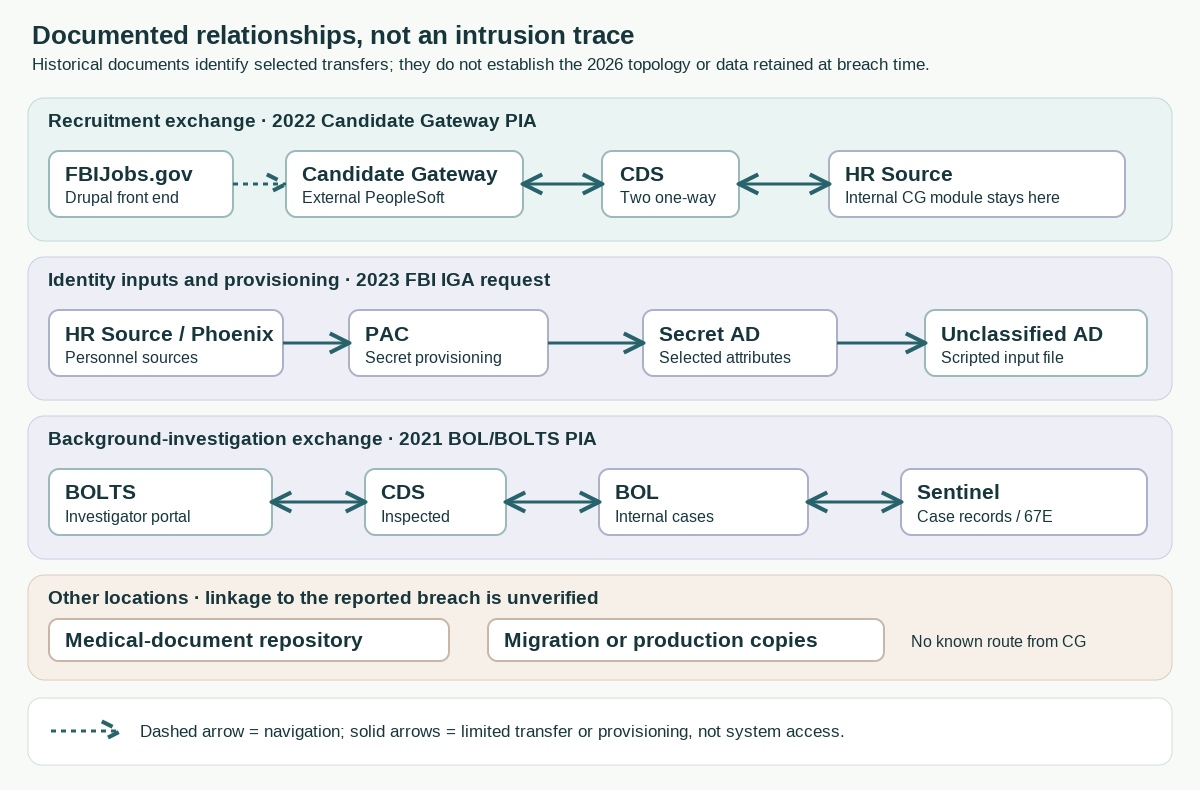
A September 2022 FBI Privacy Impact Assessment (PIA) describes FBIJobs.gov as a public Drupal website that directed applicants to Candidate Gateway (CG). The externally accessible CG ran Oracle PeopleSoft Human Resources 9.2 and Oracle Database 19c on virtual machines in AWS GovCloud. HR Source, the FBI’s internal personnel-management system, ran on FBINet. A 2023 identity-governance document identified HR Source, then primarily based on PeopleSoft 9.1 and Oracle Database 11g, as the authoritative source for FBI employees. These are dated descriptions, not verified specifications for the host affected in 2026.
The public website, the applicant-processing application, and the internal HR system had related roles but were distinct systems. The published version differences are one sign of that separation; they should not be read as a current inventory of every server involved in the incident.
HR Source and external CG exchanged defined categories of information through an accredited Cross Domain Solution (CDS), with a separate one-way transfer mechanism in each direction. The 2022 PIA lists the following categories:
| Direction | Data categories identified in the PIA |
|---|---|
| HR Source → External Candidate Gateway | Job-posting information, application data, employment-related questionnaires, recruiter communications, responses, offers, and transfer orders |
| External Candidate Gateway → HR Source | Candidate profiles, completed applications and questionnaires, applicant communications, offers, and transfer orders |
The CDS description identifies a controlled transfer of business records. It does not describe a shared database or a general-purpose connection between the external application and FBINet. Several categories, including applications, questionnaires, offers, and transfer orders, appear in both directions.
The PIA also describes an internal CG module within HR Source for FBI employees applying to employee-only positions. Those transactions stayed in the Secret domain and did not pass through the external CDS. The common CG name therefore covers functions with different network placement and transfer rules.
Retention limits the meaning of the documented flow. The PIA says applicant personally identifiable information (PII) was transferred to HR Source and purged from external CG, apart from user-account data. For data-integrity verification, PII associated with an inactive application could nonetheless remain in external CG for up to one year before automatic purging. The categories in the table describe what the architecture permitted to move, not how long every item was kept. The PIA does not identify which individual records remained in the external environment in September 2026.
Sources: FBI — Candidate Gateway PIA, 2022 · FBI — IGA Request for Information, 2023
4.2 Identity and Background-Investigation Systems
The 2023 identity-governance request describes HR Source as the personnel authority for employees and Phoenix as the authority for other personnel. Both supplied attributes to PAC, the identity-management store on the Secret network. PAC provisioned accounts there. For the main Unclassified network, a separate script retrieved selected Active Directory (AD) attributes from the Secret network and transferred an input file to the lower-classification environment. This was a separate flow from the recruitment CDS. It produced operational representations of personnel identity outside HR Source, but the document describes selected attributes, not replication of complete personnel, medical, or investigation files.
Background investigations used a different set of systems. A 2021 PIA places BICS Online (BOL) on the FBI’s internal Secret enclave, where it managed investigations and retained historical records dating to August 2006. BOL users authenticated through FBINet Windows AD and single sign-on. Authorized specialists in the Background Investigation Contract Services Unit (BICSU) could coordinate investigations, assign work, review reports, and access all BOL cases. Contract Special Investigators instead used the external BICS Online Transfer System (BOLTS) through the Law Enforcement Enterprise Portal, with a BOLTS-specific encrypted drive required for login, and were limited to their assigned case portfolios.
BOLTS was an exchange point rather than the historical repository. Transferred documents were deleted from BOLTS when downloaded or within 24 hours, although investigators could retain authorized material on the encrypted drives required for access. Documents passed between BOL and BOLTS through a content-inspecting CDS that rejected transfers marked Secret. These rules distinguish an internal role with broad case access from an external investigator’s narrower, temporary server-side access.
The PIA rated the potential impact of compromising BOL as HIGH and BOLTS as MODERATE. That rating is consistent with the difference between a historical internal case store and a case-limited transfer service. It does not mean BOLTS held no sensitive material; its users could handle assigned investigative documents, including copies retained on their encrypted drives.
BOL also exchanged investigation material with Sentinel, the FBI’s central case-management and records system. According to the 2021 BOL/BOLTS PIA, personnel-security specialists obtained leads and SF-86 questionnaires from Sentinel and returned completed reports and supporting documents as case records. A federal records schedule approved in April 2026 says classification 67E personnel case files have been stored electronically in Sentinel since 2012; they can include applications, investigations, onboarding and employment histories, and security records. The FBI also used the Office of Personnel Management’s electronic Official Personnel Folder system, and copies of eOPF material could appear in 67E files.
The documented BOL–Sentinel exchange identifies an official case-record flow, not unrestricted transfer of all Sentinel contents to BOL, BOLTS, or CG. A BOL specialist’s broad case access therefore does not itself establish access to the separate Sentinel repository.
Sources: FBI — IGA Request for Information, 2023 · FBI — BOL/BOLTS PIA, 2021 · NARA — Employment Records Schedule, 2026
4.3 Medical Records and Data Replication
The Candidate Gateway PIA includes medical notes and other health information among the categories CG could collect, process, store, disseminate, or access. It does not identify the source or storage location of the psychiatric evaluations later examined by Reuters. NARA’s 2026 schedule separately identifies an electronic system for medical documentation that officially replaced a paper medical subfile, known as sub M, in 2019. The electronic medical repository is distinct from the conventional 67E case records described in Sentinel. The schedule neither names that system MedLink nor describes its network placement or a connection to external CG.
The FBI’s administrative systems also have a documented history of integration and replacement. Accenture’s 2017 HR Source modernization contract covered PeopleSoft upgrades, legacy-system retirement, personnel analytics, and new employee interfaces. In a 2024 PegaWorld presentation, an FBI speaker recalled a long-running effort to replace a mainframe personnel application dating to 1975. The speakers described testing migration scripts against real production data in a production-like environment and discussed production mirrors using AWS RDS. The presentation establishes that a copied production dataset was used in at least one modernization workflow. It does not identify that dataset as HR Source, BOL, or Sentinel data, or connect the environment to the PeopleSoft installation affected in 2026.
Figure 1 collects the documented relationships. Its arrows represent limited information transfers or account provisioning, not general network access; the opposing arrows between CG and HR Source denote separate one-way CDS mechanisms. The identity row joins PAC’s initial Secret provisioning to a separate scripted transfer of selected AD attributes into the Unclassified network. The medical repository and migration copies have no established connection to external CG in these sources.
The recruitment, identity-provisioning, and investigation flows appear in separate bands because the documents give them different purposes and authority models. A personnel attribute copied for an account is not a complete case file; a document sent to an investigator is subject to different retention from the historical record in BOL. The figure preserves those distinctions while leaving the location and links of the medical system and production copies unresolved.
Sources: FBI — Candidate Gateway PIA · NARA — Employment Records, 2026 · Accenture — HR Modernization, 2017 · PegaWorld 2024 — FBI and Accenture
5. Reconstructing the Possible Intrusion Paths
5.1 Initial Compromise and Application-Level Access
The FBI attributed the incident to an unapplied patch on a third-party-managed platform, which Reuters identified as PeopleSoft. In other intrusions during the same campaign, Mandiant observed code execution through PeopleSoft’s Environment Management Hub, followed by credential discovery, reconnaissance, and sometimes tunneling. Those observations illustrate possible post-compromise capabilities; they do not establish the CVE or sequence used against the FBI.
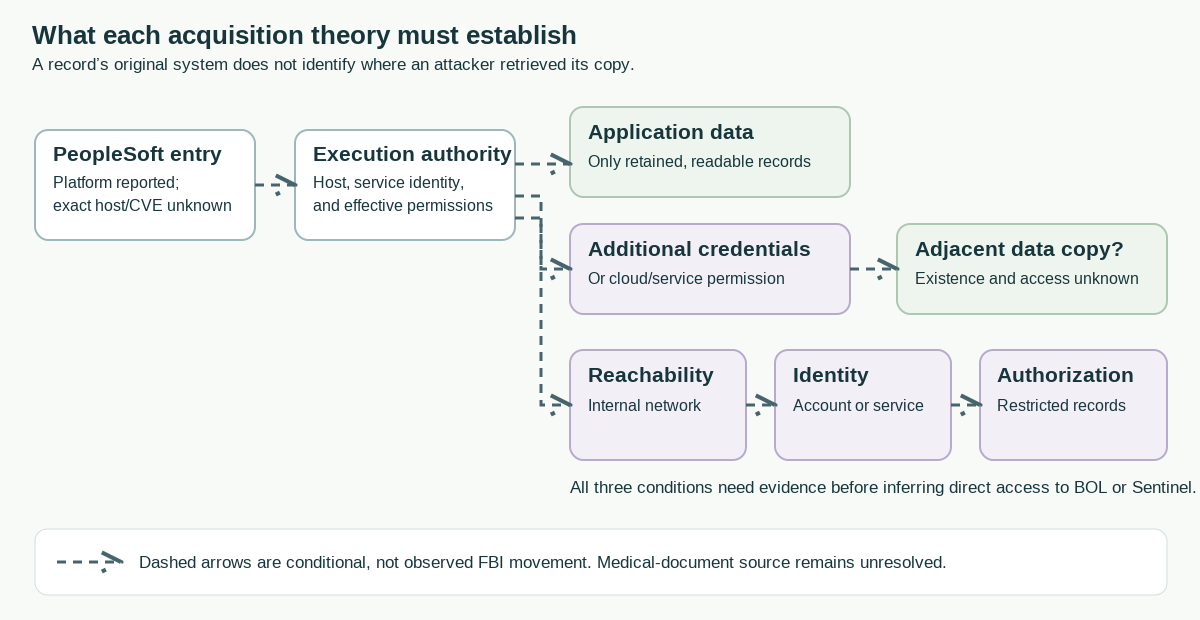
If the compromised installation was the external Candidate Gateway described in the 2022 PIA, its application database, local storage, configuration, and connected services would be the first places to examine. Code execution in a PeopleSoft management component would run with that process’s effective privileges; it would not automatically confer the Candidate Gateway runtime’s database grants, much less unrestricted access to GovCloud or FBINet. The public record does not identify the affected component, its host, or its relationship to the application service. What the attackers could retrieve would depend on the credentials, grants, and storage actually reachable from their execution context.
The CDS had already transferred certain employment information from HR Source into external CG for legitimate recruiting work. An ordinary applicant might see only their own submission, while a backend service could have broader database access. If the service retained offers, transfer orders, or questionnaires containing employee information, compromising that service could expose the stored copies without a direct breach of HR Source. The PIA documents transfer categories, however, not the breached service account’s permissions or the records present in September 2026. It also describes purging applicant data and keeping employee-only internal CG transactions in the Secret domain. Neither those transactions nor an entire historical personnel archive can be assumed to have resided in external CG.
The distinction between interface access and backend authority determines the scope of accessible records. A database that independently enforces case- or user-level restrictions could still limit a compromised application service. If restrictions existed only in the public interface, the same service might query records across many applicants. The PIA does not resolve which model applied to the affected installation, so code execution alone cannot establish the number or kind of records retrievable through it.
This route therefore has relatively few additional access steps for some applicant and hiring information if the records were still available under the application’s authority. It does not, on present evidence, explain every employee assignment or medical document examined by Reuters. That limitation concerns both data scope and retention, not merely the size of the attackers’ claim.
5.2 Lateral Movement and Data Replication
ShinyHunters claimed to have reached FBI-managed GovCloud servers after PeopleSoft. External CG was itself documented in GovCloud, but shared hosting does not make neighboring resources accessible. A move to another database could require connection information and credentials accepted there; access to cloud storage could require a service or cloud identity with the relevant permissions. A tunnel could provide network reachability while leaving authentication and record authorization unresolved. Mandiant observed searches for credentials and tunneling in the broader PeopleSoft campaign, but no public account identifies the FBI-specific resources or authorities reached.
The record’s original system is not necessarily the place from which an attacker retrieves it. A personnel export, synchronization database, or migration mirror could contain information derived from internal systems under a different application identity. HR modernization work and one documented Pega production-data copy make such repositories worth examining, not an established feature of this intrusion. In particular, the Pega presentation does not show that its copy contained BOL or Sentinel records or was reachable from the affected PeopleSoft host.
This route could account for information beyond CG’s documented recruiting workflow while leaving the original records system untouched. Its scope would depend on what fields the copy contained, when it was made, whether it was still retained, and which account could read it. A migration test using production data proves an operational practice; it supplies none of those incident-specific facts. An export restricted to account attributes would also be a poor explanation for detailed psychiatric evaluations, even if it contained names and organizational assignments.
For this hypothesis to explain the reported exposure, a relevant copy must have existed in an accessible environment, and credentials or permissions obtained from the initial compromise must have allowed the attackers to read it. Meeting those conditions could expose internal-origin information without a direct breach of its authoritative repository. The public documents establish neither condition for September 2026.
5.3 Crossing into Internal Record Systems
The cited attacker statements named CJIS, not BICS, BOL, or Sentinel. Direct access to the latter two systems is therefore a conditional explanation to test against any verified historical investigation records, not an established claim about which service was breached. The documented architecture supplies no direct route from external PeopleSoft into BOL or Sentinel. The CDS moved selected documents between domains; it was not a general login path. If the attackers entered the internal record systems, the central question is how they crossed into that authority domain. The PeopleSoft compromise alone does not answer it.
One possibility is an active connection left by an earlier integration or modernization effort: an interface, management channel, or service-to-service trust that reached farther than the documented CDS transfers. Successive personnel-system changes make that a question to investigate, not evidence that such a route still existed in September 2026. To explain the claimed intrusion, a path would have needed to be reachable from the compromised environment and to convey usable authority into an internal service. A surviving data feed that only accepted selected records would not suffice. Its endpoint, direction, credentials, and privileges would all matter.
Another possibility is an identity or management path obtained after the initial compromise. Credentials found on a PeopleSoft host might have been valid for a connected service, a management system, or an intermediate environment from which an internal identity could be acquired. That would require more than finding a password or establishing a tunnel: the attackers would need a reachable entry point, credentials accepted there, and a route from that foothold to the records. The credential searches and tunneling Mandiant observed at other organizations show why to examine this possibility, but do not establish that it occurred at the FBI. An independent compromise inside the FBI could also provide an internal foothold without PeopleSoft leading to it; no public evidence identifies one.
The identity obtained would determine the scope of a direct BOL breach. BICSU personnel-security specialists had documented access to all BOL cases, so control of one such identity could yield broad case access without bypassing authorization case by case. An external investigator’s BOLTS account, confined to assigned cases and short-lived transfers, would support a narrower explanation. Even a BOL specialist identity would not automatically confer Sentinel access. Evidence of a direct intrusion would therefore need to identify both the path into the internal environment and the effective identity or service privileges used to read each repository.
There is also a different explanation for BOL- or Sentinel-origin files: they could have been retrieved from an export or migration copy under the conditions examined in §5.2. Legacy infrastructure can matter in two distinct ways—an active connection may be a route inward, while an old copy may be the acquisition point without any entry into the authoritative system. Identifiers on disclosed files would help establish their origin but not, by themselves, decide between those routes. The age, coverage, and case distribution of a verified archive, together with evidence of the hosts and accounts that served it, would be more discriminating.
Medical information has a different evidentiary footing. Reuters found medical and psychiatric information in supplied material, whereas the claimed near-complete theft of personnel records has not been comparably verified. CG’s documented data categories include medical information, and NARA identifies a separate electronic medical-document system, but neither source locates the Reuters material or establishes that the NARA system is the system the attackers called MedLink. Recruitment storage, an administrative copy, and a dedicated medical repository remain distinct possible sources; the material alone does not establish direct access to the last of them.
5.4 Comparing the Hypotheses
Figure 2 separates the authority available on an exploited PeopleSoft host from the additional credentials or permissions needed for other resources. Dashed arrows are conditional, not an observed FBI intrusion trace.
| Hypothesis | Information it could explain | Documented basis and unverified requirement |
|---|---|---|
| PeopleSoft-related storage | Applicant and hiring records; medical documents if retained there | CG PIA describes transfers and medical data categories; actual retention and application permissions are unknown |
| GovCloud movement or data copies | Broader personnel attributes and records derived from internal systems | Campaign tactics and one documented FBI production-data copy make mechanisms worth testing; a relevant reachable copy and effective credentials are unverified |
| Direct BOL or Sentinel access | Authoritative historical investigation and personnel files, if such files were obtained | Neither system was named in the cited attacker statements; a surviving bridge or separate internal foothold, plus effective identity and record authority, are unverified |
| Direct medical-system access | Medical and psychiatric documents | A separate electronic repository is documented; its identity as MedLink and any intrusion path are unverified |
| Unrelated or mixed provenance | Corroborated details without a link to the PeopleSoft incident | Partial corroboration supports some contents, not when or how the supplier acquired them; older, separate, or fabricated material could be mixed in |
These paths differ in explanatory reach and in the evidence required to establish them. The corroborated samples call for an explanation of personnel attributes and medical documents; they do not, on present evidence, require access to BOL or Sentinel’s historical case holdings. Obtaining a hiring record from CG involves fewer additional boundaries than retrieving a restricted BOL case, provided that record remained in CG and was accessible to the compromised service. That does not make CG the most likely source of the material examined by Reuters: the samples do not identify their acquisition point or prove they came from this incident. Conversely, direct BOL or Sentinel access could explain a verified historical archive, but the present samples do not establish that such an archive was obtained or that those systems were entered.
The paths need not be exclusive. An attacker could retrieve some applicant information from a compromised Candidate Gateway and different documents from another store, if the necessary access existed. The reported two-to-three-terabyte figure and claim of near-complete workforce coverage have not been verified, so they should not be used to choose a single route for all records. The corroborated samples establish a narrower exposure and leave their retrieval location open.
Record format could narrow the alternatives. CG application identifiers, offer structures, and transfer-order references would support a recruitment-workflow origin; a consistent organization-wide set of identity attributes could point toward an HR Source-derived export. BOL or Sentinel case identifiers would suggest where records originated without proving where the attackers retrieved them, since copies can preserve those identifiers. Comparing document structure and creation history with host logs, credentials, and reachable storage would be more decisive than the record labels alone. For now, the available evidence supports conditional routes, not a ranking of which one was used or proof that all samples came from this intrusion.
6. Conclusion
The public record describes several boundaries around FBI personnel information: the external recruitment application exchanged selected data with HR Source, identity systems received selected attributes, and background-investigation records remained subject to separate roles and access controls. Reuters corroborated some identity details in the personnel sample and reported medical information in supplied material, but did not establish which system supplied that material or whether it was obtained in the reported PeopleSoft intrusion.
A record can remain protected in its authoritative system while an accessible copy defeats the practical purpose of that protection. That is a meaningful failure mode to test in this case, not a finding that it occurred. Resolving the route requires evidence of the compromised hosts, effective permissions, retained data, and when and where the disclosed documents were acquired.
References
Incident reporting and threat intelligence
- Reuters — Hacked FBI data has sensitive information about employees’ intelligence roles (September 23, 2026)
- Reuters — ShinyHunters hackers say they stole psychiatric and medical records of FBI staff (September 25, 2026)
- Reuters — FBI sample analysis and leak-site disappearance (October 3, 2026, syndicated by AOL)
- Reuters — Employee information (September 23, 2026, syndicated by Riverine Herald)
- Reuters — Accenture contractor removed from FBI following damaging data breach (October 6, 2026)
- CBS News — Cybercriminal group claims it stole FBI personnel and applicant data (September 23, 2026)
- The Register — ShinyHunters claims FBI hack (September 22, 2026)
- The Register — ShinyHunters tells The Reg: We hacked the FBI to protect our business (September 25, 2026)
- Mandiant / GTIG — ShinyHunters Targets Education Sector with Oracle PeopleSoft Exploit (June 11, 2026)
- Mandiant / GTIG — ShinyHunters Renewed Mass Exploitation Campaign Targeting Oracle PeopleSoft (September 25, 2026)
- Oracle — Security Alert Advisory for CVE-2026-35273 (June 10, 2026)
FBI architecture and historical documentation
- FBI — Privacy Impact Assessment for FBIJobs.gov and Candidate Gateway (2022)
- FBI — Privacy Impact Assessment for BOL/BOLTS (2021)
- FBI — Identity Governance and Administration Request for Information (2023)
- NARA — FBI Employment Records Schedule, DAA-0065-2023-0003 (Approved April 2026)
- Accenture — FBI Selects Accenture Federal Services to Support HR System Modernization (2017)
- PegaWorld iNspire — Operational Agility: Accelerating DevOps Adoption at FBI with Accenture Federal (2024)