How the Internet turned locally administered domain names into a global trust infrastructure—and what happened when that dependency was compromised.
Based on publicly available information as of October 12, 2026.
Abstract
In September 2026, attackers compromised the administration of three country-code top-level domains: Ghana’s .gh, Sierra Leone’s .sl, and American Samoa’s .as. They altered authoritative DNS information and obtained publicly trusted HTTPS certificates for Google, YouTube, and other organizations. Google’s systems had not been breached, and Google found no reason to believe the certificate authorities had violated their issuance requirements.
The incident exposed a dependency that developed over decades. The Domain Name System was designed to distribute the administration of names among organizations with different responsibilities, resources, and operating environments. Later, HTTPS and other Internet services began treating control of those names as evidence of authority. A local registry’s administrative decisions could consequently influence the identities recognized by browsers worldwide.
The September attacks exploited that relationship. In Sierra Leone, authorities reported unauthorized access to a CoCCA registry management system affecting 44 domain names. Certificate Transparency records showed unauthorized certificates issued across all three affected namespaces.
The publicly available evidence does not establish the initial intrusion method, a common exploit across the registries, or actual interception of user traffic. It does establish that compromising the administration of a domain namespace could produce legitimate certificates for domains belonging to organizations that had not authorized their issuance.
The question is not simply how attackers obtained the certificates, but why the authority to administer names became sufficient to obtain them.
1. Incident Overview
On October 6, 2026, Google’s Chrome Secure Web and Networking Team disclosed a series of hijacks affecting the .gh, .sl, and .as country-code top-level domains (ccTLDs). According to Google, the attackers compromised third-party ccTLD infrastructure, modified authoritative DNS records, and obtained unauthorized HTTPS certificates covering Google domains and domains belonging to other organizations. [1]
No compromise of Google’s own systems was identified. Google also stated that it had no reason to believe the issuing certificate authorities had done anything wrong.
This distinction is central to the incident.
An HTTPS certificate allows a browser to associate a domain name with a public key. The browser checks whether the certificate covers the requested hostname, whether it chains to a trusted certificate authority, and whether the connection demonstrates possession of the corresponding private key.
For an ordinary domain-validated (DV) certificate, the issuing authority verifies control of the domain. It does not necessarily establish that the applicant is an employee of the company commonly associated with that domain, or that the company’s management explicitly approved the application.
That model works because control of a domain is normally a reasonable basis for authorizing a certificate for it. But domain control is not confined to the organization operating the website. DNS is hierarchical, and a domain’s ability to direct requests to particular authoritative servers depends on information administered higher in the namespace.
For example, Google may operate the service associated with google.sl, but the delegation of google.sl depends on the administration of the .sl namespace. If an attacker can manipulate the relevant upstream information, the DNS answers observed by a certificate authority may no longer reflect Google’s intended configuration.
That is what made the 2026 incident possible.
Certificate Transparency (CT) records reviewed by The Hacker News identified 12 certificates covering seven Google and YouTube domain names, including google.com.gh, google.sl, and google.as. Eleven were issued by Let’s Encrypt and one by ZeroSSL. A broader investigation by iTnews identified 32 associated certificates, including certificates for other international brands. [2][3]
The affected names were regional Google and YouTube domains, not google.com itself. Nor does certificate issuance establish that the attackers successfully operated fraudulent websites or intercepted users’ communications. Such an attack would additionally require traffic to reach an attacker-controlled endpoint.
Nevertheless, the attackers obtained something significant: certificates signed by legitimate authorities for domain names they were not authorized to administer.
Google responded by blocking unauthorized certificates through Chrome’s CRLSet mechanism and coordinating revocation with the issuing certificate authorities. Further CT analysis identified additional potentially affected organizations, prompting more blocks and notifications.
The immediate incident was a compromise of registry-related DNS administration. Its broader significance was that this compromise could influence a separate, globally trusted authentication system.
The connection was not created in 2026. It was the result of how the Internet’s naming and security infrastructure had evolved.
2. Attack Timeline
Google has not published the exact initial-access dates or the administrative operations performed inside the compromised registry environments. The public sequence can nevertheless be reconstructed from CT records, Google’s disclosure, and reporting on the Sierra Leone incident.
The certificates appeared in three distinct clusters: Ghana on September 22, Sierra Leone on September 25, and American Samoa on September 27.
| Date (2026) | Observed event |
|---|---|
| September 22 | Two Google- and YouTube-related certificates under .gh appear in CT logs |
| September 25 | Six certificates under .sl appear, covering Google and YouTube domain names |
| September 25 | Sierra Leone later reports unauthorized access to its CoCCA registry management system on this date, affecting 44 domain names |
| September 26 | The two .gh certificates and one .sl ZeroSSL certificate are revoked |
| September 27 | Four certificates under .as appear in CT logs |
| October 1 | The remaining nine certificates in the 12-certificate Google/YouTube set are revoked |
| October 6 | Google publicly discloses the hijacks and its Chrome protections |
| October 7–9 | Additional certificate analysis and Sierra Leone’s incident disclosures become public |
Table 1. Reconstructed public timeline. CT timestamps show when certificates were first logged, not when the underlying systems were first compromised. Revocation times are also distinct from Chrome’s certificate-blocking times. Sources: [1]–[4].
The activity was concentrated. iTnews found that most associated certificates within each affected ccTLD were issued inside a window of roughly 90 minutes. This suggests relatively compact periods of certificate issuance, potentially taking advantage of temporary control over the relevant DNS state.
It does not establish that all three compromises had a common initial-access vector, that the actors were the same, or that DNS control was limited to those windows.
2.1 Sierra Leone: A Registry Compromise With 44 Affected Names
Sierra Leone provides the most concrete publicly reported information about the compromised management environment.
According to local reporting on an October 9 statement from the Ministry of Communication, Technology and Innovation, unauthorized access to the CoCCA domain management system occurred on September 25. The incident affected 44 domain names, including one government-related name and several commercial ones. [4]
The government said the incident was detected and contained that day, with affected domain configurations restored within hours. A subsequent review reportedly found no evidence of continuing unauthorized access as of October 8.
The ministry’s original release has not been independently obtained for this analysis, and the reporting does not identify the compromised accounts, specific DNS changes, or complete list of affected domains.
Even with those limitations, the reported recovery timeline can be compared with the certificate records.
Two certificates covering google.sl, including a wildcard certificate, first appeared in CT logs at 04:36 on September 25. The reported revocation time was 19:36 on October 1. The source does not specify a time zone for these clock values. Other .sl certificates were revoked either on September 26 or October 1. [2]
In other words, the registry’s reported restoration of DNS settings and the revocation of certificates derived from the compromised DNS state took place on different schedules.
The certificates were not automatically invalidated merely because the registry restored the affected domain configurations.
That does not mean Chrome necessarily accepted those certificates throughout the entire interval. Google applied browser-side blocks, but did not publish their exact deployment times. It does mean that restoring the original DNS configuration and terminating the authority represented by an already issued certificate required separate actions.
The attacker-controlled state in one system had generated an artifact recognized by another.
2.2 What the Attackers Actually Achieved
The distinction between obtaining certificates and exploiting them matters.
A publicly trusted certificate covering google.sl would allow an attacker who also controlled the corresponding private key and the user’s connection destination to operate a server that could pass ordinary TLS certificate validation for that name.
But possession of the certificate alone would not redirect users, expose existing Google sessions, or provide access to Google’s infrastructure.
The published evidence establishes unauthorized certificate issuance and alterations to authoritative DNS information. It does not establish the subsequent use of those certificates to intercept specific connections, capture credentials, or compromise Google accounts.
The compromised registry environments, historical DNS changes, ACME validation transactions, and attacker-controlled servers have not been made available for independent forensic reconstruction.
The evidence therefore supports a narrower, but still consequential conclusion: the attackers reached the certificate issuance stage of a domain impersonation capability without compromising Google.
To understand why that was possible, we need to examine how administering a DNS name became a form of security authority.
3. How DNS Became the Internet’s Trust Infrastructure
3.1 A System Designed to Distribute Names
The Domain Name System emerged in the 1980s as a way to replace centrally maintained mappings of hostnames with a hierarchical, distributed naming system.
Instead of one organization maintaining every name on the Internet, responsibility could be delegated to administrators of different portions of the namespace.
The country-code model developed within this arrangement. In RFC 1591, published in March 1994, Jon Postel described how top-level domains would be delegated and administered. Country-code domains were based on ISO 3166 codes, while designated managers were expected to operate the delegated namespaces on behalf of their local communities and the global Internet. [5]
These administrators were not necessarily national governments. They could be universities, telecommunications providers, private organizations, or other entities involved in the development of local Internet infrastructure.
The original administrative concern was that each manager should operate its namespace competently, maintain reliable name service, and serve the community fairly. It was not a framework for certifying the legal identity of every organization using that namespace.
The same distinction remains visible in IANA’s modern delegation procedures.
IANA evaluates whether a proposed ccTLD manager has sufficient operational and technical competence. However, its guidance explicitly recognizes that the requirements of a small registry differ from those of a registry handling millions of registrations. It does not prescribe one identical operational architecture for every jurisdiction. [6]
The flexibility makes sense. A globally distributed Internet needs registry arrangements appropriate to local circumstances, not necessarily identical budgets, staffing levels, infrastructure, or business models.
Oversight is similarly distributed. IANA’s 2026 guidelines on ccTLD revocation describe a framework in which concerns about registry administration should ordinarily be addressed through the applicable local governance arrangements. Intervention at the root-zone level is exceptional and must account for continuity of service and the interests of the Internet community. [7]
It would therefore be inaccurate to describe ccTLDs as names simply assigned to national governments, or to assume that IANA imposes no competence requirements.
The more significant point is that the naming system deliberately accommodates different administrative organizations and operating conditions.
Those differences did not disappear when other parts of the Internet began relying on DNS for security decisions.
3.2 The Dependency Had Already Produced Attacks
The danger of compromising administrative authority above a major organization’s domain had appeared well before 2026.
In November 2012, a compromise affecting Pakistan’s .pk domain infrastructure caused prominent names associated with Google, Apple, and other organizations to redirect to unauthorized content.
The registry operator, PKNIC, attributed the incident to a vulnerability exposed during a security upgrade that allowed four user accounts to be compromised and affected nine DNS records. Contemporary reports referred to as many as 284 affected sites, although the registry did not confirm that total. [8]
The underlying lesson was straightforward: an attacker did not need to compromise Google’s application servers to change where users were directed when visiting a Google-related country-code domain.
In 2019, Cisco Talos documented a more consequential variation in the Sea Turtle campaign. Attackers targeted organizations responsible for administering domains, including registrars and registry-related infrastructure. By manipulating DNS records and obtaining legitimate CA-signed certificates for the affected names, they were able to operate man-in-the-middle infrastructure that impersonated trusted services and harvested credentials. [9]
The two incidents exposed related aspects of the same dependency.
In 2012, compromising domain administration could redirect users away from legitimate services. By 2019, attackers had demonstrated how DNS hijacking and legitimate certificate issuance could be combined to make impersonation more convincing.
The 2026 incident showed that the certificate issuance component remained achievable even after years of improvements to the HTTPS ecosystem.
This was not a new cryptographic weakness. It was an old authority relationship persisting through successive generations of Internet security infrastructure.
3.3 How HTTPS Automation Changed the Meaning of DNS Control
As HTTPS expanded, domain names acquired a role beyond identifying destinations.
A browser authenticates a TLS connection by validating a certificate that binds a public key to a hostname. Before issuing such a certificate, a certificate authority needs sufficient evidence that the applicant is entitled to obtain one for the requested name.
For domain-validated certificates, that evidence is based on domain control.
The rise of automated certificate issuance made this relationship increasingly important. Let’s Encrypt began issuing publicly trusted certificates in 2015, and the Automatic Certificate Management Environment (ACME) protocol was standardized in RFC 8555 in 2019. [10]
ACME allows software to request and renew certificates by completing standardized challenges. Some methods validate control through an HTTP resource; DNS-01 validation checks for a specified TXT record in DNS.
This was an important improvement. Automation reduced the administrative cost of HTTPS and enabled certificates to be deployed and renewed at enormous scale.
But it also meant that control over a DNS name could be converted into a credential recognized by browsers throughout the world.
The certificate authority does not need to know the internal approval process of the organization using the name. For ordinary DV issuance, its task is to verify control according to the applicable rules.
That is an intentional design decision, not an accidental failure of the CA.
The significance changes, however, when the DNS control observed by the CA results from an upstream administrative compromise rather than an action authorized by the legitimate domain user.
A method designed to automate legitimate issuance can also process evidence generated during unauthorized control.
DNS-based authorization subsequently became common in other services as well. Cloud platforms and identity services use DNS records to verify custom domains. Email delivery and authentication depend on DNS-published configuration such as MX, SPF, DKIM, and DMARC.
Those mechanisms do not all grant the same privileges, and none should be treated as proof that DNS control automatically confers complete administrative access to a cloud tenant or email system.
Nevertheless, they reflect a common architectural pattern: DNS state is consumed by other systems as evidence relevant to authority.
The Internet had distributed name administration for scalability and local autonomy. It later made that administration an input to increasingly important security decisions.
3.4 Independent Jurisdictions, Shared Registry Software
The administrative histories of the three affected ccTLDs illustrate what this means in practice.
| Namespace | IANA-listed manager | Operational background |
|---|---|---|
.gh — Ghana | Network Computer Systems Limited | Long-standing private administration and continuing discussions over transfer to a national registry institution |
.sl — Sierra Leone | Sierratel | Historical involvement of telecommunications and external registration-service operators |
.as — American Samoa | AS Domain Registry | Local registry administration with GDNS, LLC in the United States listed as the technical contact |
Table 2. IANA Root Zone Database and registry documentation, reviewed October 2026. [11][12]
Ghana’s registry records document discussions about transferring .gh responsibilities to another national institution, including meetings in August and September 2026. They do not link that transition to the compromise. Sierra Leone’s IANA-listed manager is Sierratel, although other operators have historically provided registration services. American Samoa’s local registry lists a U.S.-based technical contact. [11][12]
The administrative arrangements differ, but the software used for registry operations can cross those boundaries.
CoCCA Registry Services, a New Zealand company, develops a Shared Registry System used by numerous ccTLD operators. Its own documentation states that the software is used for 58 top-level domains, including 56 country-code namespaces. Deployments may be locally operated or hosted through CoCCA arrangements for primary service or disaster recovery. [13]
CoCCA’s published customer information lists American Samoa’s .as as a supported license holder. Ghana’s .gh appears in a separate group of software users to which CoCCA says it does not provide commercial support.
In Sierra Leone, the government reportedly identified unauthorized access to a CoCCA management system during the September 25 incident.
These observations do not establish a common vulnerability, shared servers, or shared administrator accounts. The incident-time deployments and entry routes remain unknown.
They do show a second dependency: ccTLD administration is institutionally distributed, while its implementation may rely on common software and service providers. Shared software can reduce the burden on smaller registries; the security consequences depend on each deployment and its controls. The distinction is between locally held responsibility and operational components that can be supplied across jurisdictions.
3.5 Google Was Already Consolidating Its Regional Search Domains
Another development makes this dependency particularly revealing.
In April 2025, Google announced that it would gradually redirect traffic from country-specific Google Search domains to google.com. The company explained that improvements introduced in 2017 had already made it possible to provide localized search results without requiring users to visit country-specific domains. [14]
From a product perspective, the independent regional entry points were becoming less necessary.
But consolidation of a service does not automatically eliminate its historical domain dependencies.
As long as a regional name continues to exist and serve users, even by redirecting them elsewhere, its DNS delegation and certificate requirements remain relevant. Those dependencies still involve the registry administering the name’s parent namespace.
The exact migration status of the affected names at the time of the attacks has not been established, so the consolidation program cannot be treated as a cause of the incident.
It does illustrate a broader asymmetry: a company can consolidate its services while the names through which those services have historically been accessed remain distributed across external administrative institutions.
With that history in place, the technical path of the September incident becomes easier to understand.
4. How Registry Control Became Google’s Identity
4.1 The Registry Does Not Need to Control Google’s Servers
A country-code registry does not ordinarily administer the applications hosted under its namespace.
The .sl registry, for example, is not responsible for operating Google’s search infrastructure. Its relevant authority concerns the .sl naming system, including registration and delegation data.
Under DNS, resolving google.sl involves following the hierarchy from the root to the .sl nameservers and then to the authoritative information for google.sl.
The legitimate registrant controls its own DNS arrangements, but those arrangements must be discoverable through the parent zone.
This creates a powerful upstream dependency.
If an attacker obtains sufficient authority to change a domain’s delegation at the registry level, they may be able to replace the authoritative nameservers referenced by resolvers without compromising the legitimate registrant’s servers.
External clients, including certificate authorities, can then encounter DNS answers supplied through the modified delegation.
In this situation, Google’s own DNS infrastructure might remain intact. What changes is the path by which the rest of the Internet discovers which DNS infrastructure should be trusted for the affected name.
That distinction is essential.
The compromise of a parent registry need not provide administrative access to the registrant’s infrastructure. It can instead provide control over how that infrastructure is located—or over which alternative infrastructure is presented as authoritative.
4.2 Converting DNS State into Certificate Authority
CoCCA describes its shared registry system as software that a TLD manager may install locally or have CoCCA host as a primary or backup instance. That documented deployment choice helps identify the registry operating layer, but it does not identify the systems or permissions used in these attacks. [13][15]
It does not provide a forensic record of the September attacks.
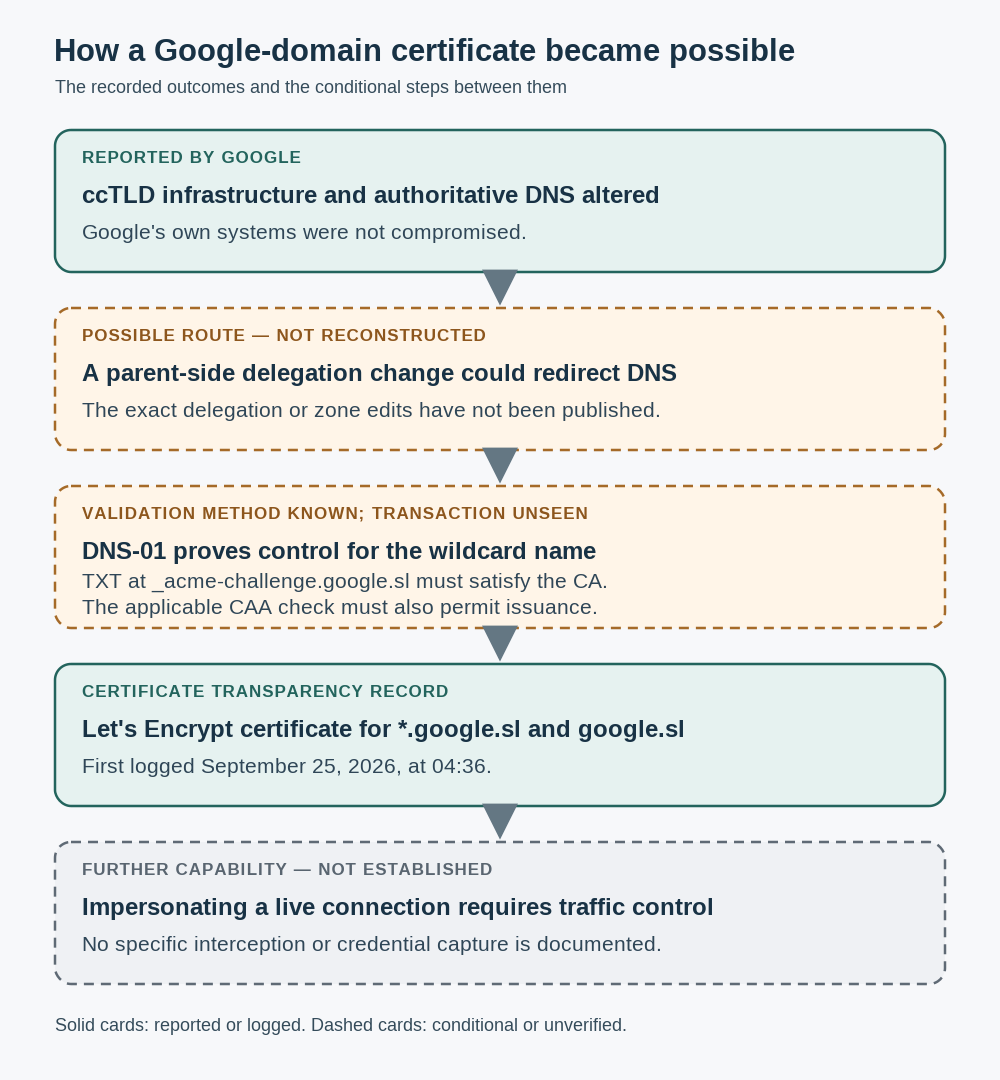
Based on the documented compromise of authoritative DNS information and the observed certificate issuance, the relevant trust relationship can be reconstructed as follows. Figure 1 applies it to one certificate; Table 3 separates the authority exercised at each stage.
| Stage | Authority or observation | Downstream consequence |
|---|---|---|
| Registry administration | Ability to modify domain registration or delegation state | Changes which DNS servers may be treated as authoritative |
| Authoritative DNS | Answers for names used in domain validation | Provides evidence observed by the certificate authority |
| Domain Control Validation | Successful verification of domain control | Authorizes issuance under the CA’s rules |
| Certificate authority | Issues a signed certificate for the requested names | Binds the names to the applicant’s public key |
| Browser | Validates the certificate during TLS connection establishment | May authenticate a connection to an endpoint using that key |
Table 3. Authority changes across the reconstructed path. These stages describe a technically plausible route consistent with the reported incidents, not a recovered record of the attackers’ individual registry and ACME operations.
Consider the Let’s Encrypt certificate covering *.google.sl and google.sl, first logged at 04:36 on September 25. That certificate and Google’s report of altered authoritative DNS are the observed endpoints of the sequence. [1][2]
Let’s Encrypt requires DNS-01 validation for wildcard certificates. For *.google.sl, the method checks a challenge TXT value under _acme-challenge.google.sl. [17] A sufficient route would be for an attacker to change the parent-side delegation of google.sl, direct the CA’s DNS lookup toward attacker-controlled authoritative servers, and serve the required TXT value while the applicable CAA check also permitted issuance. Where a valid DNSSEC chain protects the child zone, that route would additionally require the altered delegation and challenge answers to validate under the relevant chain; changing only NS records would not suffice if an intact DS record still authenticated the legitimate child. The CA could then validate domain control without modifying Google’s own servers and issue a certificate binding the names to the applicant’s public key. [16]
That route is an explanation of capability, not a recovered transaction. Google reported altered authoritative DNS information, but the exact delegation or zone edits and challenge responses have not been published. The records also do not establish precisely which CoCCA permissions or accounts, if any, were used in the Ghana and American Samoa compromises.
But the observed outcome demonstrates that the attackers successfully caused the issuance process to accept evidence of domain control for names they were not authorized to administer.
The crucial transformation is from upstream administrative control to downstream validation authority.
A registry’s ability to affect the DNS delegation of a name is converted into the ability to influence the evidence consumed by a CA. The CA then produces a certificate that clients recognize independently of the registry system in which the compromise occurred.
4.3 The Verification Worked; the Assumption Was Exploited
It would be misleading to characterize the incident simply as a case in which certificate authorities failed to identify Google’s legitimate employees.
DV certificates are not designed to establish corporate employment or independently certify legal ownership of a brand. Their purpose is to bind a public key to a domain after the applicant demonstrates control under accepted validation procedures.
Google explicitly stated that it had no reason to believe the issuing CAs had acted improperly.
The failure mode lies in the authority dependency underlying that procedure.
A legitimate domain registrant and an upstream namespace administrator have different responsibilities. The registrant operates the domain’s intended services. The parent registry administers information that can affect how the domain is delegated.
Those two kinds of control ordinarily coexist without conflict.
When the upstream administrative authority is compromised, however, DNS observations can cease to represent the configuration approved by the registrant. The certificate authority may have no independent evidence of that disagreement.
The CA can therefore follow its rules and still issue a certificate on the basis of DNS state produced through unauthorized upstream control.
This is not a failure of TLS encryption, nor necessarily a failure to execute domain validation correctly.
It is a limitation of relying on domain control as sufficient evidence of authorization when control can be affected by another administrative layer.
The distinction matters because merely fixing a CA implementation would not remove the dependency. The underlying architecture still allows the state of a delegated namespace to influence the certificates issued for names beneath it.
The 2026 attackers exploited that architecture. They did not need to defeat Google’s internal access controls to reach the certificate issuance system.
5. What Happens When the Naming Authority Fails
5.1 Restoring DNS Does Not Revoke What DNS Authorized
One of the most concrete observations in the incident concerns the recovery process.
Sierra Leone reportedly restored affected domain settings within hours on September 25. Yet several certificates issued that day were not revoked until October 1.
These are different security states managed by different systems.
A registry can restore the proper delegation records, terminate unauthorized administrative access, and return names to their intended DNS configurations. That does not automatically revoke certificates already issued by external CAs.
The certificates have their own validity periods and revocation mechanisms. A browser may also maintain emergency blocklists that operate separately from the CA’s revocation process.
There is an additional complication: certificate authorities may reuse previously completed domain-control validation for subsequent issuance, subject to the applicable requirements and their own policies.
Under the CA/Browser Forum rules in force during the September 2026 incident, the maximum reuse period for domain-validation information was 200 days. This was an upper limit, not evidence that every CA reused validation for the full period. [16]
Consequently, recovering DNS control does not necessarily invalidate every form of authorization produced during the compromised interval.
Google’s recommendation to deploy restrictive CAA records with ACME account bindings addresses this problem. CAA allows domain owners to restrict which CAs may issue certificates, with supported parameters capable of limiting issuance to designated accounts or validation methods.
A CAA restriction cannot reliably prevent issuance during an active hijack if the attacker can also manipulate the relevant DNS records. Once legitimate DNS control has been restored, however, an appropriately restrictive policy can help prevent an attacker from reusing previously established validation state to obtain new certificates.
The October 7 observations make the change of state concrete. The Hacker News checked the seven Google and YouTube names in its certificate set and found CAA records allowing only pki.goog, Google Trust Services’ CA domain. Yet the unauthorized certificates logged between September 22 and 27 had been issued by Let’s Encrypt and ZeroSSL. [2]
That is a comparison between certificate records from the attack period and DNS policy observed later. It does not show what CAA records the CAs saw when they issued the certificates, or prove which records the attackers changed. Restoring restrictive CAA also does not retroactively revoke a certificate already issued; revocation and browser blocking remain separate recovery steps.
The incident therefore exposed a recovery problem as well as an issuance problem.
A temporary compromise of one administrative system had produced certificates recognized within a separate trust system. Returning the first system to its correct state did not automatically undo the effects in the second.
5.2 Why DNSSEC and Multi-Perspective Validation Are Not the Whole Answer
The Web PKI ecosystem has introduced substantial safeguards against unauthorized issuance.
Certificate Transparency makes publicly trusted certificates discoverable through append-only logging systems, allowing domain owners and independent researchers to identify unexpected issuance.
DNSSEC provides cryptographic validation of DNS data where an appropriate chain of trust exists. Multi-Perspective Issuance Corroboration (MPIC) requires CAs to corroborate domain validation and relevant DNS observations from different network locations.
By June 15, 2026, CA/Browser Forum requirements called for at least four remote network perspectives in MPIC, alongside the primary perspective, with geographical and network diversity conditions. DNSSEC validation requirements for CA domain-control and CAA lookups were also in effect. [16]
These are meaningful security improvements. They address particular classes of DNS manipulation, routing attacks, and inconsistent observations.
But they do not provide the same guarantee as independent confirmation that a change was approved by the intended domain registrant.
If multiple network perspectives all observe the same maliciously altered upstream delegation, their agreement does not itself establish that the delegation reflects Google’s authorization.
Similarly, DNSSEC can authenticate DNS data under a valid chain of trust, but it does not inherently determine whether a legitimately authorized signer or compromised administrator acted according to the registrant’s wishes. The result depends on the precise DNSSEC configuration, trust chain, and changes made.
The public information does not establish how DNSSEC validation behaved in the three individual compromises. It would therefore be incorrect to claim that DNSSEC or MPIC was demonstrably bypassed through a specific technical mechanism in each case.
The narrower architectural conclusion is sufficient: verifying DNS answers from more locations, or validating their cryptographic integrity, is not necessarily equivalent to independently verifying the administrative authorization behind those answers.
The industry is also reducing the period during which a certificate or prior validation can remain useful. CA/Browser Forum’s adopted schedule reduces maximum public TLS certificate validity to 47 days and maximum domain-validation reuse to 10 days by March 2029.
Shorter validity periods and reuse windows can reduce the duration of certain compromise effects. They do not eliminate the fundamental reliance on domain-control evidence.
5.3 A Global Consequence Without Global Control
The incident ultimately required action by several organizations with different responsibilities.
The registries were responsible for their respective namespaces and the integrity of their administrative systems. The certificate authorities controlled issuance and revocation of the certificates. Google could detect unexpected certificates for its domains, request revocation, and implement protections in Chrome.
None of these organizations alone controlled the entire sequence.
Google could not directly restore every compromised registry environment. A registry could not unilaterally revoke certificates issued by all external CAs. A certificate authority did not necessarily have independent knowledge of the legitimate registrant’s internal approval process. Chrome could block known suspicious certificates, but its interventions would not automatically protect users of every other browser or TLS client.
Google acknowledged these limitations in its disclosure. It could not guarantee that its investigation had identified every affected domain, and warned domain owners not to rely exclusively on browser-side protection.
That division of responsibility is not inherently defective. The Internet operates precisely because independent systems can interoperate without being administered by a single organization.
The difficulty arises when authority moves across those systems more readily than accountability and recovery can follow it.
Country-code namespaces are managed according to different institutional arrangements. Their implementation may depend on international registry software providers. CAs consume DNS state according to globally standardized verification rules. Browsers then rely on the resulting certificates to authenticate connections.
A compromise in a locally administered part of that chain can therefore have consequences for organizations and users far outside the registry’s jurisdiction.
The organization suffering the consequences may have had no direct administrative control over the system where the compromise began.
This is the structural mismatch exposed by the September incident: the technical consequences of DNS administration are global, while the authority to supervise and recover that administration remains distributed.
6. Conclusion
The September 2026 attacks did not demonstrate that Google’s encryption had been broken, that its servers had been compromised, or that certificate authorities had abandoned their verification rules.
They demonstrated something more fundamental about how those rules depend on the Internet’s naming infrastructure.
Country-code domains were developed within a model that delegated namespace administration to organizations operating under different local conditions. This distribution of responsibility helped the Internet expand without requiring a single institution to operate every domain.
Over time, the authority to administer those names acquired a second role. HTTPS certificate issuance and other services began using DNS control as evidence for security decisions. The administrative hierarchy of names became part of the authentication infrastructure of the Web.
That dependency created a path through which a compromise of a registry could affect organizations that did not operate the registry and whose own systems remained secure.
In the 2026 incident, attackers used compromised ccTLD administration to alter authoritative DNS information and obtain legitimate certificates for Google and other domains. Sierra Leone reported unauthorized access to a CoCCA management system and the disruption of 44 domain names. The full intrusion methods and any actual interception of user communications remain unverified.
The problem should not be reduced to an assumption that certain countries are incapable of securing their registries. Different operational capabilities and governance arrangements are an ordinary consequence of decentralized administration. IANA assesses registry competence, and shared software can be a reasonable means of supporting smaller operators.
The deeper question is whether a system that deliberately accommodates such administrative diversity should allow upstream control of a name to carry so much weight in globally recognized authentication.
Current defenses improve detection, constrain issuance, strengthen DNS verification, and shorten the lifetime of compromised credentials. They reduce important risks, but they do not completely separate control of DNS delegation from authority over the certificates issued for a domain.
A registry can be outside Google’s operational control while still holding administrative authority that affects how Google’s regional domain names are authenticated.
The 2026 incident made that dependency visible.
The Internet distributed the administration of names, then built a global authentication system that depends on that administration.
What failed in September was not the cryptography protecting Google’s servers. It was the assumption that control observed through the naming hierarchy would continue to represent the intentions of the organizations whose names were being authenticated.
That assumption remains embedded in the architecture of the Web.
References
Incident reporting and certificate evidence
[1] Google, Chrome Secure Web and Networking Team. Chrome’s Response to Recent ccTLD Registry Hijacks. October 6, 2026. Primary disclosure, mitigation, and guidance.
[2] The Hacker News. Attackers Hijack .gh, .sl, and .as Registries to Obtain Certificates for Google Domains. October 7, 2026. CT records for 12 Google- and YouTube-related certificates, including issuers and revocation times.
[3] iTnews, Juha Saarinen. Attackers hijack ccTLDs to fake certs for Google. October 8, 2026. Analysis of 32 associated certificates.
[4] Sierra Leone Monitor. Government Confirms Hack on Sierra Leone’s .SL Domain System. October 9, 2026. Secondary reporting on the Sierra Leone Ministry of Communication, Technology and Innovation’s statement. The original ministry release has not been independently obtained.
Historical and institutional background
[5] J. Postel. RFC 1591 — Domain Name System Structure and Delegation. March 1994.
[6] IANA. Preparing an Operational and Technical Plan. Guidance for ccTLD delegation and transfer.
[7] IANA. Revocation of a Country-code Top-level Domain. January 6, 2026.
[8] TechCrunch, Ingrid Lunden. Pakistan’s PKNIC Says Hackers Exposed A Hole During Security Upgrade. November 28, 2012.
[9] Cisco Talos. DNS Hijacking Abuses Trust in Core Internet Service. April 17, 2019. Sea Turtle attack reconstruction.
[10] IETF. RFC 8555 — Automatic Certificate Management Environment (ACME). March 2019.
Registry infrastructure and operational history
[11] IANA Root Zone Database. Delegation records for .gh, .sl, and .as.
[12] GH NIC Registry. .GH Registry History. Registry administration and transfer-related records, updated September 9, 2026.
[13] CoCCA Registry Services (NZ) Limited. CoCCA Registry Services and TLD Users. Software deployment arrangements and supported/unsupported users, updated December 10, 2025.
[14] Google Search. Here’s an update on our use of country code top-level domains. April 15, 2025.
[15] CoCCA Registry Services. Shared Registry System Technical Documentation.
Web PKI and certificate validation
[16] CA/Browser Forum. Baseline Requirements for the Issuance and Management of Publicly-Trusted TLS Server Certificates. Requirements applicable to domain validation, multi-perspective corroboration, DNSSEC, CAA processing, certificate validity, and validation-data reuse as of October 2026.
[17] Let’s Encrypt. Challenge Types. DNS-01 challenge procedure and wildcard-certificate validation.
Scope and evidentiary limitations
This investigation is based on public disclosures, Certificate Transparency research, registry documentation, historical reporting, and relevant technical standards.
It does not rely on direct access to compromised registry installations, administrator authentication records, EPP logs, historical DNS zone snapshots, ACME transaction records, or attacker-controlled infrastructure.
The specific initial-access mechanisms, any common vulnerability or operational compromise across the three affected ccTLDs, the exact DNS records altered, and any actual interception of user traffic remain unverified. The registry-to-certificate sequence described in Section 4 is an architectural reconstruction consistent with the observed results, not a claim that every intermediate attacker action has been independently established.