How changes to military personnel systems created new points of custody and retrieval—and why those points matter to the 2026 breach.
An analysis based on publicly available information as of October 10, 2026.
Abstract
In September 2026, the US Department of Defense disclosed that unauthorized users had accessed files containing personal information on more than three million individuals through a vulnerability in a Defense Manpower Data Center (DMDC) file-sharing system. The vulnerability was discovered and patched on July 16, following a period of unauthorized access dating back to October 2025. The affected product, the precise location of the compromised files, and the mechanism used to access them remain unidentified.
DMDC was established in 1974 to bring together personnel information from separately administered military services. Later efforts addressed different problems: DIMHRS attempted to integrate personnel and payroll operations; a 2012 audit exposed failures of reconciliation and supporting documentation; matching agreements, reporting services, and modernization projects had to support continuing administrative work. Some reforms failed, while others solved a specific problem and created new responsibilities for preserving, exchanging, or retrieving information.
This investigation uses public audits, privacy assessments, interagency agreements, budgets, and procurement records to trace those changing responsibilities. It asks how sensitive information came to be held beyond the central personnel record, which organization could retrieve each file, and who had to retain or delete it as systems changed. The evidence does not establish that any historical reform caused the 2026 vulnerability or identify the breached product. It does show why file storage and retrieval must be examined alongside the original database.
1. Timeline of the Incident
On September 24, 2026, Military Times reported that DMDC had notified an affected individual about a security vulnerability in one of its file-sharing systems. According to the notification, dated September 18, DMDC discovered and patched the vulnerability on July 16. Its subsequent investigation found that unauthorized users had accessed files containing unencrypted personally identifiable information between October 2025 and the date of discovery.
The exposed information varied by individual and included Social Security numbers, names, dates of birth, contact information, and military occupational details. On September 28, Federal News Network reported, citing a Pentagon official, that nearly 2.8 million living individuals and approximately 294,000 deceased individuals had been affected.
| Date | Event |
|---|---|
| October 2025 | Beginning of the reported period of unauthorized file access |
| July 16, 2026 | DMDC discovers and patches a vulnerability in a file-sharing system |
| September 18 | Date of the breach notification sent to an affected individual |
| September 24 | Military Times reports the incident |
| September 28 | Federal News Network reports an affected population exceeding three million |
| September 30 | TechCrunch publishes further reporting on the prolonged exposure |
The approximately nine-month interval identifies the reported period of unauthorized access, not necessarily a continuous intrusion by the same attacker. The notification does not identify a CVE (a publicly assigned vulnerability identifier), a particular software vendor, or the type of identity or permissions used to obtain the files.
The distinction between accessing files and compromising the databases from which their contents originated is important. DMDC maintains authoritative personnel information, but it also operates systems designed to produce reports, process approved data requests, and distribute information to other organizations. A file derived from a central personnel record can exist in a different system, with different users, storage arrangements, and access controls.
The notification described in public reporting establishes that unauthorized users reached files within a DMDC file-sharing environment. It does not establish whether those files were stored for internal reporting, application-level delivery, interagency exchange, or another purpose. Nor does it establish that all affected information was obtained through direct access to the central personnel database.
The history of how DMDC came to maintain and distribute information offers one way to identify the relevant custody and retrieval questions without assuming which software was compromised.
Sources: Military Times, September 24; Federal News Network, September 28; TechCrunch, September 30.
2. What Was Actually Exposed?
The available reporting identifies the affected population and several categories of personal information, but it does not provide a complete inventory of the accessed files. This matters because DMDC maintains substantially more information than the specific fields identified in the notification.
In 2017, a National Academies report described DMDC as coordinating approximately 35 million individual records covering service members, employees, contractors, retirees, and family members. Its responsibilities included statistical analysis, benefit eligibility, identification, authentication, and enterprise integration. By 2026, the legal scope of its central personnel record system encompassed personnel histories, occupational information, assignments, training, compensation, and various administrative and benefit-related records.
That broader institutional scope should not be confused with the contents of the breached files. A personnel repository’s authority to maintain a category of information does not demonstrate that every derived report or export contains that category.
The March 2026 System of Records Notice (SORN) for DMDC 01, renamed the Uniformed Services Human Resources Information System (USHRIS), is especially revealing because it distinguishes the source records, permanent master file, and output records. The distinction indicates that information held within DMDC can exist in several forms for different purposes, rather than only as one authoritative database.
The notice also provides different retention arrangements for those forms. The central master file is retained permanently, with fiscal-year snapshots transferred to the National Archives. DMDC-held output reports are deleted when no longer operationally necessary, while requesting DoD offices retain their own recordkeeping copies under applicable records schedules.
Consequently, the presence of information concerning millions of individuals in a file-sharing environment does not, by itself, identify which repository or administrative process produced the files. They could represent original records, prepared extracts, accumulated reports, or copies maintained to support another administrative function.
The currently supported observations can be separated from the unresolved questions.
| Information or proposition | Evidentiary status |
|---|---|
| More than three million living and deceased individuals affected | Reported by a Pentagon official |
| Names, SSNs, dates of birth, contact and military occupational information | Identified in notifications and reporting; fields vary by person |
| Unauthorized access to unencrypted PII in files on a server | Described in the incident notification |
| A vulnerability in a DMDC file-sharing system | Confirmed in the notification; product unidentified |
| Direct compromise of the DMDC 01 master database | Not established |
| Involvement of any identified reporting, document-delivery, data-service, or transfer system | Not established |
| Initial intrusion method, exploited CVE, and attacker identity | Not publicly identified |
| Complete acquisition of every record concerning every affected person | Not independently established |
This distinction does not reduce the seriousness of the incident. SSNs combined with identity and military personnel attributes create substantial risks of identity fraud, impersonation, and targeted approaches to service members and their families. Depending on the records exposed, occupational and affiliation details may also make individuals easier to identify within sensitive organizations.
What the available evidence does not establish is which administrative function placed these files within reach of the vulnerable component. That unanswered question is central to reconstructing the incident.
The history of DMDC provides several documented examples of why information derived from central personnel records could be stored and delivered outside the systems responsible for maintaining the originals.
Source: Federal Register, DMDC 01 System of Records Notice, March 3, 2026.
3. Fifty Years of Integration, Institutional Dependencies, and Failure
3.1 The First Integration: Centralizing Military Personnel Information
DMDC originated from a practical difficulty facing the Department of Defense in the early 1970s. The military services had developed separate administrative systems, and the Office of the Secretary of Defense lacked reliable shared datasets for examining personnel questions across service boundaries.
A 2017 National Academies report describes how department-wide analysis was commonly conducted before DMDC’s creation. When policymakers needed information covering multiple services, contractors requested data separately and assembled purpose-specific databases. Because formats and classifications differed, significant effort could be required to prepare a usable dataset before the substantive analysis even began.
The establishment of DMDC’s predecessor in 1974 changed this arrangement. Common data formats could be specified in advance, and military services could provide information regularly for storage and maintenance. A central repository reduced the need to rebuild an integrated dataset for every analytical project and allowed the department to study military careers, compensation, readiness, and personnel trends over time.
The transition to an all-volunteer force provided an important administrative context. Recruiting, retaining, assigning, and compensating personnel required detailed information about how military employment actually operated. Longitudinal records were useful for comparing cohorts and evaluating the effects of different policies.
The reform achieved integration at the level of information, but not necessarily at the level of the institutions generating it.
The Army, Navy, Air Force, and other services retained their own personnel operations. Those organizations continued to manage assignments, occupational classifications, promotions, and pay-related processes according to the rules governing their respective services. DMDC could harmonize selected outputs without acquiring the authority or operational capacity to replace every source system.
This was not inherently a defective design. Central analysis and decentralized administration can coexist effectively. The limitation became apparent when the department later needed more than comparable statistics and attempted to integrate the underlying business processes themselves.
The original reform had reduced the cost of obtaining consistent information while preserving differences in how the information was generated. Those differences remained a recurring source of integration work.
It also changed the stakes of access to a central collection. A repository assembled for cross-service analysis could hold related information about many individuals in one place, even though the contributing services continued to govern their own source records. Whether that concentration increased the impact of any particular unauthorized access would depend on the records and permissions available at the point of access; it is not evidence that the central repository was breached in 2026.
Sources: National Academies, Personnel and Readiness Data and Their Use, 2017; GAO/NSIAD-00-12, p. 30, 1999.
3.2 From Statistics to Identity and Benefits Administration
DMDC’s role expanded as military information became necessary for purposes other than analytical reporting.
The Defense Enrollment Eligibility Reporting System (DEERS) developed into a key system for determining identity, military affiliation, and benefit eligibility. Its records support the administration of entitlements to eligible service members, retirees, and family members, including access to military medical benefits. DMDC also became important to the identity infrastructure used in issuing Common Access Cards and maintaining affiliation information relevant to access to facilities and information systems.
These functions introduced different relationships between DMDC-held information and the organizations using it.
A statistical report supports decisions about military policy. An eligibility record can determine whether a specific individual qualifies for a government benefit. A credentialing process requires information to be sufficiently current and accurate to support an identity or affiliation decision. The organizations making those decisions may operate independently from the organization maintaining the source data.
By 2017, the National Academies described DMDC as operating across decision support, benefit and readiness reporting, identification and authentication, enterprise integration, and survey management. That breadth does not mean the original analytical repository became the operational source for every service. It means DMDC-held information and related systems had become part of several administrative processes.
The consequence was a gradual increase in dependencies extending beyond DMDC itself. Medical administrators, credentialing services, military personnel offices, and other federal institutions needed continued access to authoritative information. Changing the underlying data systems could therefore affect processes established under different organizational authorities.
This expansion explains why the later history of DMDC cannot be reduced to database modernization. Its data had become essential to institutions whose duties continued regardless of which technical platform DMDC chose to operate.
3.3 The Failed Attempt to Integrate the Source Systems: DIMHRS
The limitations of centralizing information without integrating the underlying operations became particularly visible in the Defense Integrated Military Human Resources System (DIMHRS) program.
Military personnel and payroll systems had long been fragmented across services and components. The resulting inconsistencies affected more than statistical quality. GAO had documented incorrect or delayed payments to mobilized reserve personnel and difficulties tracking assignments and entitlements, including problems following Operations Desert Shield and Desert Storm.
In 1996, a Defense Science Board task force recommended moving toward a single integrated personnel and pay system. The Department of Defense initiated DIMHRS in February 1998, intending to establish a standardized system for active and reserve components across the military services.
This was a more ambitious form of integration than the original DMDC project. Rather than gathering information from several operational systems, DIMHRS sought to replace the separate arrangements with common software and business processes.
The difficulties emerged during requirements definition and program governance. A 2005 GAO investigation found that detailed requirements had not been adequately completed or accepted by user organizations. The program also lacked sufficiently integrated management across organizations whose responsibilities included personnel policy, financial administration, system development, and operational deployment.
The difficulty was not simply that engineers disagreed about system features. A common personnel and payroll system would require participating organizations to determine which existing procedures could remain service-specific, which should be standardized, and who would hold the authority to make those decisions.
These issues continued during deployment planning. In 2008, GAO documented repeated changes to the Army’s deployment date and the need to reconcile Army requirements with the capabilities being delivered. The department established additional coordination and governance mechanisms, but the project did not achieve its intended integrated deployment. In February 2010, the Department of Defense canceled DIMHRS.
Its failure did not establish that integration was impossible, and DIMHRS itself was not a replacement for DMDC. Nevertheless, the department had not achieved the unified source environment the program was intended to deliver. Separate personnel and financial systems continued to require reconciliation, especially where administrative decisions depended on the consistency of records created in different organizations.
Sources: GAO-05-189, February 2005; GAO-08-927R, September 2008.
3.4 The 2012 Payroll Audit: A Failure to Reconcile Records and Produce Evidence
A 2012 GAO audit illustrates what the continuing separation of personnel and payroll information meant in practice.
The investigation examined the Army’s ability to establish a valid population of military payroll accounts and provide documents supporting the payments made during fiscal year 2010. The Defense Finance and Accounting Service (DFAS) reported approximately $46.1 billion in active Army military payroll for that year, but the Army and its financial administrators did not have an effective, repeatable process for establishing the full population of payroll transactions.
According to GAO, DFAS’s Indianapolis office required three months and repeated attempts to identify the accounts receiving active-duty military pay. Because the Army did not have an integrated personnel and payroll system, DMDC also had to reconcile the payroll accounts with its personnel records. That comparison required more than two months of labor-intensive work.
The delay reflected several problems, including computer-system difficulties, personnel availability, and additional verification work. It should not be attributed solely to the cancellation of DIMHRS. The documented structural problem was that separate systems had to be compared, while the procedures available for performing that comparison were not sufficiently reliable or repeatable.
The audit revealed an additional failure involving supporting documentation.
GAO requested records for a sample of 250 payroll accounts. Six months after receiving the sample, the Army and DFAS had provided complete documentation for only two items, partial documentation for three, and no documentation for the remaining 245.
This did not establish that 245 payments were improper. It established that auditors could not obtain the evidence needed to determine whether those transactions were valid.
The distinction is important. A financial transaction may have occurred in a payroll system, while the personnel orders, entitlement records, or other documents justifying it are stored separately, incomplete, or difficult to retrieve. Reconciliation of database entries alone does not solve the problem of reconstructing the authority under which an administrative decision was made.
The subsequent corrective actions are particularly revealing. By 2013, the Army and DFAS had established monthly comparisons between personnel and payroll records, with discrepancies tracked for investigation. The Army also specified key supporting documents and strengthened requirements for retaining them in the Interactive Personnel Electronic Records Management System (iPERMS). DFAS designated its Corporate Electronic Data Management System (CEDMS) as a repository for pay-supporting documents handled by military pay offices, while Army records-management rules were revised in 2014.
These measures addressed real audit weaknesses. They also illustrate a particular outcome of unsuccessful integration: rather than immediately eliminating the separate systems, the government established stronger procedures for comparing them and preserving evidence across their boundaries.
The corrective system therefore consisted not only of technology but of recurring administrative work, assigned responsibilities, records schedules, and verification procedures. These arrangements became part of the continuing operation of military personnel and financial administration.
The security consequence was conditional but concrete. Retaining documents and making evidence retrievable across systems made transactions more auditable, while requiring access and retention rules for the repositories involved. The audit does not show that the reforms increased the total number of copies or that either repository held the files exposed in 2026. It shows how repairing an audit failure also required explicit governance of supporting records.
Source: GAO-12-406, March 22, 2012, including recommendation follow-up records.
3.5 Privacy Law and the Administrative Dependencies Created by Data Sharing
Other relationships around DMDC’s records developed not because earlier technology programs failed, but because the information had become necessary to functions governed by federal law.
The Privacy Act of 1974 established requirements governing the collection, use, disclosure, and protection of records about identifiable individuals. The legislation was enacted during the same period as DMDC’s establishment, although there is no established direct causal relationship between the Act and the center’s creation.
The more important historical development came as federal agencies increasingly used computer matching to verify eligibility for government benefits. The Computer Matching and Privacy Protection Act of 1988 and subsequent 1990 amendments established requirements for certain matching programs, including written agreements between agencies, oversight, notification, and procedures for verifying results before adverse decisions.
These rules did not simply prohibit sharing. They established conditions under which one federal institution could lawfully rely on information maintained by another.
The practical consequences can be seen in the 2024 Computer Matching Agreement between DMDC and the Social Security Administration.
The agreement authorizes a recurring process for verifying military retirement and survivor payments when SSA administers Supplemental Security Income and Special Veterans Benefits. SSA supplies an electronic finder file containing approximately ten million records. DMDC compares the submitted SSNs against the Retired and Survivor Pay file under DMDC 01 and returns a response file expected to contain approximately 800 matching records. The process is quarterly and uses an approved secure file-transfer mechanism, such as Managed File Transfer.
The agreement also provides an unusually explicit explanation of why the exchange continues.
Using fiscal year 2022 figures, the agencies reported approximately $98,969 in Treasury benefit from corrections and recovered overpayments, compared with approximately $409,061 in projected SSA costs. The resulting financial cost-benefit ratio was 0.24 to 1.
Despite that unfavorable ratio, the agreement concluded that automated matching remained the most efficient and comprehensive available means of obtaining the required information. The agencies explained that a manual alternative would impose a considerable administrative burden, increase privacy intrusion, and delay benefit determinations. They considered the workload too large for either SSA field offices or DMDC to handle manually.
The reported ratio evaluates a defined financial return; it does not measure every administrative or social benefit. Similarly, the conclusion that no effective alternative existed was the agencies’ assessment at the time, not proof that the exchange could never be redesigned.
Nevertheless, the agreement demonstrates why a data-sharing arrangement may remain necessary independently of the particular technology implementing it. SSA must still perform the relevant benefit determinations, while DMDC holds information needed for that task. Replacing or eliminating the transfer mechanism requires another authorized way to fulfill the underlying obligation.
The agreement also makes information custody more complicated than a simple database connection. SSA must delete the response file within 90 days of receipt after completing the necessary processing, but may copy relevant information into an appropriate SSA record to substantiate an individual benefit decision. The source records, temporary matching file, and resulting administrative evidence therefore exist under different operational responsibilities and retention rules.
The March 2026 SORN for DMDC 01 reflects the same distinction within DMDC’s own recordkeeping. It provides permanent retention for the central master file while applying different rules to input material and output reports, and explicitly distinguishes the copies retained by DMDC from those maintained by requesting offices.
An authorized transfer thus creates more than another route to the same database. It can establish new copies, new custodians, and new legal obligations that remain meaningful even if the original data-storage technology changes.
That arrangement can limit disclosure by specifying recipients and disposal periods. Its corresponding risk is that protection of the source does not by itself protect a response file or a retained record at the receiving institution. An unauthorized retrieval or a copy kept beyond its permitted period would be a failure at that later boundary, even if the original matching decision was lawful. No public evidence connects the SSA exchange to the 2026 intrusion.
At the same time, the 2026 SORN records the termination of DMDC participation in the Public Assistance Reporting Information System, removing associated routine uses. This provides an important counterexample: data-sharing arrangements can end when their administrative purposes or institutional participation change. The historical problem is not that every connection is permanent, but that each must be changed in relation to the work it supports.
Sources: SSA–DMDC Computer Matching Agreement, 2024; Federal Register, DMDC 01, March 3, 2026.
3.6 Modernization Without a Single Meaning of Integration
By the 2020s, DMDC was pursuing several modernization efforts that addressed different parts of this accumulated complexity.
USHRIS sought to reduce or eliminate redundant personnel, pay, and manpower databases and improve the management of data feeds. Data Delivery Services (DDS) aimed to replace selected older data-exchange methods with standardized application interfaces. Other programs focused on analytical platforms, cloud infrastructure, and the systems used to manage individual data requests.
These initiatives were related, but they did not have identical objectives.
A consolidated personnel repository can improve data consistency without changing every personnel or payroll transaction system. An application programming interface (API) can standardize how applications obtain information without eliminating the receiving organization’s legal purpose. Moving an application into a cloud environment can change its hosting arrangements while preserving the interfaces and business procedures on which it depends.
A 2024 Defense Information Systems Agency procurement justification illustrates the limits of changing infrastructure alone. DMDC planned to move specified personnel-related workloads to Oracle Cloud Infrastructure before further rationalizing the applications. Existing interfaces, human-resources services, and authorization requirements constrained that sequence; the document assessed a change of cloud provider as potentially delaying full operational capability by up to six years. That was a procurement estimate for specified systems, not an observed delay across DMDC.
The reporting-system transition makes the continuing obligation to serve earlier work more concrete. The fiscal year 2023 budget described a DMDC Reporting System migration to ADVANA as incomplete, with no revised completion date. Separately, on July 20, 2026, DMDC moved specified new data-request functions to a ServiceNow-based Data Request System (DRS). The existing DMDCRS still served self-service reports, requests in progress, recurring requests, and read-only access to completed work; DMDC expected read-only access to completed requests to continue until January 2027.
Starting new requests in a replacement system did not finish pending work or dispose of completed reports held under the earlier workflow. The old and new routes therefore had to coexist, each with access and retention responsibilities for the information it served. The notice does not connect this transition to the breach or establish a weakness in either route. It does show why a new request interface does not automatically retire the files and obligations created by its predecessor.
Sources: DHRA FY2023 Budget Estimates; DHRA FY2026 Budget Estimates; DMDC DMDCRS Migration Notice, July 20, 2026; DISA Fit-for-Purpose Cloud Procurement Justification, 2024.
4. Reconstructing the Architecture
4.1 The Central Records and Their Dependent Systems
The preceding history explains why DMDC should not be represented as a single personnel database surrounded by interchangeable applications. Its documented architecture includes several kinds of information holdings, distinct administrative functions, and interfaces built for different consumers.
The central personnel records support longitudinal analysis and other authorized uses. The FY2023 budget describes the Person Data Repository (PDR) as a central repository of DMDC personnel, benefits, and identity information, with related repositories supporting particular missions. DEERS-related information serves identification and eligibility functions, while data acquisition and governance activities manage information received from contributing organizations.
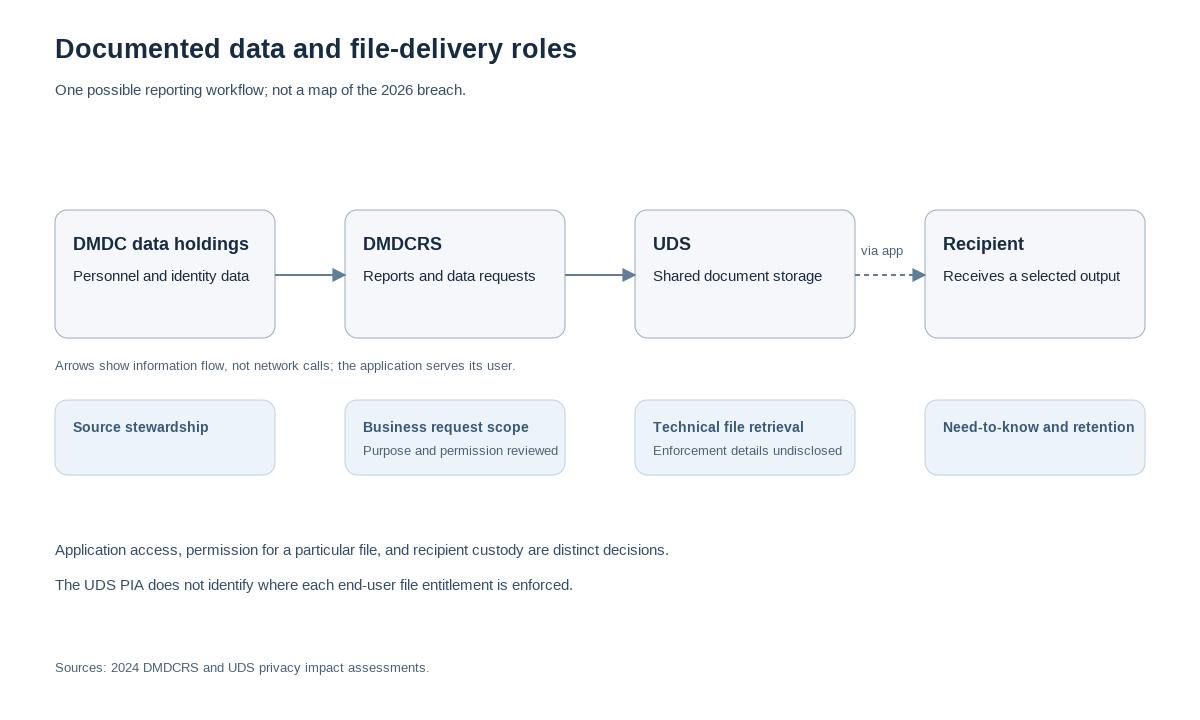
Reporting and distribution functions operate alongside these repositories. DMDCRS supports requests for reports and custom extracts. The Upload Download System (UDS) provides shared file-storage and retrieval facilities for business applications. DDS provides system-to-system access for approved consuming applications. Other arrangements, such as computer-matching agreements with federal agencies, specify the information exchanged and the obligations of the participants.
These functions are documented, but the public materials do not constitute a complete deployment diagram of the systems operating in July 2026.
| Component | Documented function |
|---|---|
| DMDC 01 / USHRIS | Central personnel and historical records subject to the relevant SORN |
| PDR and related repositories | Personnel, benefits, identity, and related data holdings |
| DEERS | Enrollment, affiliation, and eligibility information used by military services and benefits systems |
| DMDCRS | Reporting, individual data requests, and access to completed reports |
| UDS | Shared document storage and retrieval for DMDC applications |
| DDS | Approved system-to-system data access |
| Interagency matching and transfer arrangements | Exchanges governed by individual agreements and receiving-agency responsibilities |
The significant architectural issue is that a record can pass through more than one of these functions. Information originally maintained for personnel administration can become part of an analysis, report, eligibility response, or transferred file, with each operation subject to different business decisions.
4.2 From Approved Request to Downloadable File
The 2024 Privacy Impact Assessments for DMDCRS and UDS describe an important relationship between a business application and shared file-storage infrastructure.
DMDCRS allows authorized users to request or retrieve reporting information. Its users include military and civilian government employees, contractors, and other approved organizations. The business purpose and permissible scope of a request are relevant because access to the reporting application does not itself establish entitlement to every possible output.
UDS, meanwhile, is a shared service through which DMDC personnel or applications can store and retrieve documents. The assessment describes uploads through a user interface and through REST services. A consuming application can display a download link to its own users while retrieving the file through a UDS REST service. DMDCRS is explicitly identified as an application using UDS to store documents that may contain personal information.
The UDS assessment defines this division of responsibility explicitly: UDS stores and retrieves files but does not itself use the personal information in them; the applications consuming UDS use that information for their own purposes. The business reason to disclose a report therefore belongs to an application such as DMDCRS, while the bytes are retrieved through a separate service. Permission for an application to request files from UDS is a different question from a human user’s entitlement to a particular file. How the two are linked and checked is not disclosed in the PIA. The documents do not establish that file-level authorization is absent, bypassable, or enforced exclusively in one component.
They do show why a common document service can create an access boundary distinct from the authoritative personnel database. The file is no longer merely an entry in a central record; it is a document prepared for use by another application or recipient.
Sources: DMDCRS PIA, 2024; UDS PIA, 2024.
4.3 Automated Distribution and Interagency File Exchange
DDS addresses a different distribution requirement. Its April 2024 Privacy Impact Assessment describes an arrangement in which consuming applications obtain access to approved data through system-to-system services. Access requires prior review of the application and supporting documentation, while requests are recorded in audit tables.
This differs from a person submitting an individual report request through DMDCRS. The authorization concerns the consuming application and the data it is entitled to obtain, rather than only a particular human request for a report.
Interagency matching involves still another set of relationships. The SSA–DMDC agreement specifies the agencies’ legal purposes, data elements, file formats, transfer methods, verification responsibilities, and retention requirements. It is an example of how a recurring administrative obligation is translated into a technical data-processing and delivery procedure.
The SSA agreement described in Section 3.5 makes the resulting response file an operational object with an agreed recipient and a defined disposal requirement.
The recipient does not need general authority to administer the central DMDC repository in order to obtain the authorized result. The exchange is designed to make the required information available while keeping the organizations’ broader responsibilities separate.
This distinction helps explain how personal information can acquire a different custody and access context after a legitimate transfer. The source data remains governed by its original record system, while the receiving organization becomes responsible for processing and retaining the information it has lawfully obtained.
4.4 Where Authorization, Custody, and Retention Diverge
The documented architecture therefore involves several decisions that should not be collapsed into a single concept of system access.
First, the originating organization creates a personnel record under its own administrative rules. DMDC receives and maintains information for its authorized purposes. A requesting organization may then establish a legitimate need for selected information, while an analyst or automated process prepares the appropriate result.
The distribution application must make the output available to the authorized recipient. The receiving organization must subsequently use, protect, and retain the information according to the requirements governing that particular disclosure.
These operations may involve different responsible parties even though they concern information about the same person.
| Decision or responsibility | Documented governing context |
|---|---|
| Creation of the personnel record | Military service or contributing organization’s administrative system |
| Maintenance of central personnel information | DMDC data holdings and applicable records requirements |
| Approval of a data request or exchange | Request workflow, agency authority, or interagency agreement |
| Storage and technical retrieval of an output | Relevant reporting, file-storage, or transfer service |
| Subsequent use and retention | Receiving organization and applicable legal or records-management obligations |
The distinction also prevents an overly simple interpretation of the 2026 exposure. Even if the compromised files originated from a highly controlled personnel repository, that would not establish which authorization system was responsible for protecting the particular copies when they were accessed.
Conversely, the existence of separate delivery services does not imply that their authorization controls were deficient. The actual enforcement location and effective permissions must be established from the implementation or incident evidence.
What can be reconstructed from the published documents is the set of administrative and technical relationships through which personnel information becomes available outside its original recordkeeping environment.
5. How the Historical Failures Relate to the 2026 Breach
5.1 The 2020 Disclosure: An Earlier Failure at the Delivery Boundary
The most direct historical example of a DMDC data-distribution failure was reported in September 2020.
According to the federal government’s FY2020 FISMA Annual Report to Congress, a DMDC analyst prepared data for a Navy civilian employee and uploaded an incorrect dataset through DMDCRS. A secondary review did not detect the mistake. The dataset contained personal information relating to approximately 300,000 individuals, including names, Social Security numbers, dates of birth, addresses, and personnel details.
The recipient was authorized to use DMDCRS, and the transfer was conducted securely within the DoD environment. Nevertheless, the employee did not have a legitimate need to know the information contained in the file. The employee reported the mistake and deleted the downloaded material.
This incident shows the distinction between authorization to use an application and authorization to receive a particular dataset. The delivery workflow correctly recognized an approved user and transferred information through an approved channel, but the content selected for disclosure did not correspond to the recipient’s permitted purpose.
The government subsequently reported additional Privacy Act training for the Data Delivery team and work on proposed safeguards.
The 2020 event does not establish a flaw in the same software used in 2026, nor does it show that the later attackers exploited the same operational weakness. The events represent different failures. In 2020, an approved recipient received data outside the legitimate scope of a request. In 2026, unauthorized users accessed files through a vulnerable file-sharing system.
Both incidents call for examining access where personnel files were held or delivered, although the origin and purpose of the files accessed in 2026 remain unknown.
Source: OMB, FY2020 FISMA Annual Report to Congress, pp. 23–24.
5.2 Possible File-Sharing Boundaries
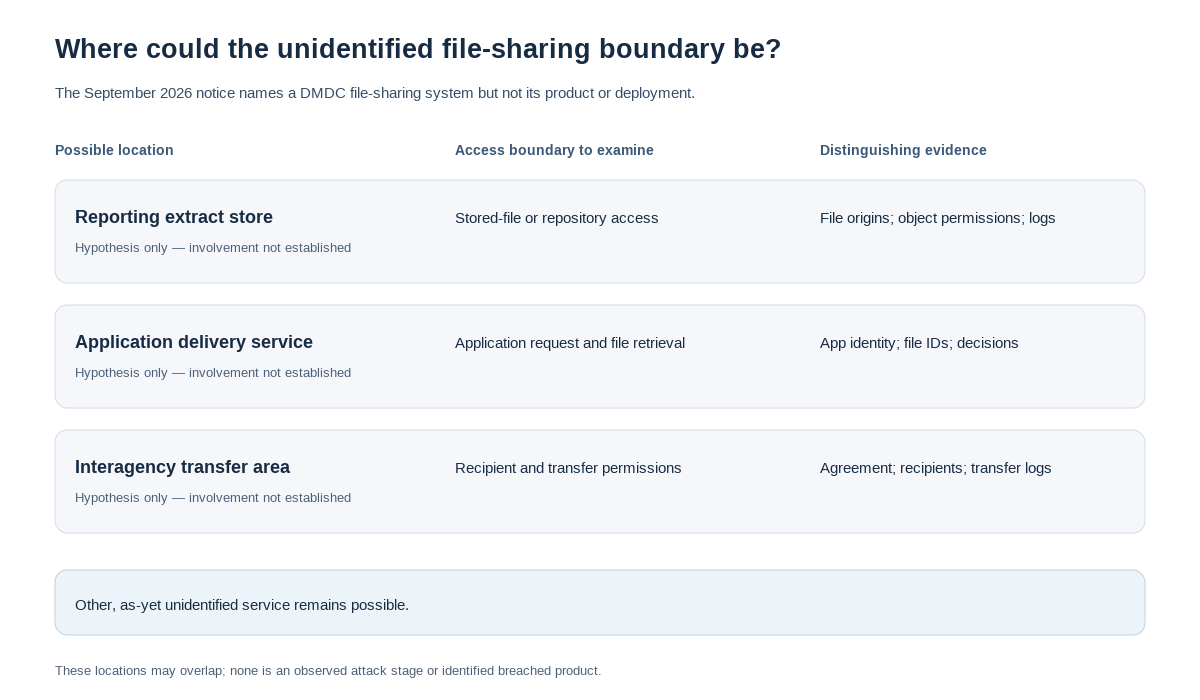
The publicly disclosed 2026 incident is compatible with several different architectural configurations, each requiring a different explanation of the unauthorized access.
The affected component could have been a repository holding files generated for personnel reporting or analysis. In that case, an attacker might have reached stored extracts without gaining administrative control over the databases used to generate them. The relevant evidence would concern the files’ origins, storage permissions, the identities able to access the repository, and the service or server through which retrieval occurred.
A second possibility is an application-mediated delivery service similar in role to the documented UDS architecture. Here, the important distinction would be between the application’s authority to retrieve files and the user’s entitlement to obtain a particular document. The relevant evidence would identify the application, service identity, file identifiers, effective authorization decisions, and retrieval records. UDS provides a documented architectural example, but there is no public evidence identifying it as the breached product.
A third possibility is an environment used for interagency or contractor-facing file exchange. DMDC has documented arrangements for transferring information under defined legal and operational conditions. A file prepared for another organization may exist in a transfer area with its own recipients and access controls. Establishing this explanation would require information about the affected exchange, recipient identities, transfer configuration, and files scheduled for delivery.
These configurations can overlap: a reporting extract could be held by a delivery service and then placed in an exchange area. The file’s purpose alone would not identify the component that mediated unauthorized access. None of these paths has been observed as a stage of the 2026 attack.
| Possible file location | Authority or control relevant to access | Evidence needed |
|---|---|---|
| Reporting or analytical extract repository | Access to stored exports, files, or repository objects | File origins, storage permissions, access logs, account roles |
| Shared application file-delivery service | Service retrieval authority and authorization for individual files | Application logs, service credentials, file identifiers, authorization decisions |
| Interagency or contractor transfer environment | Transfer-system access and authorized recipient scope | Exchange agreement, recipient configuration, transfer and retrieval logs |
A further possibility—that the affected server performed a function not represented by any of the currently identified components—must also remain open. The published record is not an exhaustive inventory of DMDC’s file-sharing infrastructure.
The important consequence of these possible configurations is that the original data’s location does not identify the service that made a particular file accessible or the control that failed there.
5.3 What the History Explains—and What It Does Not
The historical investigation establishes how DMDC acquired distinct responsibilities for storing, reconciling, and delivering personnel information. It does not establish that a particular reform caused the vulnerability discovered on July 16, 2026. DIMHRS concerned the integration of personnel and pay operations; the 2012 audit concerned reconciliation and supporting evidence; the 2020 disclosure concerned the wrong dataset in an authorized delivery. None identifies the defect in the unidentified 2026 file-sharing system. Nor does the July 20 DMDCRS migration notice describe an incident response or identify the breached product.
The history instead identifies what an incident investigation would need to determine: which process created or received the affected files, why they were retained, which service made them retrievable, and how a user’s or application’s authority was matched to each file. The answers could place the failure in a reporting repository, a shared delivery service, an exchange environment, or a component absent from the published architecture.
The legal and operational history also matters to determining responsibility. A permanent master file, a temporary DMDC report, a file prepared for an agency exchange, and a receiving agency’s recordkeeping copy may contain related personal information without having the same custodian or disposal conditions.
5.4 The Meaning of the Fifty-Year History
The objects of integration changed over time. DMDC first brought information from separately administered military services together. DIMHRS then attempted to unify personnel and payroll operations. After its cancellation, reconciliation and records-management procedures addressed the continuing need to make separate personnel and financial records agree. Matching agreements gave other institutions an authorized use for DMDC information, while repositories, reporting services, and delivery interfaces supported those uses. Later cloud and API projects changed parts of the technical environment without erasing the earlier work.
This was a sequence of administrative responses, not simply an accumulation of failed systems. Some reforms succeeded in centralizing data or correcting a specific deficiency; some connections ended when their purpose ended. Others continued because an audit, a benefit decision, or a pending request still depended on them. Each continuing arrangement could create another file to preserve, custodian to identify, or access decision to enforce. The significance for security is that responsibility follows those outputs across systems: protecting the original record does not settle who may retrieve a report, how long an exchange copy remains, or how completed work is served after a new request system begins operating.
6. Conclusion
The September 2026 incident exposed personal information concerning more than three million individuals through a vulnerability in a DMDC file-sharing system. The affected product, access mechanism, and source of the files remain unidentified. Establishing the cause requires evidence of what those files represented, why they were present, and which control failed.
The history offers a different finding. Centralization made personnel information available for authorized uses; later audits, exchanges, and reporting systems required supporting records and outputs to be retained and delivered. The 2020 wrong-dataset disclosure showed that an approved delivery could still expose information outside a recipient’s legitimate scope; in 2026, unauthorized users reached files through an unidentified system. These are different failures, and the provenance of the 2026 files remains unknown. Both direct attention to file-level access decisions. Reforms that make storage and delivery necessary create access and retention responsibilities that must survive the next technical modernization.
References
Incident and reporting
- Military Times — Military Personnel Data Exposed in Breach, September 24, 2026
- Federal News Network — More Than 3 Million People Affected by Military Data Breach, September 28, 2026
- TechCrunch — Hackers Stole Millions of US Military Personnel Records, September 30, 2026
Historical, legal, and audit records
- National Academies — Strengthening Data Science Methods for DoD Personnel and Readiness Missions, Chapter 3, 2017
- GAO-05-189 — Management of Integrated Military Human Capital Program Needs Additional Improvements, 2005
- GAO-08-927R — Maintaining Effective Communication for DIMHRS, 2008
- GAO-12-406 — The Army Faces Significant Challenges in Achieving Audit Readiness for Its Military Pay, 2012
- OMB — FY2020 FISMA Annual Report to Congress, pp. 23–24
- SSA–DMDC — Computer Matching Agreement, DoD Match #88 / SSA Match #1004, 2024
- Federal Register — Uniformed Services Human Resources Information System, DMDC 01, March 2026
Architecture and implementation
- DHRA — FY2023 Budget Estimates, Enterprise Data Services
- DHRA — FY2026 Operation and Maintenance Budget Justification
- DMDC — DMDCRS Privacy Impact Assessment, 2024
- DMDC — Upload Download System Privacy Impact Assessment, 2024
- DMDC — Data Delivery Services Privacy Impact Assessment, 2024
- DISA — Fit-for-Purpose Cloud Procurement Justification JA24-032, 2024
- DMDC — DMDCRS Migration Notice, July 20, 2026
- GAO/NSIAD-00-12 — DOD Personnel, p. 30, 1999