Analysis based on publicly available information as of October 12, 2026.
Abstract
On October 9, 2026, Adventure Inc. disclosed three separate unauthorized-access incidents affecting its skyticket reservation platform. Approximately 14.64 million customer-information records were involved in the largest incident; a second concerned refund bank-account information in a business management system; and a third involved automated viewing of bus booking pages, affecting approximately 12,000 reservations.
The reported routes point to different boundaries. Manipulation of an administrative function preceded access to data on other servers and in cloud environments. A vulnerability affected the business management system. A bus booking-completion page could be viewed without login. Together, these incidents raise two questions: how far could an internal function reach, and did every path to a customer’s booking enforce the right to view it?
Skyticket expanded by acquiring travel capabilities, connecting external reservation systems, and modernizing parts of an operating platform. Those records explain why cross-product work existed, but do not identify the authority used in the largest intrusion. The bus incident permits a closer comparison of two routes to reservation information. The public record does not establish a shared attacker, a single intrusion chain, or that integration caused any of the breaches.
1. Incident Overview
Adventure disclosed the three incidents on October 9, describing them as unauthorized access through different routes. The company reported confirmed exposure or potential exposure depending on the incident and the information involved. [1]
| Incident | Reported activity | Discovery | Reported scope |
|---|---|---|---|
| A — Unauthorized access originating from an administrative function | October 2–4 | October 5 | Approximately 14.64 million records |
| B — Exploitation of a business management system vulnerability | September 20 | September 28 | 17,780 records, including duplicates, with additional scope under investigation |
| C — Automated viewing of bus booking-completion pages | August 3–October 1 | October 1 | Approximately 12,000 reservations |
Incident A affected customer information including names, dates of birth, email addresses, telephone numbers, postal addresses, bank-transfer payer names, and hashed account passwords. Approximately 4.13 million records contained password hashes.
Adventure explained that part of skyticket’s administrative functionality had been manipulated without authorization, after which data stored on other company servers and in cloud environments was accessed.
This wording identifies an initial administrative function and other data locations, but does not identify the method used to reach them. The company has not disclosed whether an existing application capability was abused, whether credentials were compromised, or whether attackers gained control of additional execution environments.
Incident B concerned unauthorized access to a business management system through an unspecified vulnerability. Affected or potentially affected information included names, telephone numbers, and refund bank-account details: financial institution, branch, account type, account number, and account-holder name. The company identified 17,780 records, including duplicates, while stating that another portion of the scope remained under investigation. Smaller subsets also included email addresses, dates of birth, or postal addresses.
Incident C involved automated third-party viewing of bus booking-completion pages. The information included booking-holder and accompanying-passenger details, payment method and amount, booking date and time, journey information, boarding and arrival locations, bus operators, and operator-issued reservation numbers.
The 12,000 figure refers to reservations rather than individual passengers. One reservation may cover several people, so the affected population cannot be calculated simply by adding the three reported figures.
Adventure stated that it did not store customers’ complete payment-card numbers or passport images. It confirmed that passport numbers were not exposed in Incident A; for Incident B, it said that it had not confirmed passport-number exposure but was continuing to investigate that question.
The company also warned of possible secondary abuse. Exposed personal information could support targeted impersonation and phishing. Password hashes could be attacked offline, depending on the password-storage scheme and the strength of the underlying passwords. Bus itineraries and operator references could make fraudulent contacts more convincing. The public disclosure did not establish that attackers had used the exposed information to change or cancel reservations.
On October 7, Adventure suspended payments using previously saved cards and the option to save card details. This was a precaution against compromised skyticket accounts being used to purchase services with already registered payment methods, not confirmation that card numbers themselves had been stolen.
The company said it had blocked the unauthorized access routes, taken measures against the vulnerabilities, and reported the incidents to Japan’s Personal Information Protection Commission.
Three different kinds of functionality had therefore become paths to customer information: an administrative function, a business management system, and a consumer-facing booking page.
The attack timeline establishes when these routes were used and discovered. The later sections examine why the affected functions existed and what they needed to access.
2. Attack Timeline
The incidents occurred during overlapping periods, but their discovery order differed from their reported activity dates. Automated viewing of bus reservations began earliest. The business management system incident was discovered first. The largest intrusion was reported as occurring after the other two had already been detected.
| Date | Reported event |
|---|---|
| August 3 | Start of the identified period of automated viewing of bus booking-completion pages |
| September 9 | Unauthorized login to one member account confirmed |
| September 20 | Unauthorized access to the business management system |
| September 28 | Business management system incident discovered |
| October 1 | Bus booking exposure discovered; affected page corrected the same day |
| October 2–4 | Unauthorized manipulation of an administrative function and access to data on other servers and in cloud environments |
| October 5 | Large-scale incident discovered |
| October 7 | Payments using saved cards and the card-saving function suspended |
| October 8 | Customer notification emails began |
| October 9 | Adventure publicly disclosed all three incidents |
| October 10 | Recovery from an email-server disruption attributed to increased inquiries announced |
Sources: Adventure’s October 9 incident notice and skyticket’s subsequent customer communications. [1][2][3]
The bus incident is significant for its duration. The company identified automated viewing over a period of approximately two months, from August 3 through October 1. It reported correcting the page on the day of discovery, but has not disclosed how the activity was detected, whether it was continuous, or how the third party selected the reservations being viewed.
The business management system incident occurred on September 20 and was discovered eight days later. Adventure identified exploitation of a vulnerability as the cause, but did not name the affected component, describe the request or operation used, or explain how the unauthorized access was detected.
The largest incident followed on October 2–4. An administrative function was manipulated, and the subsequent access reached data beyond the initially described function. Adventure discovered the activity on October 5.
This sequence naturally raises questions about a relationship among the incidents. Incident A occurred after Incident B had been discovered and after the affected bus page had been corrected.
But timing alone cannot establish a relationship. The public record does not connect the three incidents through a common account, host, network, vulnerability, or attacker identity.
Adventure separately confirmed an unauthorized login to one member account on September 9. It did not identify that login as the entry point for the later administrative-function compromise, and it should not be treated as such without further evidence.
After the discoveries, Adventure reported containing the access routes and investigating the affected data. Customer notification emails began on October 8, and the consolidated disclosure followed on October 9.
On October 10, skyticket announced that an email-server disruption caused by increased customer inquiries had been resolved. It also warned customers about fraudulent messages exploiting the incident and delays in legitimate communications. The available notice attributes the disruption to inquiry volume, not to a further cyberattack. [3]
The timeline establishes the sequence of reported unauthorized activity, discovery, and response. It does not establish how the attackers crossed the relevant technical boundaries.
The business functions behind each affected system can be reconstructed, while the missing technical links must remain visible.
3. How the Platform Acquired Its Responsibilities
The business history matters here only insofar as it explains why skyticket had to coordinate different travel operations. It does not identify a route used in any of the three incidents.
3.1 Products, Contracts, and Operating Work
Adventure expanded skyticket beyond airline tickets through travel-business acquisitions and product connections. Its 2023 presentation about acquiring Tabikobo described targets that could add products to skyticket, fill gaps in its offering, or bring hard-to-obtain travel contracts. It proposed using Adventure’s systems and marketing expertise to improve the acquired business’s operations. [4]
Those plans explain a business need to coordinate sales, reservations, ticket issuance, changes, and customer support. They do not show that an acquired company’s database was merged into skyticket, that its staff used the same administrative interface, or that its records were among those reached in Incident A. The useful historical claim is about the growth of operational responsibilities, not the origin of a compromised dataset.
3.2 External Confirmation and Separate Refund Work
A documented 2020 hotel connection illustrates one division of responsibility. Skyticket displayed accommodation offers and submitted booking requests, while TEMAIRAZU supplied rates and availability checks before a reservation was confirmed. [5] That interface shows how one consumer-facing transaction could depend on another organization’s system. It has no documented connection to the 2026 breaches.
Airline cancellations create a more direct reason for continued internal work. A customer who cancels with an airline must separately request cancellation through skyticket before skyticket’s refund process proceeds; some carrier-side itinerary changes are not automatically reflected in skyticket’s booking view. [14][15] Card refunds can involve reversing a payment and applying a new charge; in some circumstances skyticket instead arranges a bank transfer. Customers paying by bank transfer or at a convenience store register a refund account, whose holder may differ from the booking holder. [16][17] These procedures explain why reservation, payment, cancellation, and bank-account records must be related during support and refund operations. They do not identify the vulnerable business management system in Incident B.
3.3 Incremental Technical Change
Adventure’s engineering accounts describe change to systems that were already operating. A 2020 developer wrote about adding tests to older PHP projects. [6] In 2022, an engineer described extracting selected hotel functions into a Laravel microservice because replacing the hotel reservation application all at once was impractical. The published structure named HTTP controllers, booking use cases, domain models, and external API adapters. [7]
That account demonstrates a deliberate boundary around some hotel booking operations. It does not tell us where a customer’s or employee’s permission was checked, whether the service was still deployed in the same form in October 2026, or whether it connected to the administrative function later manipulated. A hotel frontend vacancy described a customer interface and an administrative interface called HM Admin, but did not link either to that incident. [9]
Adventure’s 2024 integrated report separately identified insufficient systems infrastructure for individual API integrations accompanying overseas expansion as a business risk. [8] This was the company’s assessment of development demands, not a finding that authorization had failed. The historical record therefore explains why distinct interfaces and operational roles existed; it cannot establish which of them attackers used.
4. Architecture: The Paths Relevant to the Incidents
A current production map of skyticket’s internal APIs, databases, identities, and service permissions is not public. The available sources do establish several business and interface paths. The table separates those documented paths from the connection that is missing in the incident analysis.
| Path or component | What the sources establish | What they do not establish |
|---|---|---|
| skyticket accommodation sales → TEMAIRAZU | Rate and availability checks were made through a partner connection in 2020. [5] | That this connection reached any data or function affected in 2026. |
| Airline cancellation → skyticket request → refund processing | Carrier action did not automatically start skyticket’s refund workflow; some refunds required a registered bank account. [14][16][17] | The implementation or permissions of the system exploited in Incident B. |
| Bus booking → completion display; later booking lookup | A reference could be issued before payment; the public lookup asks for a BS reference and registered contact information. [11][12] | The authorization rule used by the affected completion page during August–October 2026. |
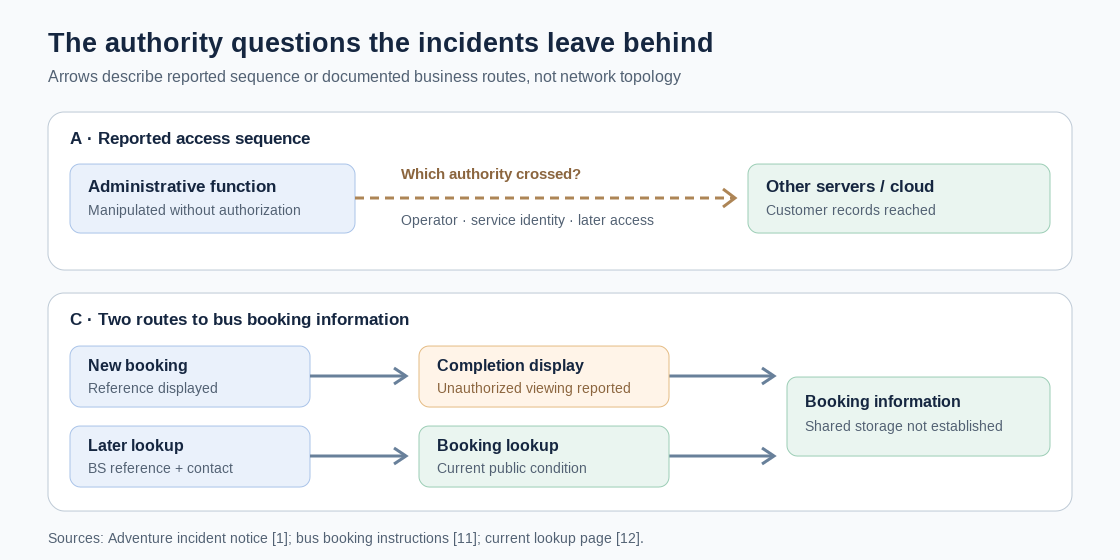
| Manipulated administrative function → data on other servers and in cloud environments | Adventure reported this sequence for Incident A. [1] | Whether the function itself had that reach, its application identity was abused, or further infrastructure access was obtained. |
These paths do not form one documented network diagram. In particular, no source connects the hotel microservice, TEMAIRAZU, or an acquired company’s system to the manipulated administrative function. A reconstruction that drew such an arrow would turn background into an alleged attack path.
4.1 Cross-Product Operations and the Administrative Gap
Adventure’s customer-support and technical-support recruitment materials described work across flights, hotels, rental cars, and buses: reservation management, ticket issuance, cancellations, refunds, exceptional cases, and investigation of reservation-management errors. They also named travel distribution and payment-related tools, including Amadeus and INFINI. [18] These are advertised responsibilities and tools, not an observation of the access held by a particular employee or application in October 2026.
The business workflow nevertheless explains why someone supporting a customer might need to correlate a skyticket booking with supplier status, payment information, and a refund request. An operator could do that in several separate applications. A shared management application could instead call backend services on the operator’s behalf. Public sources do not say which arrangement the compromised function used.
Three kinds of authority would matter in either arrangement. Operator authority governs which action an employee may request. Application or service authority governs what the management software can retrieve or execute through its own credentials. Infrastructure authority governs hosts, deployments, cloud resources, and data stores. The disclosure identifies an administrative starting point and later access to other data locations, but does not identify which of these authorities crossed the boundary.
4.2 Refund Records and the Business Management Gap
Skyticket’s public procedures distinguish a booking holder, payer, passenger, and refund recipient. A cancelled flight, a skyticket cancellation request, fee calculation, and a bank transfer can occur as separate steps. [14][16][17] That is a concrete reason for refund-account data to exist in a management workflow after the original booking.
It is not a map of the affected business management system. The disclosed vulnerability might have concerned an individual record view, a search or reporting function, or the application’s broader backend access. The public record does not identify the component, its input, its execution identity, or the authorization rule it was meant to enforce.
4.3 Two Ways to Display a Bus Booking
The bus service provides a closer comparison with an observed failure. Skyticket’s booking instructions describe both immediate payment and a pay-later option. In the latter, a booking number and confirmation email can be issued before payment; nonpayment by the deadline cancels the booking automatically. [11] The completion display therefore has to communicate a booking reference even when settlement is still pending.
The currently published later-lookup page serves members and guests. It asks for a BS-prefixed booking reference plus the registered telephone number or email address. [12] A guest can therefore retrieve a reservation without member login, provided the lookup condition is met. This published page does not prove what the lookup required throughout the 2026 incident period.
The compromised completion page was a separate display route. Adventure reported that it could be viewed without login and that a third party viewed booking information through automated access. [1] The relevant object was not only a skyticket account: it included reservation details, fellow passengers, and an operator-issued reference. Viewing that information is a distinct authority from changing a booking or accessing a bus operator’s system. Skyticket’s change procedures impose different steps for contact changes and itinerary changes. [13]
The documented architecture yields a specific question: how did a request to the completion display become associated with the customer who had just made that booking? The later lookup’s reference-and-contact check cannot answer it. Nor does the absence of member login prove the defect, because guest booking is an intended feature. The original completion-page condition, request logs, and repair diff are needed to identify the implementation failure. A 2023 bus engineering vacancy describes a product team but does not identify the affected page or its deployed code. [10]
5. What the Three Incidents Establish
The reconstruction does not identify a common exploit. Its value is narrower and more testable: it distinguishes the authority each reported route would have needed, what the business sources can explain, and which missing records would change the conclusion.
5.1 Incident A: Which Authority Reached 14.64 Million Records?
Adventure reported that an administrative function was manipulated and that data on other servers and in cloud environments was then accessed. Approximately 14.64 million customer-information records were involved, including about 4.13 million with hashed account passwords. [1] The notice does not name the initial vulnerability, the function’s ordinary purpose, or the identity used in the later data access.
The support and refund workflows explain why cross-product information retrieval could be useful. They do not show that the compromised function served those workflows. They also do not show that a single operator or application was meant to reach 14.64 million records. The engineering account of the hotel microservice and the acquisition history provide no bridge to the affected data locations.
The reported sequence permits three materially different explanations:
| Scenario | Conditional path from the administrative starting point | Evidence that would distinguish it |
|---|---|---|
| A1 — Existing management reach | An unauthorized request invokes a normal administrative operation; that operation retrieves data beyond the requester’s legitimate scope. | Function specification, operator permissions, request and export logs, backend query scope. |
| A2 — Application or service authority | Manipulation exposes or abuses the management application’s execution identity or credentials; those privileges reach another service or data store. | Service-identity assignments, credential use, internal API and database audit trails. |
| A3 — Further infrastructure compromise | The initial foothold leads to another host or cloud administrative environment; that later access reaches the records. | Host activity, administrative sessions, cloud control-plane and storage logs. |
The scenarios can overlap, but they answer different questions. Under A1, the critical boundary is between the operator’s request and a management operation capable of broad retrieval. Under A2, it is between the application’s intended operation and the independent authority carried by its service identity. Under A3, the decisive reach is obtained after a further compromise. Describing the outcome as access to data “in the cloud” cannot choose among them; the location of a record is not proof of cloud-administrator control.
The mix of booking-related fields and hashed passwords also does not prove a merged database. The records could have come from one store, several stores, replicated data, or an export assembled from separate systems. Without the data-retrieval and query trail, record variety cannot locate the boundary that failed.
This is what the public reconstruction newly clarifies: the existence of acquisitions, APIs, or a hotel microservice does not by itself explain the scale of Incident A. That scale must be explained by the effective authority exercised after the administrative function was manipulated. The published sources establish why broad coordination might be operationally useful, then stop short of showing whether that function had broad access. The distinction between A1, A2, and A3 is the concrete unresolved result, not a claim that one has been proved.
5.2 Incident C: A Confirmed Viewing Failure on One Route
Incident C is more specific about the failed outcome. Adventure said a third party automatically viewed bus booking-completion pages that could be displayed without login. Approximately 12,000 reservations were affected; the notice describes their information as viewed or potentially viewed. [1] The absence of login alone is compatible with guest booking. The unauthorized viewing is the demonstrated failure.
Two routes to booking information can be described without assuming they shared code or storage. The completion page displayed the result of a new booking and its reference. The publicly documented later lookup asks for that reference plus registered contact information. [11][12] The two routes serve different moments in a customer’s journey, but both can expose information about a reservation. The later lookup’s stated condition does not protect the completion page if the latter uses a different rule.
That comparison narrows the security question. A customer who has just booked must be able to see the result. A URL can intentionally grant guest viewing when it carries a sufficiently protected access token; the reported third-party viewing means that whatever condition governed the affected page did not prevent this access. The condition could have involved a session, a token, a reference bound to additional information, or another mechanism. No public source identifies which mechanism the affected page used. The current lookup form is also not evidence that an identical condition existed on it during the incident period.
The disclosure establishes unauthorized viewing. The exposed itinerary, passenger, payment, and operator-reference details make that consequential, but they do not demonstrate that the third party could alter or cancel the booking. [1][13] The repair diff and incident-time request records would show whether the page lacked a booking-to-requester check, whether an access link could be guessed or obtained by others, or whether another condition failed. The article can identify the route-specific boundary that failed without inventing the implementation.
5.3 Incident B: A Workflow Explanation, Not a Vulnerability Diagnosis
Adventure attributed unauthorized access to a vulnerability in a business management system and identified 17,780 records, including duplicates, with further scope under investigation. The data included refund bank-account details that were exposed or potentially exposed. [1]
The cancellation and refund procedures explain why those details were held in the business: a carrier’s action need not initiate skyticket’s refund; some refunds require the customer to register a bank account; the recipient need not be the booking holder. [14][16][17] They do not show whether Incident B involved a record-level authorization error, a reporting operation, or a broader application compromise. The record count cannot distinguish repeated individual retrieval from a bulk operation.
The affected function, request pattern, identity, and output logs would be needed to test those alternatives. Until then, Incident B should remain a separate vulnerability with a well-explained data context, not evidence for a common integration failure.
5.4 The Finding Across the Three Cases
The company described three different access routes. [1] The sources do not establish shared attackers, a common vulnerable component, or an integration change that caused all three. Treating them as one technical failure would exceed the evidence.
The cases can still be compared at the level of authority. Incident A asks which authority made data outside the initial administrative function reachable. Incident C demonstrates unauthorized viewing through a particular customer-facing route, while a different documented route asks for a reference and contact detail. Incident B shows why sensitive refund data had a business role but leaves its exploit mechanism unknown.
That comparison is the article’s contribution. It makes business coordination and consistent technical authorization separate questions in this specific platform. It does not prove that the answer to the second question was the same in all three incidents. Logs and implementation details from each affected function would be needed before the comparison could become a shared-cause finding.
6. Conclusion
Skyticket became one place to arrange many kinds of travel by connecting products, suppliers, and operational work. The sources document some of those connections: external confirmation of hotel inventory, separate airline cancellation and skyticket refund steps, and bus booking displays at different points in a transaction. They also show incremental technical change. None identifies the administrative function compromised in October 2026 or connects the hotel service or acquired systems to it.
The largest incident therefore turns on a precise unanswered question: did the manipulated function already have broad retrieval authority, did its application identity supply that authority, or did attackers gain further infrastructure access? The business history explains why cross-product work existed; it cannot select among those paths. For the bus incident, the evidence goes further. Unauthorized viewing occurred through the completion page, and the published later lookup shows a separate route with an explicit reference-and-contact condition. The affected completion page’s actual authorization rule remains undisclosed. The refund incident has a clear business reason for holding bank-account information, but its vulnerability is unspecified.
A travel platform can bring these operations together without producing one uniform authority to view and act on every record. The three incidents do not prove a single failure of integration. They show, with different degrees of specificity, why making a business operate as one platform and making its permissions consistent across every route are separate tasks. In this case, the strongest new result is the sharper question about Incident A’s effective authority and the route-specific viewing failure demonstrated by Incident C.
References
Incident disclosures and response
[1] Adventure Inc., Notice and Apology Regarding Customer Information Leakage Due to Unauthorized Access, October 9, 2026. Primary disclosure of the three incidents, affected data categories, reported dates, and response measures.
[2] skyticket, Notice Regarding Customer Information Leakage Emails, October 9, 2026. Confirmation of customer emails sent beginning October 8.
[3] skyticket, Notice of Recovery from Email-Server Disruption, October 10, 2026.
Corporate strategy and systems integration
[4] Adventure Inc., Explanatory Materials Regarding the Acquisition of Tabikobo, August 10, 2023. Acquisition criteria, travel-product expansion, and operational synergies.
[5] Temairazu Inc., Announcement of System Integration with skyticket, January 15, 2020. Unified-inventory integration, rate and availability verification, and reservation confirmation.
[8] Adventure Inc., Integrated Report 2024, September 2024, p. 33. Risk disclosures concerning personal information and infrastructure for individual API integrations.
Technical implementation and operational responsibilities
[6] Adventure developer, Building a Testing Culture in Legacy Code, December 2020. Legacy PHP systems and automated testing.
[7] Adventure developer Tomoyuki Sato, Building a Microservice with PHP/Laravel and Clean Architecture, November 30, 2022. Hotel service extraction, domain models, use cases, external API adapters, and implementation constraints.
[9] Adventure Inc., Frontend Engineer — Hotel, recruitment description. Next.js/React customer interfaces, Vue.js HM Admin, backend coordination, and deployment technologies.
[10] Adventure Inc., Web Engineer Recruitment — Bus and Rental Car Services, 2023. Product engineering context and development technologies.
[18] Adventure Inc., Customer Success and Technical Support Supervisor, recruitment description. Cross-product reservation management, airline ticketing, cancellations, refunds, external tools, and operational support.
Booking, cancellation, and refund procedures
[11] skyticket, Highway Bus — Booking Procedure. Immediate payment, pay-later reservations, booking references, and automatic cancellation.
[12] skyticket, Highway Bus Booking Confirmation. Booking reference and contact-information requirements.
[13] skyticket, Highway Bus — Booking Changes. Separate procedures for contact changes, itinerary changes, and rebooking.
[14] skyticket, Domestic Flights — Cancellation After Contacting an Airline. Requirement for a separate skyticket cancellation request.
[15] skyticket, Domestic Flights — Changes to Flights, Dates, and Passenger Information. Carrier-side changes and skyticket booking-record updates.
[16] skyticket, Credit-Card Refund Procedures. Refund and recharge processing, multiple cancellation stages, and bank-transfer exceptions.
[17] skyticket, Bank-Transfer Refund Procedures. Refund account registration, timing, and account-holder rules.