How one group entered a Ukrainian grain company, another conducted a data-wiping operation, and the path from access to administrative control remains unknown.
Incident Analysis · Sandworm · UAC-0099 · Ukraine · Active Directory · Cyber Sabotage
Analysis based on publicly available information as of October 24, 2026.
Abstract
On July 16, 2025, a Ukrainian grain logistics company was compromised through a spearphishing operation attributed to UAC-0099. The attackers installed the MATCHWOK backdoor and, the following day, introduced MythicRatatoskr, a previously undocumented remote-access tool communicating through the Yggdrasil mesh network.
On September 17, ESET observed a data-wiping operation at the company using SDelete, a legitimate Microsoft utility distributed through Active Directory Group Policy. The number of affected systems and the resulting operational disruption remain undisclosed. ESET attributed the destructive activity to Sandworm, the Russia-aligned group associated with Unit 74455 of the GRU, and assessed with high confidence that UAC-0099 had handed access to Sandworm during the intrusion. [1]
The handoff is the central feature of the case. UAC-0099 established access to the organization, while Sandworm later used a Group Policy-delivered path for the destructive operation. The public record does not establish which credentials, connections, or permissions passed between the groups, or whether the attackers changed a Group Policy object (GPO), content that an existing policy executed, or both. Entering one computer, controlling centrally managed execution, and destroying data on endpoints are different capabilities.
Comparative destructive operations demonstrate the separation. In October 2022, attackers modified Group Policy to deploy CADDYWIPER across a Ukrainian government organization’s domain, but incompatibilities and defensive controls sharply limited the damage. In November 2025, Sandworm used a different deployment script to distribute the ZOV wiper. A December 2025 attack in Poland went further: DynoWiper executed on more than 100 computers, but endpoint protection interrupted destructive overwriting; its attribution to Sandworm remains disputed. [5][6][7]
These incidents show how centralized administrative authority can initiate destructive execution across an organization, and why that authority does not guarantee the intended outcome. The grain company’s intrusion adds a question about cooperation between attackers: what did UAC-0099 provide that enabled Sandworm’s later operation? ESET documented the handoff, but the boundary between initial access and the authority to destroy remains unresolved.
1. The Grain Company Intrusion
The victim was an unnamed Ukrainian grain logistics company. Grain logistics depends on coordination among storage facilities, transportation networks, commercial transactions, and export infrastructure. During Russia’s war against Ukraine, the ability to move agricultural products to foreign markets has carried particular economic significance.
On October 22, 2026, ESET published a forensic investigation reconstructing the company’s compromise between July and September 2025. [1] It identified an initial intrusion by UAC-0099, an actor previously observed conducting cyberespionage against Ukrainian government organizations, financial institutions, and media, followed by destructive activity attributed to Sandworm. ESET assesses with medium confidence that UAC-0099 is aligned with Russian interests; Sandworm is commonly linked to Russia’s military intelligence service and has a long record of destructive operations against Ukrainian organizations.
ESET attributed the two phases to UAC-0099 and Sandworm respectively with high confidence. The victim’s name, the precise scope of the destruction, and the resulting business disruption have not been disclosed.
1.1 The first compromise
ESET attributes the entry to a spearphishing email with a malicious attachment, but its detailed telemetry begins at 06:59 on July 16, 2025, when a scheduled task named pdfopentask executed a PowerShell payload on a company computer. The report does not describe the intervening step from opening the attachment to task execution. Approximately one minute later, the MATCHBOIL downloader was deployed, leading to execution of MATCHWOK, a backdoor already associated with UAC-0099. On July 17 at 09:28, another program appeared: MythicRatatoskr, a Go-based backdoor that ESET had not previously documented.
ESET’s sample inventory lists ieupdate as a service name, and Windows event logs showed two MythicRatatoskr binaries starting as services; the report does not identify their execution accounts or establish domain privileges. Additional samples were subsequently deployed on other computers through an OpenSSH Secure File Transfer Protocol (SFTP) server, and investigators observed a separate SOCKS5 network proxy on compromised systems. [1] The attackers had established persistent access, reached additional machines, and deployed tools for collecting information and providing remote network access. Those capabilities would help an operator investigate the internal environment, but they did not by themselves establish control over policy settings or content delivered through them.
1.2 The final destructive operation
On September 17, approximately two months after the initial compromise, ESET detected data-wiping activity at the same company. The attackers deployed SDelete through Active Directory Group Policy. SDelete is a legitimate Microsoft Sysinternals utility designed for secure data deletion, while Group Policy allows Windows administrators to configure users and computers centrally. [9][10] Together, they provided a means to make managed computers perform destructive operations without installing a custom-built wiper on every endpoint.
ESET associated this phase with Sandworm because the deployment method matched techniques repeatedly observed in its previous operations. The investigation did not publicly establish how many computers were affected, whether business applications became unavailable, or whether grain transportation stopped. Such business interruption cannot be inferred simply from the victim’s industry. The known events establish an intrusion, a persistent internal presence, and a later destructive operation, while leaving the intervening transfer of control unresolved.
2. Attack Timeline
The observed sequence can be reconstructed as follows.
| Date | Observed activity | Operational significance |
|---|---|---|
| July 16, 2025 | Spearphishing, pdfopentask, MATCHBOIL and MATCHWOK | Initial execution and remote access |
| July 17 | MythicRatatoskr deployed | Additional persistent access |
| After July 17 (date undisclosed) | Additional MythicRatatoskr samples deployed to other machines via SFTP | Broader access within the network |
| August 2025 | Separate SOCKS5 proxy observed | Network reachability through compromised machines; operator undisclosed |
| Between July and September | ESET assesses that access was handed from UAC-0099 to Sandworm | Handoff mechanism and timing undisclosed |
| September 17 | SDelete deployed through Active Directory Group Policy | Administrative distribution of destructive execution |
| October 22, 2026 | ESET publishes the detailed investigation | Public reconstruction of both stages |
The two months between intrusion and destruction cannot be treated as continuous activity by an identified operator. The observed tools establish persistence and movement within the environment; the final use of Group Policy establishes a later ability to issue destructive instructions through centralized management. The public report does not connect these events through a complete sequence of authentication and authorization changes, and that gap affects how responsibility for the operation should be understood.
The order of the observed events establishes that the network was entered before it was used for the destructive operation. It does not establish when control of the policy-delivered execution path was obtained. The next sections examine the access tools, the handoff assessment, and the distinct controls that could account for the September operation.
3. The Handoff Between UAC-0099 and Sandworm
3.1 UAC-0099 before the handoff
UAC-0099 is a threat-activity cluster tracked by Ukraine’s CERT-UA. ESET dates its activity to at least 2022 and notes that CERT-UA first reported it in June 2023. Its earlier campaigns were directed at Ukrainian government organizations and media, while ESET also identifies financial institutions among its targets. ESET assesses the group’s alignment with Russian interests with medium confidence, based on its targeting. That assessment describes the apparent direction of its activity; it does not identify a command structure or place the group inside Sandworm. [1][3]
The group’s work extended beyond sending phishing messages. In a report covering late 2024, CERT-UA described attacks on government organizations, including forestry and forensic medical institutions, as well as factories. Phishing attachments containing nested archives and executable Windows shortcut (LNK) or HTML application (HTA) files led to LONEPAGE, which provided remote command execution. CERT-UA also documented a change in how that PowerShell capability was delivered: by December, an encrypted file and a .NET decryptor executed it in memory. The targets and packaging changed, while the operational purpose remained espionage and continued access. [12]
By August 2025, CERT-UA had documented another UAC-0099 chain against Ukrainian government, defense, and defense-industry organizations. Emails posing as court summonses led recipients to an archive containing an HTA file; the subsequent stages deployed MATCHBOIL, which identified the host and installed follow-on payloads, and MATCHWOK, which enabled remote PowerShell execution. The same campaign also used DRAGSTARE to collect browser credentials and files. [13] ESET later traced MATCHBOIL samples with compilation timestamps as early as April 2024 and observed the downloader during other intrusions in July and August 2025. Its continuing development suggests that the loader was a maintained part of UAC-0099’s access toolkit, not a tool unique to the grain-company intrusion. [3]
This record matters to the handoff because UAC-0099 had documented capabilities for persistent remote access and information collection before ESET identified its cooperation with Sandworm. It does not show that DRAGSTARE ran at the grain company, that its administrative credentials were stolen, or that the group itself obtained Group Policy rights there. The victim-specific evidence is narrower: the MATCHBOIL–MATCHWOK chain identifies the July intrusion as UAC-0099 activity with high confidence, while the later operator of MythicRatatoskr remains unknown. [1]
3.2 What ESET established
The relationship between UAC-0099 and Sandworm was documented before ESET published its MythicRatatoskr investigation. In its April–September 2025 APT Activity Report, ESET stated that UAC-0099 had conducted initial-access operations and transferred validated targets to Sandworm for subsequent activity. [2] By referring to multiple targets, ESET described a pattern rather than presenting the grain logistics intrusion as an isolated coincidence. The report did not identify every organization involved or explain how targets were validated.
Validation could have meant confirming that a compromised network remained accessible, examining available systems or credentials, or assessing the victim’s relevance to later operations. The published material does not establish which applied. ESET’s October 2026 investigation likewise assessed the handoff with high confidence but could not determine whether MythicRatatoskr was operated primarily by UAC-0099 or Sandworm. [1] The evidence supports a division of activities and a transfer of access, without establishing whether the operators exchanged a password, a command-and-control account, or control of an identifiable server.
3.3 What MythicRatatoskr made transferable
MythicRatatoskr helps explain how access could remain available after the initial phishing operation. Its command-and-control server was hosted within Yggdrasil, an encrypted IPv6 overlay network, so the backdoor communicated with an endpoint reachable through that network rather than an ordinary public-facing web server address. The tool supported command execution, file transfer, screenshots, and system information collection.
For network access, its proxy functionality could establish a reverse SOCKS5 connection, while expose could make a local TCP service reachable through Yggdrasil. The attackers also deployed a standalone SOCKS5 proxy on some compromised machines. ESET suggested that the port-exposure function could have been used to access this proxy, although it did not directly confirm the connection. [1] These features could make a compromised machine a continuing access point to other company resources, allowing an operator to work inside the network without repeating the original phishing attack. That continued access could confer several different capabilities:
| Capability | What it would provide |
|---|---|
| Access to a compromised endpoint | Execution and information collection within that endpoint’s permissions |
| Access through an internal proxy | Network reachability to additional internal services |
| Access to privileged administrative credentials | The ability to perform operations permitted to the privileged account |
The first two forms can facilitate the acquisition or use of privileged credentials, but neither grants those privileges by itself. A SOCKS5 connection to a domain controller, for example, would not authorize changes to Group Policy. That limit matters here because ESET did not determine which group controlled MythicRatatoskr during the later stages of the intrusion.
Yggdrasil provided encrypted overlay connectivity, not guaranteed anonymity. Its participants may still be identifiable through network observations, and ESET identified the command-and-control node within the mesh network’s topology. In this case, the documented function was persistent connectivity; concealment of the operators’ identities has not been established.
3.4 What remains unknown about the transferred authority
The handoff could have made several different resources available to Sandworm: use of a backdoor or proxy connection, credentials acquired during the intrusion, knowledge of internal systems, or access to an already privileged administrative position. The public evidence does not distinguish these resources or show whether UAC-0099 continued operating inside the network after Sandworm became involved.
The assessed handoff also says nothing about UAC-0099’s formal position within the GRU, whether access was sold, or whether every target followed a standard transfer procedure. Microsoft’s February 2025 investigation of BadPilot offers a comparison: it documented a subgroup within Sandworm specializing in the compromise of internet-facing systems and the maintenance of access for future operations. Microsoft assessed that this campaign had likely enabled at least three destructive attacks in Ukraine since 2023. [4] BadPilot and UAC-0099 are not established as the same organization. The two investigations show that access acquisition can be organized separately from destructive activity, but BadPilot’s structure cannot identify the resource transferred in the grain logistics case.
4. Administrative Delivery in Destructive Operations
Mandiant documented a recurring GRU-related sequence: initial access, internal movement, administrative control, and Group Policy deployment of destructive software. [5] Three cases from 2022 and late 2025 show how centrally managed delivery could work—and why issuing an instruction alone does not determine the damage. They cannot supply the grain company’s missing authentication history; they show what an operator still had to accomplish after reaching a network.
4.1 CADDYWIPER and the limits of administrative control
In late July 2022, attackers in a cluster Mandiant later merged into APT44, or Sandworm, entered a Ukrainian government organization, likely through virtual private network (VPN) infrastructure. About two months later, they changed Group Policy to distribute CADDYWIPER through scheduled tasks, likely using the TANKTRAP PowerShell utility. [5]
In Mandiant’s reconstruction, the policy preference files retrieved the payload from a domain controller and registered a scheduled task to run it. That is the documented path for the 2022 victim, not a finding about the grain company’s GPO contents. [5]
The deployment largely failed. Some policy settings did not work as intended; the initial payload supported only 64-bit systems; and antivirus blocked an execution attempt. A later 32-bit variant was likely executed but was not incorporated into the same GPO deployment. Damage was extremely limited. The case separates permission to change policy from successful policy application and payload execution.
4.2 ZOV and continuity in policy deployment
In November 2025, ESET detected ZOV at a Ukrainian financial institution and attributed the activity to Sandworm with high confidence. A recovered PowerShell script was configured with that victim’s domain, controller, GPO, file path, and scheduled-task details to distribute the wiper through Group Policy. [6]
Those hardcoded values show preparation for a particular management environment. They do not reveal the account or policy configuration used two months earlier at the grain company.
Sandworm had previously used POWERGAP for similar deployment. The script changed, while the need for authority over the management system remained. This comparison identifies the capability relevant to the grain company: the ability to cause selected computers to execute a destructive program through centralized policy, regardless of the particular wiper.
4.3 DynoWiper and blocked destructive writes
A December 29, 2025 attack at a Polish combined heat and power plant shows a further boundary. Attackers placed DynoWiper on a network share and arranged execution through Group Policy. It ran on more than 100 computers, but endpoint protection detected attempted changes to monitored files and stopped destructive writes. A modified version was stopped later that day. [7]
At a separate Polish manufacturer, attackers used LazyWiper. CERT Polska found that its GPO distribution script differed from the DynoWiper script only in the executable path. The payload was replaceable; successful distribution still did not ensure successful destruction. [7]
The Polish operation is a comparison, not a confirmed Sandworm campaign. ESET attributes the DynoWiper activity to Sandworm with medium confidence, whereas CERT Polska found infrastructure overlap with Static Tundra and could not establish Sandworm’s participation. [6][7]
Across the three cases, the distinction is clear.
| Incident | Administrative capability | Destructive outcome |
|---|---|---|
| 2022 CADDYWIPER | GPO modification and scheduled deployment attempted | Limited by compatibility, configuration, and antivirus |
| 2025 ZOV | GPO-based deployment script identified | Full extent of damage not publicly established |
| 2025 DynoWiper | Execution reached more than 100 endpoints | Endpoint protection interrupted destructive data writes |
For the grain company, these cases distinguish control of a policy-delivered execution path, application of a policy on endpoints, and completed data destruction. They do not reveal which group acquired the control needed for the September operation.
5. Architecture of the Access Pipeline
The grain company’s reported path begins with a phishing attachment, followed in the detailed telemetry by a scheduled PowerShell task on one computer; the intervening trigger is not described. MATCHBOIL then loaded MATCHWOK; MythicRatatoskr communicated with a command-and-control server in Yggdrasil; further samples reached other machines through SFTP; and a separate SOCKS5 proxy appeared on compromised systems. These components supplied code execution, persistent connectivity, and potential internal reach. ESET does not show that any of them carried permission to change Group Policy. [1]
At the other end of the case, ESET observed SDelete deployed through Active Directory Group Policy. A GPO contains settings, is linked to a site, domain, or organizational unit, and is applied by computers or users within its effective scope. [9][11] A policy can also invoke a script or payload stored elsewhere, as Mandiant documented in the separate CADDYWIPER case. [5] ESET does not identify the grain company’s account, GPO, referenced files, or sequence that connected the initial foothold to the deployment. The pipeline therefore has documented endpoints and an unresolved authority transition between them.
Figure 1 places the observed tools and the assessed operator handoff beside the control required for the final operation. Its columns separate analytical boundaries; they do not assert that the control was acquired after the handoff. The missing connection is the route from usable network access to control of a policy-delivered execution path.
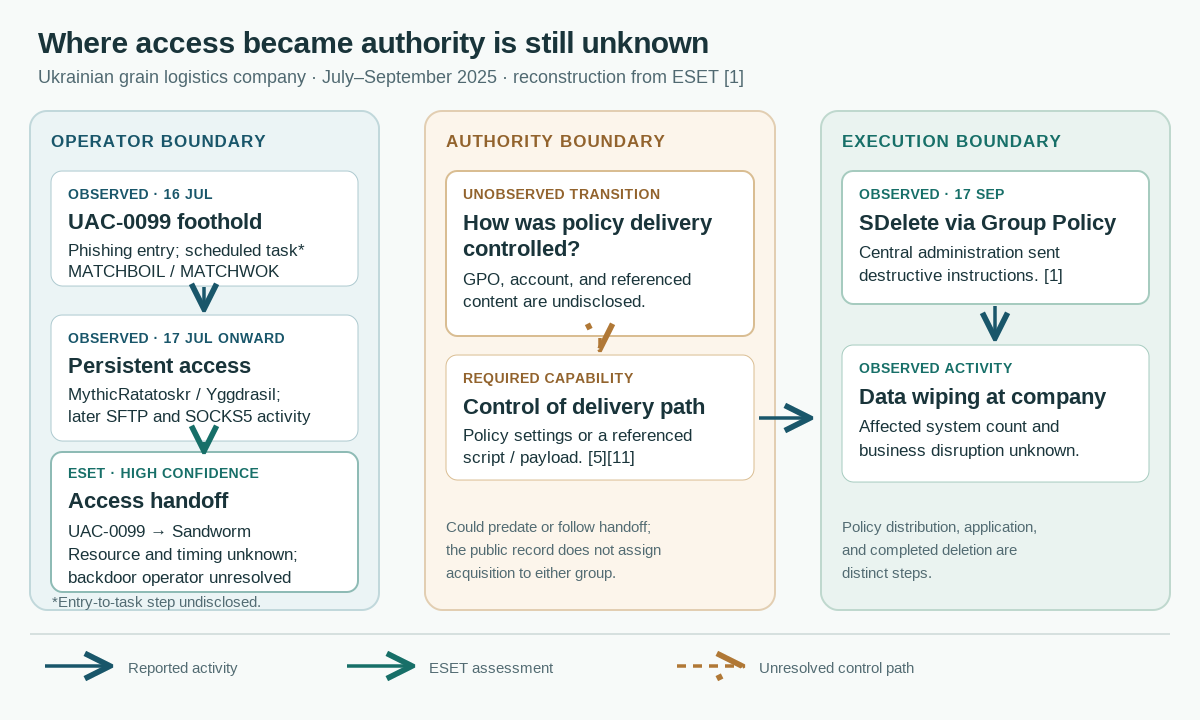
The following three boundaries locate what changed and what remains unobserved.
5.1 The operator boundary
The first boundary concerns the attacker rather than the victim’s administrative hierarchy. UAC-0099 gained access to the grain logistics company, and ESET assessed that access was later handed to Sandworm. For Sandworm to benefit, it had to be able to use some portion of UAC-0099’s access or information: perhaps a connection, credentials, knowledge of internal systems, or infrastructure maintained by another group. ESET assesses the handoff with high confidence but does not identify the resource or the operator of MythicRatatoskr at the later stage. [1]
5.2 The authority boundary
The second boundary lies inside the victim organization. Code on a compromised endpoint runs with the permissions of the identity under which it executes, while a proxy exposes network services reachable from that machine. Causing centrally managed execution across computers requires further control of what the applicable policy tells them to run. If attackers alter GPO settings, Microsoft distinguishes permission to edit a GPO from permission to link it to a site, domain, or organizational unit; linking requires modify permission on that container. Creating an unlinked GPO alone does not make its settings apply to other computers. [11]
An operator could change an existing applicable GPO if it had edit rights, or create and link a new one if it had the relevant permissions. It could also alter a script or payload that an already applicable policy invokes, provided it had write access to that content and the policy’s execution context would run it. Policy scope and filtering then determine which computers process the instruction. [5][9][11] These are conditional routes, not a reconstruction of the victim’s configuration.
ESET’s observation of SDelete deployment shows that the attackers exercised sufficient control over a Group Policy-delivered execution path. It does not disclose whether a GPO or referenced file changed, which account was used, or whether that control was acquired before or after Sandworm obtained access. [1]
5.3 The execution boundary
The third boundary separates a centrally managed instruction from its realized effect. Once policy settings or referenced content are altered, the intended computers must receive and apply the policy; the relevant files must be accessible, execution conditions must be satisfied, and the destructive operations must be permitted to proceed. The earlier CADDYWIPER case shows that policy compatibility can prevent broad execution, while the Polish DynoWiper case shows that execution on many machines can occur without completing the intended data destruction. For the grain logistics company, the public investigation confirms destructive activity but does not identify the computers on which each stage succeeded.
5.4 What would distinguish the groups’ roles?
The three boundaries can be summarized as distinct questions.
| Boundary | Required transition | Public evidence in the grain case |
|---|---|---|
| Operator | Access established by UAC-0099 becomes usable in Sandworm’s operation | ESET assesses a handoff; mechanism undisclosed |
| Authority | Access within the network becomes control of a GPO-delivered execution path | SDelete via GPO observed; exact control path undisclosed |
| Execution | Centrally distributed instructions produce destructive effects on endpoints | SDelete-based destruction observed; affected scope undisclosed |
This is an analytical model; ESET did not observe every transition. Authentication records would show which identities accessed the domain, while GPO change and link history and file-write records for referenced content could show how delivery was controlled. Evidence of who operated the backdoor could then be compared with the timing of those changes. None of these records has been published for this victim, so the division of preparation between the groups remains unresolved.
6. The Strategic Targeting of Grain Logistics
The political weight of this target class predates the intrusion. Russia’s blockade of Ukrainian Black Sea ports in 2022 made grain shipments a subject of international negotiation; the UN- and Türkiye-brokered Black Sea Grain Initiative operated from July 2022 until Russia ended its participation in July 2023. [16] In a statement to the UN Security Council that month, Russia’s representative presented the decision as a response to what Moscow said were unfulfilled conditions for Russian food and fertilizer exports, and said it would treat ships bound for Ukrainian ports as potential military carriers. [15] Those are Russia’s stated positions, not an independent finding about the ships or the later cyber operation. Ukraine’s economy ministry described its response as opening an alternative maritime corridor, arranging war-risk insurance for ships, and developing Danube logistics to preserve exports. [17] The ability to move agricultural goods had become both an economic necessity and a contested element of the war.
The scale of that dependency was measurable in July 2025, the month of the initial compromise. Ukraine’s economy ministry reported that agricultural and food products accounted for USD 1.7 billion of the more than USD 3.3 billion in goods exported that month, over half the total; it also reported 3.5 million tonnes of agricultural exports. [14] A grain logistics company can therefore sit in a sector with consequences for export revenue and Ukraine’s relationships with overseas buyers. Yet the victim’s place in that chain is undisclosed. Deleting files from an office workstation would not have the same effect as disabling warehouse management, transport scheduling, or port operations, and no public evidence identifies which of those functions, if any, was disrupted here.
ESET’s April–September 2025 activity report described Sandworm attacks against government, energy, logistics, and grain-sector organizations and assessed that attacks against grain-related businesses were likely intended to weaken Ukraine’s wartime economy. [2] This assessment has a plausible strategic setting in the documented contest over exports, but the setting does not identify who selected this company or show that the data-wiping operation was coordinated with a military strike, a diplomatic decision, or a particular export disruption.
UAC-0099 complicates that political reading. ESET documented its compromises of multiple Ukrainian transportation companies during July and August 2025, followed by manufacturing and energy-sector victims, while its broader campaign also reached government and defense organizations. [3][13] This is a record of access across institutions relevant to wartime governance and production; the published cases do not establish a single state tasking list or show that every victim was handed to Sandworm. ESET’s description of validated targets suggests a selection step between intrusion and later use, but neither the criteria nor the decision maker is public. [2] The handoff therefore points to a possible way that reconnaissance and destructive priorities could be joined without proving where political direction entered the process.
The distinction matters for the outcome as well. The decision to compromise an organization and the decision to destroy data there could have been made at different times by different operators. ESET’s evidence connects UAC-0099’s access to Sandworm’s later operation at this company; it does not show that the operation reduced grain exports or changed the wider contest over Black Sea trade.
7. Conclusion
ESET documents a phishing-led intrusion attributed to UAC-0099, an assessed transfer of access to Sandworm, and a later data-wiping operation through Group Policy. The comparison with CADDYWIPER and DynoWiper shows why these findings cannot be compressed into a single act of “handing over destruction”: centrally managed delivery, application on endpoints, and completed deletion each depend on different conditions. For this victim, ESET confirms destructive activity without publishing the affected system count or evidence of interrupted grain exports.
The public record therefore supports cooperation across an operator boundary, while the internal authority transition remains unassigned. That distinction limits claims about each group’s preparation and about the operation’s effects on grain exports. UAC-0099 opened a path into the company and Sandworm conducted the destructive operation, but the evidence does not show where that path became authority over the company’s managed computers.
References
Initial Intrusion and Access Handoff
[1] ESET Research. Anton Cherepanov and Peter Strýček. “MythicRatatoskr: An Yggdrasil-enabled backdoor deployed in a UAC-0099–Sandworm collaboration.” October 22, 2026.
Primary technical investigation documenting the initial intrusion, MythicRatatoskr, the assessed handoff, and the September 2025 data-wiping activity.
[2] ESET Research. APT Activity Report: April 2025–September 2025. Sandworm section, page 21.
Documents destructive activity against Ukraine’s government, energy, logistics, and grain sectors and reports the transfer of validated targets from UAC-0099 to Sandworm.
[3] ESET Research. Fernando Tavella. “MATCHBOIL: New tricks, same old evil intentions.” October 8, 2026.
Technical analysis of UAC-0099’s downloader and its deployments across Ukrainian transportation, manufacturing, and energy organizations.
https://www.welivesecurity.com/en/eset-research/matchboil-new-tricks-same-old-evil-intentions/
[4] Microsoft Threat Intelligence. “The BadPilot campaign: Seashell Blizzard subgroup conducts multiyear global access operation.” February 12, 2025.
Documents a specialized initial-access operation within Sandworm and its relationship to subsequent destructive activity.
Destructive Operations and Administrative Execution
[5] Mandiant. Dan Black and Gabby Roncone. “The GRU’s Disruptive Playbook.” July 12, 2023; attribution updated April 2024.
Reconstructs the October 2022 CADDYWIPER attack and describes recurring operational methods used in Russian military intelligence’s destructive operations.
https://cloud.google.com/blog/topics/threat-intelligence/gru-disruptive-playbook
[6] ESET Research. “DynoWiper update: Technical analysis and attribution.” January 30, 2026.
Compares ZOV and DynoWiper, their Group Policy deployment mechanisms, and the evidence supporting ESET’s attribution assessments.
https://www.welivesecurity.com/en/eset-research/dynowiper-update-technical-analysis-attribution/
[7] CERT Polska. Energy Sector Incident Report — 29 December 2025. January 30, 2026.
Detailed forensic investigation of the Polish energy and manufacturing incidents, including DynoWiper, LazyWiper, administrative access, distribution scripts, endpoint protection, and attribution evidence.
https://cert.pl/uploads/docs/CERT_Polska_Energy_Sector_Incident_Report_2025.pdf
Windows Administrative Architecture
[8] CERT Polska. “Energy Sector Incident Report — 29 December 2025.” January 30, 2026.
Official publication accompanying the forensic investigation of the coordinated incidents affecting Polish energy infrastructure.
https://cert.pl/en/posts/2026/01/incident-report-energy-sector-2025/
[9] Microsoft Learn. “Group Policy processing.”
Documentation of policy application, scope, precedence, inheritance, and filtering in Windows environments.
[10] Microsoft Sysinternals. Mark Russinovich. “SDelete.”
Official documentation of the secure-deletion utility used in the grain logistics company’s destructive incident.
https://learn.microsoft.com/en-us/sysinternals/downloads/sdelete
[11] Microsoft Learn. “Group Policy Management Console.”
Documents the separate permissions for editing GPO settings and linking a GPO to an Active Directory site, domain, or organizational unit.
UAC-0099 Campaign History
[12] State Service of Special Communications and Information Protection of Ukraine / CERT-UA. Russian Cyber Operations: Analytics for the H2 2024. Pages 15–16.
Documents UAC-0099’s late-2024 espionage targets, phishing delivery, LONEPAGE remote-command capability, and changes to its loader.
https://cip.gov.ua/services/cm/api/attachment/download?id=68768
[13] CSIRT of the State Scientific and Research Institute of Cybersecurity Technologies and Information Protection. “Court Summons Phishing Lure Used in Cyberattacks on Ukrainian Government and Defence Sector.” August 29, 2025.
Official English account of CERT-UA’s investigation into UAC-0099’s MATCHBOIL, MATCHWOK, and DRAGSTARE campaign against government and defense organizations.
Grain Trade and Political Context
[14] Ministry of Economy of Ukraine. “У липні Україна експортувала товарів на понад $3,3 млрд” [Ukraine exported more than USD 3.3 billion in goods in July]. August 8, 2025. Ukrainian.
Reports the value and volume of Ukraine’s July 2025 agricultural and food exports relative to total goods exports.
[15] Permanent Mission of the Russian Federation to the United Nations. “Выступление и.о. Постоянного представителя Д.А.Полянского на заседании СБ ООН по «черноморской инициативе»” [Statement on the Black Sea Initiative at the UN Security Council]. July 21, 2023. Russian.
Primary record of Russia’s stated reasons for ending the initiative and its public position on vessels bound for Ukrainian ports; its claims are attributed to the Russian representative, not adopted as established facts.
https://russiaun.ru/ru/news/unsc_210723
[16] Council of the European Union. “Ukrainian grain exports explained.” Archived October 9, 2025.
Summarizes the blockade, the Black Sea Grain Initiative, and Russia’s July 2023 decision to end its participation.
https://www.consilium.europa.eu/en/infographics/ukrainian-grain-exports-explained/
[17] Ministry of Economy of Ukraine. “Щоб зберегти експортні можливості, Уряд ухвалював неординарні рішення і це дало результат” [Government measures to preserve export capacity]. January 5, 2024. Ukrainian.
Explains Ukraine’s alternative maritime corridor, war-risk shipping insurance, and development of Danube logistics as government responses to wartime disruption.
Evidentiary Scope
This investigation is based on publicly available ESET, CERT-UA, Mandiant, Microsoft, and CERT Polska reports, official Ukrainian export data, a Russian diplomatic statement, an EU account of the grain-shipping chronology, an official Ukrainian CSIRT account, and product documentation. No independent forensic examination of the Ukrainian grain company’s systems was conducted.
ESET attributes the July 2025 initial intrusion to UAC-0099 and the September destructive activity to Sandworm with high confidence. It also assesses the access handoff with high confidence. The precise handoff mechanism, the identities and privileges of the accounts used, and the timing of any operator transition are not publicly established.
ESET assesses UAC-0099’s alignment with Russian interests with medium confidence. The group’s role in this incident does not establish its formal organizational position within Russian military intelligence.
The 2024 and 2025 UAC-0099 campaign reports describe other victims and establish a history of persistent access and information collection. They do not show that DRAGSTARE was deployed, credentials were taken, or privileged accounts were controlled at the grain company.
The report’s description of validated targets supports an assessment that some compromised organizations were selected for subsequent activity. It does not establish formal selection criteria, a universal workflow, or a commercial market for access transfers.
The historical CADDYWIPER and ZOV cases are used to compare documented administrative execution mechanisms. The Polish DynoWiper and LazyWiper cases are comparative evidence of those mechanisms, not confirmed extensions of the same Sandworm campaign. ESET’s medium-confidence DynoWiper attribution and CERT Polska’s separate infrastructure-based assessment remain unresolved.
The three boundaries identified in this article—operator, administrative authority, and endpoint execution—are an analytical framework constructed from the reported events. The framework does not imply that investigators observed every transition within the Ukrainian grain company’s environment.
The victim company’s identity, the number of affected systems, the damage to specific business functions, and any interruption to grain transportation or exports have not been publicly established.
The supported conclusion is therefore limited: ESET documented an access handoff between activity attributed to UAC-0099 and Sandworm, followed by destructive execution through legitimate administrative infrastructure. What control was transferred, and which group acquired the ability to make that infrastructure deliver the destructive operation, remain unanswered.