Analysis based on publicly available information as of October 16, 2026.
Abstract
On October 15, 2026, the University of Toronto’s Citizen Lab and the advertising security company Confiant exposed how Discover-Tech used commercial advertising infrastructure to reach selected devices and deliver Candiru spyware. At least 45 Al Jazeera devices were targeted in 2024–2025, with infections confirmed on a subset. In four months of 2026, Discover-Tech’s MyDSP also submitted approximately 3.77 billion advertising bids and won around 442 million impressions. Those transactions measure market reach, not infections. [1][2]
The underlying business problem predates this operation. In separate, documented cases, Google personnel assisted advertisers selling unlawful prescription drugs, LeadClick depended heavily on a deceptive advertiser, and agencies offered access to Meta’s platforms for campaigns they knew violated its rules. The customers creating the risk were also sources of revenue. [3][4][5]
Discover-Tech shows how much more valuable advertising access could become when sold into the surveillance market. It combined established DSP infrastructure, recognized vendor registrations, device identifiers, and code delivery with a customer platform designed for targeting individuals. Its exposed records show little ordinary advertising revenue or conversion activity, while technical evidence connects its delivery system to spyware infections. [1]
This article traces how harmful customers became commercially useful to advertising intermediaries, how buyer opacity and divided oversight preserved access, and how a surveillance company entered that market. The record establishes active assistance in earlier cases and a working spyware delivery system at Discover-Tech. It does not establish that the major exchanges knowingly participated in the Candiru attacks.
1. Incident Overview
An advertisement is usually understood as a message purchased by a company wishing to reach potential customers. In modern programmatic advertising, however, the transaction also provides access to technical capabilities: identifying an audience, selecting particular devices, collecting information associated with an advertising request, and delivering content that may execute code within a browser or application.
These capabilities are distributed across an elaborate commercial system. Publishers sell advertising inventory through supply-side platforms, while advertisers and agencies acquire impressions through demand-side platforms, or DSPs. Exchanges connect the two sides through automated auctions. Advertising networks, resellers, data brokers, and measurement services supply additional information and distribution capacity.
Discover-Tech used this system to connect commercial spyware operators with the devices of their intended targets.
Citizen Lab identified a customer-facing platform called Controlium, through which surveillance-related clients could specify targets using mobile advertising identifiers, browser or cookie identifiers, and IP addresses. Discover-Tech then purchased advertising impressions through its own MyDSP infrastructure or third-party platforms, including Beeswax and Eskimi. Advertisements could invoke its NOAS server, which decided whether to return additional JavaScript according to identifying information associated with the device. [1]
For most visitors, the server could return an empty response. For selected targets, it could supply code that contacted further infrastructure operated by Candiru, now known as Integrity Labs. Confiant’s independent examination identified sophisticated fingerprinting, encrypted communications, and mechanisms for obtaining additional code. At this point, the advertisement could run web code within the browser or app’s restrictions; installing native spyware would require a further exploit or other transition beyond that restricted context. Citizen Lab linked the advertising delivery process to actual infections through network records from Al Jazeera and a recovered Windows spyware component, but the public record does not reconstruct the complete exploit chain on each device. [1][2]
The distinction between ordinary impressions and infections is essential. Approximately 719 million bids were associated with advertisements likely to invoke the NOAS delivery mechanism, but those bids do not represent 719 million attacks or infections. Similarly, the number of websites and applications carrying Discover-Tech advertisements demonstrates distribution reach, not the number of compromised publishers or users.
The more consequential finding concerns what Discover-Tech had been able to purchase from the advertising market.
The company did not have to negotiate separately with thousands of websites to obtain access to their visitors. Nor did it need those publishers to knowingly participate in spyware operations. It could acquire advertising opportunities through commercial intermediaries whose normal business was connecting buyers with audiences.
The same market that allowed ordinary businesses to purchase impressions from news websites, applications, and consumer services also supplied Discover-Tech with opportunities to reach specific individuals.
Following coordinated disclosure, Google, IAB Europe, Beeswax, Vungle, and Eskimi took steps to restrict or terminate Discover-Tech’s participation. These actions demonstrated that the company could be excluded from important parts of the advertising ecosystem, but they occurred after the documented 2024–2025 spyware activity and years after Discover-Tech first obtained recognized industry access. [1]
That history raises an uncomfortable question. Why was the surveillance company able to participate in the market for so long, and how different was its commercial behavior from relationships the advertising industry had already established with other problematic customers?
2. Timeline — From Problematic Advertising to Commercial Spyware Delivery
The relationship between advertising intermediaries and questionable customers long predates the Discover-Tech investigation. Its development is visible through enforcement proceedings, commercial restructuring, the emergence of specialized surveillance products, and attempts by the advertising industry to improve its own oversight.
| Period | Development |
|---|---|
| 2003–2009 | Google continues serving certain Canadian online pharmacies targeting U.S. consumers, while employees provide advertising and website optimization assistance. |
| 2011 | Google agrees to a $500 million forfeiture over advertising connected to unlawful prescription-drug sales. |
| 2015–2017 | RelevanTech develops mobile-device marketing technology and is acquired by advertising company Glispa. |
| 2016 | MyDSP operates as part of Matomy’s advertising technology business. A U.S. appeals court upholds LeadClick’s liability for participation in deceptive affiliate advertising. |
| 2018 | Matomy restructures its advertising operations, reports declining revenue associated with its DSP exit, and sells MyDSP to Marketcom Technology. |
| 2019 | Israeli company Insanet develops Sherlock, an advertising-based infection capability offered in Candiru sales material. |
| 2020 | Discover-Tech is established, surveillance-industry figures enter its corporate network, and MyDSP-related assets move under its control. |
| 2021 | IAB Tech Lab releases buyers.json and DemandChain Object to make advertising buyers more identifiable. |
| 2023 | Haaretz reports the commercialization of advertising-based tracking and spyware delivery. |
| 2024–2025 | Discover-Tech advertising infrastructure is used in Candiru attacks against Al Jazeera devices. |
| 2024–2025 | Advertising businesses and security vendors publicly describe the commercial obstacles to buyer transparency. |
| December 2025 | Reuters documents Meta advertising resellers offering access for prohibited campaigns and examines the company’s internal assessment of advertising fraud. |
| March–June 2026 | Discover-Tech’s MyDSP records approximately 3.77 billion bids and 442 million successful impressions. |
| October 2026 | Major advertising organizations suspend or terminate Discover-Tech’s access; Citizen Lab and Confiant publish their findings on October 15. |
The chronology does not establish a single organization coordinating these developments. Google, LeadClick, Meta’s advertising resellers, and Discover-Tech operated in different markets and were involved in different conduct. What connects their histories is the commercial significance of customers whose activities create serious risks for the people receiving their advertisements.
2.1 Advertising intermediaries were already commercial participants in unlawful markets
In August 2011, the U.S. Department of Justice announced that Google had agreed to forfeit $500 million in connection with advertisements placed by Canadian pharmacies selling prescription drugs unlawfully to consumers in the United States.
The government’s findings went well beyond the presence of illegal advertisements on a platform. Google had been aware since at least 2003 that such shipments were generally unlawful. Nevertheless, Canadian pharmacy advertisers continued targeting U.S. consumers, and between 2003 and 2009 Google personnel helped some of those advertisers place and optimize their advertisements and improve their websites. [3]
Google eventually strengthened its pharmacy advertising controls, including independent verification requirements. In its agreement with the government, the company acknowledged that it had improperly assisted the advertisers and accepted responsibility for that conduct.
The $500 million figure included revenue earned by the pharmacies as well as Google’s advertising income. It was not simply a measure of Google’s profit from the relationship.
The significance lies instead in the relationship itself. The advertising company had knowledge of serious legal problems involving a class of customers and nevertheless provided commercial services that improved their ability to sell products.
This was not merely an attacker evading an automated inspection system. It was an advertising business providing assistance to paying advertisers despite information about the unlawful character of their activities.
Five years later, the LeadClick case provided another example with unusually detailed evidence about the underlying commercial incentives.
2.2 LeadClick: when deceptive advertisers became the business
LeadClick Media operated an affiliate marketing network whose participants promoted products on behalf of advertisers. One of its major customers was LeanSpa, a weight-loss supplement business that relied on misleading marketing practices, including websites designed to resemble independent news coverage.
LeadClick recruited affiliates, approved deceptive promotional material, and provided advice about the content of advertisements. It also bought advertising inventory from genuine websites to drive visitors toward the fraudulent news-style pages. In September 2016, the U.S. Court of Appeals for the Second Circuit upheld the finding that LeadClick could be held responsible for its participation in the deception. [4]
The court record contains a particularly revealing financial detail. By 2011, LeanSpa-related offers represented approximately 85% of LeadClick’s eAdvertising division sales. LeadClick had billed LeanSpa around $22 million over the course of their relationship, although the advertiser had paid only part of that amount and accumulated substantial arrears.
Despite the unpaid bills, LeadClick continued paying the affiliates responsible for driving customers to LeanSpa. The intermediary was not simply collecting a fee from a customer it barely knew; its business had become heavily dependent on that customer’s advertising activity.
Affiliate marketing payments created a direct relationship between the intermediary’s revenue and the effectiveness of the advertiser’s campaign. LeanSpa paid for acquired customers, while LeadClick and its affiliates benefited from generating more of them. The deception was therefore embedded in a performance-based commercial system whose participants were financially rewarded for producing results.
When most of a division’s sales depend on one problematic customer, terminating that customer is no longer a routine moderation decision. It becomes a decision about the intermediary’s own survival and revenue.
2.3 Meta: selling the ability to bypass advertising rules
A December 2025 Reuters investigation revealed a more recent and particularly direct form of cooperation between advertising intermediaries and prohibited advertisers.
Reuters approached agencies offering access to Meta’s advertising platforms and sought help placing advertisements for an implausible investment scheme. Some of the agencies appeared in Meta’s official partner directory, where they were presented as vetted advertising specialists. Despite being told that the proposed advertisements would violate Meta’s policies, several intermediaries agreed to provide advertising accounts and charged commissions for doing so.
Some agencies explicitly marketed their ability to obtain advertisements through Meta’s enforcement systems. They promoted access to specialized accounts or relationships with larger advertising partners, presenting these arrangements as advantages for customers whose campaigns would otherwise risk suspension. Reuters purchased advertising through these intermediaries, and the test advertisements reached more than 20,000 Facebook and Instagram users. [5]
The investigation revealed a hierarchy of advertising agencies and resellers. Large Chinese advertising partners maintained substantial relationships with Meta and supplied advertising access to smaller agencies, some of which in turn served customers elsewhere. This arrangement created additional layers between Meta and the advertisers whose campaigns ultimately appeared on its platforms.
The commercial incentive was visible at the reseller level: restricted advertising could command higher commissions, while access to an account less likely to face immediate enforcement became a marketable service.
A companion Reuters investigation examined internal Meta records concerning revenue from prohibited advertising. According to those documents, Meta estimated that more than $3 billion of its 2024 advertising revenue from Chinese advertisers came from scams, illegal gambling, pornography, and other content prohibited under its policies. Internal records also described efforts to reduce harmful advertising, their substantial initial success, and subsequent decisions that limited parts of the enforcement program amid revenue concerns. [6]
Meta disputed aspects of the reporting, described its efforts to combat fraud, and took action concerning agencies identified by Reuters, including removing its partner directory and reviewing the program.
The investigation demonstrates that advertising access can become a product sold through reseller relationships, and that customers interested in violating platform rules may actively seek intermediaries offering exactly that capability. Reuters’ test concerned deceptive investment advertising, not Discover-Tech or spyware delivery.
This is the commercial relationship that makes the Discover-Tech case more intelligible. Advertising intermediaries do not necessarily need to develop malicious content themselves to participate in its distribution. They may instead sell the access, accounts, technical capabilities, or operational assistance that allow a customer to reach an audience.
3. The Market for Customers Other Platforms Would Reject
The cases above expose a conflict within the advertising business: the customer most likely to violate a platform’s rules can also be a lucrative source of demand.
Legitimate commercial advertisers purchase attention because they expect to earn a return through sales, subscriptions, or other business outcomes. Fraudulent advertisers may be able to spend aggressively because successful deception can generate unusually high revenue per victim. The economics of malware distribution and surveillance are different again, but they create another reason to pay for precisely targeted traffic.
These customers may present serious legal and reputational risks, yet still offer attractive commercial opportunities to intermediaries competing for advertising budgets.
3.1 Competition creates demand for specialized intermediaries
The development of programmatic advertising placed increasing competitive pressure on independent advertising technology companies. Large platforms controlled significant volumes of advertising inventory and user data, while smaller DSPs, SSPs, networks, and resellers competed through pricing, technical features, customer service, and specialized access to particular audiences.
This did not make smaller advertising companies inherently illicit. Specialization is an ordinary competitive response, and many companies invest heavily in preventing fraud because poor-quality traffic damages their commercial relationships.
But the same competitive environment can create demand for services that mainstream platforms will not openly provide. Customers operating in restricted advertising categories may value access to otherwise unavailable inventory, more permissive campaign review, identity-masking arrangements, or assistance with account restrictions.
Reuters’ investigation of Meta resellers documented one version of this business model. In that setting, the ability to place advertisements prohibited by platform policy was not merely an operational accident. Some agencies advertised it as part of their commercial offering.
The relevance to spyware is not that every such reseller eventually becomes an offensive cybersecurity vendor. It is that control over advertising access can acquire commercial value independent of the product being advertised.
A company may sell advertising impressions to one customer, campaign-management services to another, and privileged distribution capabilities to a third. The same infrastructure can support businesses whose legal status, intended outcomes, and willingness to pay differ enormously.
3.2 MyDSP: advertising access enters the surveillance market
Discover-Tech’s advertising infrastructure provides a concrete connection between the restructuring of ordinary advertising technology and the commercial surveillance market.
MyDSP began as a demand-side advertising platform operated by Matomy. During Matomy’s 2018 restructuring, the company exited several underperforming businesses and sold MyDSP to Marketcom Technologies Ltd, part of the Market Group that also owned Glispa. A 2019 archived MyDSP site placed the product within Glispa’s advertising business. [1]
Matomy’s interim financial statements recorded $8.228 million for the first half of 2017 against a DSP shutdown-related revenue adjustment, compared with $2.067 million for the first half of 2018. The figures indicate a sharp decline in the activity being exited, although they should not be treated as a complete independently audited income statement for MyDSP. The company reported efforts to remove non-compliant traffic elsewhere in its advertising operations during the same restructuring. [7]
Subsequent securities disclosures identified the MyDSP sale consideration as approximately $850,000, subject to adjustments. [8]
Discover-Tech was founded in March 2020 by people who had worked in advertising technology. Citizen Lab’s examination of Israeli company records found that Eric Banoun, a figure in the commercial surveillance industry, joined its board soon afterward, while its shareholders included people with advertising backgrounds and a company linked by reporting to the Intellexa network. These connections place advertising and surveillance experience within the same corporate venture; they do not establish any individual’s knowledge of a particular attack. [1]
Between June and October 2020, Discover-Tech gained control of the mydsp.io and mtrtb.com domains from Marketcom. Citizen Lab also identified a Google advertising provider record in which ID 3036 changed from MarketDSP to Discover-Tech on July 31, 2020. The company name and website changed, but the domains attributed to that provider remained the same. Archived MyDSP administrative code listed connections to advertising vendors including Google, Yandex, and Vungle, though it does not date each connection or show its contractual terms. [1]
The distinction between acquiring software and acquiring a place in the market is important. A DSP’s operational value includes its domains, integrations, provider records, and commercial relationships with exchanges and other intermediaries. Software alone does not buy an impression; a recognized and connected buyer can.
The surviving Google record demonstrates continuity in registration information. It does not prove that contractual authorizations were automatically transferred or that no new review occurred. It does show why the commercial position surrounding MyDSP mattered alongside its code: Discover-Tech could build a surveillance-facing service on infrastructure that already had a history in the advertising market.
More fundamentally, the transaction does not establish that financial distress caused MyDSP to enter the surveillance business. Discover-Tech’s early ownership and management already included people associated with offensive cybersecurity and surveillance companies.
The evidence supports a more specific interpretation: existing advertising technology and traces of established market access were incorporated into a company that connected the advertising industry to a higher-value surveillance market. Matomy’s declining DSP revenue did not have to cause this outcome for the transfer to be commercially consequential.
3.3 Spyware delivery becomes a premium commercial capability
The conversion of advertising infrastructure into a surveillance product was already underway before Discover-Tech’s known attacks.
In September 2023, Haaretz described Israeli companies developing technology that could use commercial advertising systems to track individuals or deliver spyware without requiring a victim to click a malicious link. Among them was Insanet, established in 2019 by entrepreneurs combining advertising technology experience with relationships in the offensive cybersecurity sector. [9]
Insanet developed Sherlock, an advertising-based infection capability that was promoted alongside existing spyware products. A Candiru sales document from 2019 reportedly offered Sherlock-based infection as an additional capability priced at €6 million.
The figure came from a commercial proposal rather than a confirmed final contract, and its precise licensing and charging conditions should not be generalized to other products. Nevertheless, it establishes that advertisement-based infection was being marketed as a specialized, expensive capability years before the Discover-Tech investigation.
This offers an important contrast with ordinary programmatic advertising. An advertiser typically pays a comparatively small amount for an impression, while a surveillance customer may value the ability to identify or compromise one particular device at a radically different level.
The services are not interchangeable, and the price of Sherlock cannot be used to calculate Discover-Tech’s profit margin. What changes is the commercial object: rather than selling audience exposure for marketing, the intermediary sells the technical ability to reach an identified person.
The surveillance industry had effectively found a new class of supplier in advertising technology.
4. The Business of Not Identifying the Buyer
The historical cases show why an intermediary might retain a profitable customer who violates its rules. Buyer identity determines whether other participants can recognize that customer across the market.
In June 2021, IAB Tech Lab released buyers.json and DemandChain Object, two specifications intended to make buying relationships more transparent. The first permits advertising systems to disclose the buyers they represent; the second allows participants in a transaction to identify the organizations involved on the buying side.
The stated rationale explicitly included malvertising and harmful advertisements. If publishers could identify the buyers behind problematic campaigns, they would be better positioned to exclude those buyers across different demand sources. [13]
The technical proposal was available well before Discover-Tech’s operations became public. Adoption, however, confronted the commercial value of keeping customer relationships private.
In June 2024, PubMatic publicly discussed the obstacles to wider adoption. Advertising DSPs have commercially valuable relationships with their customers, and openly publishing buyer information can create confidentiality concerns. PubMatic proposed allowing relevant participants to receive buyer information through transaction-level DemandChain data rather than requiring every relationship to be publicly disclosed. [14]
The difficulty lay in the incentives of companies that compete to acquire and retain advertising customers, not merely the absence of a data format.
In October 2025, Confiant addressed the same issue directly. Referring to buyers.json and DemandChain, it argued that the technical approach was workable but broad adoption had stalled because commercial incentives were not aligned. Confiant warned that insufficient visibility allowed malicious advertisers to move between DSPs after being detected. [15]
This is a revealing feature of the industry’s history. Advertising businesses had developed standards to identify sellers and intermediaries because buyers needed to know whether advertising inventory was legitimate. Similar standards for identifying the ultimate buyers, whose money supports the system, encountered stronger resistance.
Customer confidentiality has legitimate commercial uses, and limited adoption does not show that DSPs meant to protect criminal buyers. PubMatic’s transaction-level proposal also demonstrates an alternative to publishing every relationship openly. The conflict remains: a DSP benefits from protecting information about its customers even when other participants need that information to identify repeat offenders.
But the consequences of non-adoption are not neutral. A harmful advertiser may continue obtaining traffic through a different intermediary when the organizations responsible for reviewing or displaying advertisements cannot reliably connect its activities across platforms.
That limitation becomes particularly serious when advertising access can execute code and collect identifiers from the device itself.
Discover-Tech operated in precisely this environment. Its ability to maintain connections with multiple advertising providers meant that its access was not dependent on a single interface or exchange. A complete examination of its activity would require linking corporate identity, customer relationships, account histories, advertising creatives, tracking infrastructure, and the code delivered after an impression was won.
Standards intended to improve some of these connections existed. Public evidence does not show their consistent implementation across Discover-Tech’s transaction paths. Wider buyer disclosure could have helped publishers connect activity to Discover-Tech across demand sources. It would not, by itself, have identified an undisclosed surveillance client behind Discover-Tech; that would also require customer and account records.
5. Discover-Tech’s Business — Advertising Without Ordinary Advertisers
The buyer-transparency problem becomes more pointed when the apparent buyer has little evidence of ordinary advertising customers. Citizen Lab’s reconstruction of MyDSP’s bidding records adds that economic dimension to Discover-Tech’s case.
Between March and June 2026, MyDSP submitted 3,770,286,576 bids and won 441,954,291 impressions. Approximately 67.4% of those bids were associated with Yandex, 24.74% with Google Ad Manager, and 7.24% with Vungle. These figures relate only to the MyDSP dataset and exclude Discover-Tech’s separate use of Beeswax and Eskimi. [1]
Despite this extensive activity, the database identified only three advertisers. Most advertising appeared under Discover-Tech’s name or names associated with related properties. A substantial amount of activity promoted generic AliExpress products through affiliate links, without evidence that AliExpress had commissioned those campaigns.
The system also contained accounting fields for advertiser revenue, DSP profits, margins, and conversions. Almost all recorded revenue values were zero, while the conversion fields were consistently zero throughout the period. The database estimated advertising expenditure of approximately $109,091, assuming its monetary fields used the expected micro-dollar units.
These records do not establish Discover-Tech’s complete financial position. The company could have maintained separate billing systems, and the available dataset omitted spending through other DSPs. Even so, the information is unusual for an organization whose apparent commercial purpose was purchasing advertising for third-party customers.
Citizen Lab concluded that it had found no good evidence that MyDSP was earning money through ordinary commercial advertising.
The advertising campaigns themselves also had a distinctive technical characteristic. At least 718,748,885 bids, approximately 19% of the total, were associated with creatives likely to invoke Discover-Tech’s NOAS mechanism. That function allowed different JavaScript to be returned according to a device’s identifying characteristics, providing a delivery route for spyware or other targeted code. These figures describe bids associated with the mechanism, not confirmed exploit executions or infections. [1]
Confiant’s observations supplied additional context. The company documented Discover-Tech scripts collecting device information and, when an ad ran in a friendly iframe sharing the publisher’s origin or directly in the page, first-party cookies that were not marked HttpOnly. A cross-origin SafeFrame would not confer that same cookie access. This is access available to web code in those rendering contexts, not evidence of native code execution. Its investigation also examined large-scale cookie synchronization activity, which could help maintain an identity graph without requiring Discover-Tech to win and pay for every advertising impression. [2]
Taken together, these findings suggest that Discover-Tech’s advertising operation was valuable for something other than conventional marketing results.
A surveillance customer could benefit from the collection of identifiers, the confirmation that a device was active, the association of that device with a particular person, and eventually the opportunity to deliver additional code. A campaign that produced no product purchases might still achieve exactly what the surveillance customer wanted.
Controlium’s design was consistent with this interpretation. It provided customer accounts, configurable limits, geographic controls, access to particular advertising platforms, and operational security features. Citizen Lab also identified users associated with Candiru’s infrastructure, including accounts with indications of presales functions. These observations support the existence of a commercial service offered to surveillance-related customers, although they do not reveal the company’s billing arrangements or the value of particular contracts. [1]
The significant economic question is therefore not how Discover-Tech earned commissions on ordinary consumer purchases. It is whether advertising costs formed one component of a larger surveillance service sold to customers who valued device identification and access rather than conversions.
No publicly available contract establishes how much Discover-Tech received for those services. But the technical capabilities, customer management system, and connections to spyware operators make the alternative commercial purpose difficult to ignore.
6. Architecture of the Relationship — Revenue, Control, and Responsibility
The advertising industry’s relationship with problematic customers is shaped by who earns from access, who can inspect a buyer, and who can stop an advertisement from running.
A platform can control which businesses participate in an auction, impose restrictions on advertising content, and terminate access. At the same time, it may delegate campaign management, identity verification, creative inspection, or downstream content responsibility to other commercial participants.
The resulting contracts define who is responsible to whom. The operational question is different: which company had the information and authority to recognize a harmful customer, and what incentive did it have to use that authority while the customer was paying?
6.1 The commercial transaction and its separate decision-makers
The documented components form two connected paths. On the buying side, a surveillance-related customer could use Controlium to select identifiers and manage a campaign. Discover-Tech then purchased impressions either through MyDSP or through third-party DSPs such as Beeswax and Eskimi. Exchanges supplied publisher or application inventory, and a winning advertisement reached a visitor’s device. On the delivery side, an advertisement could invoke Discover-Tech’s NOAS server, which used identifying information to decide whether to return further JavaScript. In the documented infections, selected devices then contacted Candiru infrastructure. That contact did not itself grant native execution: an additional exploit or other boundary crossing was needed to install and persist spyware, and the precise step is not public. The available evidence does not map every individual infection to one exchange or DSP. [1][2]
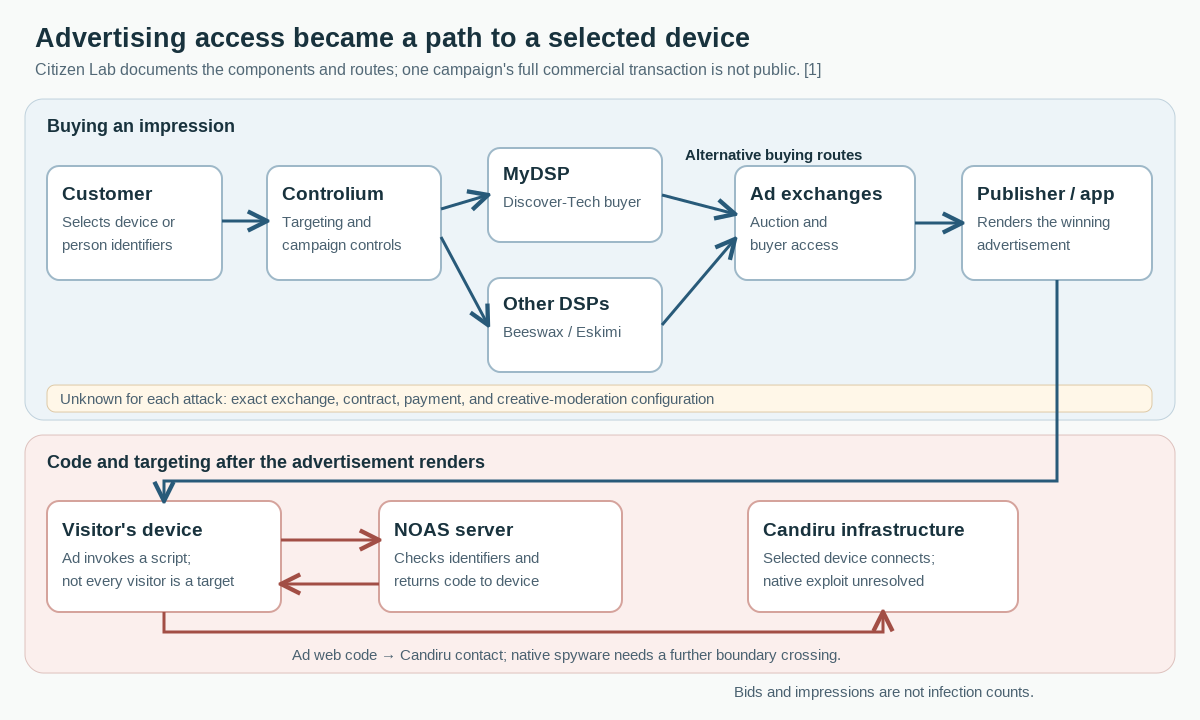
In a conventional advertising transaction, different organizations may separately control the following decisions:
| Function | Typical controlling party | Information or responsibility that may be missing |
|---|---|---|
| Selecting the ultimate advertiser | Agency, reseller, or DSP | The exchange or publisher may not see the final customer |
| Approving commercial access | DSP or advertising platform | Approval may not establish the ultimate purpose of a campaign |
| Reviewing advertising material | Platform, DSP, or external review provider | Dynamic scripts may behave differently after inspection |
| Purchasing an impression | DSP and exchange | A valid bid does not establish that subsequent code is safe |
| Rendering third-party content | Publisher, browser, application, or SDK | The publisher may not know every later network request |
| Handling harmful activity | Multiple parties under separate agreements | No participant necessarily possesses the complete transaction record |
The table identifies the points at which a paying buyer can remain commercially useful while its ultimate purpose is only partly visible to the next participant. Specialization is ordinary in advertising; the diligence performed at each boundary determines whether that specialization also protects a harmful customer.
6.2 Google: strong control rights and contractual allocation of liability
Google’s Authorized Buyers Terms provide an unusually clear example of how advertising distribution authority and legal responsibility are assigned.
The terms place responsibility for advertising creatives, targeting decisions, destinations, and advertised services on the purchasing customer. They prohibit malware, spyware, and other malicious code, while allowing customers to use external advertising servers for serving and tracking advertisements. Google retains the right to reject or remove advertisements and suspend or terminate access. [10]
Sections 9 and 10 establish contractual limits on liability and require customers to defend and indemnify Google and specified related parties against categories of third-party claims involving advertising content, targeting, destinations, services, and breaches of the terms.
Those clauses allocate commercial risk; they do not describe the actual quality of Google’s review. Google simultaneously retains authority over access and asks the customer to warrant that its campaigns comply. The decisive oversight question is what Google checked about a buyer and its delivered code before and during that buyer’s participation, including when enforcing its policies could cost advertising revenue.
The contrast with the 2011 pharmacy case is revealing. Contractual responsibility assigned to advertisers did not prevent government investigators from examining whether Google had actively assisted unlawful sales. In that case, the actual commercial conduct of Google’s staff was central to the enforcement action.
The distinction is between the customer’s promise in a contract and the platform’s own sales, review, and enforcement decisions.
For Discover-Tech, the publicly available evidence does not reveal Google’s complete inspection history or the precise purchasing agreement on every route. Its authority to prohibit malicious code and terminate access is clear; the extent of inquiry during the years of participation remains open.
6.3 Yandex: advertising review can be contractually delegated
Yandex’s advertising network provides another example of the division of oversight responsibilities.
Under its published rules, a publisher may enable a configuration in which advertisements from selected external DSPs are reviewed by those DSPs rather than by Yandex. This option is disabled by default. When enabled, the usual Yandex moderation and certain subject restrictions do not apply to the advertisements covered by the arrangement. [11]
The Russian-language participation rules further state that, in this specific configuration, Yandex does not review the content and disclaims specified contractual liability to the publisher, while the publisher assumes responsibility for handling related complaints and disputes at its own expense.
These provisions describe a formal allocation of moderation and financial risk, not Yandex’s overall review practice or a release from statutory duties. The publisher chooses the configuration; Yandex retains the ability to offer or withdraw the arrangement; the DSP becomes the immediate reviewer. Whether any Discover-Tech impression used it is unknown.
The issue is what each participant actually inspected and could see, including the ultimate buyer and later code, while all continued to participate in the transaction.
Given Yandex’s substantial share of the MyDSP bids observed by Citizen Lab, the actual moderation arrangements used in Discover-Tech’s transactions would be an important subject for further investigation.
6.4 Certification does not verify the ultimate customer’s conduct
Discover-Tech’s appearance in Google’s vendor records and IAB Europe’s Global Vendor List created an additional layer of institutional recognition.
The two systems served different purposes. Google’s vendor arrangements concern participation in advertising technologies and related technical requirements, while IAB Europe’s Transparency & Consent Framework primarily governs how participating organizations communicate data-processing purposes and privacy-related choices.
Neither system should be interpreted as a universal assurance that every code fragment eventually supplied by a listed company has been examined and found harmless.
On October 15, IAB Europe announced that Discover-Tech had been suspended from its Global Vendor List following an audit that identified violations of TCF policies. The organization also emphasized that investigating conduct outside the substantive scope of the framework was not within its mandate or capabilities. [12]
The statement illustrates the narrowness of this particular framework. Registration could help a company participate in the market without verifying the purpose of every advertisement it later delivered.
The unanswered question is who connected registration, customer identity, campaign behavior, and code delivery during the years when Discover-Tech held that access, and what prompted them to make those checks.
7. What the Advertising Industry Could Have Recognized
The record supports a strong criticism of the market’s incentives and oversight. It supports different conclusions about what each named company could have recognized in the Discover-Tech case. General knowledge of malvertising, information available about a vendor, and knowledge of a specific Candiru campaign are separate questions.
7.1 The general risk was not a surprise
By 2020, the Google and LeadClick cases had already shown that problematic advertisers could receive active commercial help. The industry’s own standards body later identified buyer opacity as an obstacle to stopping malvertising; PubMatic and Confiant described the commercial resistance to wider buyer transparency. These were warnings about a recurring market condition, not predictions of one spyware campaign. [3][4][13][14][15]
The industry thus had reason to examine more than whether a creative passed a routine inspection. A buyer’s identity, ownership, real customers, changing code, and history across platforms also mattered. Each inquiry could threaten a commercial relationship that generated advertising demand.
7.2 Discover-Tech’s commercial appearance was unusual
Discover-Tech combined older advertising assets and recognized vendor registrations with corporate ties to the surveillance industry. Its exposed MyDSP records showed few ordinary advertisers and almost no recorded conversions. Its delivery mechanism could return different code to an individually selected device. Together, those characteristics make the company’s actual customers and use of advertising inventory a serious due-diligence question. [1]
The observations were not equally available to every provider. Corporate records and vendor entries were publicly accessible, but Citizen Lab learned much of the bidding and Controlium detail from exposed systems. A platform’s own account records and advertising security telemetry might have shown additional behavior; the public record does not reveal what each provider observed or investigated at the time.
7.3 The cooperation inside the surveillance market is much clearer
Citizen Lab linked Discover-Tech’s advertising delivery to Candiru infrastructure, Controlium accounts associated with surveillance customers, and confirmed spyware infections. By contrast, the evidence identifies Google, Yandex, Beeswax, and Eskimi as providers of advertising infrastructure or services; it does not establish their knowledge of those specific infections. Several restricted Discover-Tech after disclosure, and Eskimi described earlier blocks of suspicious creatives. [1]
This difference in evidence matters for accountability. The 2011 Google agreement concerns admitted assistance to unlawful pharmacy advertisers; the LeadClick judgment concerns adjudicated participation in deceptive marketing; Reuters documented agencies selling prohibited access to Meta and reported on Meta’s internal fraud assessments. None is proof of a secret agreement in the Candiru attacks. Together they establish that active support for harmful customers has been a real commercial practice, while Discover-Tech shows a surveillance business making use of the same industry’s access and infrastructure. [3][4][5][6]
To determine what a particular provider should have recognized about Discover-Tech, investigators would need its account and contract history, customer verification, rejected creatives, code-review telemetry, complaints, and internal risk assessments. The lack of those records limits claims about specific knowledge; it does not erase the documented value that harmful customers have brought to advertising intermediaries.
8. Conclusion — The Customer Was Already Part of the Business
Discover-Tech’s spyware delivery was technically sophisticated. Its route into advertising was built from familiar commercial assets: a DSP, established vendor entries, exchange connections, device identifiers, and a customer interface through which surveillance operators could select targets. Advertising bids bought opportunities to reach devices; a successful consumer purchase was beside the point.
The historical cases show why the surrounding market deserves scrutiny. Google personnel assisted unlawful pharmacy advertisers. LeadClick’s dependence on LeanSpa made a deceptive customer central to a division’s sales. Reuters found agencies selling prohibited access to Meta’s platforms and reported internal concern about the revenue attached to fraudulent ads. In each case the harmful advertiser was also a customer whose money or activity supported an intermediary’s business. [3][4][5][6]
The industry’s response to buyer opacity exposes the same tension. IAB Tech Lab proposed standards to identify the buying side and explicitly named malvertising as a reason. Wider adoption ran into the commercial value of keeping customer relationships private. Contracts could assign responsibility for an ad to a buyer while the platform retained power to admit that buyer and stop distribution. Neither a contract nor a vendor listing answers how diligently that power was exercised. [10][13][14][15]
Discover-Tech turned this market position toward surveillance. Its publicly visible records do not reveal its contracts or profit, and the evidence does not establish that the major exchanges knew about the Candiru attacks. What is established is a spyware delivery system using advertising access, within an industry where active assistance to harmful customers and resistance to buyer transparency were already documented.
The advertising industry’s worst customers were not simply outsiders evading a filter. In the cases examined here, some were paying customers, major sources of sales, or buyers of privileged access. Discover-Tech brought a mercenary spyware operator to the end of that commercial chain. The industry’s central problem is the incentive to keep selling access when recognizing and excluding the customer would mean giving up business.
References
Discover-Tech and mercenary spyware investigations
[1] Citizen Lab, University of Toronto. “Exposing AdFection: How Discover-Tech Turned Targeted Ads Into a Pipeline for Zero-Click Mercenary Spyware.” October 15, 2026.
https://citizenlab.ca/research/how-discover-tech-turned-targeted-ads-into-a-pipeline-for-spyware/
[2] Confiant Threat Intelligence. “ADINT: Weaponized Ad Tech for Zero-Click Spyware and Mass Identity Vacuuming.” October 15, 2026.
https://blog.confiant.com/p/adint-weaponized-ad-tech-for-zero-click-spyware-and-mass-identity-vacuuming
Advertising misconduct, commercial relationships, and corporate history
[3] U.S. Department of Justice. “Google Forfeits $500 Million Generated by Online Ads & Prescription Drug Sales by Canadian Online Pharmacies.” August 24, 2011.
https://www.justice.gov/opa/pr/google-forfeits-500-million-generated-online-ads-prescription-drug-sales-canadian-online
[4] United States Court of Appeals for the Second Circuit. Federal Trade Commission v. LeadClick Media, LLC, No. 15-1009. September 23, 2016.
https://www.ftc.gov/system/files/documents/cases/160923leanspaopinion.pdf
[5] Reuters. “Meta’s ‘Trusted Experts’ Helped Me Run Scam Ads on Facebook and Instagram.” December 15, 2025.
https://www.reuters.com/investigations/metas-trusted-experts-helped-me-run-scam-ads-facebook-instagram-2025-12-15/
[6] Reuters. “Meta Tolerates Rampant Ad Fraud From China to Safeguard Billions in Revenue.” December 15, 2025.
https://www.reuters.com/investigations/meta-tolerates-rampant-ad-fraud-china-safeguard-billions-revenue-2025-12-15/
[7] Matomy Media Group. “Matomy Reports 2018 Interim Results.” August 30, 2018.
https://mayafiles.tase.co.il/rpdf/1181001-1182000/P1181913-00.pdf
[8] Matomy Media Group. Securities filing documenting the July 29, 2018 MyDSP sale agreement and September 5 completion. Tel Aviv Stock Exchange disclosure, Hebrew.
https://mayafiles.tase.co.il/rpdf/1512001-1513000/P1512474-00.pdf
[9] Omer Benjakob, Haaretz. “Revealed: Israeli Cyber Firms Have Developed an ‘Insane’ New Spyware Tool. No Defense Exists.” September 14, 2023.
https://archive.ph/Vkxt1
Advertising contracts, transparency, and institutional responsibility
[10] Google. “Authorized Buyers Terms.” Version dated March 24, 2020, particularly Sections 1, 3, 5, 9, 10, and 11.
https://www.google.com/intl/en/authorizedbuyers/terms/
[11] Yandex Advertising Network. “Rules of Participation,” Section 3.5, and “Moderation of Advertising Platforms.”
https://yandex.ru/legal/partner/ru/
https://yandex.com/support/partner/en/web/units/dsp-moderation
[12] IAB Europe. “Recent Reports Concerning a TCF Vendor, Discover-Tech.” October 15, 2026.
https://iabeurope.eu/recent-reports-concerning-a-tcf-vendor-discover-tech/
[13] IAB Tech Lab. “Buyers.json and DemandChain Object.” Specifications released June 2021; documentation updated January 2024.
https://iabtechlab.com/buyers-json-demand-chain/
[14] Eric Bozinny, PubMatic. “Fostering Programmatic Transparency Through Buyers.json and DemandChain Object Adoption.” June 18, 2024.
https://pubmatic.com/blog/fostering-programmatic-transparency-through-buyers-json-and-demand-chain-object-adoption/
[15] Danielle Koffler, Confiant. “Hope Isn’t a Strategy: Who Pays When Ad Tech Stalls on Transparency?” October 21, 2025.
https://www.confiant.com/news/hope-isnt-a-strategy
Evidentiary Scope
This analysis combines technical research by Citizen Lab and Confiant, advertising platform terms, regulatory announcements, court findings, corporate financial records, commercial product reporting, and investigative journalism. These sources establish events at different times and under different evidentiary standards; they do not constitute a single documented conspiracy or complete commercial transaction network.
The findings concerning Google and unlawful pharmacy advertising arise from a 2011 government agreement. The LeadClick findings arise from federal civil litigation and an appellate decision. The Reuters investigations concerning Meta concern agency practices, internal business records, and controlled advertising purchases in 2025. None directly establishes participation in the 2024–2025 Discover-Tech attacks.
The technical evidence supports a relationship between Discover-Tech and mercenary spyware operators, including Candiru, and establishes spyware infections facilitated through advertising delivery. The public reports do not reconstruct the complete exploit or other transition from ad web code to native spyware execution on each device. The precise contracts, fees, ultimate customers, and financial arrangements linking Discover-Tech to individual surveillance operations also remain incompletely documented.
The MyDSP bidding dataset covers March–June 2026 and excludes spending through some third-party advertising platforms. Bid counts, impressions, advertising identifiers, profiling events, targeting events, and confirmed infections are distinct measures and must not be treated as interchangeable. Financial values derived from the database depend on assumptions about field units and do not represent complete audited accounts.
The article does not establish that Google, Yandex, Meta, Beeswax, Eskimi, or IAB Europe knowingly facilitated Candiru spyware deployment. Meta is included as a comparison concerning advertising resellers and problematic customers, not as an identified participant in Discover-Tech’s delivery chain. Likewise, commercial connections or earlier employment in the surveillance industry do not independently establish legal liability or knowledge of a specific campaign.
Finally, contractual allocation of responsibility does not necessarily eliminate statutory obligations. The enforceability and consequences of platform agreements depend on the governing law, the conduct of the parties, and the surrounding evidence.
The principal conclusion concerns a documented commercial pattern and a structural risk: advertising intermediaries have sometimes provided active commercial support to problematic customers, while the wider market permits buyer identity, code delivery, review authority, and responsibility to be divided among multiple participants. Discover-Tech exploited that environment to supply capabilities used in spyware attacks. Whether particular advertising providers recognized and tolerated its specific activities remains a separate question requiring additional evidence.