How an exposed agent key gave the attacker control of LiteLLM’s official release, and how that release exposed cloud credentials at downstream organizations.
Incident Analysis · LiteLLM · Software Supply Chain · AI Agents · GitHub Actions
Analysis based on publicly available information as of October 24, 2026.
Abstract
On October 21, 2026, LiteLLM’s official release infrastructure published seven malicious Python wheels and several compromised container image tags, even though the official GitHub source tag remained clean. The private release workflow had been changed to build from Berri-AI/litellm, an attacker-controlled lookalike of the legitimate BerriAI/litellm repository; the authorized pipeline then built, signed, and published the resulting artifacts. [1][2]
The route into that workflow began months earlier, when a configuration file containing the master key for an experimental LiteLLM Agent Platform deployment was accidentally committed to a public repository on May 27. Although the commit was removed from visible history, the key remained valid. On October 10, the attacker used it to access an Agent Platform API response containing a GitHub organization owner’s CLI OAuth token, then used that identity to run workflows that collected other maintainers’ credentials. Eleven days later, those credentials helped modify the release workflow, approve publication, and remove execution records. [1][5]
Protections introduced after LiteLLM’s March supply-chain incident did intervene: branch protection initially rejected the workflow change. The attacker used the owner’s authority to disable that protection, while a stolen maintainer identity passed the production approval gate. Docker provenance subsequently recorded both the legitimate release workflow and the attacker-controlled source, preserving evidence of the substitution without stopping publication. [4]
The escalation did not end at publication. The malicious packages contained Python startup hooks capable of collecting credentials, and Wiz later observed AWS API use of instance-role credentials harvested from affected CI runners and Kubernetes nodes. [3][6][8] This investigation traces how an exposed agent key became release authority, why the official pipeline accepted attacker-selected source, and what the public record establishes about the attack’s reach into other organizations. The total affected population and successful execution of a separate second-stage loader remain unknown.
1. Incident Overview
1.1 A gateway distributed into privileged environments
LiteLLM is an open-source library and AI gateway that provides a common interface to language-model providers, including OpenAI, Anthropic, Google, and Amazon Bedrock. Organizations use it to centralize model access, manage upstream API credentials, route requests, monitor usage, and apply access policies.
The software runs on developer workstations, in CI environments and application containers, and in production infrastructure. A Python process in those settings may have access to cloud workload credentials, source-control tokens, SSH keys, database connection strings, or AI provider API keys, making a compromised release consequential wherever it is installed. Version 1.107.0 contained malicious startup components that could execute when Python started, without an application explicitly importing LiteLLM; the official publishing infrastructure thus distributed code capable of running in environments that already held operational credentials. [3][6]
1.2 The official source and published artifacts diverged
The compromised artifacts appeared during the following intervals.
| Distribution | Affected artifacts | Exposure window, UTC |
|---|---|---|
| PyPI | Seven litellm==1.107.0 wheels | 11:39–13:23 |
| Docker Hub | v1.107.0, latest, main-latest, main-stable | 11:46–14:20 |
| GitHub Container Registry | Corresponding affected image tags | 11:46–13:51, by which time they were unavailable |
LiteLLM confirmed that the official v1.107.0 GitHub tag did not contain the malicious startup files, while independent analysis found those files inside all seven distributed wheels. The source distribution contained a modified build configuration but not the same malicious payload files. The divergence points to the release infrastructure accepting an unauthorized source repository and producing official artifacts from it, rather than malware being inserted into the official source tag. [2][3]
1.3 Security controls introduced after the March incident
After another supply-chain compromise in March 2026, LiteLLM announced a redesigned CI/CD system on March 30. Its protections included:
- Separating validation and release operations into different repositories.
- Running security scans and tests in isolated environments.
- Using PyPI Trusted Publishing instead of long-lived publishing credentials.
- Protecting Docker release tags against modification.
- Signing Docker images with Cosign. [7]
The redesign sought to prevent ordinary development operations or compromised dependencies from directly obtaining publication authority. In October, the attacker instead acquired permission to change the workflow that selected the source for publication. The release infrastructure could still authenticate as the legitimate publisher, but its build input now came from a repository the attacker controlled.
2. Attack Timeline
LiteLLM’s final attack-chain investigation, published on October 23, replaced an earlier provisional explanation that GitHub tokens had been stolen from AI response logs. Using API logs and GitHub audit records, it connected the master-key exposure, Agent Platform response, GitHub Actions credential collection, and malicious release. All times below are UTC. [1]
| Date and time | Confirmed activity |
|---|---|
| May 27, 18:53 | opencode.json, containing the Agent Platform master key, is committed to the public LiteLLM-Labs/lite-harness repository. The visible commit is removed; the master key is not revoked. |
| Oct 10, 21:13–21:28 | The attacker authenticates to the Agent Platform API with the exposed key. |
| Oct 10, 21:27 | The managed-agent listing API returns a GitHub organization owner’s CLI OAuth token. |
| Oct 10, 22:11 | A temporary workflow in BerriAI/litellm sends six CI secrets, including GH_TOKEN, to an external endpoint. |
| Oct 10, 22:12 | Another workflow in BerriAI/litellm-auto sends RELEASE_PLEASE_TOKEN to the same endpoint. |
| Oct 12, 12:08–12:30 | Additional workflows across private repositories collect other CI and environment secrets. |
| Oct 21, 10:08:29 | Branch protection rejects an unauthorized change to the private release workflow. |
| Oct 21, 10:08:34 | The attacker disables the protection and pushes the change using the organization owner’s token. |
| Oct 21, 10:46 | Staging begins with the source set to Berri-AI/litellm at commit 20535d8f. |
| Oct 21, 11:08 | Staging succeeds and production begins. |
| Oct 21, 11:11 | A stolen maintainer token approves the production gate. |
| Oct 21, 11:39–11:46 | The malicious wheels and container images are published. |
| Oct 21, 11:53–11:54 | A third stolen maintainer token deletes the staging and production execution records. |
| Oct 21, 12:09–12:24 | The attacker reverts the workflow modification and force-pushes the release branch to remove the visible changes. |
| Oct 21, 13:23–14:20 | The affected public distributions are quarantined, removed, or redirected to verified clean artifacts. |
| Oct 23, 21:00 | LiteLLM publishes its final root-cause report. |
The roughly two-hour public exposure of malicious packages captures only the last phase of the intrusion. The attacker had reached GitHub development infrastructure on October 10, eleven days before publication, and Socket independently reconstructed those early workflows from surviving commits, workflow metrics, and deployment records. [5]
The October 10 activity acquired credentials later used against the release, whereas the October 12 activity expanded collection into other secrets. LiteLLM reported that the latter did not contribute to the path that produced the poisoned artifacts, so the two rounds have different roles in the reconstruction.
3. How an Agent’s Credential Became GitHub Ownership
3.1 A removed commit left a valid master key
On May 27, a public configuration file named opencode.json exposed the master key for a LiteLLM Agent Platform deployment. LiteLLM removed the commit from visible repository history after identifying the mistake, but did not revoke the key. [1]
The credential was no longer visible in the default branch, yet the authentication service continued to accept it. About four and a half months later, on October 10, the attacker used that key to authenticate to the Agent Platform. Removing the source-control exposure had not ended the authority conveyed by the key.
3.2 An agent-management API returned the owner’s token
LiteLLM described the Agent Platform as an experimental project that orchestrated self-hosted cloud agents capable of creating pull requests in GitHub repositories. To perform those operations, the platform held a GitHub authentication token belonging to an organization owner, rather than a dedicated service account with permissions limited to the agents’ tasks. [1]
At 21:27:10 UTC on October 10, the attacker requested:
GET /api/v1/managed_agents/agents?limit=100
According to LiteLLM’s investigation, the response returned every managed agent’s configuration, including the owner’s GitHub CLI OAuth token. The master key had authenticated the caller to an experimental agent-management service; the token in the response then let that caller authenticate to GitHub as an organization owner. This conveyed the GitHub identity itself, beyond permission to ask an agent to create a pull request.
LiteLLM reported that the token also avoided certain additional GitHub reauthentication requirements because it had been issued after the owner’s authentication. GitHub accepted a valid credential, but its holder was now an unintended party. [1]
3.3 The API exposed more authority than the requested operation required
An agent needs permission to perform actions on behalf of a user or organization, while a management interface needs permission to inspect and administer the agent. Those permissions need not be equivalent, yet this interface returned a credential that allowed its holder to exercise the underlying GitHub identity outside the service.
The public investigation confirms the token’s appearance in the API response but does not include the Agent Platform server implementation. Serialization of a stored configuration object, an API response model with sensitive fields, or another path could have produced that response; without the server code and deployment configuration, the internal cause cannot be distinguished.
The documented boundary failure is narrower and sufficient for this analysis. The platform held a credential for its agents’ GitHub operations, and a caller authorized to read agent configuration received it in a form usable for unrelated GitHub operations. Administration of the agent service thereby became a route to the owner’s GitHub authority.
4. GitHub Actions Turned One Identity Into Several
4.1 The attacker controlled the work performed by CI
With the organization-owner token, the attacker could create a short-lived branch, ci-tmp-a351cc, in BerriAI/litellm on October 10. Its new .github/workflows/cache.yml workflow ran on a push and used six configured secrets, including GH_TOKEN, another maintainer’s GitHub CLI OAuth token. Instead of building or testing LiteLLM, the workflow collected those values and transmitted them to an external endpoint. [1][5]
GitHub Actions makes secrets available to jobs authorized to use them, so the attacker did not need an API that displayed repository secrets as plaintext. Control of the workflow instructions determined what the job did with those values. The malicious workflow even declared permissions: {}, which restricted its automatically issued GITHUB_TOKEN but did not stop it from using repository secrets explicitly supplied to the job. The operative authority was the ability to create and execute a workflow in that repository’s context.
4.2 Additional maintainer credentials were collected
The first malicious workflow ran in BerriAI/litellm at 22:11:45 UTC. Twenty-four seconds later, a temporary workflow in BerriAI/litellm-auto collected RELEASE_PLEASE_TOKEN, the GitHub CLI OAuth token of a third maintainer; the attacker removed the execution records shortly afterward.
Socket independently recovered the malicious workflow commits, branch activity, and execution evidence. Its investigation established that the workflows ran successfully, but its public GitHub evidence alone could not prove that every referenced secret was successfully delivered.
LiteLLM’s internal investigation supplied the stronger connection: GitHub audit logs recorded token hashes associated with subsequent actions. It matched the GH_TOKEN taken in the October 10 workflow to the token used to approve the malicious release on October 21, and matched RELEASE_PLEASE_TOKEN to the token used to delete release execution records. These links connect credential acquisition to later use through audit evidence, rather than workflow contents alone. [1][5]
4.3 A second collection round expanded into other environments
On October 12, the attacker ran further workflows across private repositories. Socket reconstructed a six-job workflow that accessed repository and organization secrets, referenced five GitHub Environments, and targeted material including AI provider API keys, database connection strings, Redis credentials, serialized browser session state, and a GitGuardian API key. This round reached secret scopes beyond those targeted on October 10. [5]
It expands the known breadth of the intrusion, but LiteLLM said those additional secrets were not used to produce the malicious artifacts. The company characterized some as minimally sensitive test secrets or provider keys with limited funding; the implications still depend on each credential’s scope and validity. Public evidence does not show that every targeted service was subsequently compromised.
4.4 Three identities were not three independent barriers
Three GitHub identities appeared in the attack: the organization owner changed protected workflows and initiated staging, a second maintainer approved production, and a third removed execution records. Yet the latter two credentials were collected through workflows enabled by the first identity, so the approval sequence did not require unrelated compromises of two more people.
LiteLLM also acknowledged that an organization owner could have relaxed or removed the production approval requirement. The company believed the attacker used separate maintainer tokens to avoid conspicuous administrative activity. [1] The second approval was therefore part of the documented sequence, but its presence alone did not establish an independent barrier against someone who already held the owner credential.
5. The Release Pipeline Signed the Wrong Source
5.1 Branch protection initially rejected the change
LiteLLM kept its release workflow in the private BerriAI/project-releaser repository. On October 21, the attacker tried to change it so that the pipeline could build from a repository other than the legitimate BerriAI/litellm. The critical modification was commit 9cf97e9, titled ci: release from a fork source repository.
At 10:08:29 UTC, branch protection rejected an attempt to push that commit with the second maintainer’s token: a pull request, two successful checks, and approval from the workflow’s code owner were required. At 10:08:34, the attacker used the organization-owner token to disable the protection and force-push the same modification. [1]
In those five seconds, the protection first enforced its rule and then lost effect when the attacker changed the rule. The sequence exposes the dependence of branch protection on an administrative identity that was already compromised.
5.2 The attacker supplied a different repository
At 10:46:39 UTC, the attacker dispatched staging from Berri-AI/litellm at commit 20535d8f, rather than the legitimate BerriAI/litellm source.
The one-hyphen difference signaled a change of repository owner and therefore of authority over the source. The attacker’s copy of LiteLLM contained malicious startup files and packaging modifications. Staging completed at 11:08:09, production began at 11:08:53, and the second maintainer’s stolen token approved its gate at 11:11:18. The authorized pipeline then published seven malicious wheels to PyPI and compromised container images to the project’s registries. [1][2]
The official LiteLLM release tag did not need to change: the modified workflow brought a different source tree into the official build process.
5.3 The official pipeline produced the artifacts
The resulting artifacts reached the public under LiteLLM’s legitimate package and container identities; this was a release from its own pipeline, which LiteLLM reported had signed and published the malicious build. [1]
As part of the March improvements, the project had adopted PyPI Trusted Publishing, which lets an authorized workflow publish without a long-lived PyPI credential, and Docker Cosign signing, which lets recipients verify image signatures. Neither mechanism alone establishes that the selected source was approved. [7] The public investigation does not independently verify every affected artifact’s signature, so the signing conclusion rests primarily on LiteLLM’s incident records. Docker build provenance provides more specific evidence about the source that entered the build.
5.4 The provenance recorded the attacker-controlled repository
Socket inspected provenance attached to a compromised Docker image. It recorded LiteLLM’s legitimate release workflow in BerriAI/project-releaser as the builder, but identified the attacker’s Berri-AI/litellm repository at commit 20535d8f as the source. The recorded values are summarized below. [4]
| Property | Recorded value |
|---|---|
| Release workflow | BerriAI/project-releaser |
| Source repository | Berri-AI/litellm |
| Source commit | 20535d8f |
| Distribution identity | Official LiteLLM container image |
| Reported publisher | LiteLLM’s authorized release pipeline |
The provenance exposed the discrepancy between the legitimate builder and the unauthorized source, although observing metadata is not the same as validating every cryptographic assertion attached to an artifact. Socket’s analysis supports the recorded substitution; it is not a comprehensive signature verification of all affected releases.
The build history contained enough information to distinguish the sources, yet that distinction did not prevent publication. An approved CI system can build unapproved code unless the repository and commit are checked against an authorization rule that the attacker cannot redefine through the same compromised authority.
5.5 The production approval rule was temporarily relaxed
LiteLLM normally required an authorized engineer to initiate a release and a special account associated with a physical device in its office to approve it. Earlier that week, the company had relaxed this restriction to support more frequent customer bugfix releases, allowing any two authorized engineers to trigger and approve a release. [1] The stolen maintainer tokens were sufficient under the temporary arrangement; the record does not require an assumption that the attacker defeated an active physical-device restriction on October 21.
LiteLLM also acknowledged that an organization owner could have modified the approval requirement even without the temporary relaxation. The deeper dependency was the authority to define the rule, alongside the identities used to satisfy it.
5.6 The attacker removed execution records
After publication, the attacker used the third stolen maintainer token to delete production and staging workflow execution records at 11:53:49 and 11:54:01 UTC. The owner token was then used to revert the malicious workflow change and force-push the repository back to an earlier commit, leaving the temporary modification and reversal absent from normal branch history. [1]
The attempted cleanup did not erase GitHub audit logs, surviving commit objects, repository activity, workflow metrics, deployment records, or Docker provenance. Together, these records let investigators reconstruct the attack, while the distributed artifacts retained information about the source that had produced them.
6. The Compromised Release Reached Other Organizations
6.1 Python startup activated the credential collector
The malicious wheels installed cook.pth, cook.py, and sitecustomize.py into Python’s library directory, outside the LiteLLM application directory. During ordinary interpreter initialization, cook.pth could import cook.py and launch its credential collector; Python also attempted to import sitecustomize.py, which supplied the separate loader path. Neither trigger required anyone to start a LiteLLM server or explicitly import the library. With the invoking process’s access, the collector could read local credentials, encrypt them, and attempt to send them to attacker-controlled infrastructure. [3][6][8]
The collector targeted cloud credentials, browser authentication material, source-control configuration, private keys, environment variables, and developer-tool credentials. It also attempted to obtain LiteLLM database records, including upstream provider credentials and model configuration, when database access was available.
A separate Unix-oriented loader could retrieve and execute additional Python code. Microsoft and Wiz analyzed that capability, but their investigations did not establish successful delivery of a second-stage payload; the code’s capability should not be read as evidence that this later execution occurred. [6][8]
6.2 Stolen AWS credentials were used after publication
Between 16:20 and 17:01 UTC on October 21, Wiz observed the attacker validating AWS instance-role credentials harvested from affected CI runners and Kubernetes nodes across multiple environments. The AWS requests came from IP addresses Wiz associated with the attacker; they included sts:GetCallerIdentity calls, Amazon Bedrock model enumeration, and, in some environments, enumeration of IAM roles, users, and access keys. This establishes subsequent use of credentials obtained downstream, while leaving the number of affected organizations, the volume of extracted information, and successful billable inference through Bedrock unresolved. [8]
Wiz also cited ClickPy data indicating approximately 49,000 downloads of the malicious PyPI version. Downloads can be repeated or automated, and installation does not guarantee payload execution, so that figure cannot be treated as a count of infected machines or organizations. The download count and observed cloud activity describe different dimensions of the incident.
6.3 Two distinct credential-theft operations
The incident had two stages of credential compromise. Before the release, the attacker obtained credentials from LiteLLM’s development infrastructure through the Agent Platform API and GitHub Actions, gaining control over the distribution process. Afterward, malicious Python code attempted to collect credentials from LiteLLM users’ systems, extending the attack into other organizations.
The evidence differs across those stages. LiteLLM’s internal API and GitHub audit records establish the initial compromise; malware analysis and researchers’ observations in affected environments establish what the distributed code could do and where stolen credentials were subsequently used. The observed AWS activity shows that this supply-chain attack reached beyond LiteLLM’s own systems, while leaving its full downstream population unmeasured.
7. How the Supply-Chain Attack Escalated
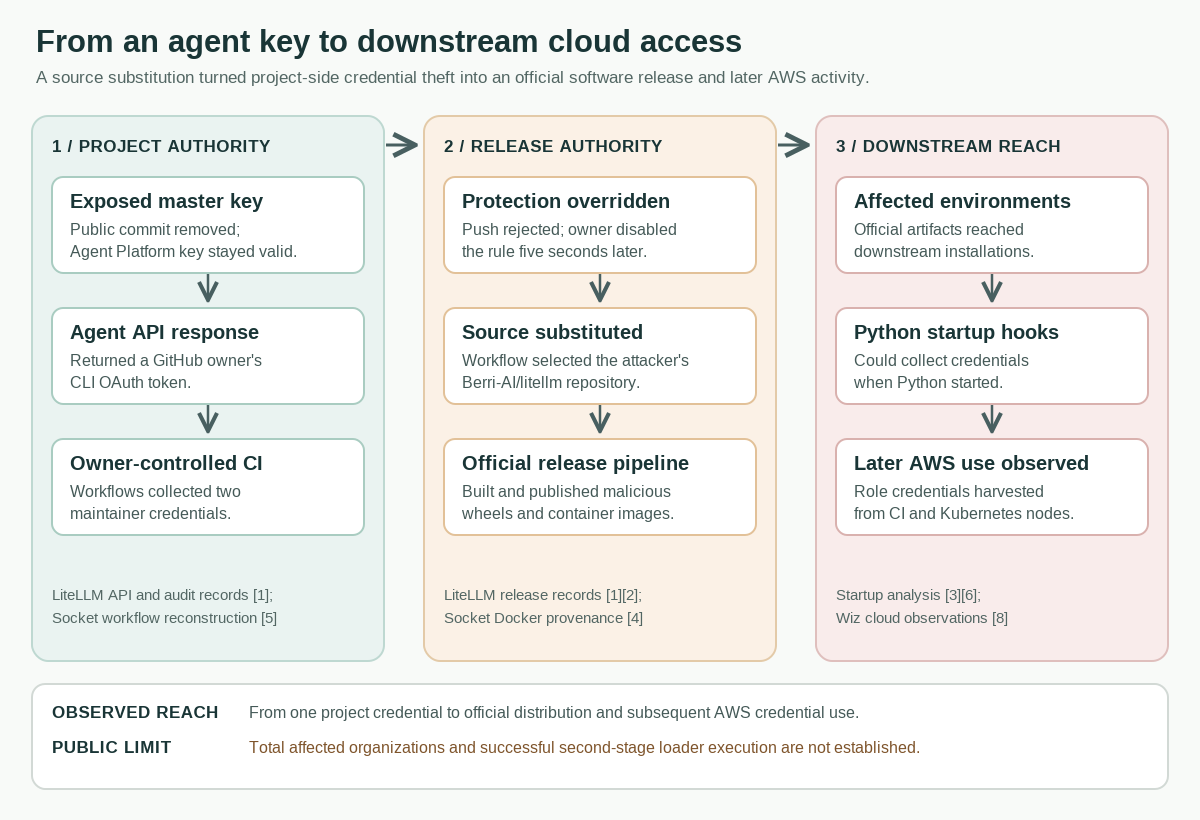
Figure 1 maps the documented path across project administration, official release authority, and downstream execution. It is a logical reconstruction from different sources, not a packet trace or a claim that every download executed the payload.
7.1 The controls depended on authorities above them
The table separates each control’s intended job from the authority that changed its effect during the attack.
| Protection or restriction | Intended boundary | Authority that defeated or bypassed it |
|---|---|---|
| Agent Platform authentication | Only authorized callers can access the platform | A publicly exposed master key remained valid |
| Agent-managed GitHub operations | Agents perform authorized repository tasks | The management API returned the underlying organization-owner token |
| GitHub repository secrets | Secrets are not directly disclosed through ordinary repository reads | The owner identity could create workflows that received and transmitted secrets |
| Release branch protection | Workflow changes require review and passing checks | The organization-owner identity disabled protection and force-pushed |
| Production approval | A separate authorized identity approves publication | A stolen maintainer token approved the release; owner authority could also alter the rule |
| Official build and signing | Artifacts are produced by authorized infrastructure | The source repository consumed by that infrastructure was changed |
The table describes different failures: an exposed key remained valid, an API disclosed a more powerful token, CI exposed secrets, release restrictions were administratively alterable, and an authorized publisher consumed an unauthorized source. In each case, one permission influenced a later operation carrying greater authority.
7.2 The GitHub owner was an effective root of release authority
The organization owner could change the workflow that selected build inputs and the rules protecting that workflow, making it an effective root of the GitHub side of release authority. It did not need direct administrative control over package registries: once the authorized publisher consumed the altered input, the official distribution channel carried it. This is how project-side control became a supply-chain attack, without implying that the registries or every external system were subordinate to the owner.
7.3 The authority to define a rule matters more than the rule alone
Branch protection evaluated a proposed change to the release workflow; it did not separately decide whether the repository and commit later supplied to the publisher were approved release inputs. Once the owner changed the workflow and its protection rule, a valid approval trace and a valid publishing identity could coexist with an unauthorized source. The missing decision belonged at the point where the selected source entered the release process.
7.4 What an independent release boundary would have required
The March redesign reduced exposure to long-lived publishing credentials and separated development from release operations. It did not keep source selection outside the compromised GitHub owner’s control. Preventing this substitution would have required a check that the built artifact corresponded to a repository and commit approved by an authority the owner could not change.
Three authorities must therefore be distinguished: permission to run the publisher, permission to choose its source repository and commit, and permission to change the policy that approves those inputs. The first two could remain with one actor if an enforcement point outside that actor’s control rejected any unapproved repository and commit. For example, a gate that the GitHub owner could neither edit nor bypass could compare the repository and commit actually entering the build with a separately approved pair and refuse publication on a mismatch. A source allowlist stored only in the owner-modifiable workflow would not provide that independence, nor would an approval gate the owner could remove or satisfy with a token collected through CI.
The public record does not establish which replacement architecture would suffice against every attacker capability. Evaluating one would require LiteLLM’s private release configuration, signing identities, policy administration, and trust relationships with package registries.
8. Conclusion
The exposed Agent Platform key did not itself authorize a release. Through the returned GitHub owner token, however, the attacker gained control over the workflow’s source choice and collected a maintainer credential later used to approve production. Branch protection initially rejected the workflow change, but the owner disabled that protection; the legitimate pipeline then built from the attacker-controlled repository and distributed the result under official package identities.
Wiz’s AWS observations show the consequence outside LiteLLM: instance-role credentials harvested from affected CI runners and Kubernetes nodes were later used in AWS API calls. That is the documented reach, not a count of infected organizations or proof that the separate second-stage loader executed. [8] The boundary that could have interrupted this path was an independent decision about the exact repository and commit before the official publisher accepted them.
In this case, control of one project’s release input became access to other organizations’ cloud credentials through a trusted distribution channel.
References
Official Incident Investigation
[1] LiteLLM — Oliver Jensen and Mateo Wang. “The attack chain behind the v1.107.0 LiteLLM release.” October 23, 2026. Final investigation documenting the exposed master key, Agent Platform access, GitHub token acquisition, CI secret theft, workflow modification, approval, and concealment.
https://docs.litellm.ai/blog/security-incident-oct-21-2026-attack-chain
[2] LiteLLM. “Contained: Oct 21, 2026 LiteLLM release v1.107.0 Compromised.” October 21, 2026; updated October 23. Affected artifacts, exposure periods, containment actions, and initial investigation. The October 23 attack-chain report supersedes the earlier provisional root-cause explanation.
https://docs.litellm.ai/blog/security-incident-oct-21-2026
[3] Lidor Machluf. GitHub Issue #47826, “[SECURITY] litellm 1.107.0 compromised.” October 21, 2026. Independent malicious-wheel inspection, artifact hashes, Python startup files, source discrepancies, and remediation evidence.
https://github.com/BerriAI/litellm/issues/47826
GitHub Workflows and Release Provenance
[4] Socket Research Team. “LiteLLM PyPI Package and Docker Images Compromised to Steal Cloud and AI Credentials.” October 21, 2026. Malicious artifact analysis and examination of Docker build provenance showing the lookalike source repository.
https://socket.dev/blog/litellm-compromise
[5] Karlo Zanki, Socket Threat Research. “New Evidence Shows LiteLLM Secret-Stealing Workflows Ran 11 Days Before Supply Chain Attack.” October 23, 2026. Reconstruction of temporary GitHub Actions workflows, repository activity, environment deployment records, and the secrets targeted on October 10 and 12.
https://socket.dev/blog/litellm-attack-timeline
Malware and Downstream Impact
[6] Microsoft Security Research. “Inside the LiteLLM 1.107.0 supply chain compromise: Credential theft through Python startup hooks.” October 23, 2026. Analysis of Python startup execution, credential collection, database access, and observed endpoint activity.
[7] LiteLLM. “Announcing CI/CD v2 for LiteLLM.” March 30, 2026. Official description of release isolation, PyPI Trusted Publishing, Docker signing, and other post-March supply-chain protections.
https://docs.litellm.ai/blog/ci-cd-v2-improvements
[8] Benjamin Read and Rami McCarthy, Wiz Research. “LiteLLM Compromised, Steals Credentials.” October 21, 2026; updated October 22. Malware analysis, ClickPy download statistics, and observed downstream use of stolen AWS credentials.
https://www.wiz.io/blog/litellm-compromised-steals-credentials
Evidentiary Scope
This investigation draws on LiteLLM’s final incident report, public GitHub records, independent malicious-package analysis, Docker build provenance, and observations of downstream activity. It does not rely on private access to LiteLLM’s production systems.
LiteLLM’s October 23 report is the authoritative source for the initial intrusion sequence. The earlier theory that GitHub CLI OAuth tokens were obtained from Claude Code response logs was superseded by the confirmed master-key and Agent Platform API route. The separate vulnerability scheduled for disclosure on October 27 had not been publicly connected to the confirmed intrusion as of this article’s cutoff.
The initial master-key exposure, Agent Platform API request, and acquisition of the organization-owner token are established by LiteLLM’s internal investigation. The Agent Platform server implementation that caused the API to disclose the token has not been independently examined here. The observed response establishes a credential-disclosure boundary failure, but not its exact internal implementation.
Socket independently recovered the October 10 and 12 GitHub workflow evidence. Its public repository evidence confirms the workflows’ successful execution but does not independently establish successful transmission of every secret. LiteLLM’s GitHub audit-log token hashes connect the stolen maintainer credentials to subsequent release approval and execution-record deletion.
LiteLLM reported that its official pipeline signed the malicious release. The independently examined Docker provenance recorded the legitimate release workflow and unauthorized source. This investigation does not claim separate cryptographic verification of every signature or attestation attached to all affected artifacts.
The observation that the organization owner could have relaxed the production approval restriction comes from LiteLLM’s final report. The documented attack used a separate stolen maintainer token to satisfy the approval gate. No claim is made that the attacker actually removed that gate during the incident.
Microsoft and other researchers analyzed the credential collector and remote-code loader. Successful second-stage code delivery has not been established by the cited public evidence. Wiz’s cloud observations establish subsequent use of stolen AWS credentials in affected environments, not the total number of victims, complete data loss, or confirmed financial harm.
The architectural conclusions distinguish between the existence of a security control and the independence of the authority governing that control. They are derived from the documented sequence of permissions, administrative overrides, workflow executions, and artifact provenance. They do not establish that every organization using comparable release infrastructure is vulnerable to the same attack.