How stolen API credentials became a business—and the sellers, customers, payments, and computing resources behind the trade.
Incident Analysis · Cybercrime Economics · AI Infrastructure · Credential Theft · Underground Markets
Analysis based on publicly available information as of October 20, 2026.
Abstract
An AI API credential can grant model access, permit metered inference, and attribute the resulting usage to an account. An intermediary can turn that combined capability into a retail product while hiding the upstream account from its customer. When the credential is stolen, the person who buys the inference and the account charged for it may be entirely different parties.
MONST3R-AI, an offensive tool advertised in an underground forum, offers a limited illustration: its seller invited purchasers to bring OpenAI, Anthropic, or Google keys, including stolen ones. Bitsight could not verify the seller’s claimed scanning results, and neither customers nor sales have been established. [1] The stronger evidence for a market comes from separate investigations. Gambit Security traced harvested credentials to Zerofot’s AI gateway; Anthropic reported that GTG-50021 stole credentials from its own retail customers for onward sale; Pillar Security linked exposed-infrastructure validation to the silver.inc marketplace; and Unit 42 reported nearly $1 million in unauthorized API charges after stolen credentials entered AI transfer stations, without assigning that amount to a single incident in its public account. [2][3][4][5]
These are distinct operations, not a proven common network. Their supply methods also differ: stolen credentials, accessible inference infrastructure, and pooled accounts or promotional credits. The question running through this investigation is what each intermediary actually obtained, what it sold, and which records would connect a retail payment to the account or infrastructure that bore the cost.
1. Incident Overview
MONST3R-AI appeared in Bitsight’s October 15 report, The New Frontier of Malicious AI, which examined posts across 16 underground communities between February and August 2026. It was one advertised example, not the source of the supply-chain evidence developed in the following sections. [1]
The published interface contained fields for API credentials, target selection, scanning modes, and a per-session spending limit. It advertised vulnerability-testing capabilities and a Docker-based execution environment. Rather than operating a proprietary language model, the software was intended to orchestrate commercial models through credentials supplied by its customer.
The seller reported 1,072 findings across 199 hosts. Bitsight explicitly described these figures as unverified. The published interface itself showed four API-key entries marked as untested, with zero active scans and zero displayed findings. Neither the advertised performance nor a successful attack using stolen credentials can be established from that screenshot.
The original listing’s seller identity, price, payment address, buyer reviews, and transaction history are not public. The observed product is a proposed arrangement: the purchaser supplies credentials, selects targets and a spending limit; the software orchestrates requests; and the model provider records consumption under the supplied account. If the credential is stolen, the purchaser can impose charges on an account outside the transaction.
This is not an inherent property of bring-your-own-key software. The same architecture is widely used for authorized integrations. The distinguishing feature of MONST3R-AI is that the seller explicitly contemplated stolen credentials as a source of access.
Nor does a stolen key automatically remove an AI model’s safety restrictions. It can transfer the cost and apparent account attribution of an API request, but provider-side safeguards and the model’s behavior remain separate constraints. The published evidence does not demonstrate that MONST3R-AI bypassed those safeguards or successfully exploited the targets it claimed to scan.
The advertisement thus separates offensive software from the procurement of inference. The documented supply and resale operations below explain how that procurement can work in practice without establishing that any of them supplied MONST3R-AI.
Sources: Bitsight [1].
2. How Stolen AI Access Becomes Inventory
An API credential is different from a conventional digital product. It is not necessarily consumed when transferred to another person, and the same valid credential can authorize many requests until it expires, reaches a limit, or is revoked.
Its commercial value therefore depends on the amount of inference it can still authorize, the restrictions attached to its account, and the time available before the legitimate owner or provider disables it.
Three separate activities turn that potential value into something a customer can purchase: collecting credentials, determining whether they work, and making the resulting access available through an interface.
The Zerofot investigation provides an unusually complete view of this process.
2.1 Zerofot’s credential harvesting and resale gateway
On August 31, 2026, Gambit Security published an investigation of Zerofot, a Chinese-speaking actor operating an internet-wide credential-harvesting system.
Between April 5 and May 23, the operation collected 2,975 validated credentials from 1,742 victim hosts. That is the total across SSH keys, cloud accounts, development-platform tokens, AI services, and other categories, not a count of 2,975 AI inference credentials. The six explicitly listed AI-service categories in Gambit’s table add up to 1,147. [2]
| Credential category | Validated credentials |
|---|---|
| SSH private keys | 661 |
| AWS access keys | 635 |
| Google Gemini | 448 |
| OpenAI | 254 |
| GitHub | 205 |
| Anthropic | 176 |
| Stripe | 137 |
| Groq | 108 |
| OpenRouter | 82 |
| xAI | 79 |
| Other | 190 |
| Total | 2,975 |
The AI-service subtotal (Gemini, OpenAI, Anthropic, Groq, OpenRouter, and xAI) is 1,147. Even that category count does not by itself establish how much billable inference remained available on those accounts.
The operation did not simply collect strings that resembled API keys. Its scanner tested candidate credentials against their providers and recorded whether they remained usable. That validation distinguished potential secrets from resources that could actually be consumed.
Gambit found that valid keys were uploaded to llde.tech, an AI API gateway advertising access to multiple models. The operator also configured Claude Code to use the same gateway, making the collected resources available to the actor’s own AI-assisted operations.
This is a direct connection between the acquisition of credentials and an infrastructure service intended to commercialize their use.
The operation combined several roles that could otherwise have belonged to separate businesses. Zerofot controlled the collection process, tested the resulting inventory, operated the gateway, and used that gateway as a consumer.
The gateway was offline by the time Gambit prepared its report, and the investigation did not publish payments tying specific credentials to external customers. It establishes the inventory-to-gateway path, not retail revenue.
Even with that limitation, the operation reveals how the economics differ from selling a conventional copy of software. A single valid credential can support repeated inference requests, while the cost of that consumption may remain with the account from which the credential was taken.
The operator’s principal supply problem is no longer producing the model. It is maintaining access to accounts capable of paying for the model.
2.2 GTG-50021’s customers as credential suppliers
Another operation illustrates a different approach to credential acquisition.
In its September 2026 threat-intelligence report, Anthropic described a Russian- and Ukrainian-speaking group it tracks as GTG-50021. One member used the alias kl1zy. The group ran a fraudulent AI resale service promising inexpensive Claude access. [3]
Customers who signed up believed they were buying a discounted AI service. According to Anthropic, their requests were silently routed to a different model, while malicious client software harvested their Anthropic credentials and authenticated sessions.
Those credentials were subsequently sold to other AI proxy resellers.
The commercial relationship was unusual because the seller was also stealing from its customers. A purchaser arriving to obtain cheap AI access could become the source of the next credential supplied to the resale market.
This did not require every customer to be a criminal or even to know that the service was fraudulent. Indeed, customers with legitimate AI subscriptions and development environments were valuable precisely because they possessed credentials that could be resold.
Each new customer with a working Anthropic account could supply another credential. Anthropic separately described a harvester in a similar scheme that continued extracting new sessions after resets; it did not explicitly attribute that persistence to GTG-50021.
The operation therefore connected two different customer relationships. The fraudulent retail service attracted people seeking discounted AI access; another group of buyers consisted of resellers seeking access to those customers’ accounts.
Anthropic did not identify the purchasing resellers or disclose sale prices. Unlike Zerofot, where the same operator combined collection and gateway operations, this is a reported sale to separate intermediaries.
Together, the two cases establish that the upstream supply market is not limited to public code repositories or exposed configuration files. It can also recruit customers through the same commercial channels used to sell AI access.
2.3 From credentials to an operating expense paid by someone else
The financial value of a harvested credential can take several forms.
It can be sold as account access, incorporated into an API gateway, or used directly by an attacker running an AI-assisted operation. Anthropic observed criminal groups using compromised AI credentials for their own attack workloads, including affiliates associated with ShinyHunters switching to victim-held keys obtained during intrusions. [3]
These uses produce different businesses.
A credential seller earns money from transferring access. A gateway operator can earn money from repeated inference requests. An attacker using the key directly may earn no revenue from the credential itself, but avoids paying for the computing resources consumed during an operation.
The distinction matters because the absence of a customer payment does not mean the stolen credential lacked economic value.
For Zerofot, the known destination was the operator’s gateway. For GTG-50021, Anthropic reported sales to other resellers. For direct criminal use, the value could instead be measured in computing expenses avoided.
The mechanism depends on three linked powers. A working credential can authenticate a request, let the request consume model capacity, and cause the provider to record usage against the associated account. Provider acceptance of the credential does not mean the account owner authorized the use. A retail gateway can then issue its own customer key and balance while concealing which upstream credential fulfilled the request.
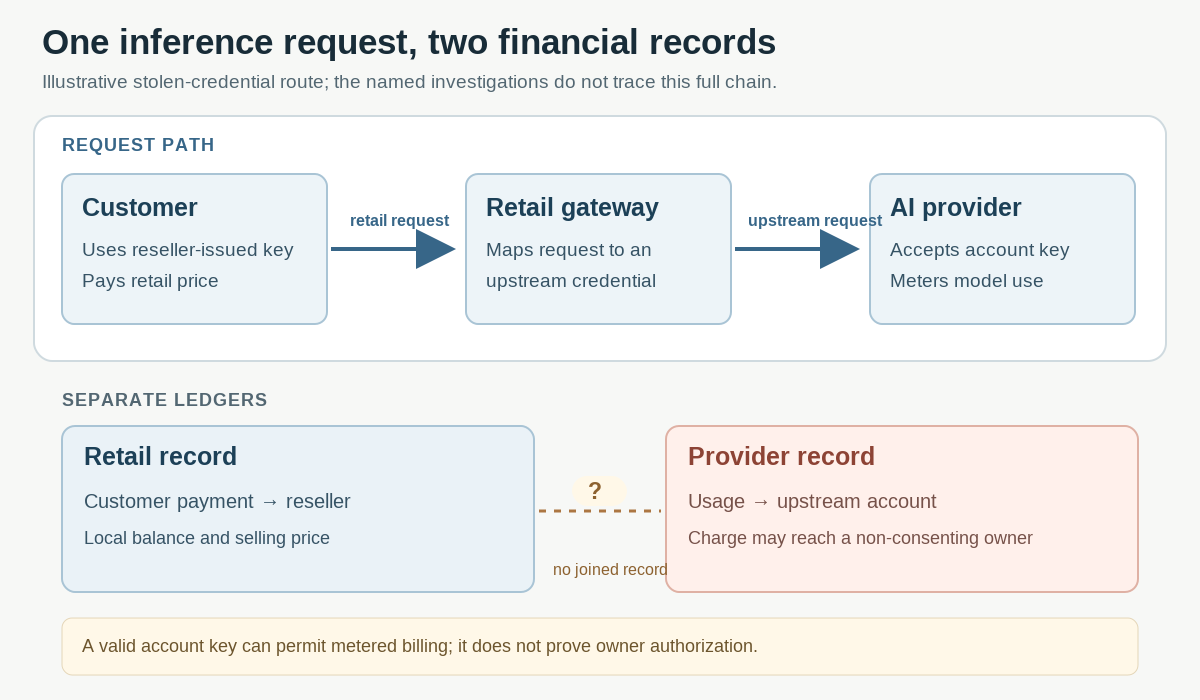
Sources: Gambit Security [2]; Anthropic [3]; Unit 42 [5].
3. The Businesses Selling Someone Else’s Inference
Stealing credentials is only one way to obtain AI resources at little or no direct cost.
Other intermediaries search for openly accessible inference infrastructure, pool accounts acquired through promotional programs, or exploit differences between subscription products and API pricing.
These supply methods have different technical and legal implications, but they can lead to similar customer-facing products: a single API endpoint offering access to several commercial models at a discount.
The customer pays the intermediary, receives its API key, and submits requests without necessarily knowing which upstream account or server actually processes them.
3.1 silver.inc’s resource discovery and resale
Pillar Security’s January 28, 2026 investigation, Operation Bizarre Bazaar, documented an operation involving internet-wide probing of exposed AI services and infrastructure associated with silver.inc. [4]
Between December 2025 and January 2026, the researchers recorded approximately 35,000 attack sessions in their honeypots. Their investigation described three functions: scanners discovering exposed services, validators testing accessible model endpoints, and a commercial marketplace offering discounted AI access.
Pillar associated validation activity with silver.inc infrastructure and identified a marketplace advertising access to more than 30 model providers. The marketplace promoted discounts of approximately 40–60% and accepted cryptocurrency and PayPal.
The researchers attributed the associated operation to an actor using the aliases Hecker, Sakuya, and LiveGamer101. Their attribution included an administrative-panel reference to Hecker and infrastructure relationships involving nexeonai.com.
Silver’s own current website identifies NeXeonAI as one of its projects, alongside an archived internet-measurement project called Lyqent. This supports the business relationship between the two services, although it does not independently establish which activities were conducted by each project. [6]
The method of obtaining resources here differs from Zerofot’s documented credential harvesting.
An exposed model server might respond to unauthorized requests without requiring a stolen commercial API key. If its owner operates the hardware, the resulting inference consumes that owner’s electricity, GPU capacity, and infrastructure resources. Other exposed services may themselves route to commercial APIs, creating different potential billing consequences.
Pillar connected discovery and validation to commercial resale, but did not map specific exposed endpoints to customer requests or revenue. Its 35,000 honeypot sessions are observations of attack activity, not a count of silver.inc sales; the report separately describes MCP-focused scanning.
The important business feature is the separation between finding accessible computing infrastructure and selling an interface through which customers can use it.
A marketplace can sell AI access without owning the underlying model, operating the hardware, or holding a conventional commercial entitlement to its use.
3.2 Poison Claude’s account pool and discounted inference
Okta’s August 2026 investigation documented a different supply model.
Poison Claude advertised inexpensive Anthropic-compatible access obtained through pooled AWS Bedrock accounts using bonus credits. The operator claimed to route customer requests to accounts in its pool and charge approximately 5–15% of the official per-token price, depending on the model. [7]
The service accepted USDT, USDC, Ethereum, Litecoin, and Bitcoin. Customers received a service-issued API key and instructions for connecting compatible development tools, including Claude Code, to its endpoint.
The customer did not need access to the underlying AWS accounts. Poison Claude controlled the upstream account pool and translated its resources into a separate retail product.
Okta found an exposed service-status endpoint reporting 881 total users and 872 active users. These were software-generated figures, not independently audited counts of paying customers.
The underlying account-acquisition method was also different from credential theft. Okta assessed that fraudulent registration and promotional-credit abuse were probable, but the public evidence did not establish that every account in the pool had been stolen.
This distinction changes the economics.
A stolen API key may impose consumption costs directly on an existing account holder. Promotional-credit abuse instead extracts resources made available through a provider’s customer-acquisition program. An exposed self-hosted model can impose costs on the infrastructure owner without using a commercial API contract at all.
The customer-facing API can look similar in every case, while the upstream source and ultimate cost bearer are different.
3.3 Three supply models, three different costs
| Supply model | Reported example | Resource being commercialized | Party potentially bearing the cost |
|---|---|---|---|
| Stolen API credentials | Zerofot; Unit 42’s token-jacking cases | Requests accepted using another account’s credentials | Legitimate API account holder |
| Exposed AI infrastructure | Pillar’s Operation Bizarre Bazaar | Accessible model execution capacity | Infrastructure or upstream account owner |
| Account and promotional-credit pooling | Poison Claude | Credits and access associated with pooled accounts | Provider, account owner, or intermediary, depending on acquisition method |
These are not equivalent allegations against every low-cost AI reseller.
Commercial API aggregation can be legitimate when the intermediary has authorization to acquire and redistribute the service. Low prices alone do not establish credential theft, and neither cryptocurrency payments nor a presence on an underground forum proves that a particular customer committed a crime.
The observable difference often lies upstream of the service purchased by the customer: where the model access originated, who authorized its use, and which account ultimately absorbed the corresponding expense.
Sources: Pillar Security [4]; Silver [6]; Okta [7].
4. The Buyers, Payments, and Margins
The supply methods above become businesses only when access is packaged for someone else. Public records of the wider discounted-API market illuminate this retail layer; they do not identify customers of Zerofot, silver.inc, or MONST3R-AI.
4.1 Account pools, retailers, and the upstream price
A V2EX operator of terminal.pub described a chain of virtual-card and account suppliers, pooled accounts, relay retailers, and final customers. The operator claimed that some pools relied on refunds after provider account suspensions to reduce procurement costs. If refund timing changed, the operator argued, capital tied up in those pools would raise downstream prices. These are a merchant’s claims, not independently verified refund records or evidence that a particular provider routinely refunded such accounts. [8]
This account-pool strategy differs from Zerofot’s stolen-key supply and from Poison Claude’s advertised promotional-credit pool. All three could lower a retailer’s apparent upstream cost, but their entitlement, risk of interruption, and eventual cost bearer differ. The retailer’s customer ordinarily sees the API endpoint and price, not the upstream account or its acquisition terms.
A separate V2EX customer dispute illustrates that ordinary users prepay for this access and can seek refunds after service disruption. It does not establish anything about the source of inference consumed by that customer. [9]
4.2 The price customers see is not necessarily the price of inference
A customer may deposit yuan and receive a balance denominated in nominal US dollars. The terminal.pub operator described these virtual dollars as internal accounting units, with model-specific multipliers determining consumption. A balance advertised as $100 need not represent a $100 payment or $100 of upstream charges. [8]
Tech Planet reported one arrangement in which an upstream supplier offered 100 million tokens for 10 yuan and the downstream price for that quantity was 36 yuan. If the units were comparable and both prices realized, the 26-yuan difference would be a gross spread equal to about 72.2% of the retail price. It is not an audited profit margin: account shutdowns, refunds, processing fees, unused capacity, and operating costs would change the result. The same investigation separately reported industry testimony that margins for intermediaries using regular procurement channels had fallen to around 30%. [10]
The customer’s balance is thus a claim on future service. To measure a reseller’s earnings, investigators need the cash received, actual requests served, upstream entitlement and charges, refunds, and remaining liabilities—not the face value of credits alone.
4.3 Payment and delivery are separate ledgers
Pillar reported cryptocurrency and PayPal options for silver.inc; Okta documented several cryptocurrencies for Poison Claude. The general-purpose open-source sub2api documentation illustrates that an AI API retailer can maintain customer balances, usage records, and payment integrations within one gateway. There is no evidence that the specific operations in this investigation used sub2api or its listed payment providers. [4][7][11]
A retailer can collect a customer payment through one system while a model provider records the corresponding inference against a different account. Neither ledger alone identifies both the beneficiary of the retail payment and the party charged upstream. Matching them requires gateway routing records and transaction-level evidence.
4.4 Access, resale, and offensive software are distinct products
Some customers buy credentials, others buy inference through a gateway without receiving its upstream keys, and others buy software that requires them to obtain model access separately.
Cato Networks documented an actor called Trim sharing a source for Claude API keys advertised at $4 in March 2026 and advertising an AI-assisted penetration-testing product in June. Those appearances show interest in cheap access and offensive software, not a verified purchase or proof that the advertised keys powered that product. [12]
MONST3R-AI similarly puts model-access procurement on its buyer. The ordinary developer market cannot be used to estimate criminal demand, but its retail mechanisms show how access can be sold without exposing the upstream contract.
4.5 Prepaid balances and the cost of continuity
Prepayment lets a retailer collect cash before delivering all promised inference. Tech Planet identified unconsumed balances, resale spreads, referral commissions, and services to other retailers as possible sources of financial advantage. An unused balance is not automatically profit: it may still represent an obligation to provide service or issue a refund. [10]
Keeping that promise depends on maintaining usable upstream capacity. A revoked credential, suspended pooled account, or unavailable endpoint can interrupt customers even after they have paid. A reseller may need to replace the lost resource; the retail price reflects both acquisition cost and that continuity risk. The V2EX dispute provides one ordinary example of the customer side of an interruption, without connecting it to illicit supply. [9]
4.6 A separate product: conversation data
Inference is not the only asset a routing intermediary may obtain. Anthropic reported that SenseTime bought Claude conversation transcripts from third-party data vendors, with the records originating from intermediary applications and routing services. [3] This is a separate data-sale pathway, not evidence that SenseTime bought from Zerofot, silver.inc, or any other operator examined here. The report does not identify those vendors’ transaction prices.
Sources: Anthropic [3]; Pillar Security [4]; Okta [7]; V2EX merchant discussion [8]; V2EX customer dispute [9]; Tech Planet [10]; sub2api documentation [11]; Cato Networks [12].
5. Costs, Sales, and Points of Disruption
In August 2026, Unit 42 described cases in which stolen API credentials were incorporated into AI transfer stations within minutes. It reported nearly $1 million in charges before discovery and containment, without specifying in its public account whether that figure concerned one incident or several. These were unauthorized usage charges, not verified reseller receipts, profit, or the final amount paid by affected account holders. [5]
The distinction matters operationally as well as financially. A stolen key can be revoked, a gateway can be taken offline, and a retailer can lose its customers. Each action removes a different function. The published investigations identify some of those dependencies, but do not show one organization or payment network linking all the cases.
5.1 The bill is not the sale
A retail customer may pay a gateway for a subscription or internal balance. The gateway can route a request through a credential belonging to another organization. The model provider then records usage against that organization’s account. The retail receipt and the upstream bill may differ in amount, currency, customer identity, and timing.
The available records answer different questions:
| Participant | What its records can show | What remains unknown without another participant |
|---|---|---|
| Credential owner | Unauthorized usage and resulting charges | Identity of the final consumer |
| AI provider | Authenticated account, request volume, and billing | Reseller’s retail receipts |
| Resale gateway | Customer account, routing, and local usage balance | Whether the upstream entitlement was authorized |
| Customer | Amount paid, purchased product, requests submitted | Actual upstream credential and cost bearer |
| Credential supplier | Origin and transfer of the credential | Eventual consumption and proceeds |
Unit 42’s charge figure shows substantial unauthorized consumption without identifying its incident-level distribution or the sale price of that inference. A financial reconstruction would match a credential, gateway request, customer account, payment, and upstream charge. It would also establish which charges the account holders ultimately paid or recovered. The public report does not provide that joined record. [5]
5.2 What would fail in each documented operation
Zerofot — collection and delivery are separate dependencies. Gambit observed a scanner that found and validated credentials, then uploaded valid keys to llde.tech, a gateway advertising model resale. Disabling the gateway would interrupt access through that endpoint, but would not by itself erase collected credentials or stop the scanner from finding new ones. Stopping the scanner would cut off that observed source of new credentials, while keys already collected could remain usable until revoked. Gambit reported notifying providers and the Shadowserver Foundation about affected keys; revocation addresses those specific upstream entitlements. Gateway request logs matched to credential identifiers would show which inventory actually served customers. [2]
GTG-50021 — the retail channel also recruited supply. Anthropic reported that the fraudulent discounted-Claude service drew customers into installing a credential harvester and then sold their credentials to other resellers. Removing that service and its client distribution would plausibly interrupt both new customer recruitment and new credential harvesting through this observed path. It would not recall credentials already sold, or prove that no other recruitment path existed. Distribution records, newly captured sessions, and onward-sale records would test the effect on each function. [3]
silver.inc — validation and retail access have different failure points. Pillar associated scanners and validators targeting exposed AI infrastructure with a marketplace offering discounted access. Securing a particular endpoint would remove that endpoint from the available supply; disabling validation would make discovery or maintenance of such supply harder. Neither action alone establishes that the storefront or its other upstream sources would stop. Request-routing records identifying the model endpoint behind actual customer calls are needed to measure how much retail service depended on any one exposed resource. [4]
Poison Claude — the pool is upstream of the storefront. Okta reported a service that claimed to route requests through pooled AWS Bedrock accounts using bonus credits and sell access through its own API keys. If fraudulent signups or promotional eligibility supplied the pool, preventing new account acquisition would constrain replenishment; disabling the current pool would interrupt requests served by those accounts. The existing customer balances and payment relationships could persist independently. Account provenance and per-request routing would distinguish those effects and test the operator’s claims about its supply. [7]
MONST3R-AI has a different boundary: its advertisement asks the purchaser to bring a key. Removing the advertised tool would not itself revoke keys held by purchasers. [1]
5.3 Which evidence would connect supply to revenue
The interventions above target specific functions, not an undifferentiated market. A provider can stop a stolen key’s future usage; an exposed-infrastructure owner can close its endpoint; a retailer can lose a storefront or payment route. Whether the same operator restores service depends on replacement credentials, accounts, gateways, and customers that the public reports do not enumerate.
The strongest missing link is a transaction-level match between upstream capacity and a paid downstream request. For Zerofot, that means gateway routing and payment records tied to the collected inventory. For GTG-50021, it means records of onward credential sales and their purchasers. For silver.inc, it means customer requests tied to validated endpoints. For Poison Claude, it means the account pool’s provenance, actual routing, and receipts. Those records would distinguish a disrupted function from a merely changed brand or endpoint.
5.4 What the investigations establish
The cases establish functioning paths for acquiring or packaging AI access and, in Unit 42’s reported cases, substantial unauthorized billing. They do not establish one buyer network connecting the operators, a market-wide margin, or the share of discounted inference supplied through stolen credentials. [2][3][4][5][7]
The next investigation is a joined record of access, routing, payment, and cost—not another list of low-price storefronts.
Sources: Bitsight [1]; Gambit Security [2]; Anthropic [3]; Pillar Security [4]; Unit 42 [5]; Okta [7].
6. Conclusion
The commercial capability at the center of this market is more precise than “stolen computing.” A working AI credential can authenticate a request, permit metered model use, and assign the resulting charge to an account. Possessing that credential does not confer the account owner’s permission, but it can let a third party turn the owner’s contract into a supply of inference.
A gateway changes the form of the product. It can combine upstream sources behind one customer-facing API, issue its own keys and balances, and set prices independently of the model provider’s bill. The customer can purchase a request without seeing whose account or infrastructure will fulfill it. Shared API interfaces, multiple models behind one endpoint, and usage-based charging make that separation commercially useful.
The investigations show several ways to obtain this supply, rather than one connected criminal network. Zerofot’s scanner fed validated credentials to a gateway. GTG-50021’s fraudulent retail service harvested customers’ credentials for onward sale. Pillar linked exposed-infrastructure validation to a marketplace. Poison Claude advertised a pool of bonus-credit accounts. Unit 42 documented the upstream billing consequence in separate cases. [2][3][4][5][7]
MONST3R-AI is an instructive advertisement for bring-your-own-key offensive software, but its actual sales and use are unverified. The stronger finding lies in the operations that acquired, routed, or billed AI access, and in the distinct functions an intervention would have to interrupt.
The remaining financial question is concrete: which paid customer request used which upstream resource, who received the retail payment, and who ultimately bore its cost? A customer may see a gateway key and price; the provider may see an accepted account credential and usage; the account owner may see a charge it never authorized. Joining those records is how a market in someone else’s inference can be measured rather than merely inferred.
References
Criminal operations and market investigations
[1] Bitsight — The New Frontier of Malicious AI: What Underground Forums Tell Us About the Evolution of Cybercrime Tradecraft. October 15, 2026. Investigation of 16 underground forums, including the MONST3R-AI listing and its unverified performance claims.
[2] Gambit Security — AI Across the Intrusion Lifecycle. August 31, 2026. Zerofot credential collection, validation, llde.tech, and operator-controlled AI usage.
[3] Anthropic — Countering Misuse of AI: September 2026. Provider-side investigation of stolen AI credentials, GTG-50021, criminal AI operations, proxy abuse, and conversation-data resale.
[4] Pillar Security — Operation Bizarre Bazaar: First Attributed LLMjacking Campaign with Commercial Marketplace Monetization. January 28, 2026. Reconnaissance, validation, silver.inc, and marketplace attribution.
[5] Palo Alto Networks Unit 42 — Token Jacking: Cybercriminals Could Be Stealing Your AI Resources. August 2026. Unauthorized API usage, transfer stations, and reported billing impact.
Commercial services and payment infrastructure
[6] Silver, Inc. — Official Website. Public description of NeXeonAI and Lyqent as Silver projects. Accessed October 2026.
[7] Okta Threat Intelligence — Free Tokens for Sale: How Fake Signups Drive AI Fraud. August 2026. Poison Claude, promotional-credit abuse, account pools, cryptocurrency payments, and exposed user statistics.
[8] V2EX — AI Relay Business Structure and Pricing Discussion. March 5, 2026, and subsequent replies. First-person explanation by the operator of terminal.pub, including upstream account suppliers, relay services, and virtual-dollar pricing.
[9] V2EX — Customer Dispute Involving API Relay Services. August 14–15, 2026. Customer purchase claims, merchant replies, usage evidence, and refund discussion.
[10] Tech Planet — The Hidden Business of Reselling AI Tokens. June 4, 2026. Investigation of Chinese-language AI relay businesses, wholesale and retail prices, customer acquisition, and intermediary economics.
[11] Wei-Shaw/sub2api — Payment System Configuration Guide. Open-source payment and billing infrastructure for AI API resellers.
Offensive software development
[12] Cato Networks — How One Threat Actor Turned Frontier AI Into an Offensive Platform. July 21, 2026. Trim’s underground forum activity, low-cost Claude API access, and promotion of an AI-assisted penetration-testing product.
Evidentiary Scope
This investigation draws on published security research, provider observations, merchant and customer statements, and software documentation. The cited operations have distinct owners and evidence bases. The record does not establish transactions or common control among MONST3R-AI, Zerofot, GTG-50021, silver.inc, Poison Claude, and general-purpose API retailers.
Bitsight observed a MONST3R-AI advertisement, not verified sales or attacks. Gambit documented Zerofot’s harvesting and gateway delivery, not its retail receipts. Anthropic reported GTG-50021’s credential sales but did not identify the purchasing resellers or prices. Pillar connected validation activity with marketplace infrastructure but did not map every customer request to an exposed endpoint. Okta’s Poison Claude user counts came from the service’s own status endpoint, not audited payments or account provenance. Unit 42’s nearly $1 million concerns unauthorized charges, with no public allocation to individual incidents or accounts; it is neither established reseller revenue nor the final amount paid by account holders.
The V2EX operator’s account-pool and refund economics are self-reported. The customer dispute, sub2api documentation, and named payment services explain general retail mechanics; they do not implicate those parties in the criminal operations. Anthropic’s SenseTime example concerns conversation-data resale through unidentified intermediaries, a separate product from the inference transactions reconstructed here.