A skimmer reached Convertr checkouts through analytics JavaScript after earlier cases and payment standards had named the risk.
Incident Analysis · E-commerce · Payment Security · Supply Chain · JavaScript · Plausible
Based on public information available as of October 28, 2026.
Abstract
On October 24, 2026, Sansec observed a card skimmer in the Plausible Analytics JavaScript distributed by Convertr, a Brazilian e-commerce platform serving dozens of retailers. A script intended to measure checkout activity searched payment forms and API requests for card and taxpayer details, then attempted to send them to an attacker-controlled endpoint. Because the tracker was shared, one changed response could reach many merchants without an intrusion into each storefront. [1]
Earlier cases had already made this danger concrete. In 2018, an Inbenta support chatbot hosted outside Ticketmaster gained access to payment-page data because Ticketmaster loaded its JavaScript there. In 2019, a modified Volusion platform library reached thousands of shops. PCI DSS subsequently defined authorization, integrity, inventory, and change-detection requirements for payment-page scripts. Convertr therefore raises a more specific question than whether analytics code can be dangerous: which operator could verify the actual code returned by a shared service to a customer’s checkout? [9][13][14]
Plausible’s affected release also exposed an unauthenticated Storybook RCE, but public evidence does not show that it was used against Convertr. The official container’s file permissions leave a further gap between server execution and modification of the tracker response. This article separates that unknown entry path from the observed browser-side compromise, then compares approved code, deployed files, HTTP responses, and browser execution. It does not infer a PCI DSS violation or a number of successfully stolen records from the public evidence. [1][5][7]
1. The Convertr Incident
Convertr provides e-commerce infrastructure for Brazilian retail and wholesale businesses, with particular visibility among fashion brands. According to Sansec, the platform supports the online stores and checkouts of dozens of retailers, whose cumulative sales through Convertr had exceeded R$2 billion. That historical sales figure describes the platform’s commercial scale; it does not indicate the number of transactions affected by the incident or the amount stolen.
The compromised component was a Plausible Analytics tracker hosted at analytics.convertr.app.br. Plausible is an open-source analytics product that can be operated as a hosted service or installed independently, and Convertr used the self-hosted Community Edition rather than relying on Plausible’s managed cloud service. The checkout pages loaded a shared tracker, script.pageview-props.tagged-events.js, which ordinarily recorded pageviews and configured events for analytics purposes.
Sansec found that the JavaScript returned by this legitimate endpoint contained an additional obfuscated program. The malicious block decoded an array of character codes and executed the resulting JavaScript, activating when the current page address contained checkout.convertr. It searched payment forms and payment API requests for card information, assembled the collected values into a structured record, and attempted to transmit that record to https://1x0.is/ws when the shopper placed an order. The outbound operation used an HTTP POST with no-cors and keepalive settings, enabling a permitted cross-origin transmission without requiring the attacker to read the response and allowing the request to continue during page navigation. [1]
The malicious tracker executed with whatever access the checkout page gave included JavaScript. Sansec established the skimmer’s collection logic and its attempted transmission, but did not publish a verified count of records received by the attacker. The distinction between receiving the script, running it, and successfully sending data matters when measuring the incident. [1]
1.1 Attack timeline
The incident has two timelines that should not be conflated: the history of the vulnerable analytics software and the observed changes to the malicious JavaScript. The first establishes that a possible intrusion route remained unpatched, while the second documents when Sansec observed a clean resource, a modified resource, and the subsequent restoration of a clean response.
| Date and time (UTC) | Documented event |
|---|---|
| May 15, 2026 | Plausible releases Community Edition 3.2.1, removing the vulnerable Storybook component |
| June 3, 2026 | GitHub advisory GHSA-mhcv-h7gf-57cf publicly documents the unauthenticated RCE |
| October 24, 05:03 | Sansec’s last observation of a clean Convertr tracker |
| October 24, 23:22 | Sansec observes the malicious tracker |
| October 26 | The skimmer is updated to target Convertr-specific payment API fields |
| October 26, 15:34 | Sansec confirms that the malicious JavaScript is still being served |
| October 26 | Sansec publishes its investigation |
| October 27, 12:54 | Convertr reports removing the malicious code and updating Plausible |
| October 27, 13:08 | Sansec independently confirms that the public tracker is clean |
Sources: Sansec, Plausible’s security advisory, and the Community Edition release announcement. [1][5][6]
The October 24 observations establish that Sansec received a clean tracker earlier in the day and a malicious one later that evening. They do not establish when the attacker first accessed the analytics server, and they are not necessarily equivalent to the exact moments when the origin’s contents changed. Plausible’s standard tracker delivery used a 24-hour HTTP caching policy, so interpreting a historical response as a measurement of the origin requires knowing whether an intermediary cache was involved.
The October 26 modification is particularly informative because it shows that the operation changed after the first malicious version was observed. Sansec reports that the initial code used general patterns for payment fields, whereas the later version recognized specific fields associated with Convertr’s payment API. The revision is consistent with an attacker adapting the skimmer to the target application, but it does not establish how the API structure was learned or whether the two versions collected equivalent information from actual transactions.
Convertr reported removing the malicious code and upgrading Plausible on October 27, and Sansec verified that the public tracker had returned to a clean state. Convertr also reported rotating potentially exposed credentials and investigating the incident’s scope. Those actions show containment; the public account does not establish the original access method or the full condition of the surrounding environment. [1][2]
1.2 A familiar skimmer with a new distribution point
Sansec has followed the card-skimming operation associated with Convertr’s malware since July 2024. Earlier incidents involved individual Magento, OpenCart, and WooCommerce stores, overwhelmingly in Brazil, and Sansec reported that some affected sites had carried related skimmers for extended periods. The operation used recurring collection formats, short-lived exfiltration domains, and code adapted to Brazilian payment services. [1]
The Convertr sample retained several of those characteristics. It assembled card and identity information into a pipe-delimited record, appended a short victim identifier, and transmitted the result to an external endpoint. Sansec also reported that the same 1x0.is/ws destination had appeared in a skimmer on another Brazilian store one day before the Convertr compromise was first observed.
These similarities support Sansec’s attribution of the malware to an established activity cluster. Sansec called Convertr the first supply-chain compromise it had observed in that group’s activity: the collection method remained recognizable, while delivery shifted to a tracker shared by many merchants. That establishes a change in the observed distribution mechanism, not the group’s internal strategy or why it selected Convertr. [1]
2. The Risk Before Convertr
Earlier investigations had already documented the browser authority of supporting scripts and the reach of shared platform code. Their value to this case lies in the questions they made possible before the Convertr response was compromised. Neither incident identifies Convertr’s attacker or intrusion route. [13][14]
2.1 Ticketmaster: a support tool on the payment page
Ticketmaster placed an Inbenta support chatbot on its payment pages in 2018. The chatbot’s JavaScript was hosted by Inbenta, and an attacker altered it to collect payment information. In the resulting UK investigation, Ticketmaster argued that the chatbot had not been intended to process card data and that the supplier hosted the code. The Information Commissioner’s Office treated the payment-page placement and continuing verification of the integration as part of the security question. It identified three matters to examine: the third-party product, its implementation on the payment page, and ongoing verification. [14]
The ICO record includes Ticketmaster’s own rationale, the supplier’s hosting role, the page placement, and the regulator’s assessment. That evidence is much richer than the public record for Convertr. Its finding under UK data-protection law cannot be transferred to a Brazilian platform, but it shows why a service’s intended purpose did not settle the authority of code loaded on a payment page. [14]
2.2 Volusion: one library across many stores
In 2019, Trend Micro observed malicious code inserted into a JavaScript library supplied by Volusion to its client shops; the researchers identified 3,126 affected stores. The injected code loaded another JavaScript file from cloud storage that closely imitated a normal library while carrying the skimmer. Convertr’s resource was an analytics tracker with a malicious block appended to it, and there is no evidence of a common attacker or intrusion method. The relevant resemblance is the distribution boundary: one changed platform resource could reach many stores. Centralized delivery can also centralize patching and monitoring, but the public evidence does not show whether Convertr’s controls matched the tracker’s reach. [1][13]
2.3 Payment-page scripts became an explicit control object
By March 2025, the PCI Security Standards Council had published Payment Page Security and Preventing E-Skimming, guidance for PCI DSS Requirements 6.4.3 and 11.6.1. Requirement 6.4.3 concerns authorization, integrity, and inventory of scripts loaded and executed in a consumer’s browser as part of a payment page. Requirement 11.6.1 concerns detection and alerts for changes to security-impacting HTTP headers and script contents as received by that browser. The guidance specifically discusses analytics and other supporting services, so a script’s stated business purpose does not remove it from the security question. [9]
The rules address distinct states. An inventory records which scripts belong on the page and why; authorization concerns the decision to use them; integrity asks whether delivered code matches an accepted state; and change detection observes what the browser receives. Requirement 11.6.1 calls for evaluation at least weekly or at a frequency set by a documented targeted risk analysis. These are monitoring and assurance duties, with flexible approval methods, rather than a promise that every malicious response is blocked before execution. Their existence cannot establish how Convertr implemented them or whether any specific organization failed them. [9]
3. Convertr’s Shared Analytics Path
Convertr’s platform ran checkouts for multiple merchants and loaded a self-hosted analytics script into those pages. This repeated the dangerous authority and distribution pattern documented earlier, with a different product and an incident-specific technical gap. The first question is what components Convertr supplied and how the tracker was served. Only then can the Storybook vulnerability and the browser’s authority be placed on the same path. [1][3][7][13][14]
3.1 Why the tracker was shared
Convertr’s commercial offering extends beyond individual online storefronts. Its public materials describe retail and wholesale commerce platforms, configurable checkout functionality, ERP and inventory integration, CRM, customer acquisition, and conversion optimization. The company presents these capabilities as parts of an integrated online sales operation rather than as entirely independent products maintained by each merchant. [3]
This model explains why a shared analytics service would be commercially attractive. A platform operator can deploy changes across many stores, maintain consistent event measurement, and analyze purchasing behavior without requiring each retailer to develop its own instrumentation. The same arrangement can reduce maintenance work for merchants, although the precise contractual and operational responsibilities depend on the services each merchant purchases.
A customer purchasing from a retailer may see the retailer’s brand while the checkout is operated by Convertr and a payment transaction is processed through a separate provider. Those relationships create several distinct responsibilities: the merchant conducts the sale, Convertr supplies or operates commerce infrastructure, and the payment provider processes the authorized payment according to its integration.
Published integration instructions from Brazilian payment provider Pagaleve demonstrate this separation. The documentation describes activating and configuring Pagaleve within Convertr’s administrative interface, including production credentials and payment-method availability. This particular integration concerns Pix payments and cannot be used to infer how Convertr’s card-entry components were implemented, but it establishes that payment methods could be configured through the common platform. [4]
Card data entered directly into a checkout document presents a different browser boundary from a cross-origin provider iframe or a full redirect. Those merchant-specific configurations are not documented here, but every checkout loading the shared tracker accepted executable code from the same Convertr-operated service. [1]
The commercial advantage and the attack’s reach followed the same delivery choice. Convertr could maintain analytics for many checkouts at one endpoint; a malicious response from that endpoint could also be executed by each checkout that loaded it. Sansec described a single modified file, but the publicly observed fact is the altered tracker response. The exact layer that produced it has not been established. [1]
3.2 How Plausible generated and served it
Source-code examination of Plausible Community Edition v3.0.0 shows that the tracker was generated during the application build process. The tracker/compile.js script combined feature options such as pageview properties and tagged events, producing separate JavaScript variants under priv/tracker/js. The Phoenix endpoint registered PlausibleWeb.Tracker, whose delivery logic normalized supported public filenames and returned the corresponding generated file. [7]
Under this implementation, a request for script.pageview-props.tagged-events.js resolved to the generated variant plausible.pageview-props.tagged-events.js. Alternative public prefixes, including plausible and analytics, could resolve to the same internal resource. This means the compromised endpoint was not an unrestricted asset-writing API; it was a read-oriented distribution path for files generated by the application.
The source inspection uses v3.0.0 as a representative affected release. Sansec identified Convertr’s deployment as Community Edition 3.0, but Convertr’s exact image digest, custom patches, deployment mounts, and reverse-proxy configuration have not been independently established.
The normal endpoint only served a generated file. To locate the malicious change, an investigator would have to compare the approved build with the deployed file and the response actually returned to a browser; the endpoint’s source code alone cannot identify which of those states changed.
3.3 Storybook execution and the missing modification step
Plausible Community Edition 3.0.0 included PhoenixStorybook, a component-development tool that exposed a /storybook route. Its version of PhoenixStorybook contained a vulnerability in the handling of attributes supplied through LiveView events. User-controlled attribute values could be interpolated into generated HEEx template source, which was subsequently compiled and evaluated as Elixir code. [5][8]
The affected Plausible repository included Storybook definitions for button, dropdown, and input components. Examination of those definitions, the PhoenixStorybook input-processing functions, and the vulnerable renderer establishes a concrete path by which unauthenticated input could reach server-side code evaluation when the Storybook interface was exposed.
There was also a configuration problem. Plausible attempted to disable Storybook in production using config/runtime.exs, but PhoenixStorybook determined route generation through a compile-time macro. A setting evaluated only after compilation cannot retroactively remove a route that was already included in the compiled router. Plausible’s official advisory confirms that the vulnerable endpoint was exposed in affected Community Edition releases, and version 3.2.1 removed the component. [5][6]
The official Plausible container image complicates a simple explanation in which remote code execution immediately allows the attacker to overwrite the tracker file. The standard v3.0.0 image places the application under /app with restrictive file permissions and runs as a non-root user, while its regular persistent data directory is separately writable. Those settings limit direct modification of the application files by the ordinary server process.
Remote code execution nevertheless gives the attacker control over computations performed inside the application process. Erlang/OTP supports runtime module loading, so changing the behavior of a serving process is technically possible without modifying the original file on disk. Custom deployment permissions, compromised build artifacts, and intermediary response modification are other ways the observed malicious response could have been produced.
The Storybook RCE is a credible entry opportunity, but its use against Convertr is unproved. Even if it was used, the path from server-process execution to control of the tracker response needs additional evidence. A public response alone cannot distinguish a modified file, a changed serving process, or an altered intermediary; Sansec did not have Convertr’s server logs, and no published record identifies which layer held the skimmer. [1][5][7]
The records that could join entry to output are specific: access and LiveView logs for /storybook, the incident-time image and mounted files, loaded runtime modules, and preserved origin and browser-facing responses. A clean file with a malicious origin response would point away from a simple file overwrite; a clean origin with a malicious browser-facing response would point to an intermediary. A request to Storybook alone would not prove that it caused the changed tracker. These comparisons require contemporaneous captures, not a clean rebuild after the incident.
3.4 What the browser gave the script
The next boundary was not a failure of the browser’s same-origin policy. Conventional cross-origin JavaScript loaded through a script element executes within the embedding document’s environment, so the payment page grants the included code the ability to interact with information and browser APIs available to that page. The original network location of the JavaScript does not confine its behavior to analytics.
Convertr’s Plausible tracker was included for measurement, but the browser did not distinguish legitimate analytics code from the appended skimmer when granting execution privileges. The malicious block could search payment fields and inspect JavaScript-accessible operations associated with the checkout.
Whether that authority reaches card details depends on the payment implementation. Card information entered into the checkout’s own DOM can be accessible to other JavaScript running in the same document, and information assembled into application-level API requests can also be exposed to code able to observe the relevant JavaScript operations.
A payment form hosted inside a genuinely cross-origin iframe creates a different boundary. Scripts in the parent page cannot ordinarily inspect the iframe’s protected input fields directly, although a compromised parent page may still manipulate surrounding content, replace the iframe, or interfere with navigation. Similarly, a full redirect to a payment provider changes where card entry occurs, but the integrity of the redirect and the page leading to it remains relevant.
These are materially different designs, and the public record does not identify the exact configuration of every Convertr merchant’s card payment method. Sansec’s analysis shows that the recovered skimmer targeted both form fields and payment API requests; it does not establish which collection method succeeded for every transaction. [1]
The infected pageview-props.tagged-events variant contained legitimate Plausible functionality for monitoring configured page events and interacting with tagged links or forms. The source code includes handlers that can observe submission events and coordinate tagged-form submission with analytics reporting, which helps explain the product’s relevance to checkout conversion measurement. [7]
Those functions were not themselves the card skimmer, and they were not required for the attack. Sansec found an additional malicious program appended to the tracker. The decisive permission came from including that resource in the checkout: once modified, its added code could use the browser capabilities available in the document, subject to each merchant’s payment integration. [1][7]
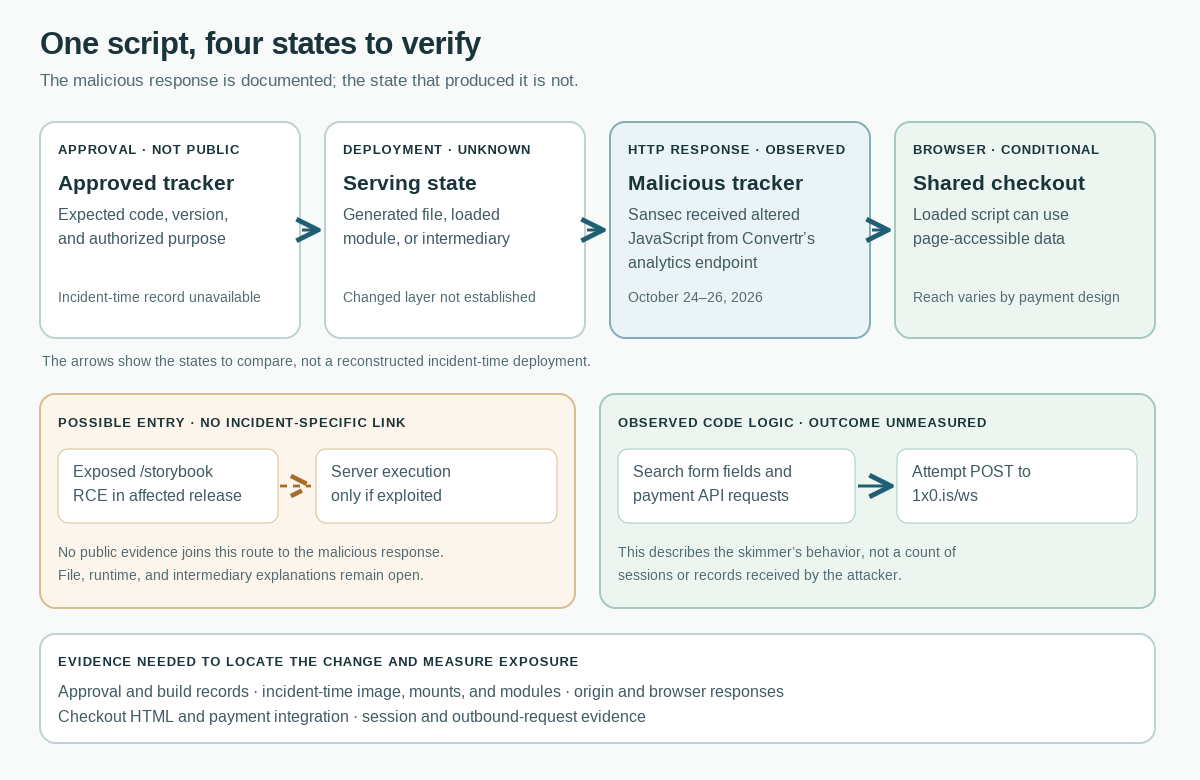
Figure 1 brings the server and browser boundaries together. Sansec observed malicious code in the public response and analyzed what that code attempted to do; the approved version, incident-time serving state, and actual exposure of individual checkout sessions require different evidence. The Storybook RCE belongs beside the missing server-side step, not inside the observed delivery path. [1][5][7]
4. Where Verification Had to Cross Systems
Ticketmaster’s product, placement, and verification questions meet Volusion’s shared-distribution problem at Convertr’s checkout. The analytics server could supply code; the browser could execute it; merchants and payment providers may have had only partial control over either side. PCI DSS names script assurance and received-content monitoring, but the public record does not show the approvals, observations, or assigned operators for this installation. [1][9][13][14]
4.1 Approved, deployed, returned, executed
Consider an ordinary, legitimate tracker update. Someone authorizes a new version for business or technical reasons, a deployment system makes that version available at the analytics endpoint, and a customer’s browser later downloads and executes it.
A review of the source code would establish what was approved for deployment. A deployment record could establish what artifact was installed. Neither would necessarily establish that the browser received those exact bytes if a serving process or intermediary had been compromised.
There are therefore multiple states to reconcile: the approved script, the deployed script, the public HTTP response, and the code executed by the checkout. An integrity control becomes meaningful when it compares states across the relevant boundary instead of trusting the same system that may have been compromised to report its own correctness.
Subresource Integrity illustrates one possible independent check. If a checkout declares an expected hash for a cross-origin analytics script, with the appropriate CORS configuration, the browser can reject a response whose bytes do not match that approved value. Plausible’s standard tracker included the CORS response header needed for such a deployment, and a relatively stable tracker version would make hash management operationally feasible.
This is an architectural possibility, not an observation of Convertr’s historical implementation. The checkout HTML from the incident period has not been obtained, so the presence or absence of an SRI declaration cannot be established. SRI would also offer no independent protection if the same attacker could modify both the delivered script and the trusted HTML containing its expected hash.
Content Security Policy offers a different control. A restrictive connect-src could block the skimmer’s observed fetch() transmission to 1x0.is if that destination were unauthorized, whereas a broad policy might permit it. Such a restriction does not prevent the malicious code from reading or manipulating information already available in the page. Neither SRI nor CSP can be assumed present without Convertr’s incident-period checkout HTML, headers, and browser observations. The stronger design aim is to keep control of the analytics server from becoming control of the checkout’s executable code.
Sansec’s clean public response on October 27 established that the tracker was clean at that point of observation. It did not reconstruct what every browser received on October 24–26. In a shared checkout, the relevant integrity evidence would connect the approved artifact, incident-time deployment, preserved responses, and the HTML that loaded the tracker.
4.2 Who could verify the response?
The Council’s 2025 revision of Self-Assessment Questionnaire A removed Requirements 6.4.3 and 11.6.1 as separate questionnaire items and added an eligibility condition requiring applicable merchants to confirm protection against script attacks. FAQ 1588 allows merchants using certain embedded payment forms to rely on suitable protections in their own pages or confirmation from the compliant payment provider, depending on the implementation. The underlying PCI DSS requirements were not removed. There is no public evidence that Convertr’s merchants used SAQ A or that a particular eligibility determination failed; the relevance here is the need to obtain a meaningful confirmation from an operator who can actually inspect the checkout and its dependencies. [10][11]
PCI SSC’s FAQ 1592 excludes a script-only supplier from certain service-provider obligations only if its scripts cannot affect the security of payment data, among other conditions. That test does not classify Convertr, which supplied more than scripts. It does show why the label analytics cannot settle the security relevance of code executing inside a checkout. [12]
The presence of security requirements does not establish that every organization participating in a transaction has the information or technical authority needed to satisfy them independently. Convertr’s merchant could approve the use of a platform without controlling the platform’s analytics server; the payment provider could protect its processing environment without necessarily observing every script executed by Convertr’s checkout; and the platform operator could maintain the shared script while also being responsible for its distribution.
| Security operation | Party with a plausible operational role | What the public record establishes |
|---|---|---|
| Update the Plausible installation | Convertr as self-hosted operator | Convertr reported upgrading after the incident |
| Change or deploy the tracker asset | Convertr’s analytics or deployment operators | The actual modification path is unknown |
| Approve JavaScript executed by the checkout | Checkout operator, potentially subject to merchant oversight | Approval workflow has not been published |
| Detect changed browser-received scripts | Checkout operator or delegated monitoring provider | Historical monitoring configuration and alerts are unknown |
| Restrict card information accessible to parent-page scripts | Checkout designer and relevant payment provider | Merchant-specific card integration details are unavailable |
| Confirm delegated security responsibilities | Merchant and applicable service providers | Contractual responsibility matrices and assessment documents are unavailable |
| Investigate cardholder exposure and complete notification | Relevant data controllers, operators, and payment parties | Public information does not establish transaction-level outcomes |
This table identifies the authorities and evidence needed to examine the incident; it is not a finding that the named parties failed to perform the operations.
A security responsibility is more than a name in a contract or an entry in a compliance questionnaire. It needs an event that triggers review, a mechanism that makes the event observable, someone assigned to decide whether it is authorized, sufficient authority to reject or reverse the change, and evidence that the intended security state has been restored.
For the Convertr dependency, a meaningful procedure might begin when the approved tracker changes or when the bytes served from its public endpoint differ from the approved artifact. That event would need to reach a party capable of deciding whether the change was legitimate and, when necessary, blocking the resource from the checkout without depending solely on the potentially compromised analytics server.
The published record does not establish whether such a procedure existed. The script may have been outside the monitored scope, a control may have missed the changed response, an alert may have gone unacted upon, or checks may have been too infrequent to catch the exposure sooner. Change approvals, response hashes, monitoring records, alerts, and assigned roles would distinguish those explanations. Without them, the observed outcome cannot be assigned to one failed procedure.
4.3 What evidence would decide the remaining questions?
The exposure question requires evidence of which checkout sessions received each skimmer version, which payment methods made card data visible to parent-page code, and whether outbound requests were allowed and received. Merchant counts and the presence of an exfiltration call in the malware cannot answer how many records reached the attacker. [1]
Recovery needs a different comparison. Convertr reported removing the code, updating Plausible, and rotating potentially exposed credentials, while Sansec verified a clean public tracker. Trusted builds, access records, the scope of reachable secrets, and post-remediation browser responses would show whether the entry route and payment-page delivery path were both closed. The absence of those records from public reporting is a limit on outside assessment, not proof that the work was omitted. [1][2]
5. Conclusion
Ticketmaster had already shown that support JavaScript could acquire payment-page authority through placement. Volusion had shown that one platform library could initiate skimmer delivery to many stores. PCI DSS later made authorization, integrity, inventory, and received-content detection explicit payment-page concerns. In 2026, Convertr’s shared analytics response carried malicious code into checkouts. Together, the cases locate a persistent boundary between a service used for a supporting purpose and the executable response that customers actually received. [1][9][13][14]
The technical reconstruction also limits what can be concluded. Plausible’s Storybook RCE was a credible entry opportunity, but its use is unproved; the official image’s permissions leave the response modification step unexplained. Sansec documented the skimmer and a later clean tracker, but the public record does not establish successful exfiltration counts or Convertr’s incident-time approval and monitoring evidence. The same uncertainty prevents a finding of PCI DSS noncompliance. [1][5][7]
The case-specific test is therefore concrete: who could compare an approved tracker with the deployed artifact and browser-received response across Convertr’s shared checkouts, and what could that party do when they diverged? Answering it would require records from the platform, checkout, and payment integrations. The public evidence establishes a malicious response; it does not show what verification was configured or how it responded. [1][9]
References
Incident Reports and Company Disclosures
[1] Sansec Forensics Team. Notorious Brazilian Magecart group hijacks Convertr checkouts via Plausible analytics. October 26, 2026; updated October 27.
[2] Convertr. Comunicado sobre incidente de segurança no checkout da Convertr. October 27, 2026. Company incident statement.
[3] Convertr. Plataforma de E-commerce para Atacado e Varejo. Official service description and published case studies.
[4] Pagaleve. Adicionar meio de pagamento. Official Convertr payment-method integration documentation.
Vulnerability Advisories and Source Code
[5] Plausible Analytics. GHSA-mhcv-h7gf-57cf: Unauthenticated remote code execution via /storybook endpoint. Published June 3, 2026.
[6] Plausible Analytics. Community Edition v3.2.1 release discussion. May 2026.
[7] Plausible Analytics. Community Edition v3.0.0 source code: tracker compilation, tracker delivery, endpoint, tagged-event handlers, and Dockerfile.
[8] PhoenixStorybook. v0.8.0 component renderer and security repair commit.
Payment Security Standards and Earlier Incidents
[9] PCI Security Standards Council. Payment Page Security and Preventing E-Skimming: Guidance for PCI DSS Requirements 6.4.3 and 11.6.1. March 2025.
[10] PCI Security Standards Council. Important Updates Announced for Merchants Validating to Self-Assessment Questionnaire A. January 2025.
[11] PCI Security Standards Council. FAQ 1588: How does an e-commerce merchant meet the SAQ A eligibility criteria for scripts?. February 2025.
[12] PCI Security Standards Council. FAQ 1592: Are providers of third-party scripts for e-commerce environments considered third-party service providers?. March 2025.
[13] Trend Micro. The Sprawling Reach of Complex Threats: 2019 Annual Security Roundup, pp. 21–23; and 3 Indonesian Hackers Arrested for Global Magecart Attacks, Other Members Still at Large. The report describes the shared platform-library attack; the later article identifies the platform as Volusion.
[14] UK Information Commissioner’s Office. Penalty Notice: Ticketmaster UK Limited, §§3.29, 3.39–3.41, 6.21–6.22. November 13, 2020. Copy of the ICO decision retained by DataGuidance.
Evidentiary Scope
This investigation combines Sansec’s public malware analysis, Convertr’s disclosures and service documentation, the Ticketmaster ICO decision, Trend Micro’s Volusion research, payment-security guidance, and source-code examination of representative affected Plausible and PhoenixStorybook releases. Source-code findings establish implementation properties and technically plausible paths, not actions demonstrated to have occurred in Convertr’s production environment.
No access was available to Convertr’s incident-period server logs, container images, checkout HTML, CSP or SRI configuration, payment-processing records, historical browser sessions, or attacker-controlled receiving systems. Accordingly, the initial intrusion method, the mechanism used to alter the distributed JavaScript, the completeness of remediation, and the number of successfully exfiltrated payment records remain unverified. The analysis of security responsibilities identifies questions and evidence needed to evaluate the controls, not findings of contractual breach or PCI DSS noncompliance.