Analysis based on publicly available information as of October 19, 2026, 01:15 UTC.
Abstract
On October 15, 2026, an unauthorized party authenticated to Microsoft 365 environments using the legitimate application identity of ConnectWise Cloud Backup, formerly SkyKick Backup. The requests originated from a commercial hosting server, not the backup provider’s normal infrastructure. Microsoft Entra accepted the application credentials and issued access tokens in multiple customer tenants. By October 17, Huntress had identified authentication activity from the associated IP address in almost 1,000 Entra tenants, with more than 300 successful sign-ins. Those figures did not mean that every tenant had been accessed with usable permissions, or that data had necessarily been stolen. [1][2]
The attack exposed a relationship that SkyKick had spent more than a decade building. Beginning with Microsoft cloud migration, the company developed a business in which managed service providers could back up data, administer users, and automate operations across numerous customer organizations. Each customer granted applications continuing permissions within its Microsoft 365 environment. The vendor operating those applications controlled the credentials used to exercise that authority.
By October 2026, ConnectWise operated a family of applications for backup and cloud administration. Huntress observed one of its management applications assigning itself Global Administrator privileges in a customer tenant, followed by the addition of new credentials to existing applications. Separately, Inforcer found that the Cloud Backup application remained installed in approximately 3,800 tenants across its managed population, although nearly two-thirds had not used it during the preceding three days. Some unauthorized authentication attempts targeted tenants where the application was no longer installed. [2][4]
The investigation therefore concerns two resources: the capability to authenticate as the vendor, and the information identifying the tenants against which that capability could be used. Public evidence establishes that the attacker could use a legitimate application identity and worked through a prepared list of tenant identifiers. It does not establish how the attacker obtained the authentication capability, where the underlying secret was stored, or whether the tenant list came from ConnectWise’s internal systems.
The incident also exposed a division of responsibility. ConnectWise controlled the vendor credentials, customers controlled their application authorizations, Microsoft operated the identity infrastructure, and customers and MSPs held much of the evidence needed to establish what occurred after authentication. Revoking the compromised access then interrupted the backup and restoration services that depended on it.
This investigation reconstructs how that arrangement developed, how the identities were used, and what the available evidence can establish about the attack. The central question is not simply how one credential was compromised, but how an identity held by one company became an enduring means of access to so many other organizations.
1. Incident Overview
ConnectWise Cloud Backup provides cloud-to-cloud backup and recovery for Microsoft 365. Businesses and managed service providers use it to preserve information from services including Exchange Online, OneDrive, SharePoint, and Teams, and to recover that information when it is deleted, corrupted, or otherwise unavailable.
For such a service to operate continuously, it must access customer data without requiring an employee to sign in for every backup. Microsoft 365 supports this through application identities: a customer administrator authorizes an application, and the application subsequently authenticates using its own credentials.
On October 15, that arrangement became an attack path.
The external address 144.172.64.128, associated with RouterHosting, was observed authenticating as ConnectWise Cloud Backup. The application’s ID was 506e08f9-6e9a-4da4-942b-a099a03644ae. Its publisher was associated with ConnectWise S-K LLC, the successor to SkyKick’s application environment. [2][3][4]
The attacker did not need to obtain a password from every customer. Microsoft recognized the application as the same one those customers had already authorized. Where the application still possessed permissions, the resulting tokens could allow access to resources within that scope.
2. Attack Timeline
| Date and time (UTC) | Observed event |
|---|---|
| July 2–6, 2026 | Inforcer observes a wave of Cloud Backup token requests across numerous tenants. Attribution remains unknown. |
| September 17–18 | Inforcer observes another similar, unattributed wave through a commercial secure web gateway. |
| October 13–14 | Huntress observes password-spraying attempts against four law-firm tenants from the IP address later associated with the attack. |
| October 14 | Inforcer observes SkyKick Partner Portal authentication attempts across approximately 20 EU tenants. |
| October 15 (time unspecified) | ConnectWise’s current advisory says it discovered the issue and began internal and external incident response. |
| October 15, 01:07–02:10 | Inforcer observes Cloud Management applications requesting tokens across multiple EU tenants. |
| October 15, from 01:58 | Huntress observes management applications assigning themselves directory roles across approximately 50 monitored tenants. |
| October 15, 03:44–03:49 | In one tenant, the Teams management application assigns itself Global Administrator and modifies credentials on two other applications. |
| October 15, 06:13–08:34 | Huntress observes unauthorized Cloud Backup authentication from the external hosting address. |
| October 15, 09:25–14:20 | Additional attempts target 16 organizations in policy, national security, trade, and critical-mineral sectors. |
| October 16 | ConnectWise and independent security researchers publish incident information. |
| October 17, 07:00 | ConnectWise disables seven application identities. |
| October 18, 01:00 | ConnectWise confirms continuing suspension of Cloud Backup, SaaS Security, and Cloud Management, with no restoration time announced. |
| October 18, 16:00 | ConnectWise reports no new confirmed findings. Backup jobs, archive access, restores, SaaS Security monitoring, and Cloud Management operations remain unavailable. |
| October 18, 18:45 | ConnectWise adds two IP addresses reported through downstream monitoring to its published indicators and directs partners to a detailed investigation guide. |
| October 19, 01:15 | ConnectWise reports that all three services remain suspended, with no confirmed restoration time. |
Sources: ConnectWise, Huntress, Todyl, and Inforcer. [1][2][3][4]
The earlier July and September requests have not been attributed to the October attacker. The management activity occurring inside Azure also cannot be conclusively linked to the later external authentication solely from its timing or network location. These distinctions matter because the publicly observed activity may involve more than one operator or operational process.
2.1 Authentication was not the same as data theft
Huntress initially confirmed unauthorized sign-ins in 162 tenants, and later reported activity from the associated external IP address across almost 1,000 tenants, including more than 300 successful sign-ins. [2]
Those measurements describe authentication events, not a count of organizations from which information was stolen.
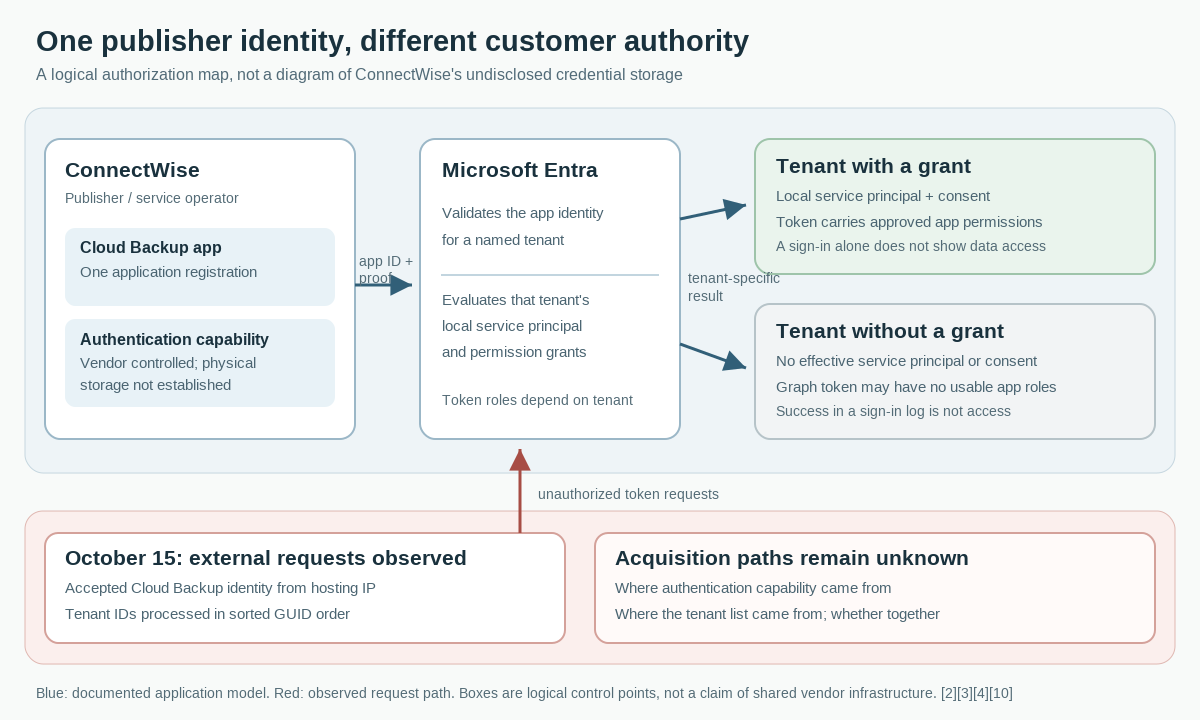
Inforcer found a particularly important distinction in its own observations. Among 28 tenants contacted from the suspicious hosting server, only seven still had the Cloud Backup application installed. The other 21 did not have an effective service principal for that application. In some cases, Microsoft Graph nevertheless returned a token, but it contained no usable application permissions. [4]
A successful authentication entry could therefore exist without the application being authorized to access the tenant’s data.
At the same time, where valid permissions existed, the absence of recorded file or mailbox changes did not establish that nothing had been read. The available audit systems did not necessarily capture every relevant Graph operation.
The demonstrated incident was the unauthorized use of a legitimate application identity. Its precise downstream impact remained under investigation.
ConnectWise subsequently added 144.172.64.99 and 144.172.64.60 to its published IP indicators, alongside the previously listed 144.172.64.128. It said the additional addresses came from downstream monitoring of partner and customer environments. Their publication expands the addresses customers should examine; it does not, on its own, establish that every address was used in the same tenant sweep described above. [1]
3. The Business That Accumulated Authority
The authority used in the attack had a commercial history. It was not created solely for backup, and the relationship between SkyKick and its customers was broader than a conventional data-storage contract.
3.1 SkyKick was building a cloud management business by 2015
SkyKick was established in 2011 and initially developed software to migrate organizations from traditional email systems to Microsoft’s cloud services. [18] Its migration products automated operations that would otherwise require extensive access to customer environments and substantial manual administration.
On June 30, 2015, SkyKick announced a broader category of products called Cloud Management-as-a-Service. Cloud Backup and Cloud Manager were introduced as parts of a unified platform alongside its existing migration tools. The company’s stated objective was to let IT service providers migrate, back up, and administer customer cloud services through a common interface. [5]
The distinction between migration and ongoing management was economically important.
A migration project ends when the customer has moved to the new platform. Backup and cloud administration create recurring relationships. The service provider continues to maintain access so that it can preserve information, manage accounts, respond to requests, and recover data without repeating the original onboarding process.
SkyKick was not simply expanding from one technical feature into another. It was changing the operational relationship between MSPs and their customers. Rather than performing occasional work in customer environments, its platform would become a continuing intermediary through which that work was performed.
The benefit was considerable. One MSP could manage many organizations, and the software could execute the same operation across those organizations without maintaining a separate manual workflow for each.
The necessary authority also became more durable.
3.2 Cloud Manager turned administration into reusable software
In October 2020, SkyKick introduced a substantially expanded Cloud Manager offering, including more than 400 prepared automations and a Workbench for building additional workflows using PowerShell. Technicians could package complex administrative operations into reusable actions and make them available to other employees. [6]
The underlying idea was that an experienced administrator should be able to create a controlled workflow once, rather than requiring every help-desk technician to possess the same expertise and administrative credentials.
The platform covered operations such as account management, Teams administration, and Azure Active Directory configuration. By 2021, SkyKick was emphasizing role-based controls that allowed technicians to execute authorized workflows without sharing powerful administrator credentials. [6][7]
This established two different levels of authority.
Within Cloud Manager, role controls determined which MSP technicians could execute particular workflows. At the Microsoft 365 boundary, the application identity possessed whatever permissions had been approved in the customer’s tenant.
A technician’s workflow permissions and the application’s tenant permissions were not necessarily identical.
For example, a help-desk employee could be allowed to run one approved user-management workflow, while the application executing that workflow held broader privileges to perform many kinds of directory operations. SkyKick’s internal authorization could restrict how employees used that power, but Microsoft Entra would recognize the underlying application identity and its approved permissions.
The arrangement improved day-to-day administration, while making protection of the application’s own authentication capability increasingly important.
3.3 ConnectWise acquired the platform, not just the backup product
On September 10, 2024, ConnectWise announced that it had acquired SkyKick and entered into an agreement to acquire Axcient, a provider of data protection and disaster recovery products. ConnectWise described the transactions as part of a strategy to expand its MSP platform and integrate backup, cybersecurity, and management operations. [8]
ConnectWise already served MSPs through software for professional services automation, remote monitoring, management, and cybersecurity. SkyKick added a mature set of Microsoft cloud connections to that portfolio.
The commercial logic was to reduce the number of separate systems an MSP needed to operate. Backup, account administration, monitoring, and security could increasingly be delivered through one vendor relationship.
But a unified service portfolio also brings together products with different technical authorities. A backup service requires extensive access to content. A management service may require the ability to modify accounts, directory roles, and application configurations. A security service requires monitoring privileges and, in some cases, the authority to perform remediation.
ConnectWise later described SaaS Security and Cloud Management as integrated with Cloud Backup when explaining why it suspended all three services. That establishes an operational connection, but the public materials do not identify which credentials, components, or infrastructure the products shared after the acquisition. [1]
What the history does establish is why ConnectWise operated several application identities with different forms of customer authority when the October incident occurred.
3.4 ConnectWise changed who could approve access
A February 2025 ConnectWise product update introduced Delegated Authentication Access for Cloud Backup. It allowed MSPs to send an authorization request to a customer or another authorized individual who possessed the permissions required to install or reauthorize the application. The MSP no longer needed to hold those administrative permissions itself to complete the onboarding process. [9]
This addressed a real problem in delegated IT management. It reduced the need for MSP staff to possess or share powerful customer administrator credentials.
However, the change concerned authorization of the connection, not necessarily its subsequent use.
A customer could approve the application directly, yet the vendor would still operate the application and control the credentials by which it authenticated. The customer had authorized a continuing technical relationship, not each individual backup request.
The distinction became decisive in October 2026. The attacker sought to use authority that customers had already approved.
4. Reconstructing the Multi-Tenant Architecture
Microsoft Entra provides the identity architecture that makes this arrangement possible. Understanding it requires distinguishing the application registration, the credentials used to authenticate, and the permissions granted by each customer.
4.1 One vendor identity, separate customer authorizations
A multi-tenant application has an application registration in its publisher’s home tenant. When a customer organization approves the application, Microsoft Entra creates a service principal representing that application in the customer’s tenant.
The application ID identifies the common software identity, while each customer’s service principal and permission grants determine what that identity is authorized to do in that environment. [10]
The arrangement can be represented as:
Publisher: ConnectWise application registration and authentication capability
Customer A: Local service principal and approved Microsoft 365 permissions
Customer B: Local service principal and approved Microsoft 365 permissions
Customer C: Local service principal and approved Microsoft 365 permissions
The customer’s administrator does not generally possess the application’s private authentication material. That material, or the ability to obtain an equivalent assertion, is controlled through the publisher’s authentication infrastructure.
When the application needs access to a customer tenant, it presents its own authentication material to Microsoft Entra and requests an access token. If authentication succeeds, the resulting token reflects the permissions available to that application in the target tenant.
This means that customers can individually approve or withdraw an application, but a common vendor authentication capability may work across every tenant where suitable approval remains in place.
The backup company did not literally hold every customer’s private key. It held the capability to authenticate through identities that many customers had authorized.
4.2 A historical key-management design
A historical SkyKick security document distributed by Cloud Direct describes how the company protected sensitive customer information in its backup infrastructure.
According to that document, SkyKick encrypted sensitive information using AES-256 and protected the associated symmetric encryption keys with RSA-2048 public-key encryption. The corresponding RSA private keys were held in Windows Azure certificate-management stores and made available to the systems requiring them. The company also described access controls, logging, and monitoring around the dependent systems, private keys, and decryption functions. Sensitive information was to remain encrypted through intermediate processing and be decrypted at the service endpoint where authentication or authorization was necessary. [11]
The design illustrates a general boundary between storing an encrypted secret and allowing a service to use or decrypt it. Access to storage alone might not yield an authentication capability, while access to a signing or decryption service might. But this older document concerns customer information and credentials; it does not establish where ConnectWise held the OAuth authentication material used in October 2026. A key for decrypting stored information is not necessarily a key for authenticating an application to Microsoft Entra.
5. How the Authority Was Used in the Incident
The October records test three distinct parts of this architecture: the authentication material accepted as ConnectWise, the list of tenants selected for requests, and the permissions or connection states that remained in customer and vendor systems. Each has a different evidentiary boundary.
5.1 What the October authentication reveals
Todyl’s investigation identified the suspicious credential type as clientAssertion. In the published sign-in fields, the credential key ID and certificate thumbprint were empty. The target resource was Microsoft Graph. [3]
A client assertion is an authentication token supplied by an application to establish its identity. Certificate-based authentication is one way to generate it, but the published field alone does not identify where a private key was stored or prove precisely how the assertion was created. Microsoft’s identity platform also supports federated workload authentication arrangements. [12][19]
ConnectWise later revoked certificates associated with the affected application connections and invalidated the shared Cloud Backup credentials. This confirms that certificate-based authentication mechanisms were within the containment scope. It does not identify the original source of unauthorized authentication material. [1]
The attacker’s requests came from an external hosting server, but that address identifies the source of the requests to Microsoft Entra, not necessarily the system where the assertions were generated.
Several explanations remain technically possible. Authentication key material might have been copied from an operational or deployment environment. A legitimate signing service might have been made to generate assertions without releasing the key itself. An application registration might have been modified to accept another credential. A federated authentication arrangement might have been abused.
These mechanisms would require different access privileges and leave different forensic records. The public investigation has not established which occurred.
What is confirmed is that the attacker possessed the ability to present authentication material accepted as belonging to the ConnectWise application. Because the activity crossed multiple customer tenants, it cannot be explained simply as the theft of a single customer-specific Graph access token.
The decisive evidence would come from the publisher side: application credential changes, signing-service activity, secret retrieval, production host access, and deployment records. Those are not contained in the customer sign-in logs published by Huntress and Todyl.
5.2 The target list and its possible sources
The attack required more than authentication capability. It also required deciding which tenants to contact.
The observed target selection may be as revealing as the credential itself.
The attacker worked through a prepared list
Huntress observed the Cloud Backup application authenticating from 144.172.64.128 between 06:13 and 08:34 UTC on October 15. Requests proceeded through tenant identifiers in sorted GUID order. Inforcer independently observed one authentication attempt per tenant across 28 of its monitored environments, with the identifiers similarly ordered despite being spread across several geographic regions. [2][4]
That sequence is more consistent with automated processing of a prepared list than with interactive exploration of individual companies.
The list was not simply a set of currently active backup customers.
Inforcer found that only seven of its 28 contacted tenants still had the backup application installed. Two were active users of the service, while five retained installations that were not currently being used. The remaining 21 had no effective installation. Some of the targeted tenants were MSPs’ own internal environments. [4]
This composition matters because the attacker was not restricting requests to locations where the application was known to possess valid authorization.
The sorted identifiers establish a prepared list; its composition is the clue to test against candidate sources below.
ConnectWise retained connection information after application removal
Inforcer’s investigation identified a related behavior in the vendor’s normal operational environment.
It observed SkyKick-related services continuing to request tokens for tenants months after their applications had been removed. In some cases, thousands of unsuccessful authentication attempts had accumulated for a single tenant. [4]
This indicates that vendor-side configuration could remain out of sync with the customer’s current authorization state. Removing an application from Microsoft Entra did not necessarily remove the corresponding tenant from whatever operational records were used to schedule or attempt vendor authentication.
The presence of old entries does not itself imply a security breach. The requests would fail to obtain useful access if appropriate permissions no longer existed.
It does, however, show that ConnectWise’s connection information and the customer’s actual authorization state were managed through different lifecycles.
This supplies a specific comparison set: the identifiers in those retained connection records can be compared with the October target sequence.
Multiple applications contacted the same internal MSP tenant
One of Inforcer’s observations is unusually specific.
On October 14 at 20:11 UTC, the SkyKick Partner Portal application obtained a token for an MSP’s internal tenant. Early the next morning, the Teams and SharePoint management applications made additional authentication attempts against the same tenant. At 07:11, the Cloud Backup application requested another token from the suspicious external hosting server.
None of the relevant applications was installed in that tenant, so the observed authentication attempts did not result in usable customer access. [4]
The significance lies in the repetition. Several applications associated with the same vendor contacted an organization where they no longer possessed effective access.
A shared vendor-side connection registry could produce such behavior; separate systems with overlapping historical records could, too. The records to compare are each application’s connection source and the tenant sets processed by the vendor services and the external host. Timing and tenant overlap alone cannot identify a common operator.
An internal customer database is not the only explanation
Microsoft Partner Center provides authenticated interfaces through which partners can retrieve information about their managed customers, including tenant identifiers. That creates another possible source for a list broader than the customers actively using Cloud Backup. [13]
Microsoft documents a publicly accessible OpenID configuration endpoint that accepts a tenant domain as its identifier. An attacker starting with organization domains could therefore assemble some tenant identifiers without first compromising a backup vendor’s customer database. This is a possible collection method, not evidence that the October actor used it. [20]
The October 15 activity supports considering both kinds of information source.
Huntress identified a later wave involving 16 tenants in policy, national security, trade, and critical-mineral sectors. Most did not use ConnectWise products, and the attempts failed to obtain effective access. The selection appears to have reflected interest in those organizations rather than merely the current customer population. [2]
The 16-tenant wave does not identify a separate operator, but its mostly noncustomer targets suggest that one source may not explain every attempt. Three testable accounts of the tenant identifiers remain:
| Possible source | Observation it could explain | Record or prediction that would distinguish it |
|---|---|---|
| Retained vendor connection records | Former customers and inactive installations appeared in the sweep; ConnectWise services also contacted removed tenants. | Compare the ordered October target set with dated vendor connection exports, including removed connections. A close match among obsolete entries would support reuse of those records. |
| Partner Center customer data | MSP and customer tenant identifiers could be obtained through authenticated partner interfaces. | Compare Partner Center access logs and the partner/customer tenant set at the relevant time with the attacker’s list. Coverage of managed tenants beyond Backup, with corresponding access, would support this route. |
| Independent collection | Public tenant discovery could include organizations with no ConnectWise installation, as in the later targeted wave. | Compare the list with independently discoverable domain-to-tenant mappings and the actor’s selected sectors. A substantial set absent from both vendor and partner records would favor this explanation. |
These predictions could also indicate that the actor combined sources. None establishes that the required records were accessed by the October actor.
The July and September activity complicates the origin story
Inforcer also observed two earlier waves of Cloud Backup authentication.
Between July 2 and July 6, it recorded low-volume Microsoft Graph token requests from the egress infrastructure of a commercial secure web gateway. It directly monitored such activity in more than one hundred tenants and estimated, from last-sign-in information, that approximately 1,900 of its managed tenants had been contacted.
Another wave occurred on September 17–18 through the same gateway provider, involving approximately 250 monitored tenants. Inforcer could not attribute either wave. [4]
These records raise a question about normal vendor operations. The July requests account for many last-sign-in dates, but the logs do not establish whether those requests represented backup jobs, connection checks, or another process. If live backups used the same application identity, the relationship between those requests and ordinary backup activity remains unclear.
Nor do those records establish that the October attacker was active in July or September.
The most useful comparison would be between the tenant sets contacted during those earlier waves and the October sweep. A substantial overlap, especially among obsolete connections, would support a shared source of target information. A different distribution could indicate independent collection or a different operational purpose.
The complete target lists and the vendor’s internal connection records are not public, so this comparison remains open.
Were the credentials and the list obtained together?
The two required resources—authentication capability and tenant identifiers—may have been acquired through different paths.
A compromised backend responsible for both scheduling customer connections and obtaining tokens could theoretically expose both. Alternatively, the attacker could have acquired credentials from a deployment or key-management environment and assembled target identifiers separately. A credential copied from one system need not imply that the same system contained customer records.
The unanswered question is therefore more precise than whether ConnectWise suffered a generic supply-chain attack. It is whether the attacker reached a system that combined the authority to authenticate with knowledge of the customers to whom that authority could apply.
5.3 What authority remained
The attacker’s use of a vendor identity would have been less consequential if customer authorizations automatically disappeared when the corresponding service ceased to be used.
The available measurements suggest that this did not happen consistently.
Thousands of installations were no longer recently active
On September 27, before the incident, Inforcer inventoried the Cloud Backup application across 663 MSPs. It found 3,790 tenants with the application installed. Of those, only 1,359 had recorded use during the preceding three days. Inforcer also reported approximately 1,890 whose last observed sign-in occurred during the July wave, 436 last used before late August, and 94 with no sign-in history. [4]
The four reported groups total 3,779, eleven fewer than the stated 3,790 installations. Inforcer does not explain the difference in the published breakdown, so the groups should not be read as a complete partition of the inventory.
The figures describe Inforcer’s managed population, not Microsoft 365 globally. Nor does a three-day period without a sign-in prove that a backup subscription was cancelled. Some installations might have been inactive for other legitimate reasons, including the possibility of differing operational authentication paths.
Even with those qualifications, the inventory reveals a substantial number of authorizations that remained present without recent evidence of use.
The persistence has a straightforward technical explanation. The commercial subscription, the local Microsoft Entra application approval, and the publisher’s authentication credentials are separate objects managed by separate processes.
A backup subscription can end without automatically removing the service principal or its permissions. A customer can revoke an application without removing its tenant identifier from the vendor’s operational records. A vendor can rotate one credential without discovering unrelated credentials added elsewhere.
The system therefore retains multiple versions of the relationship: the contract, the authorization, and the operational configuration.
The attack encountered those states as they existed, not as the current business relationship might have been understood.
Management applications possessed a different kind of authority
The Cloud Backup authentication was not the only suspicious activity.
The two product families carried different forms of authority. In Todyl’s monitored tenants, Cloud Backup’s approved access covered mailbox contents and attachments through Exchange Web Services, OneDrive and SharePoint files, Teams chats, and the write operations needed for restores. These are data-access capabilities; their exact Graph application-permission names and tenant-by-tenant grants are not published in the incident reports. Cloud Management, by contrast, appears in Huntress’s directory audit records performing administrative changes, including assignments of named Entra roles. The observed role assignments are not evidence that Cloud Backup had those management privileges. [2][3]
Huntress observed approximately 50 monitored tenants in which ConnectWise Cloud Management applications assigned themselves directory roles, often Exchange Administrator. Many of these requests used a User-Agent associated with legitimate ConnectWise automation, and their classification remains uncertain. [2]
In one customer tenant, however, Huntress documented a more unusual sequence between 03:44 and 03:49 UTC on October 15.
The ConnectWise Cloud Management – MS Teams application assigned itself Global Administrator privileges. During the same five-minute period, actions associated with Python-urllib/3.12 modified two existing applications: one operated by an MSP and the other belonging to Huntress. New client secrets were added, with expiration dates in 2028. Huntress subsequently confirmed seven sign-ins using the new credential added to its application. [2]
The significance is not simply that the attacker may have gained a stronger role. Creating a new credential for an existing application produces another way to authenticate as that application. If the original compromised identity is later disabled, the newly created authentication path may remain valid.
Microsoft Graph provides ordinary administrative APIs for directory-role assignment and application credential management. Those operations require suitable permissions, but do not inherently require exploiting a vulnerability in Microsoft Entra. [14][15]
For example, Microsoft’s documented application permission for its directory-role membership API is RoleManagement.ReadWrite.Directory. Its service-principal addPassword API documents Application.ReadWrite.OwnedBy for an application it owns, or broader Application.ReadWrite.All or Directory.ReadWrite.All. These names describe possible authorization paths for the API operations, not verified grants to the ConnectWise applications in this tenant. The published audit events identify the role and credential changes, but do not provide the precise token permissions used for each call. [14][15]
The precise authorization sequence is unresolved. An application with sufficient existing application-management permissions might add credentials without first becoming Global Administrator. Alternatively, a role assignment may have contributed to the subsequent operation. The audit records do not establish which permissions were required and exercised in this specific sequence.
The scope of the newly created credentials also depends on the application objects to which they were added. A credential associated with a single-tenant application does not automatically provide access across every customer of an MSP. Huntress confirmed that its affected application was partner-specific, and no wider customer-to-customer movement through the MSP management application was established.
The observations nevertheless demonstrate a different form of persistence from dormant Cloud Backup consent. Instead of relying solely on previously granted vendor access, an actor could introduce new authentication material into an already trusted application.
The vendor and customer environments could disagree about what remained authorized
The combination of these observations reveals several distinct persistence mechanisms.
An unused service principal can continue holding permissions. A vendor’s connection registry can continue containing a tenant after the local service principal has been removed. A privileged application can retain a directory-role assignment. A newly added client secret can remain valid after the application that created it has been disabled.
None of these states is automatically resolved by the others.
This explains why revoking a compromised vendor credential is only one part of incident containment. It prevents new authentication through that credential, but previously issued tokens may remain usable until they expire or are otherwise invalidated. Revocation also does not undo previously authorized changes or guarantee that every customer tenant has returned to its prior state. [1]
The persistence problem was therefore not limited to neglected subscriptions. It extended to the independent lifecycles of application consent, role assignment, credential creation, and service configuration.
6. Containment, Recovery, and Evidence
On October 17 at 07:00 UTC, ConnectWise disabled seven application identities associated with the affected service environment. It revoked certificates used for affected connections and invalidated the shared Cloud Backup credentials. By October 18, the company had also suspended SaaS Security and Cloud Management while its investigation continued. [1]
These actions addressed the risk that compromised identities could continue authenticating to customer environments.
They also stopped important services.
6.1 The security response interrupted the recovery service
ConnectWise confirmed that scheduled Cloud Backup jobs were no longer running. Existing backup archives remained preserved and encrypted, but customers could not access them or perform restores during the interruption.
The company stated that it had found no evidence that its stored backup archives had been accessed. That statement was limited to those archives and did not establish that live Microsoft 365 data in customer tenants had been unaffected. [1]
This distinction mattered operationally.
Customers faced the possibility that an attacker had used the backup application’s existing permissions to access live information. During the same containment response, they lost new backup coverage and immediate access to restores from existing archives.
The response affected other operations as well. SaaS Security monitoring and alerting were unavailable, while Cloud Management user and license administration was interrupted. At 16:00 UTC on October 18, ConnectWise reported no new confirmed findings. Its October 19, 01:15 UTC update said the three services remained suspended and gave no confirmed restoration time. [1]
A service intended to reduce the consequences of data loss had itself become dependent on an authentication capability that could no longer be trusted.
Restoration therefore required more than replacing one secret. ConnectWise needed to validate its service environment and determine when reconnection would be safe, while customers needed to examine changes that might have persisted independently of the disabled vendor identities.
6.2 The evidence was held by different organizations
The investigation faced a related division.
ConnectWise could inspect its infrastructure, application registrations, credentials, and backup systems. Microsoft operated Entra authentication and the underlying APIs. Customers and MSPs controlled their local application approvals, directory records, and many of the logs required to investigate activity within their tenants.
Todyl and Huntress confirmed unauthorized authentication from customer-side records. But those records did not necessarily reveal which files, messages, or directory information had been read. Some Microsoft Graph operations require separately configured activity logging to reconstruct, and records that were never collected cannot be recovered retrospectively. [2][3][16]
The forensic evidence is therefore divided into several categories.
| Evidence | What it establishes | What remains unknown |
|---|---|---|
| Entra application sign-ins | Whether authentication occurred | Whether the token was used to retrieve data |
| Application permissions | What operations were authorized | Which operations were actually performed |
| Directory audit events | Recorded administrative changes | Every later action using the modified identity |
| Microsoft Graph activity logs | Recorded API requests | Activity outside the configured collection and retention scope |
| Vendor authentication and infrastructure records | How the vendor’s systems used credentials | Customer operations not visible to the vendor |
In its October 18 advisory, ConnectWise explicitly stated that Cloud Backup did not provide the downstream visibility necessary to determine independently whether a particular customer’s Microsoft 365 environment had experienced unauthorized activity. Customers and MSPs were instructed to examine application sign-ins, credential additions, directory roles, consent grants, federation trusts, and other changes in their own environments. [1]
Thus, ConnectWise held credentials recognized across many tenants but could not independently establish everything those credentials had been used to do inside them.
Customers, conversely, could identify certain suspicious authentications and permission changes, but generally lacked direct access to the vendor’s key-management systems or the evidence that could identify where the authentication capability had originally escaped.
6.3 The control boundary was also divided
Microsoft Entra gives customers the ability to disable a vendor’s local enterprise application or withdraw its permissions. But that is not the same as controlling the publisher’s authentication credentials.
Customers also cannot necessarily apply the same workload identity restrictions to a third-party multi-tenant SaaS application that they could apply to a suitable service principal registered within their own tenant. Microsoft’s Workload Identity Conditional Access has scope restrictions excluding those third-party multi-tenant applications. [17]
The customer could revoke its delegation. The publisher could invalidate its credentials. Microsoft could enforce the resulting identity rules. Yet no one of those actions automatically repaired every change that might have been made through a compromised application.
This made containment a distributed operation.
ConnectWise’s centralized credential revocation interrupted the service platform. Individual customers and MSPs still needed to inspect and potentially remove unauthorized credentials, roles, and permissions within their directories. Even after those actions, some might lack sufficient logging to determine whether sensitive data had been read before containment.
The incident exposed a mismatch between centralized operational authority and decentralized responsibility for investigation and recovery.
6.4 The unexplained period between detection and revocation
ConnectWise’s current advisory says it discovered the issue on October 15 and initiated incident response. It disabled the seven affected application identities on October 17. [1]
The public statements do not specify what was detected, at what time on October 15, or whether that detection preceded the major unauthorized Cloud Backup authentication activity documented by external researchers. It may have been suspicious application authentication, activity within the vendor’s infrastructure, an indication of credential exposure, or another event.
Nor do they identify when investigators determined that the affected identities could no longer be trusted or when the full scope of necessary revocations became clear.
It would therefore be premature to interpret the interval between detection and disablement simply as a failure to respond quickly. Disabling a shared application identity interrupts every legitimate customer relying on it, and the company was investigating multiple applications and services.
The interval nevertheless belongs in the technical reconstruction. Knowing what ConnectWise first detected could clarify whether the company initially saw a downstream symptom of credential misuse or evidence closer to the original compromise.
That distinction remains important because the source of the authentication capability is still unknown.
7. Conclusion — Who Controlled the Keys?
SkyKick’s original business was built around a practical problem: IT service providers needed to manage more cloud systems for more customers without reproducing every task manually. Migration software reduced the work of adopting Microsoft 365; Cloud Backup made protection a continuing service; Cloud Manager allowed administrative operations to be automated and reused across customer organizations.
This model required durable authority. The service provider needed to authenticate repeatedly, and customer environments needed to recognize its applications without requiring a new approval for every operation.
Over time, the commercial relationship and the technical authorization could become detached. A subscription could end while consent remained. A tenant could remove an application while its identifier remained in vendor-side operational records. A management application’s permissions could exceed those exposed to an individual technician through the product’s interface.
In October 2026, someone used the legitimate Cloud Backup identity outside the vendor’s authorized operations. The actor could submit authentication requests across many tenants, and the successful requests encountered permissions customers had previously granted. Other suspicious activity showed how management applications could also be used to alter privileged roles and introduce additional credentials into existing trusted software.
The public evidence does not establish that the attacker obtained the customer list and the authentication capability from the same system. It does not identify the compromised secret store, application host, signing service, or initial intrusion. Nor does it prove that every successful authentication resulted in data access.
What the evidence does establish is the architecture within which the incident occurred.
The authority to enter customer environments was granted individually, exercised through vendor-controlled application identities, and retained through technical permissions that did not always follow the lifecycle of the underlying business relationship. The evidence needed to investigate unauthorized use was held largely by customer tenants, while the capability needed to stop future vendor authentication was controlled centrally.
That arrangement created a particularly difficult recovery problem. The vendor could revoke its credentials, but doing so interrupted the services that depended on them. Customers could investigate and disable their local permissions, but could not directly reconstruct the vendor-side compromise or determine every use of its authentication material.
The attack therefore exposed several boundaries that had been managed separately: the commercial relationship, the application authorization, the authentication capability, the connection registry, and the audit trail.
The history of SkyKick explains why those boundaries developed. The October investigation shows the consequences when they no longer describe the same operational reality.
The decisive unanswered questions remain where the attacker obtained the ability to authenticate as ConnectWise, and whether the target tenant identifiers originated from the same compromise. Answering them would establish the initial technical failure.
But the broader structure is already visible. The customers had delegated access to a vendor, while retaining neither direct control over the vendor’s means of authentication nor complete visibility into its use.
The backup company did not need everyone’s passwords to exercise that authority. It needed only its own recognized identity and the permissions that customers had left in place.
When that identity became untrustworthy, the system could not simply continue to protect the customers it had been built to serve.
References
Incident investigation and response
[1] ConnectWise. Cloud Backup (formerly SkyKick) Service Interruption — Trust Center Advisories. Originally published October 16, 2026; checked through the October 19, 2026, 01:15 UTC update. Official incident response, affected identities, service suspension, additional IP indicators, stored archives, and customer remediation guidance.
[2] Huntress. ConnectWise (SkyKick) Vendor Credentials Abused in M365 Attacks. October 16–17, 2026. Authentication observations, directory-role changes, application credential additions, and additional targeting.
[3] Todyl. Investigation: Unauthorized Access Through the ConnectWise Cloud Backup Microsoft 365 App. October 16, 2026. Application authentication records, credential-type fields, permissions, and audit limitations.
[4] Inforcer, Dan Harris. When the Backup App Becomes the Way In. October 17, 2026. Independent authentication observations, tenant inventory, historical token requests, and inactive application connections.
SkyKick, ConnectWise, and MSP business history
[5] SkyKick. SkyKick Launches New Cloud Management Category, Secures Additional $10 Million in Funding. June 30, 2015. Launch of Cloud Backup and Cloud Manager as part of a unified cloud management platform.
[6] ChannelPro Network. SkyKick Launches Automated Cloud Administration Solution. October 20, 2020. Cloud Manager automation and administrative workflows.
[7] Help Net Security. SkyKick Cloud Manager Enhancements Help ITSPs Better Manage and Secure Cloud Customers. May 14, 2021. Role-based access and administrative automation.
[8] ConnectWise. ConnectWise Accelerates Next Generation of Data Protection and Cybersecurity for MSPs with Acquisitions of Axcient and SkyKick. September 10, 2024.
[9] ConnectWise. Introducing Delegated Authentication Access: Enhanced Security for Cloud Backup. February 11, 2025.
[18] Outermind. Meet our team. SkyKick co-founder Brad Younge’s biography identifies the company’s 2011 founding.
Identity architecture, credentials, and auditing
[10] Microsoft Learn. Application and Service Principal Objects in Microsoft Entra ID.
[11] SkyKick, distributed by Cloud Direct. SkyKick — Cloud Backup Security. Historical credential encryption, Windows Azure certificate management, and access-control architecture. Publication date not established.
[12] Microsoft Learn. Certificate Credentials for Application Authentication.
[13] Microsoft Learn. Partner Center REST API — Get Customers.
[14] Microsoft Learn. Add Directory Role Member — Microsoft Graph.
[15] Microsoft Learn. servicePrincipal: addPassword — Microsoft Graph.
[16] Microsoft Learn. Microsoft Graph Activity Logs Overview.
[17] Microsoft Learn. Conditional Access for Workload Identities.
[19] Microsoft Learn. Workload Identity Federation. Federated client assertions and app registrations.
[20] Microsoft Learn. OpenID Connect on the Microsoft Identity Platform. Public tenant-scoped discovery endpoints can use a tenant domain or GUID.
Evidentiary Scope
This investigation is based on public statements by ConnectWise, independent observations by Huntress, Todyl, and Inforcer, historical SkyKick documentation, and Microsoft’s published identity and API specifications. No non-public ConnectWise infrastructure records, application secrets, customer databases, or original attack tooling were available for examination.
It reconstructs the business and authority structure from those published records; it does not report newly collected forensic evidence.
The unauthorized Cloud Backup authentication on October 15, the specific privileged application changes reported by Huntress, and the interruption of ConnectWise services are supported by direct observations or official statements. The initial credential-acquisition mechanism, the physical or logical location of the compromised authentication material, the origin of the attacker’s tenant list, the identities and relationships of the operators, and the full extent of data access remain unresolved.
The earlier July and September token-request waves are unattributed. Similarly, not all Cloud Management role assignments observed before the external authentication can be classified as malicious. The records establish unusual behavior but do not demonstrate a single continuous intrusion involving every observed event.
The historical SkyKick encryption document describes the company’s earlier treatment of customer-sensitive information. It should not be interpreted as evidence identifying the storage location of the OAuth credential involved in October 2026. The 2024 acquisition establishes the corporate relationship but does not establish that a particular integration or migration introduced the compromise.
The application-installation and activity figures published by Inforcer describe its own managed population and include short observation windows. Inactive use is not equivalent to an expired contract, and a successful Microsoft Entra sign-in does not necessarily establish effective authorization or data theft.
Finally, ConnectWise’s statement that stored backup archives showed no evidence of unauthorized access is distinct from the question of what an attacker may have accessed inside live customer Microsoft 365 tenants.
The reconstruction should be revised if subsequent forensic findings identify the credential source, establish the provenance of the tenant list, connect the separate activity clusters, or provide direct evidence of data access beyond authentication and administrative changes.