How an Iranian-linked espionage operation maintained its surveillance infrastructure for nearly twenty years—and what its technical operations reveal about the people, organizations, and intelligence requirements behind it.
Incident Analysis · Prince of Persia · Infy · Iran · Cyber Espionage · Command and Control
Analysis based on publicly available information as of October 26, 2026.
Abstract
On May 27, 2026, an Iranian-linked cyber-espionage operation known as Prince of Persia resumed collecting information through newly established command-and-control infrastructure. During the first week of activity, its Tonnerre malware extracted more than 1,800 files from a single victim. By July, another component of the operation, Tornado, was using shared web hosting in the United States. Researchers could identify machine GUIDs, communication times, transferred files, and retrieval interfaces in this operation’s infrastructure, yet none of those records identified who commissioned the surveillance or received its results. Semperis published its latest infrastructure findings on October 22. [1][7]
Malware associated with Prince of Persia dates back to 2007, and the operation’s targets have included Iranian political activists, Persian-language journalists, dissidents, diplomatic personnel, and selected organizations abroad. Over nearly two decades, researchers have identified its malware, taken control of command domains, observed development practices, and recovered server records. Together, those investigations reveal a continuing process of registering infrastructure, testing software, maintaining infected machines, selecting devices for additional surveillance, collecting files, and retrieving the results, even as the software and infrastructure changed.
The organization responsible for that process remains unidentified, but the trail does not end at the command server. Domain registrations preserve administrative aliases; a server-side list selected machine identifiers for additional malware; and a 2025 Telegram group held collected files and commands alongside a pseudonymous user account. Researchers also documented a retrieval interface associated with moving files from European servers toward Iran. [5][7][8] These records identify operational decision points and an operator-facing destination, without identifying who paid for the infrastructure, who ordered the selection of people to monitor, or which institution received the resulting information.
This investigation reconstructs Prince of Persia as an operating intelligence-collection capability. It examines the people and activities visible through technical evidence, the roles performed by its infrastructure, and the organizational relationships that remain outside the observed system.
1. Incident Overview
On October 22, 2026, Semperis published new research into Prince of Persia, also known as Infy, documenting renewed activity after a quieter period earlier in the year. The investigators identified command servers supporting Foudre, Tonnerre, and Tornado, three malware families associated with the operation. A renewed server appeared on May 27, after which Tonnerre transferred more than 1,800 files from one infected victim environment during its first week of activity. Semperis withheld the victim’s identity, and the file count says nothing about the number of people compromised. [1]
The public findings begin after the malware was already communicating with its command server. They do not establish how this victim’s computer was compromised, which application or document delivered the malware, or which user’s privileges it obtained. Earlier Infy campaigns used malicious documents and compromised websites, while researchers analyzed a possible archive exploit in a later Tornado sample; none of those observations identifies this victim’s entry route. [1][2][5][8] Continued monitoring showed a relatively low number of visible victims, consistent with selective surveillance but also potentially reflecting difficulty obtaining new infections.
Tornado supplied the more unusual infrastructure change. Earlier Prince of Persia servers had commonly operated on virtual private servers managed through interfaces such as CyberPanel. In July 2026, Tornado’s second-stage command infrastructure appeared instead on Namecheap shared hosting in the United States, administered through cPanel. That change describes where and how the servers were hosted; it does not locate the operators themselves. [1]
Tornado’s second-stage infrastructure had previously supplied Telegram connection settings to selected infected machines, enabling communication and data transfer through a bot. Researchers could not retrieve the previously known settings file from the 2026 configuration, so its replacement mechanism remains unresolved. The server’s documented role nevertheless shows why the architecture matters: malware on victims’ computers, the servers controlling it, the people administering those servers, and any institution requesting surveillance occupy different positions in the operation. The technical links among some of those positions are visible; the institutional links are not.
2. Attack Timeline
Prince of Persia’s history is unusually well documented for an operation whose organizational identity remains unknown.
| Period | Documented activity | Operational significance |
|---|---|---|
| 2007–2010 | Early Infy samples and attacks associated with politically sensitive Iranian targets | Establishes an early surveillance capability |
| 2013 | Campaigns targeting Persian-language media and political contacts during Iran’s presidential election | Demonstrates interest in domestic politics and related communications |
| 2015 | C2 domain administration, malware delivery, and attempts to reverse malicious-domain classifications | Reveals infrastructure maintenance activity |
| May–June 2016 | Unit 42 documents Infy and takes control of most identified C2 domains | Exposes victims and disrupts the attackers’ ability to issue commands |
| 2016 | Researchers identify Iranian malware testing activity and selective filtering of sinkhole-related traffic | Provides evidence about operating geography and network conditions |
| 2017 | Foudre introduces stronger mechanisms for authenticating command servers | Reduces exposure to another C2 takeover |
| 2018–2021 | Foudre and Tonnerre use staged malware deployment, HTTP infrastructure, and FTP-based instructions | Expands remote surveillance and information collection |
| 2022–2025 | Continued malware development and diversification of infrastructure, including Telegram-based communication | Adds collection and communication channels |
| December 2025 | SafeBreach publishes details of backend storage, victim identifiers, testing systems, and information retrieval | Makes previously concealed operational practices visible |
| January–February 2026 | Operators change servers, remove records, and strengthen portions of their communication handling | Demonstrates an operational response to public research |
| May 27, 2026 | Renewed activity and substantial file collection through Tonnerre | Confirms continuing surveillance |
| July–August 2026 | Tornado second-stage infrastructure is identified on U.S. shared hosting | Reveals a change in infrastructure procurement and administration |
| October 22, 2026 | Semperis publishes the renewed infrastructure findings | Documents the latest visible phase |
Sources: Unit 42 [2][3][4], Guarnieri and Anderson [5], Check Point and SafeBreach [6][7][8], Semperis [1].
The timeline follows a technical activity cluster through malware lineage, recurring infrastructure practices, and overlapping targets. It cannot establish continuity of personnel or institutional ownership: a developer of an early Infy variant and an administrator operating Tornado in 2026 may have worked for different organizations. The repeated work is a firmer basis for reconstruction than an assumed twenty-year chain of command.
Across these phases, someone had to develop and test software, administer infrastructure, manage infected machines, and collect information. Those recurring functions make the operation’s working structure visible even though the employees and supervisors who performed them cannot be identified.
3. The People Behind the Infrastructure
3.1 The first visible administrators
In their 2016 investigation, Claudio Guarnieri and Collin Anderson examined the registration history of Infy command domains. Several registrations contained email addresses associated with the name Amin Jalali. The same cluster of identifiers appeared in the administration of multiple domains used by the operation. [5] An account named aj58 also appeared on the Sophos support forum in July 2015. The account complained that two domains associated with Infy had been incorrectly classified as malicious and requested that the classification be removed. The domains had been used for command and control.
The forum request adds a maintenance action to the registration trace. Because security-product classifications could interfere with communications between infected computers and the servers, someone connected to the infrastructure had a practical reason to seek their removal. That action reveals responsibility for keeping the command channels usable.
The published name could have been an alias or information borrowed from another person, and the records do not identify an employer or government institution. They establish an attempt to preserve the command infrastructure, with no verified personal identity behind it.
3.2 Malware development was an observable recurring activity
The 2016 research also found evidence of testing before malware deployment. Small numbers of machines communicated with the command infrastructure before new variants appeared among victims. Some of the testing connections originated from Iranian networks, particularly in Razavi Khorasan province. The researchers documented a recognizable interval between testing and deployment. Infy version 29 was observed being tested on January 3, 2016, before deployment on January 13. Version 30 was tested on February 2 and deployed on February 21. [5]
Those intervals show a maintained capability: changes were tested before deployment rather than appearing as isolated malware samples. Later investigations likewise document updates, communication tests, server maintenance, and configuration changes, making the engineering work itself observable across successive versions.
The records do not reveal whether one person performed several tasks or a larger organization divided them among programmers and operators. They support an engineering function without establishing a department, headcount, or employment structure.
3.3 Victim management was distinct from malware development
The 2016 sinkhole operation gave Unit 42 access to communications from 326 infected systems containing 456 malware agents across 35 countries. [3] The researchers found that more capable Infy M variants were disproportionately associated with apparently higher-value victims. Some computers carried both the standard and more capable variants. The pattern suggested that the attackers were maintaining different levels of access to different victims.
Later Foudre infrastructure made the selection mechanism more explicit. SafeBreach found that its v34 backend examined each infected machine’s unique identifier before deciding whether to supply an encrypted update; machines left off the selected list could receive an invalid destination or an error response. [7] The server could therefore distinguish infected computers and treat them differently, regardless of who made the selection decision.
The list shows where a decision about additional malware took effect, not who made it. SafeBreach later observed the list cleared and server-side PHP logic checking a particular machine name or GUID instead. [8] Neither version supplies the instruction that placed a machine on the list, the name of a person who changed it, or evidence that the same person chose the original phishing targets. The operation required a victim-management capability distinct from merely producing a malicious executable, but its technical selector cannot be equated with the authority that set surveillance priorities.
3.4 Data collection and infrastructure maintenance created additional functions
The later backend investigations reveal further recurring work. Collected files were stored in server directories. Communication logs recorded identifiers and connection details. The infrastructure distinguished known attacker test machines from ordinary victims and provided interfaces for retrieving collected data. Following the December 2025 publication of SafeBreach’s research, the operators modified the infrastructure, removed historical records, obscured victim IP addresses, and changed the handling of some client submissions. [8] In 2026, the operation adopted new hosting arrangements and changed the control panel used to administer part of its Tornado infrastructure. [1]
Rebuilding after disclosure required infrastructure migration, configuration changes, data storage, and continuing control over infected machines. The evidence supports those practical functions, summarized below, even though it does not assign them to named employees.
| Operational function | Publicly observed evidence | What remains unknown |
|---|---|---|
| Infrastructure administration | Domain registration, reclassification requests, server migration, control-panel changes | Administrator identities and employment |
| Malware development | New variants, code changes, cryptographic validation mechanisms | Developers, contracts, development budget |
| Testing and release | Repeated test-machine connections and version deployments | Size of the testing team |
| Victim management | Different malware variants and GUID-based update selection | Who decided which targets deserved additional surveillance |
| Collection administration | Communication logs, file storage, retrieval interfaces | Who reviewed the collected information |
| Operational response | Replacement servers, revised logging, changed configurations after disclosures | Who authorized infrastructure changes |
The table describes work the operation sustained rather than confirmed job titles or separate employees. Public research does not show how that work was divided among individual operators, contractors, or government personnel; the separate question of who authorized the work is examined in section 6.
4. The Intelligence Collection Operation
4.1 Why the political targets matter
The purpose of the operation is most apparent in its historical choice of victims. Guarnieri and Anderson documented Infy activity involving websites associated with Jundallah, a Baloch organization opposed to the Iranian government. The attackers compromised websites and used them as a means of reaching visitors. The researchers also identified activity around Iran’s 2013 presidential election, including attacks against Persian-language media and politically connected individuals. [5] Other investigations linked the operation to attacks against diplomatic and foreign institutional targets.
These targets could expose information valuable for political, security, or diplomatic purposes. A journalist’s computer may hold confidential sources and unpublished reporting; an activist’s device may expose the communications of people who were never directly compromised; and a diplomatic employee may hold correspondence about relationships between institutions or governments. The specific value of each intrusion depends on what the operators actually acquired.
One compromised device can reveal a network of people and their activities over time, so the small visible victim populations in several investigations do not imply a small potential intelligence yield. Coupled with continued investment in individual infections, the target pattern is consistent with selective intelligence collection rather than an effort to maximize infections for direct financial profit. It does not reveal what information, if any, a government official requested.
4.2 The malware collected more than a single stolen document
Foudre and Tonnerre supported a continuing surveillance process. The 2017 Foudre analysis documented keylogging, clipboard collection, system reconnaissance, and retrieval of malware updates. [4] Check Point and SafeBreach later found that Tonnerre could collect files from local directories, network shares, and removable devices, take screenshots, record audio, and receive additional instructions from remote infrastructure. [6]
The network-share function could reach files available to the infected machine under its effective user and host permissions. The command channel did not itself grant access to other machines or shares.
Because the tools could remain on a device and receive further instructions, collection was not fixed at the moment of infection. Continued access could expose documents and communications created later, turning one compromise into an ongoing view of a person’s activities.
The 2026 Semperis findings provide a concrete example of collection volume. More than 1,800 files were transferred from one victim during the first week after renewed activity began. The researchers did not publish the victim’s identity or the full contents of the files. [1] The number establishes collection volume, not the intelligence value of those files. It nevertheless demonstrates that the infrastructure was actively receiving substantial amounts of information from individual targets.
4.3 The difference between stolen data and intelligence
The technical record chiefly follows raw data—files, screenshots, logs, and other information—into servers or external services used by the operation. Such material could help an analyst identify contacts, investigate political networks, track future events, or prepare reports. The public investigations do not show Prince of Persia performing those analytical steps, however, so the possible uses cannot be treated as observed intelligence products.
The investigations document transfer into attacker-controlled systems and, in some cases, retrieval mechanisms. SafeBreach also recovered a Telegram group’s message history, including 118 collected files, 14 shared links, and commands sent to Tonnerre; a pseudonymous user account was present in the group. [7][8] This takes the observable chain beyond a storage directory to a communication space accessible to an apparent operator. It still does not identify an analytical department, a report-production process, or delivery to a particular institution.
5. Architecture of the Espionage Pipeline
5.1 What a C2 server does in this operation
Command and control, or C2, is the infrastructure through which an operator communicates with compromised computers. Across Prince of Persia’s malware generations, its servers identified infected machines, provided endpoints that malware could authenticate, distributed updates and communication settings, received collected data, and made files available for retrieval. These functions did not always occur in the same sequence or through the same components; the table distinguishes the documented arrangements before examining their control boundaries.
| Malware and infrastructure | Role |
|---|---|
| Infy / Infy M | Initial persistent surveillance, command execution, data collection, and more capable functionality for selected targets |
| Foudre and its HTTP C2 | Initial collection, device identification, command-server validation, and updates |
| Tonnerre and associated HTTP/FTP infrastructure | Expanded surveillance, instructions, file collection, and data transfer |
| Tornado first-stage infrastructure | Initial Tornado communications and coordination with further infrastructure |
| Tornado second-stage infrastructure | Additional configuration and communication functions, including historically observed Telegram credential distribution |
| Telegram services | An external messaging and data-transfer channel used in some later configurations |
| Backend file storage and retrieval | Organization and retrieval of collected information by those able to access the relevant interfaces |
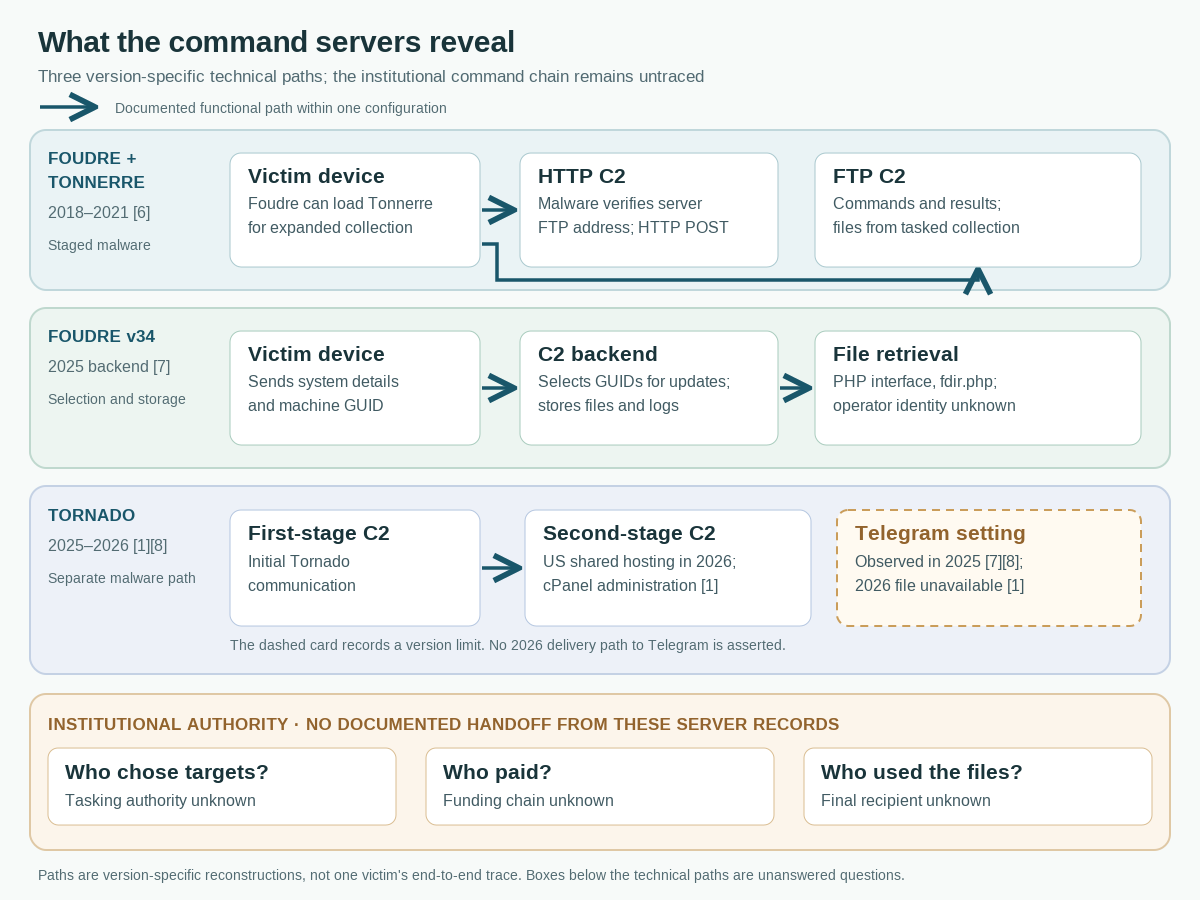
Foudre and Tonnerre have a documented staged relationship, while Tornado has its own first- and second-stage architecture. The component list therefore describes several observed configurations rather than a mandatory infection path running through every malware family.
Figure 1 separates three version-specific technical paths from the institutional questions the server records cannot answer. Its arrows join documented functions within each configuration; they do not connect the configurations into one victim’s history.
5.2 The first control boundary: selecting and maintaining victims
The Foudre v34 backend illustrates victim management at the server boundary. Each infected machine sent system information and a machine GUID, which the server checked against a text list before deciding whether to supply an encrypted update. A selected machine received a redirect to the update file; an unselected one could receive an invalid destination or no useful response. [7] After the December 2025 disclosures, the visible list was emptied and the PHP backend was observed checking specific machine names or GUIDs instead. [8] These are concrete places where an already compromised device could be selected for additional functionality. The published records do not show who entered those identifiers or how the initial target was chosen.
Foudre also used cryptographic validation to authenticate its command server, a development Unit 42 documented in 2017 after researchers had taken over Infy command domains. [4] A third party redirecting a predicted domain could no longer impersonate the server merely by controlling its address. That change protected the operators’ technical authority over infected devices while leaving the identity of the people or institution exercising that authority unknown.
5.3 The second control boundary: issuing instructions and collecting results
Tonnerre extended the collection capability through a two-part communication path documented by Check Point and SafeBreach in 2021. The malware authenticated an HTTP command server, obtained information about an FTP server, and then used FTP to retrieve commands and return their execution results, including files collected in response to those commands. Its built-in collection logic used HTTP POST for other data transfers. [6] HTTP therefore did more than identify the FTP destination, and FTP was not the route for every collected file.
Later versions added arrangements involving Telegram, but the visible technical relationship remained one in which an infected machine received instructions, performed collection or execution tasks, and returned results. The server could direct a particular machine; the available records do not show whether a technician chose the instruction independently, acted on a supervisor’s request, or followed intelligence tasking from elsewhere.
5.4 The third control boundary: storing and retrieving collected information
SafeBreach’s December 2025 investigation exposed how the Foudre v34 backend handled data after collection. Its directories separated validation, updates, received files, and communication records; machine GUIDs also divided files from attacker test machines from those associated with other infections. Connection logs retained hostnames, GUIDs, IP addresses, and communication times, while a PHP interface named fdir.php supported retrieval of collected files. [7]
SafeBreach described the interface as a way to move information from command servers commonly located in Europe toward Iran. [7] That gives the file trail a stated geographical direction and a retrieval mechanism. The public report does not supply an authenticated download session tied to a named person, a destination organization, or evidence that a particular intelligence service obtained the files.
The backend’s separation did not prevent every other retrieval path. Using server records and predictable storage information, researchers obtained files from attacker testing machines despite the PHP interface’s intended distinction between test data and ordinary victim data. This exposed part of the attackers’ own operational activity and showed that an application’s file-selection rule was not equivalent to access control over every path to the stored files.
5.5 Tornado and the external messaging service
In the later infrastructure, Telegram provided an additional mechanism for communication and information transfer. SafeBreach documented settings distributed to selected infected machines, including credentials for a Telegram bot and identifiers for its communication destination. [7] Semperis subsequently identified the Tornado second-stage server as a component historically associated with this credential distribution. The settings file, tga.adr, was not distributed to every infected machine indiscriminately. The C2 used victim-selection logic to determine which machines could receive the relevant information.
Once obtained, a bot credential operates within Telegram’s authorization model, whose permissions need not match the C2’s rules for an individual infected computer. SafeBreach found the bot and one user account, presented as “Ehsan,” in the 2025 group; the account’s handle was @ehsan8999100. The researchers considered that user likely to be an operator, but the handle is not a verified personal identity. [7] Using the credential and Telegram’s message-forwarding operation, they recovered messages that included 118 collected files, 14 shared links, and commands sent to Tonnerre. [8] The exposed API responses leave room for caution about the precise conversation type, so the result establishes access through permitted bot operations rather than a generic bypass of group privacy settings.
This made the group a documented operator-facing destination for some collected material. SafeBreach subsequently observed the non-bot account replaced and the original account added to another channel of unknown purpose. [8] Neither account’s presence shows who read each file, whether the material was passed onward, or who requested the underlying surveillance. The public evidence does not establish that Telegram knew of or participated in the espionage operation.
5.6 Disrupting and rebuilding command infrastructure
The 2016 sinkhole operation showed how much of the surveillance capability depended on command infrastructure. Unit 42, working with the relevant domain administrators, redirected most identified Infy C2 domains to infrastructure controlled by researchers. The attackers consequently lost the ability to communicate normally with many infected systems. The intervention also exposed the scale and distribution of the victim network. [3]
Foudre’s later cryptographic server validation made that kind of takeover more difficult. The operators subsequently adopted additional domain-discovery mechanisms, updated communication protocols, and changed their servers. Following the SafeBreach disclosures in December 2025 and February 2026, they removed logs, changed some data-handling practices, and replaced infrastructure. [8]
Across these responses, the operators changed how their infrastructure recognized victims, accepted communications, protected command channels, and exposed stored data. That continuing administration is visible in the technical record, whereas the decision to fund replacements—and any instruction from an external customer—remains outside it.
5.7 The United States as an infrastructure provider, not an identified command center
The 2026 transition to U.S. shared hosting introduced a different contractual and administrative environment. Semperis identified Tornado second-stage infrastructure on Namecheap-hosted IP 68.65.122.203, with evidence of cPanel administration and communication logs associated with both victim activity and attacker testing. [1] The server appeared to have been established around July 7. This differed from the virtual private servers and CyberPanel-based administration previously associated with the operation.
Shared hosting lets a customer operate applications without administering a separate virtual operating system, and unrelated sites can share one IP address. For a web-based C2, the provider administers the underlying service, the customer account controls its applications and files, and the malware operator uses those resources to communicate with computers it has compromised. Each actor controls a different part of the path, so hosting ownership alone cannot identify who directed the surveillance.
The fact that unrelated malicious domains appeared on the same shared IP does not establish a relationship between their operators and Prince of Persia. Nor does the use of Namecheap establish that the company knowingly supported the operation. Semperis also reported a later domain associated with a Cloudflare IP address. The publicly presented evidence for that change is less specific than the evidence for the Namecheap server: a DNS association alone does not establish a functioning HTTP C2 behind Cloudflare’s proxy. The documented relocation to U.S. shared hosting is therefore the stronger basis for analyzing the 2026 infrastructure change.
The U.S. location of a server also says little about where its operator worked. A compromised computer in one country can communicate with a server in another while someone retrieves its data from a third. Neither the hosting contract nor the server’s IP geolocation identifies the technical operator, a supervisor, or an intelligence customer.
6. The Missing Institutional Chain
6.1 The evidence for Iranian state alignment
Prince of Persia has repeatedly been described as an Iranian state-sponsored or state-aligned threat actor. Its historical victims included people and institutions relevant to Iranian political and security interests; malware tests involved Iranian networks; and infrastructure administration left registration and account traces connected with Iran. Activity also varied around major disruptions to Iranian internet connectivity. Together, these observations support an Iranian-linked intelligence assessment, but they do not identify the Ministry of Intelligence and Security, the Islamic Revolutionary Guard Corps, or another institution as the operators’ employer.
The 2018 Carnegie Endowment report by Collin Anderson and Karim Sadjadpour supplies an important qualification. [9] Its authors had observed more direct state interactions for several other Iranian threat groups and considered Infy’s institutional link more tenuous under that criterion. They also treated Iran’s 2016 filtering of Infy-related command domains as potential counterevidence: filtering prevented infected machines from reaching the campaign’s infrastructure, although interference with outside observation was another possible explanation. The filtering’s purpose was never established. Later research has added operational traces connected with Iran without resolving which institution, if any, commanded the campaign.
The January 2026 shutdown presents a similar limit. SafeBreach observed command-server maintenance cease around the start of the disruption and resume as connectivity partly returned. [8] Filterwatch documented a staggered restoration in which selective access preceded unrestricted internet service. [12] Operators affected by Iranian network conditions could produce that timing without privileged knowledge of government decisions; the correlation therefore does not establish direct intelligence-service employment or authorization to conduct surveillance.
6.2 The Iranian contractor model
Separate Iranian cyber investigations show how technical operators and intelligence customers can belong to different organizations. In 2020, the FBI identified Rana Intelligence Computing Company as a front used by Iran’s Ministry of Intelligence and Security and attributed surveillance of dissidents, journalists, and foreign targets to activity conducted through it. [10] In August 2026, the U.S. Department of Justice announced a superseding indictment charging 17 people associated with the Mabna Institute. Prosecutors alleged that Mabna employed or contracted hackers to obtain information from universities, companies, and other institutions for the IRGC and additional governmental or institutional customers. [11] Those claims retain the evidentiary limits of an indictment.
Neither case establishes a connection to Prince of Persia. Their relevance is the organizational possibility they demonstrate: a private company, its employees, or outside contractors can translate an intelligence requirement into technical work while other actors select targets or receive the results. Prince of Persia could have used such a contractor, an internal government team, or another arrangement; the public evidence does not distinguish among them.
6.3 The resources are visible; the financing is not
The operation’s technical history reveals several categories of expenditure.
| Resource | Evidence of operational use | Missing financial evidence |
|---|---|---|
| Domains and DNS services | Repeated registrations and replacement of C2 names | Registrant payment records and ultimate payer |
| Hosting | VPS infrastructure and later U.S. shared hosting | Contract holder, invoices, payment method |
| Software development | Multiple malware families and updates | Developer salaries, invoices, employment contracts |
| Testing | Repeated test-machine connections and staged deployments | Ownership and funding of test environments |
| Data storage | Collected files and historical communication logs | Storage costs and account ownership |
| Operational administration | Server migrations, control-panel changes, certificate and configuration management | Who paid for ongoing maintenance |
| Intelligence analysis | No directly identified downstream institutional workflow | Analysts, customers, report delivery, and budget |
The resources in the table had to be maintained, but their existence does not identify a payer. The historical registrations associated with the name Amin Jalali and the 2026 identification of Namecheap shared hosting are the closest public traces of infrastructure procurement in the cited investigations. [2][5][1] The first supplies registration contact information, and the second identifies a provider and an IP address; neither report supplies a verified invoice, payment instrument, customer contract, or beneficial owner. A technical administrator could register a domain using money supplied by an employer, while a contractor could buy hosting for an intelligence customer. Even a verified billing account might therefore identify only the purchaser of one service rather than the institution financing the wider operation.
The continuing work also provides no basis for assigning a budget or assuming one government institution paid for every stage across two decades. The cited investigations identify no verified Prince of Persia revenue stream, annual operating budget, procurement contract, or payment ledger; the responsible financial entity remains unidentified.
6.4 Where the evidence ends
The publicly documented process can be divided into two parts. The first is the technical collection pipeline:
Malware development → target infection → device management → surveillance → data transfer → storage and retrieval.
Research into Prince of Persia provides evidence for each of these activities, although not every step has been reconstructed for every malware version or victim.
The second is an analytical model for testing whether an institutional intelligence pipeline can be traced:
Intelligence requirement → target selection or authorization → technical tasking → analysis of collected material → reporting → institutional use.
These arrows do not describe an observed Prince of Persia organization chart or establish that it had a formal target-approval process. They mark decisions and handoffs for which the public record would need evidence before a command chain could be reconstructed.
The sources locate the last documented point on each of the three trails.
| Question | Furthest documented trace | Boundary the trace does not cross |
|---|---|---|
| Who paid? | Historical C2 registration contacts and the provider of the 2026 shared-hosting server [2][5][1] | The cited reports provide no verified payment, customer contract, or source of funds connecting either service to a sponsor |
| Who selected targets? | Political targeting in historical campaigns, selective Infy M deployment, and later GUID or machine-name checks for additional malware [5][3][7][8] | No instruction identifies who chose the initial people to approach or who ordered an infected machine promoted to deeper surveillance |
| Where did the information go? | Server storage and retrieval through fdir.php; a 2025 Telegram group containing collected files, commands, and a pseudonymous user account [7][8] | No authenticated handoff, report, or delivery record identifies a final institutional consumer |
These traces concern different decisions. The backend selection rule proves that additional malware could be withheld from or supplied to a particular infected device; it does not explain why that person was targeted. The Telegram history establishes that collected material entered an operator-facing communication space; it does not establish who ultimately used it. A hosting provider supplies resources to an account holder, while the person operating malicious code and any intelligence customer may be separate. Even identifying one administrator would not, by itself, identify the ultimate sponsor.
6.5 What would establish the missing relationship?
The next records to seek differ by question. A hosting invoice and its payment trail could connect a specific server to a purchaser, but an additional contract or transfer would still be needed to identify a sponsor behind that purchaser. A dated change to the selected-machine list, paired with an authenticated operator session and a tasking message, could connect an instruction to a specific upgrade decision. For the files already observed in server storage and Telegram, account records or onward-transfer messages could establish who took possession after the operator-facing endpoint. None of those records is contained in the public investigations reviewed here.
Prince of Persia’s technical record therefore gets farther than a bare C2 map: it exposes selection logic, a route for retrieval toward Iran, and a communication space containing collected material. It does not connect those points to a verified payer, the person authorizing a target, or an institutional intelligence consumer.
7. Conclusion
Prince of Persia survived repeated exposure through continuing development, testing, victim management, collection, and infrastructure replacement. Its operators rebuilt after sinkholing and public research, then placed part of Tornado’s 2026 command infrastructure on U.S. shared hosting. That history establishes the persistence of a surveillance capability; it does not establish that the same people or institution directed every phase.
The evidence goes beyond malware lineage. The Foudre backend shows where already infected machines were selected for more capability, while server retrieval paths and a 2025 Telegram conversation show where some collected material became available to apparent operators. Historical targeting and Iranian operational traces support an Iranian-linked intelligence assessment, but neither the technical selectors nor the pseudonymous Telegram account identify who set the surveillance priorities or consumed an intelligence product.
The command infrastructure is documented more closely than the authority behind it. The available records reach selected machine identifiers, file-retrieval paths, and an operator-facing conversation; they stop before a verified payer, the author of the targeting instructions, or a final institutional recipient. Naming a particular agency or contractor as the commander would require evidence across those boundaries, not merely a common malware label or a server under technical control.
References
Prince of Persia: Technical investigations
[1] Semperis, Tomer Bar. Prince of Persia: Threat Group Hiding in Plain Sight. October 22, 2026. Renewed C2 activity, victim file collection, infrastructure migration, and Tornado second-stage servers.
[2] Palo Alto Networks, Unit 42. Prince of Persia: Infy Malware Active in Decade of Targeted Attacks. May 2016. Malware history, initial discovery, and infrastructure.
[3] Palo Alto Networks, Unit 42. Prince of Persia — Game Over. June 2016. C2 sinkholing, victim population, and selective deployment of Infy M.
[4] Palo Alto Networks, Unit 42. Prince of Persia — Ride the Lightning: Infy Returns as Foudre. 2017. Foudre’s surveillance functionality, DGA, and C2 validation.
[5] Claudio Guarnieri and Collin Anderson. Iran and the Soft War for Internet Dominance. Black Hat USA, August 2016. Political targeting, domain-registration evidence, administrator aliases, malware testing, and Iranian telecommunications filtering.
[6] Check Point Research and SafeBreach Labs. After Lightning Comes Thunder. February 8, 2021. Foudre and Tonnerre capabilities, staged malware deployment, and HTTP/FTP command infrastructure.
[7] SafeBreach Labs, Tomer Bar. Unmasking the Evolving Iranian Prince of Persia. December 18, 2025. Malware variants, backend storage, GUID-based updates, file retrieval, testing environments, and Telegram communications.
[8] SafeBreach Labs, Tomer Bar. An Update on the Prince of Persia Threat Actor. February 4, 2026. Infrastructure changes following disclosure, modified data-handling practices, Telegram investigations, and the January internet shutdown.
Institutional and political context
[9] Collin Anderson and Karim Sadjadpour. Iran’s Cyber Threat: Espionage, Sabotage, and Revenge. Carnegie Endowment for International Peace, January 4, 2018. Iranian cyber organizations, contractor relationships, differences in attribution evidence, and domestic political surveillance.
[10] Federal Bureau of Investigation. FBI Releases Cybersecurity Advisory on Previously Undisclosed Iranian Malware Used to Monitor Dissidents and Travel and Telecommunications Companies. September 17, 2020. Rana Intelligence Computing Company and its reported relationship with MOIS.
[11] U.S. Department of Justice, Southern District of New York. 17 Iranians Charged with Conducting Massive Cyber Theft Campaign on Behalf of the Islamic Revolutionary Guard Corps and Other Iranian Entities. August 18, 2026. Superseding indictment describing the alleged activities and customer relationships of Mabna Institute.
Network and connectivity context
[12] Filterwatch (فیلتربان). روایت اینترنت ایران در یک ماه: از قطع منطقهای به خاموشی کامل و «فهرست گزینشی». January 28, 2026. Persian-language analysis of Iran’s January internet restrictions, partial connectivity restoration, and selective network access.
Evidentiary Scope
This investigation is based on public malware analyses, sinkhole observations, server-side data-handling records, infrastructure investigations, historical political-targeting research, official government statements, criminal allegations, and independent network measurements. The strongest direct evidence concerns the technical operation: malware capabilities, server behavior, victim-management mechanisms, testing patterns, infrastructure maintenance, and movement of collected data. Organizational functions reconstructed from those observations are not presented as verified departments, employee positions, or formal reporting relationships. The name Amin Jalali and other published operational aliases are treated as historical registration or account identifiers, not verified personal identities or evidence of government employment.
Prince of Persia’s connection to Iranian political and intelligence interests is supported by the historical target pattern and technical observations. Attribution to a particular government agency remains unestablished. The 2018 Carnegie report distinguished the strength of Infy’s state connection from that of other Iranian groups. Later SafeBreach and Semperis research provides additional operational evidence, but not a verified institutional command chain. The Rana Intelligence Computing and Mabna Institute cases are presented as independently documented examples of Iranian cyber operations involving corporate or contracting structures. No relationship between those entities and Prince of Persia is alleged here.
The 2016 telecommunications filtering and the January 2026 internet disruption are treated as observations about network conditions and operational timing. They do not independently prove government instruction or privileged access. The public server investigations demonstrate that collected files were stored and could be retrieved through the documented infrastructure. SafeBreach also recovered files and commands from a 2025 Telegram conversation with a pseudonymous user account; that account is an operational lead, not a verified personal identity or an institutional recipient. These records do not prove that all collected files reached that conversation or an Iranian state institution. The later Semperis investigation was authored by Tomer Bar, who was also involved in the preceding SafeBreach research. These publications represent an important continuous research effort, not wholly independent confirmations by unrelated investigators. The July 2026 Namecheap infrastructure is supported by published administrative and communication observations. The later reported Cloudflare infrastructure has a narrower public evidentiary basis and is not treated as necessary to this investigation’s conclusions.
No verified Prince of Persia employment records, procurement contracts, operating budgets, payment ledgers, intelligence tasking instructions, or downstream intelligence reports were identified. The principal unresolved boundaries are therefore the assignment of surveillance targets, the financing of technical operations, and the movement of collected information from the technical operators to its institutional consumers.