How Moldova’s public-service breach exposed the gap between institutional authority, individual data access, and the records meant to justify it.
Incident Analysis · Moldova · Digital Government · Data Interoperability · Access Control
Based on public information available as of October 30, 2026.
Abstract
Between October 19 and 23, 2026, attackers submitted approximately 11 million requests to Moldova’s digital public services, querying roughly one million national identification numbers and extracting personal information associated with an estimated 750,000 of them. The Electronic Governance Agency (AGE) reported that the attackers exploited vulnerabilities in services accessible without authentication, then used information obtained through those services to retrieve additional data. The initial service also recorded incorrect legal grounds for processing personal information, causing citizens to see misleading explanations in their government access histories.
The incident occurred within an administrative system built to exchange information across institutions. Moldova’s MConnect platform enables authorized organizations to retrieve records held by other authorities, while MLog provides a centralized record of legally significant data operations. The legal framework assigns responsibility for the subsequent use of exchanged data to the receiving institution, but the public documentation does not establish how individual requests were authorized in the services involved in the attack.
Government records predating the breach provide a broader institutional history. A 2021 audit identified weaknesses in the implementation of interoperability. A parliamentary evaluation in 2024 documented exchanges outside MConnect and recorded the data-protection authority’s concern that an older access method could not identify individual users. Cybersecurity supervision then changed under a 2025 framework, while a new personal-data law took effect in August 2026. These are distinct developments; none identifies the route used in October.
These findings do not establish why the vulnerable service permitted unauthorized extraction. They instead expose two connected questions: where the authority to retrieve another institution’s records was supposed to be constrained, and whether the audit mechanisms designed to explain those operations could independently verify the reasons they recorded.
1. The Five Days of Unauthorized Data Retrieval
1.1 Eleven million requests against public services
On October 24, 2026, Moldova’s Electronic Governance Agency, the Information Technology and Cyber Security Service (STISC), and the Cybersecurity Agency (ASC) announced that they had contained an attack against several government digital services. The agencies reported approximately 11 million access requests intended to obtain personal information without authorization. Some services had been disconnected while investigators examined the activity, leaving parts of the country’s digital administration temporarily unavailable. [1]
AGE’s more detailed statement on October 27 established that unauthorized activity had occurred between October 19 and 23. Approximately one million national identification numbers, known as IDNPs, had been queried, and preliminary findings indicated that information associated with roughly 750,000 of them had been extracted. The number described identifiers associated with retrieved records, not 750,000 compromised government accounts or a complete personal dossier obtained for every individual. [2]
The range of potentially exposed information was unusually broad. AGE identified civil-registration details, family relationships, medical insurance status, family doctors, pensions, social benefits, disability information, driving licenses, photographs, vehicles and companies owned or managed, tax arrears, IBANs, and government payment histories. These categories ordinarily belong to different administrative functions, from social protection and healthcare to taxation and vehicle registration, although the government’s statement did not identify the particular databases or APIs through which each category was obtained.
The distinction between access to information and control over an underlying system also matters. AGE reported no compromise of payment-card information and no evidence that state-register entries had been modified. Possession of an IBAN did not confer authority to transfer funds, just as obtaining information about a company or property did not alter its legal ownership. The more immediate danger lay in the ability to combine authentic personal details in fraudulent communications, including impersonation of banks and public authorities.
1.2 Containment extended beyond the initial service
Authorities stopped the identified unauthorized extraction at 11:30 a.m. on October 23, according to AGE. That day, investigators examined 82 digital public services and preventively disconnected more than 30 information systems and administrative interfaces. Subsequent attempts to access or extract government information were detected and blocked on October 25 and October 27, while affected services were restored gradually after remediation and additional testing. [2]
The response involved AGE, STISC, ASC, the Intelligence and Security Service (SIS), and other competent authorities, reflecting the fact that government services are operated across multiple administrative and technical organizations. The number of disconnected systems, however, should not be treated as a count of compromised systems: preventive isolation can affect services that investigators have not found to be vulnerable.
The October 27 disclosure provided the clearest public description of the original attack. AGE said that the attackers had exploited vulnerabilities in services accessible without authentication and subsequently used the information they obtained to extract additional data. This establishes a relationship between the initial access and later retrieval, but it does not identify the services, the individual interfaces, or the authorization checks that allowed the sequence to continue.
An unauthenticated government endpoint is not necessarily defective. Public verification services and certain administrative inquiries are deliberately accessible without login, provided they restrict what information can be requested and returned. The relevant failure is therefore not simply that a service was public, but that the services involved permitted data extraction beyond authorized use. How that occurred remains the central technical uncertainty.
2. The Government Built to Exchange Information
2.1 The administrative purpose of interoperability
Moldova’s digital government architecture was developed around a practical objective: citizens should not have to provide the same information repeatedly when dealing with different public institutions. A person applying for a benefit, registering a business, or obtaining an administrative document may need information already held by the state, yet the institution handling the application does not necessarily maintain the authoritative record.
MConnect was developed to make those records available through a common interoperability framework. Law No. 142/2018 on data exchange and interoperability, together with the implementing regulations, established the legal and institutional basis for exchanging information between authorized participants. Its underlying principle was that data already held by one authority could be reused by another for a lawful administrative purpose, reducing duplicate collection and the circulation of paper certificates. [3]
This model changes the relationship between a service and the information it can obtain. An administrative application no longer needs to maintain its own copy of every record it uses; instead, it may retrieve information from the authoritative institution when the relevant operation requires it. That is an important improvement in the consistency and availability of government records, but it also means that the effective reach of an individual service can extend beyond its local database.
The distinction is particularly important in an incident involving personal identifiers. An IDNP can serve as a means of locating a record within a government dataset, but identifying the subject of a record does not establish the caller’s entitlement to retrieve it. A system designed to accept an IDNP as an inquiry parameter must still determine whether the requesting institution and the particular operation have the necessary authority.
2.2 Institutional access is approved before individual requests occur
MConnect’s published connection procedure describes an administrative process for obtaining access to datasets. A prospective participant identifies the required data through the Semantic Catalog and submits an electronically signed connection application and technical annex to AGE. The exchange must have a stated purpose and legal basis, and the administrative application is reviewed before access is configured. These administrative steps govern institutional access; they do not establish the authorization rules applied to each later request. [4]
The catalog supplies a common description of data assets and available inquiries, allowing institutions to identify information relevant to their services. It is not, however, a public inventory of every effective permission assigned to every production system. An institution’s eligibility to request a dataset, its approved connection, and the actual conditions applied to an individual transaction are different things.
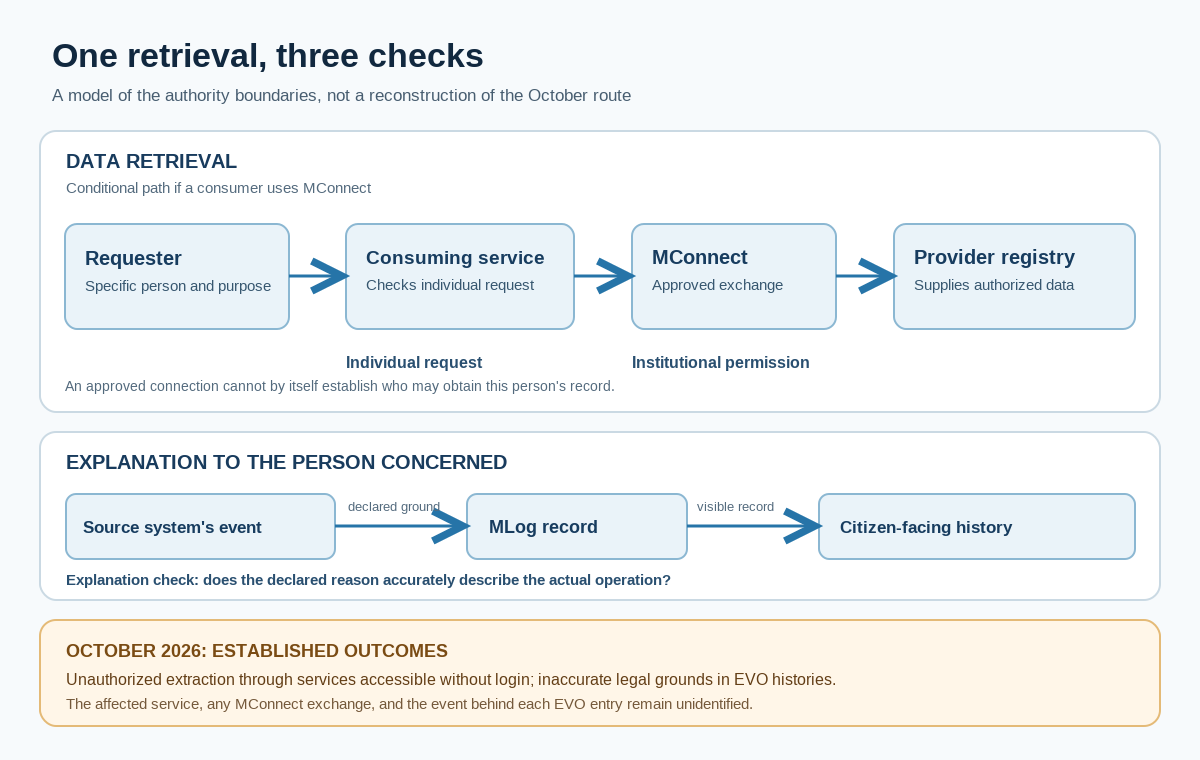
That distinction creates a critical boundary. Suppose a public service is legitimately authorized to retrieve civil-registration information when processing an eligible administrative request. The institution maintaining the register may recognize the calling service as an approved consumer, but that recognition does not necessarily establish whether the person initiating a particular request was entitled to obtain information about the specified individual.
For such a transaction to be lawful, the permission granted to the institution must be connected to the circumstances of the operation. Depending on the service, those circumstances may include the identity of the requester, their relationship to the data subject, the administrative procedure being performed, and the scope of information required. Public MConnect documentation explains how institutions obtain access, but it does not provide enough information to reconstruct the complete runtime authorization logic of the services implicated in the October attack.
2.3 The older exchange infrastructure was part of the same history
Moldova’s interoperability program did not replace every earlier information-exchange arrangement at once. A 2021 performance audit by the Court of Accounts found weaknesses in the implementation and monitoring of MConnect, including public institutions that had entered into connection arrangements without completing operational integration. The audit also addressed the coexistence of newer interoperability services with conventional or older mechanisms for obtaining government data. [5]
Subsequent follow-up records described the continued use of bilateral connections based on the Common Object Interface (COI), while some institutions requested additional time to migrate their exchanges. These records describe the migration process in earlier years, not necessarily the state of individual connections in October 2026, but they demonstrate that government data exchange had developed through multiple technical and contractual arrangements.
The National Security, Defence and Public Order Commission of Parliament revisited Law No. 142/2018 in a 2024 ex-post evaluation. AGE told the commission that some exchanges still occurred outside MConnect despite the statutory expectation that public participants use the platform. It identified legacy systems unable to consume or provide MConnect web services, as well as reluctance among some institutions to exchange data electronically. That account makes the migration issue more concrete than a general observation that old systems existed: the intended common interface and the operational connections had not completely converged. [18, pp. 17–18]
The same evaluation recorded a more pointed objection from the National Centre for Personal Data Protection (CNPDCP). The centre said that high-volume access through the Acces-Web search system and COI remained a concern; in February 2024 it had asked AGE and the Public Services Agency (ASP) to address the legality and security of such processing. In the centre’s assessment, COI still used by some authorities at that time did not identify by name the individual users who accessed personal data, even though those users were expected to justify each operation’s purpose and legal basis. This was CNPDCP’s 2024 assessment of an older access method, not a finding that the October 2026 attackers used COI. [18, pp. 40–41]
This history limits what can be inferred from the October incident. The presence of MConnect in Moldova’s digital government architecture does not establish that the attackers used it, and the existence of an older interface does not establish that such an interface remained vulnerable. Determining the actual acquisition route requires identifying the first affected service, its downstream connections, and the permissions that were effective at the time.
Nevertheless, the historical record is essential to understanding the problem. Interoperability was not simply a network connection between databases; it was a process of consolidating relationships among institutions that had previously exchanged information through different systems, agreements, and administrative procedures.
3. Who Was Responsible for the Data After It Was Retrieved?
3.1 The law assigns responsibility to the data consumer
Law No. 142/2018 draws a particularly important distinction between the institution providing data and the institution consuming it.
Article 12(2) states that the data provider is not responsible for how the data consumer subsequently uses the information. Article 12(3) assigns responsibility for that use to the data consumer, while Article 12(1) establishes that participants and the platform holder remain subject to the relevant forms of legal liability for violations of the law. [3]
These provisions do not create blanket immunity for a data provider or establish that every responsibility rests with the receiving institution. Their significance is more precise: the law distinguishes responsibility for supplying information through the exchange framework from responsibility for its use after acquisition.
For the October incident, this distinction matters because the public record does not establish which institution performed the downstream requests or under whose access rights the resulting information was retrieved. If a registered administrative service used its institutional permissions to respond to unauthorized external requests, the legality of the service’s own conduct would become central. A data provider could have correctly recognized an authorized institutional consumer without thereby verifying the circumstances of every request that originated inside that consumer’s application.
Conversely, if an attacker accessed a downstream service through an independently exploitable authorization defect, the relevant failure might lie within that second service rather than in the legitimate permissions of the initial consumer. The two explanations imply different technical faults and potentially different institutional responsibilities.
The law supplies a framework for evaluating those responsibilities, but it does not identify which explanation occurred. Assigning liability under Article 12 would require more than showing that an institution participated in MConnect: investigators would have to establish the actual exchange, the applicable obligations, and the conduct of the responsible participants.
The law also links the exchange to the data subject’s rights. Paragraphs 6–8, added to Article 12 in 2023, place protection of those rights with the participants that supply or consume personal data through the platform. On an express request from the data subject, the competent authority must identify the supplying or consuming participant, the date, and the declared legal basis and purpose. The person then exercises their rights against the relevant participant. The duty to explain an exchange thus sits in the same law as the division of responsibility for using the data. The word “declared” matters: an institution’s asserted purpose is not independent proof that a particular query was justified. These provisions concern exchanges through the interoperability platform; neither the October retrieval route nor a connection between this statutory disclosure and any particular EVO entry has been established. [3][18, p. 40]
3.2 A valid system identity is not a valid individual request
The difference between institutional and individual authority can be expressed through the questions an information system must answer.
A government data source may need to determine whether the requesting service is registered and permitted to consume a particular dataset. The service making the request must also decide whether its current operation is authorized to access information about the specified person. These decisions are related, but they operate at different levels.
The potential failure is easiest to understand when the requesting service is publicly accessible. A legitimate institution may possess a broad capability to retrieve information needed for its administrative functions, while the public endpoint that invokes that capability should expose only narrowly defined operations. If the endpoint allows arbitrary external requests to exercise the institution’s broader access rights, the institutional authorization remains technically valid even as the individual transaction becomes unauthorized.
This is a plausible model for the reported attack, not an established reconstruction. AGE’s statement that data obtained through an unauthenticated service enabled further extraction is consistent with an authorization boundary failing somewhere in the sequence, but it does not demonstrate that a downstream provider accepted the original service’s identity as sufficient authority.
The important point is that the existence of a legal access agreement does not answer the question of what a service may do on behalf of a particular requester. The legal and technical arrangements for granting institutional access must ultimately be reflected in the decisions made when data is retrieved.
4. The Access History That Gave the Wrong Reason
4.1 A second failure appeared in citizens’ access records
AGE’s October 27 disclosure contained a finding that is unusually important for understanding the accountability of digital government.
According to the agency, the electronic service initially targeted by the attackers had incorrectly recorded the legal basis for processing personal information. As a result, citizens checking their data-access histories in the EVO application saw records associated with requests for civil-status documents or the processing of driving licenses, even though those explanations did not correctly describe the underlying activity. [2]
This does not establish that the civil-status or driving-license services were themselves compromised. AGE identified those administrative procedures as the misleading processing grounds recorded by the initially targeted service, not as confirmed names of vulnerable endpoints.
The distinction matters because an access history has a different purpose from an ordinary operational log. A technical record may help investigators determine which endpoint was called and when. A record presented to a citizen is expected to explain why the state accessed their information and under what administrative authority that processing took place.
When that explanation is incorrect, citizens may observe a genuine access event while receiving misleading information about its justification. The failure therefore concerns more than the accuracy of a software label: it affects the ability of individuals to understand and challenge government processing of their personal data.
4.2 MLog records legal events supplied by other systems
Moldova’s MLog service was designed as a centralized register of legally significant events generated by government information systems. Its public technical documentation describes an integration model in which registered systems submit event records through authenticated interfaces, rather than each institution maintaining an entirely separate implementation of legal-event logging. [6]
MLog’s API distinguishes several fields that matter for understanding the October disclosure. legal_entity identifies the organization on whose behalf an operation was performed, while legal_basis records its stated legal authority. The user and subject fields can distinguish the individual associated with the operation from the person whose information was accessed, and event_correlation can connect events generated by different systems during a common activity.
The field legal_reason requires particular care. Although its name suggests a legal justification, the published API documentation describes it more generally as the reason an event was created, giving examples such as an application number or a telephone number. It must not be treated as an automatically verified legal purpose, or as interchangeable with legal_basis.
MLog also distinguishes ordinary event registration from the special treatment of personal-data access events. The general event format requires event_time and event_type, with other predefined fields optional; event types containing PersonalData are recognized for specialized processing under a documented convention. The existence of those fields and classifications does not itself establish which values a particular production integration must provide or whether MLog independently verifies their substantive accuracy. [7]
That distinction is central to the reported failure. A logging platform may authenticate a source, receive a correctly formatted event, and preserve it without establishing that the asserted legal authority reflects what the source application actually did.
4.3 The system submitting a record is responsible for what it describes
AGE’s signed MLog usage conditions assign the participating institution responsibility for identifying which events its systems will log, defining their structure, maintaining the event stream, and obtaining the certificates used by each integrated system. These are concrete duties at the point where an institution connects its application to the shared log. [9, pp. 7–8]
These measures identify the participating system and create a controlled channel for submitting events. They do not, on their own, turn the logging service into an independent adjudicator of each underlying administrative transaction.
The same conditions require an institution querying stored events to ensure the truth and correctness of the purpose and legal ground it supplies for that query. That obligation should not be confused with an independent check of the legal ground originally attached to every event sent by a source system. [9, pp. 6, 8]
This division of work makes the October disclosure particularly revealing. The government had established a common facility for recording access, yet AGE said the initially affected service supplied a legal explanation that was incorrect. The public record does not show whether the relevant entries passed through MLog. If they did, the central logging service could have performed exactly as designed while preserving an inaccurate account supplied by the originating system.
The published evidence does not show whether the incorrect legal basis also influenced the authorization decision that permitted data retrieval. It may have been generated entirely after the access occurred, or it may have originated from shared business-process configuration used elsewhere in the service. Distinguishing those possibilities would require the actual request-handling logic and the event payloads, neither of which has been disclosed.
4.4 The visibility of the record did not guarantee its reliability
Moldova had gone beyond keeping access logs solely for internal investigators. Through services such as EVO and MCabinet, citizens could inspect histories associated with the processing of their information. AGE’s documentation for verifica.gov.md, an address-verification service, explicitly describes the use of MLog to record data access and make those records visible through the government’s citizen-facing interfaces. [10]
This is an important administrative capability, particularly in a system where one institution can obtain records maintained by another. It allows citizens to see information about government use of their data without having to question each institution separately.
But visibility and verification are different guarantees. Making an event available to the individual concerned increases transparency only to the extent that the event accurately describes the processing it represents. A central register can preserve what a service claims happened; it cannot necessarily establish that the claim is correct unless the relevant properties are independently checked.
The October attack therefore revealed two potentially separate failures: unauthorized data extraction and an inaccurate account of the processing presented to citizens. The public evidence confirms both, but it does not yet establish whether they shared an implementation defect.
Article 12(7) gives the citizen’s question a legal form: for a platform exchange, who supplied or consumed the data, when, and for which declared ground and purpose? AGE also says that MConnect exchanges are reflected in MCabinet or EVO. The statute does not prescribe MLog or EVO as the implementation of that right, and the disclosed October entries have not been traced to a particular MConnect transaction or MLog event. The significance of the inaccurate history is therefore the reliability of the explanation the administration gave, rather than evidence that the logging platform itself was compromised. [3][4][2]
The older COI concern and the incorrect EVO entries pose different accountability problems. CNPDCP’s 2024 assessment questioned whether one historical access method could identify the person who made a query; AGE’s 2026 disclosure said that the first affected service assigned a wrong legal ground to records citizens could see. Neither observation establishes the other’s cause. Together they show why an investigation needs both a reliable actor or service identity and a purpose that can be checked against the underlying operation, rather than a visible entry alone. [18, p. 41][2]
5. The Institutions Responsible for Keeping the System Secure
The records in this chapter concern three linked tasks: identifying a defect, changing the service that contains it, and verifying that the changed service enforces the intended access rule in production. An audit, a penetration test, a supplier contract, and regulatory supervision can contribute to different tasks; their existence alone does not complete the chain.
5.1 Oversight had been changing before the attack
The problem of responsibility extended beyond the software interfaces. Moldova’s Court of Accounts had already examined the implementation of MConnect in 2021 and identified weaknesses in coordination, adoption, and monitoring. These findings concerned an earlier stage of the interoperability program and cannot establish the condition of the services attacked in 2026, but they show that the management of cross-institutional data exchange had been subject to formal scrutiny. [5]
The parliamentary evaluation in 2024 showed that supervision was divided even before the cybersecurity rules changed. AGE told the commission that, when approving a MConnect connection, it checked the applicant’s purpose and legal basis for the requested dataset and issued a decision accompanied by a technical annex. That annex was meant to identify the supplying and consuming participants, the systems and data involved, the authentication and authorization methods, and the query parameters. The annex would therefore be an unusually useful record if an affected exchange passed through MConnect, although it would describe an approved flow rather than prove the legitimacy of every later request. [18, p. 20]
CNPDCP, the personal-data authority, told the same commission that it saw a conflict between its independent role in checking processing under the then-applicable privacy law and AGE’s role in approving interoperability connections. It also said that a 2021 amendment had ended an earlier joint implementation arrangement and removed a notification-and-authorization requirement for processing. These were the centre’s positions in 2024 under Law No. 133/2011; they are historical evidence of contested responsibilities, not a finding that the same legal conflict persisted unchanged when Law No. 195/2024 took effect on August 23, 2026. [18, pp. 39–40][20]
A more recent institutional change occurred in 2025. AGE’s annual activity report recorded that a planned program of at least two cybersecurity audit missions concerning public-administration ICT infrastructure had not been completed. The report classified the activity as Nerealizat (lipsă temei legal), or not carried out because the legal basis was lacking. [11, p. 19]
AGE attributed that decision to Government Decision No. 562/2025, which replaced the earlier security framework with risk-based requirements for providers in critical sectors and transferred supervisory responsibilities to ASC. Because the new framework included transition periods, AGE considered further audits under the superseded rules inappropriate and stopped the planned activity to avoid overlapping institutional supervision.
The same report records other assurance work. AGE carried out penetration testing and code reviews for several individual systems, including e-Consulat, the government customer-support system, and verifica.gov.md, and monitored recommendations from earlier audits. In a separate internal-control section, AGE says that five internal-audit reports from previous periods were presented to its council and then its founder. Two covered MConnect’s management process, with emphasis on data exchange and interoperability, and AGE’s own personal-data-processing process. The report names those audits but does not disclose their findings, remediation orders, or closure evidence. It would be inaccurate to treat them as audits conducted in 2025 or as proof that the October service was inspected. [11, pp. 19–20, 26]
These forms of assurance addressed different questions. A penetration test can examine application behavior within its scope; an internal audit can evaluate AGE’s management process; and regulatory supervision can assess an operator’s applicable duties. The missing connection is whether a finding about a relevant flow reached the owner able to change the service and was retested against its production authorization rule.
The relevant questions are now concrete: what did the MConnect and personal-data audits examine, what corrective work did they require, and who checked its completion? Answering them for this incident still requires identifying the first affected service and its regulatory status.
5.2 Different authorities could answer different parts of the case
The Cybersecurity Agency was constituted under Government Decision No. 1028/2023, following Law No. 48/2023. Its published national framework lists both Decision No. 562/2025, on security duties for providers in critical sectors, and Decision No. 825/2025, on supervision and state control over compliance with those duties. These instruments define a cybersecurity oversight route, but the public incident statements do not identify the first affected service or establish whether its operator was classified within that regime. [19]
The ministerial map should be read with the same care as the technical one. The Ministry of Economic Development and Digitalization lists ASC among the public institutions for which it acts as founder, while AGE’s own institutional history identifies the State Chancellery as its founder. These relationships place the agencies within government, but do not transfer application-level authorization decisions from a service owner to a ministry. CNPDCP has a different role as the personal-data supervisory authority; it is not the operator of the affected records. [22][23][21]
Personal-data supervision followed another route. CNPDCP says Law No. 195/2024, effective August 23, 2026, requires a controller to notify it of a personal-data breach without undue delay and, if possible, within 72 hours of becoming aware of it. In its notice about this incident, CNPDCP confirmed that AGE had notified it. The centre also drew a clear operational boundary: it does not manage the government databases or secure them itself; the organizations controlling those systems must implement appropriate safeguards, while CNPDCP supervises and investigates compliance with personal-data law. The notice does not, by itself, establish which other controllers had duties in this incident or whether every applicable duty was met. [20][21]
These are separate forms of accountability for the same transaction. AGE’s connection file can establish what an institution was approved to consume through MConnect; the service owner and data controller must be able to explain the authorization decision and the processing of a particular record; ASC can examine the cyber duties of an operator within its jurisdiction; and CNPDCP can examine whether processing and notification complied with privacy law. STISC’s infrastructure role may yield operational evidence, but hosting a service is not the same as deciding whether its public caller may obtain a person’s data. Until the affected service and its connections are identified, the public record cannot assign a specific failure to any one of these bodies.
5.3 AGE had documented operational security risks eight months earlier
On February 23, 2026, AGE’s governing council approved an annual activity plan whose fourth objective concerned cybersecurity and compliance with information-security requirements. The plan identified insufficient financial, human, and technical resources, inconsistent or outdated internal processes, and difficulties financing ISO 27001 certification work as internal risks. It also explicitly identified delays by external suppliers in remediating vulnerabilities as an external risk. [12, p. 9]
These were formal planning statements made before the incident, rather than explanations constructed in response to public criticism afterward. The plan did not identify the vulnerability exploited in October or establish that a defect in the affected service had previously been reported.
The reference to suppliers is particularly useful because vulnerability management often depends on institutions that do not directly maintain all the software they use. An agency may commission a test or receive a security finding, while a contractor controls the implementation of a fix and another organization determines whether the corrected system can be accepted into production. Responsibility for identifying, implementing, and verifying remediation can therefore be distributed even when the operational objective is shared.
AGE’s plan sought to make these activities measurable through risk assessments, an updated register for critical systems, security scans, tracking of identified and remediated vulnerabilities, and management reporting. These commitments create concrete questions for subsequent investigation: what systems were examined, what was found, which defects were assigned for remediation, and what evidence established that the fixes had been accepted?
5.4 Security-testing and certification procurement
Public procurement records provide examples of the practical limits involved in obtaining independent security assurance. In 2025, AGE initiated external security-testing procurement for Wallet 2.0, EVOSign, and eKYC, with an estimated value of 1.1 million Moldovan lei. The initial procedure and a subsequent tender were both recorded as cancelled because submitted offers did not meet requirements. [13]
Those cancellations establish that the specified procurement procedures did not result in the intended contracts. They leave open whether the products were tested through other arrangements; none has been identified as an affected service in October.
A separate procurement for ISO 27001-related certification preparation reached the award-notification stage in October 2026, shortly before the incident. That project concerned the agency’s information-security management system rather than the authorization behavior of a known affected endpoint, and the published award notice does not establish when substantive work began or what findings were produced. [14]
These records are relevant because they distinguish security activities that an institution plans, purchases, performs, and verifies. A planned audit may be deferred, a procurement may fail, and a completed assessment may still require remediation by another organization. The issue is whether a finding can travel from inspection to a corrected service and then to an independently checked result.
The October incident makes that distinction consequential. Until the initial service is publicly identified, its inspection history and maintenance arrangements cannot be connected to these procurement records. The strongest institutional finding is therefore not that a failed tender caused the breach, but that the government had documented several separate mechanisms for obtaining security assurance whose execution must be examined individually.
6. The Government’s Response and the Questions It Left Open
6.1 Political responsibility was addressed before technical responsibility was established
On October 28, Prime Minister Vasile Tofan announced that AGE director Nicoleta Colomeeț would step down and that Artiom Cociu would temporarily assume leadership of the agency. Tofan described the need to shift government attention from promoting digital services toward strengthening their security, while Colomeeț indicated that the leadership transition had been agreed upon. [15]
The announcement placed the breach within a broader discussion of how Moldova’s digital administration should be governed. Authorities also emphasized closer coordination among the institutions responsible for electronic services, technical infrastructure, and cybersecurity supervision.
A change of leadership may be part of an institutional response to a serious incident, but it does not establish which technical decision failed. AGE managed important shared services, STISC operated government technology infrastructure, ASC held cybersecurity responsibilities, and individual public institutions controlled administrative services and data resources. Identifying the responsible organization for a specific unauthorized transaction requires reconstructing what those institutions actually controlled.
The government also raised the possibility of foreign state involvement, although no named state or group had been publicly attributed responsibility for the incident. ASC director Mihai Lupașcu reported that at least 700 different IP addresses were associated with the activity, a figure that indicates distributed request infrastructure but does not reliably establish the number, location, or affiliation of its operators. [16]
6.2 A separate authentication flaw complicated the public explanation
During the same period, independent researchers reported an XML Signature Wrapping vulnerability in Egov.Integrations.MPass.Saml, a .NET library used by service providers to process SAML authentication responses. Their analysis concerned insufficient binding between a valid XML signature and the response content subsequently trusted by an application, with additional validation reported in a newer package version. [17]
This is a potentially serious authentication issue, but it should not be merged with the documented data-extraction sequence without additional evidence. AGE described an initial route involving services accessible without authentication, while the SAML report concerns validation of authentication messages. A relationship between them would require evidence that an affected service used the vulnerable library and that manipulated authentication responses formed part of the unauthorized data requests.
The government temporarily disabled some MPass authentication methods on October 28, but the announcement did not establish that the reported library defect caused the breach. Treating the simultaneous disclosure and remediation of authentication issues as proof of a single exploit chain would obscure the mechanism that investigators still need to identify.
6.3 The remaining evidence must connect operations, authority, and records
A defensible technical reconstruction needs to establish more than the sequence of public-service requests. It must identify which service first returned information, how the attackers used that information in later queries, which identities or service credentials authorized those queries, and which administrative datasets supplied the responses.
The audit reconstruction requires a separate but related examination. Investigators must determine what legal-event records the affected systems generated, which legal_basis values they supplied, whether the values corresponded to the actual operations, and how the entries appeared in EVO. The public description of incorrect legal grounds does not disclose whether the error originated from application configuration, business-process mapping, or a shared source of authorization and logging information.
Both reconstructions are necessary because the evidence currently supports more than one explanation. The initial public service may have exercised valid institutional permissions on behalf of an unauthorized caller, a downstream service may have independently failed to authorize individual requests, or the attackers may have combined separate vulnerabilities across multiple services. The pattern of exposure and the use of IDNPs do not distinguish those possibilities.
The organizational investigation must then establish who could inspect, modify, and approve changes to the relevant services. Historical audit findings, procurement records, and security plans can identify the institutions and processes that should be examined, but they cannot replace the missing transaction logs, service configurations, and remediation evidence.
The institutional documents now provide a more exact set of records to seek. If MConnect carried a relevant exchange, its connection decision and technical annex could identify the approved participants, authentication method, query parameters, and dataset; runtime logs and service code would show whether the actual request stayed within that approval. Another route would require its own agreement and access records. The earlier MConnect and privacy audits, any AGE test or supplier fix, the service owner’s critical-sector classification, any ASC examination, and CNPDCP’s investigation could then be connected to the same service and to evidence that a correction was accepted in production.
7. Conclusion
Moldova’s October 2026 incident produced two confirmed outcomes: unauthorized retrieval of personal information associated with an estimated 750,000 national identifiers, and inaccurate legal grounds in access histories shown to citizens. The government had built a framework for institutions to exchange authoritative data and to account for that exchange to the people concerned. Parliament’s evaluation and AGE’s audit records show how many bodies and procedures could inspect parts of that framework, but they do not establish the route used in this attack or the condition of the first affected service.
Three claims must hold for an individual retrieval to be accountable. The institution must have permission to consume the dataset; the particular operation must be legitimate for the caller and data subject; and the reason later declared to the citizen must describe that operation accurately. A valid connection decision can establish the first claim without proving the second. An authenticated log submission can preserve the third claim without verifying its truth. Article 12’s information right makes that final distinction a legal matter as well as a technical one.
The missing evidence is the link across those claims: the initial service, its downstream authority, its request-level checks, and the event data behind the citizen-facing explanation. Until those records are connected, the case shows an accountability boundary that failed in practice, while the exact place where authorization and explanation diverged remains open.
References
Incident Reports and Government Response
[1] Electronic Governance Agency (AGE), Autoritățile au blocat un atac cibernetic asupra mai multor servicii publice digitale. Investigația continuă, October 24, 2026. Initial disclosure and approximately 11 million access requests.
[2] AGE, Aproximativ un milion de IDNP-uri vizate în tentative de extragere a datelor cu caracter personal, October 27, 2026. Exposure estimates, chronology, technical explanation, and incorrect recording of legal processing grounds.
[15] Radio Moldova, Schimbări la conducerea AGE după atacurile cibernetice. Premierul Tofan anunță o schimbare a priorităților, October 28, 2026.
[16] Moldova 1, Șeful ASC: Situație fără precedent. Cel puțin 700 de adrese IP implicate în atacul cibernetic, October 29, 2026.
Legal Framework and Interoperability
[3] Republic of Moldova, Law No. 142 of July 19, 2018, on Data Exchange and Interoperability, and consolidated Romanian text showing the 2023 additions to Article 12(6)–(8). The official PDF was inaccessible from the review environment; the consolidated text was used to check the later amendment.
[4] AGE, MConnect Interoperability Platform and connection and citizen-history explanation. Official descriptions of datasets, legal grounds, signed applications, technical annexes, and the visibility of exchanges in EVO or MCabinet.
[5] Court of Accounts of Moldova, Curtea de Conturi a examinat performanța platformei de interoperabilitate MConnect, July 6, 2021. Performance audit and implementation findings.
[18] Parliament of Moldova, National Security, Defence and Public Order Commission, Raport de evaluare ex-post de impact a Legii nr. 142/2018 cu privire la schimbul de date și interoperabilitate (PDF), 2024, especially pp. 17–20 and 39–41. Records AGE’s and CNPDCP’s positions in the parliamentary evaluation; their statements are attributed to those bodies.
Logging and Accountability
[6] AGE, Guide to Government Digital Services (PDF), p. 9, and MLog Special Conditions (PDF). Logging purpose, central service, and the integrating institution’s responsibilities.
[7] eGov4Dev, MLog API Reference. Event definitions and legal fields. The live page returned HTTP 404 on October 30, 2026; a dated search-cache rendition of the official page is retained with the editorial evidence. Published API guidance does not establish the configuration of an affected production service.
[8] eGov Moldova, MLog client package, and eGov4Dev, MLog integration guide. The guide specifies client registration and network-access requirements. The live guide returned HTTP 404 on October 30, 2026; a dated search-cache rendition is retained with the editorial evidence. These published requirements do not establish how an affected service was configured.
[9] AGE, Special Conditions for Government Platform Use, Order No. 3005-05, January 21, 2022 (PDF), including MLog usage conditions.
[10] AGE, Official Information on verifica.gov.md. Address-verification service and citizen access-history functionality.
Institutional Oversight, Planning, and Procurement
[11] AGE, Raportul privind realizarea Planului de acțiuni pentru anul 2025 (PDF), pp. 19–20, 26. Technical testing, changes in cybersecurity audit responsibilities, and the list of internal-audit reports from previous periods.
[12] AGE Governing Council, Decision No. 24 of February 23, 2026 — Activity Plan and Budget (PDF), especially the cybersecurity objective and identified risks.
[13] Moldova public-procurement records, August 2025 security-testing tender and November 2025 repeated tender; cancellation status recorded in the official public-procurement register.
[14] World Bank, Procurement Notice OP00476812, consultancy related to AGE’s security-management certification preparations.
[19] Cybersecurity Agency (ASC), National Regulatory Framework. Lists Law No. 48/2023 and Government Decisions Nos. 1028/2023, 562/2025, and 825/2025.
[20] National Centre for Personal Data Protection (CNPDCP), Law No. 195/2024 on Personal Data Protection: Main Provisions and Legislative Changes. Confirms the August 23, 2026 effective date.
[21] CNPDCP, Preliminary Information and Recommendations for Citizens in the Context of the Security Incident in Government Electronic Services, October 2026. AGE’s notification, controller obligations, and the centre’s oversight role.
[22] Ministry of Economic Development and Digitalization, Subordinate Institutions. Lists ASC among the public institutions for which the ministry acts as founder.
[23] AGE, Agenția de Guvernare Electronică are o nouă conducere, May 19, 2021. Identifies the State Chancellery as AGE’s founder.
Separate Technical Research
[17] Maxim Masiutin, XML Signature Wrapping Authentication Bypass in Moldova’s MPass SAML Library, October 2026. Independent research; no publicly established causal connection to the government data-extraction incident.
Scope and Limitations
This article relies on publicly available government announcements, legal texts, platform documentation, audit records, procurement material, and local reporting. The October incident’s initial vulnerable service, downstream interfaces, effective authorization rules, exact extraction sequence, and the cause of inaccurate legal-event recording have not been publicly established.
Historical audit findings and documented security-management risks are evidence of institutional conditions, not forensic proof of the attack’s cause. The reported MPass library vulnerability is treated separately because the public record does not demonstrate that it was used in the intrusion. Public developer documentation describes published integration requirements and should not be taken as proof that every affected service followed the same production configuration.