Abstract
On November 2, 2026, Google announced the disruption of XCPE, a backdoor installed on more than 1.3 million Android set-top boxes and other connected devices. Google assessed with high confidence that Videostrong Technology, the hardware manufacturer, had developed and operated it for financial gain, selling device access to affiliates that installed proxy, advertising-fraud, and other malware modules. [1]
The access began in software the customer received with the device. A firmware-resident component could restore the backdoor after removal; remote commands then selected workloads; and those workloads connected to independent commercial networks. Videostrong had long offered remote device-management services, but the public record does not establish that its marketed management system and XCPE were the same product. The case turns on the technical capability the manufacturer retained after sale and the uses to which Google says it put that capability.
This investigation separates three linked questions: which companies produced and sold the hardware, who controlled the backdoor and its later workloads, and what those workloads exposed customers to. Google could interrupt control infrastructure and exclude Videostrong from future certified Android supply. Neither action establishes that the backdoor was removed from devices already sold, while public records do not identify every affiliate contract or payment recipient.
1. The XCPE Operation
1.1 A botnet installed before the customer received the device
The coordinated disruption took place during the final week of October 2026. Google published its findings on November 2, identifying Videostrong Technology Co. as the organization responsible for developing and operating the XCPE backdoor. The investigation involved Google, Synthient, Plume, TrendAI, Lumen, HUMAN Security, and Japan’s National Police Agency.
Most affected devices were Android television set-top boxes, although Google also identified the backdoor on equipment used for telehealth, karaoke, and digital signage. These products differed in brand, model, and intended use, but shared software that gave a remote operator persistent access to the Android environment.
The central component, x.cpe, appeared as com.oemservice in some firmware builds. Google found that it ran with Android system-level privileges and could reinstall itself after users removed the corresponding application. Once activated, it obtained instructions from remote infrastructure and could install applications, execute shell commands, capture screenshots, simulate key input, and collect information about the device and its accounts.
The additional applications performed the revenue-generating work. Some generated fraudulent advertising activity, while others registered the device with residential proxy networks or peer-to-peer content-delivery services. Google also identified modules capable of installing further malware, allowing access to an infected device to be extended through additional software operators. [1]
The manufacturer’s alleged role is supported by evidence extending beyond the presence of its products in the infected fleet. Synthient purchased and analyzed a MECOOL KM9PRO Max, identified firmware and application signing information, and traced the device’s control infrastructure. An exposed file repository associated with that infrastructure contained a document signed by Videostrong’s R&D director, Owen Cao. Researchers also identified company email addresses associated with malware signing and an infrastructure relationship between the manufacturer’s domain and the operator’s administrative system.
Synthient reported that videostrong.cn resolved to the same IP address as the administrator panel associated with mqtt.anyevonline.com, which exposed facilities for viewing devices, issuing tasks, and managing application installations. Combined with the distribution infrastructure and signed application artifacts, these findings supported Synthient’s independent high-confidence attribution to Videostrong. [2]
Google’s assessment concerns the development and operation of the backdoor, not merely the presence of malicious code in a manufacturer’s products. It remains an investigative attribution rather than a judicial determination about particular executives. The distinction matters for the chronology: this was software maintained across device models and deployed workloads, not an isolated contaminated build.
1.2 The observed scale of the operation
TrendAI measured the XCPE network between June 3 and October 1, 2026, using telemetry that recorded infected devices, deployed modules, control messages, and available proxy addresses.
| Observed measure | Result |
|---|---|
| Infected devices | 1,472,554 |
| Device models | 206 |
| Countries and territories | More than 170 |
| Devices assigned monetization modules | Approximately 1.33 million |
| Distinct residential exit IP addresses | 3,849,226 |
| Average daily available residential IPs | 182,025 |
| Peak daily available residential IPs | 366,562 |
| Captured control messages | 2,360,663,001 |
These measurements describe different aspects of the network. The number of distinct IP addresses accumulated over four months does not represent the same number of devices or households, since broadband addresses may change over time. Similarly, the control-message total includes operational communications and cannot be equated with successful malware executions or financial transactions.
TrendAI’s observations nevertheless show how extensively the compromised fleet was used. Approximately nine out of ten identified devices were assigned modules for advertising or proxy monetization, and the infrastructure maintained a substantial number of residential addresses available on an ordinary day. Malaysia, Brazil, Iraq, Mexico, and Taiwan accounted for the largest observed device populations, with further substantial concentrations in the United States, Germany, the United Kingdom, Australia, and Canada. [3]
Google separately estimated that disrupting command servers operated by malware affiliates would sever their access to at least 10 million additional compromised devices. These were not all XCPE devices or necessarily Videostrong products. The affiliates distributed their modules through other channels, so interference with their independent infrastructure could affect a much larger population than the manufacturer’s botnet alone.
Those figures describe a managed fleet, not just many infected boxes. The operator had to identify devices, distribute workloads, and change configurations at scale. The timeline shows how persistent access and interchangeable revenue modules came to occupy different parts of that system.
2. The XCPE Timeline
The relevant history begins before the discovery of the malware. Videostrong’s corporate records describe remote device management as part of its business, while Synthient’s file inventory lists an x.cpe sample first seen on December 14, 2020. The inventory records version 3.6.5 and SHA-256 677e64469956197d424186c0225020e22a48dab8309fa48ca50afd25d33f6c2d. It does not date the start of the later monetization operation. [4][5]
| Date or period | Documented event | Significance |
|---|---|---|
| 2011–2012 | Videostrong established and entered the Android set-top-box business | Beginning of its recorded manufacturing operations |
| 2017 | Videostrong reports signing an Android TV partner agreement with Google | Participation in the certified Android device ecosystem |
| 2018 | Videostrong reports deploying its Terminal Management System across its product line | Remote management becomes an established product capability |
| December 14, 2020 | Synthient lists x.cpe version 3.6.5 as first seen [5] | Identifiable historical software lineage; later capabilities not established |
| 2021–2023 | Additional x.cpe and com.oemservice versions observed | Continued development across package and version branches |
| Late 2024 | Monetization modules increasingly separated into com.abc.nexus | Division between persistent control and executable workloads |
| January–April 2025 | KM9PRO Max certification records and subsequently analyzed firmware | Independent product and software baselines |
| Late 2025 | Synthient purchases a MECOOL KM9PRO Max | Physical examination of a distributed product |
| January 2026 | Research into Kimwolf and BadBox devices expands the investigation | Connection to the broader proxy and malware ecosystem |
| June–October 2026 | TrendAI records extensive fleet activity and monetization | Quantified operation of the infrastructure |
| August 2026 onward | Dedicated droppers begin replacing some Nexus deployments | Further separation and modification of execution components |
| Late October 2026 | Coordinated disruption of XCPE and related infrastructure | Interruption of central and affiliate control systems |
| November 2, 2026 | Google and research partners disclose the findings | Public attribution and description of the response |
The 2020 inventory entry establishes a reported first-seen date for one file, not its release date or the capabilities of the later XCPE operation. Establishing when device management became criminal monetization would require comparing the early executable code with later samples.
The architectural transition documented by Google is clearer. Earlier XCPE implementations included monetization functionality more directly, whereas later versions retained the primary backdoor as a communication and management agent while assigning module execution to com.abc.nexus. This separation allowed the operator to change revenue-generating software without replacing the initial privileged component.
Synthient found multiple Nexus configurations rather than a single uniform release sequence. Some versions bundled APSolo, Jaguar, LinkFog, and GaGaNode, while later builds added or removed TitanNet, BirdSDK, AppSalt, and Traffmonetizer. Two builds labeled 1.7.88 contained different combinations of SDKs, indicating that the version name alone was insufficient to identify a device’s actual monetization capabilities. [2]
From August 2026, Google observed specialized droppers replacing parts of the Nexus system. These packages could install individual modules and, in some variants, attempted additional persistence through privileged system locations. The change reduced dependence on a general-purpose loader while preserving the ability to alter what the device executed.
The surviving versions do not explain the motive for each change. They do show a stable need for device access alongside repeated changes to the software that used it. To understand why the manufacturer could occupy that position, the next question is how hardware, firmware, brands, and customer support were divided in its business.
3. The Supply Chain and Its Actors
The records in this section do different jobs. Equipment filings and shipping records identify commercial relationships and product movements. Software samples and infrastructure observations identify execution and control paths. Google’s attribution identifies the alleged operator. None of these records, taken alone, assigns every company in the supply chain a role in the malicious operation.
3.1 Remote management was an established Videostrong product
Videostrong describes a business that combines hardware design, firmware development, software customization, mass production, and connected-device management. Its customers include companies selling equipment under their own brands, which means the manufacturer may remain responsible for aspects of software maintenance even when the final consumer has never heard its name.
The company’s published history records the expansion from OTT and hybrid television equipment into Android TV products, followed by its 2017 Google partnership and the deployment of a Terminal Management System, or TMS, in 2018. [4]
For a company distributing thousands of set-top boxes, remote management can make maintenance possible without recalling each unit. It also creates a continuing technical relationship with hardware now owned by someone else: software can be installed and configuration changed after the sale.
XCPE used precisely this category of capability. Its control infrastructure could distribute applications, execute commands, and manage deployed components without the device owner’s participation. Google also identified historical tms, ott, and ota infrastructure associated with the same broader domain family used in the XCPE operation.
This does not establish that the marketed TMS and XCPE were identical applications or shared code. It establishes why remote installation and management were within the manufacturer’s business, while Google’s investigation describes an unauthorized use of comparable authority. The firmware and command path, reconstructed below, show what XCPE itself could do.
3.2 Skyworth and the authority to manufacture, sign, and update
The relationship between Videostrong and Shenzhen Skyworth Digital Technology provides a more concrete example of how manufacturing responsibility can be divided.
Synthient’s analyzed MECOOL KM9PRO Max reported SkyworthDigital as its manufacturer and carried the product identifier HPR311-MECOOL. The device ran Android 12 with a firmware identifier ending in C1.0.8_20250325, and the build was dated April 11, 2025. The preinstalled com.oemservice backdoor was signed with an APK certificate identifying Skyworth Digital Technology. [2][5]
An FCC filing establishes an additional relationship involving the same model family. On January 13, 2025, Videostrong requested a change in identification from Skyworth’s original FCC ID WNA-HPR3A-W5 to 2AGKB-KM9PROMAX. The letter, signed by Owen Cao, stated that the changed identification concerned equipment without hardware, software, or appearance differences from the original authorization.
The relationship also operated in the opposite direction. In March 2024, Skyworth had requested to identify equipment originally authorized under Videostrong’s 2AGKB-KM2PLUS as WNA-LEAP-S4, likewise relying on the existing equipment authorization. [6][7]
These records demonstrate that the companies participated in arrangements involving common equipment designs and different commercial identities. They do not establish that Skyworth developed XCPE, authorized the backdoor, or knew about its criminal use.
FCC equipment authorization also has a different purpose from Android software certification. Reusing radio compliance test results under an authorized change of identification does not establish that an Android firmware image has been reviewed for malicious software. The two procedures should not be treated as a single security approval.
The APK signing record raises a separate technical question. An Android application certificate can establish a cryptographic relationship among software packages and their permitted updates, but the organizational name recorded in the certificate does not independently establish who held the private key or approved a particular build.
Consequently, the essential production evidence would be the signing-key custody records, the relevant firmware images, and the build and update procedures connecting the two manufacturers. The public filings establish a commercial manufacturing relationship and identify artifacts that can be compared, but they do not determine responsibility for the malicious software inserted into those artifacts.
3.3 Bboys, the retail brands, and the actual distribution chain
A second corporate relationship appears in the intellectual property and marketing records.
Public U.S. trademark history for the MXV 4K mark identifies Videostrong as the original registrant and Shenzhen Bboys Technology as a subsequent owner. The record includes an ownership-assignment update in May 2022. Bboys also appears in historical MECOOL and YOKATV branding materials, while a MECOOL product catalogue identifies Bboys using the same industrial building, sixth-floor location, and telephone number published by Videostrong. [8]
These are stronger indicators of an established business relationship than a common address alone. They show a combination of shared commercial facilities, product branding, and a documented transfer of intellectual property. The precise corporate ownership and control structure, however, requires company registration records and cannot be inferred from the trademarks.
Bboys is particularly relevant because the XCPE infrastructure used mqtt.szbboys.com as a principal control endpoint. Google also documented related configuration and file-distribution services under the broader szbboys.com infrastructure.
The coincidence of the company name, brand-management relationship, and infrastructure naming provides a concrete lead for reconstructing the operation. It does not independently identify the domain’s contractual registrant or prove that the Bboys legal entity operated the server. Establishing that would require registration history, hosting records, administrative accounts, or other direct evidence.
The commercial distribution continued through independent channels. Public shipping data identifies Videostrong as the exporter of IPx1 PRO and IPx2 PRO television boxes to DHE BOSS INC in May and September 2026. DHE BOSS publicly describes itself as a North American distributor of YOKATV products. The records connect a named manufacturer to a named distributor and identifiable product families, rather than merely showing that similarly branded devices appeared in overseas markets. [9]
They do not establish that the specific shipped units were infected or that the distributor knew of XCPE. Their significance is different: they locate a real point in the supply chain where responsibility for firmware verification, updates, product safety, and customer notification could have been assigned.
This separation of manufacturing, branding, and retail distribution matters to Google’s response. Excluding a manufacturer from certified Android production is not equivalent to withdrawing a single consumer brand, since the same company may develop software for products sold under multiple names. Conversely, a brand owner or distributor may depend on software it neither developed nor signed.
Thus the sale, the software update, and any eventual repair could involve different companies. The party with the customer relationship might not hold the signing key or possess a clean firmware image; the public records do not resolve those responsibilities. The device-side path shows why that distinction matters.
3.4 The operator, affiliates, and other companies had different roles
Google assesses with high confidence that Videostrong intentionally developed, deployed, and operated XCPE for financial gain, then sold access to criminal affiliates whose modules ran on affected devices. Synthient’s device and infrastructure investigation independently supports an attribution to Videostrong. This is the evidence for identifying the manufacturer as the principal operator; it is not an inference from its presence in the FCC and shipping records. [1][2]
The affiliates controlled separate malware and proxy services. Google’s report identifies their modules and independent command infrastructure, but the public artifacts do not provide a complete contract or payment chain for each service. A proxy customer who uses an infected exit for ordinary traffic also has a different role from a customer who exploits reachable local services; Synthient observed the latter behavior in its IPWeb investigation, without identifying every buyer or tying every such session to an XCPE device. [1][12]
Skyworth’s equipment filings and APK certificate, Bboys’ trademark and brand records, and DHE BOSS’s shipment records establish narrower commercial or technical connections. They do not establish that those legal entities selected XCPE tasks, operated the malicious control servers, or knowingly distributed infected units. Likewise, the presence of an SDK in Nexus does not establish its provider’s knowledge of the installation or identify the ultimate recipient of payments. The evidence needed to allocate those responsibilities would include signing-key custody, server administration, affiliate agreements, account ownership, and settlement records.
The figure keeps the commercial evidence separate from the software path. Its top row combines records from different products and dates; it is not a traced itinerary for one infected box. The lower rows show the route from a firmware-resident component to independent modules and the kinds of exposure those modules created.
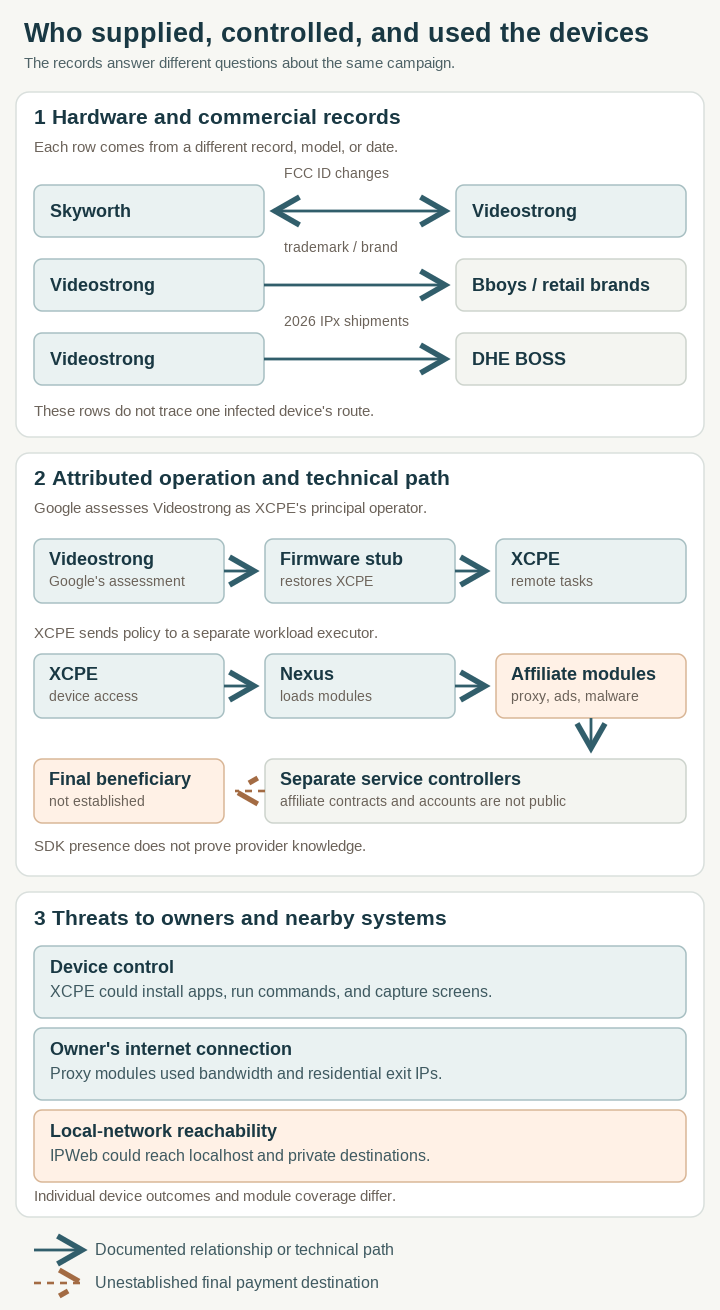
4. The Device Control Path
Google describes three connected layers: a firmware-resident installation path, a remote command channel, and separately managed workloads. The first two gave the operator continuing technical control of the device. The third let other services use that control without necessarily sharing the same command infrastructure. [1]
4.1 The firmware retained a privileged installation path
Google reconstructed an initialization sequence in which a limited XCPE stub was included in the firmware and operated with android.uid.system privileges. During startup, it located another APK in an OEM-specific directory and installed the corresponding application under /data/app.
The arrangement meant that the executable component could be installed after startup without depending entirely on an external download. If the user removed it, the firmware-resident mechanism could repeat the installation after reboot. [1]
An APK’s location under /data/app does not by itself establish its package identity, update status, or effective privileges. Google’s published sequence identifies the firmware-resident stub and subsequent installation, but does not provide the PackageManager and signing state needed to reconstruct every privilege transition. The practical persistence finding is narrower and clear: removing the visible application did not remove the preinstalled component that could restore it. [1]
The initial installation path therefore began in software supplied with the hardware. How Google’s certification tests assessed that delayed installation is addressed in Section 6.
4.2 XCPE converted local authority into remotely controlled operations
After initialization, XCPE selected a bootstrap server using local device configuration and system properties. Google’s analysis identified a lookup through the ContentProvider content://com.release.debug.provider/configs, followed by HTTP requests that obtained information needed to establish a persistent MQTT connection.
The configuration endpoints included /router/config/mqtt, which supplied broker details and device-specific topic information, and /router/config/app, which supplied application and module settings.
XCPE also stored configuration in another ContentProvider, com.oem.share.provider, making the resulting information available to other applications within the device software environment, including YokaTV Player. The configuration system therefore extended beyond a single APK: multiple components could depend on settings obtained from the remote operator. [1]
The MQTT infrastructure supplied instructions addressed to individual devices or groups. Google observed tasks for silent application installation, script execution, screen capture, network reconnaissance, and collection of device and account information. Some operations used Android APIs such as Instrumentation.sendKeyDownUpSync() for key injection, while others invoked shell commands or native binaries.
The fact that the backdoor ran under the Android system UID does not mean it possessed unrestricted root privileges. Android also enforces permissions through system-service checks, signing requirements, privileged-app policy, and SELinux. The detailed configuration varies among devices, but the operations reported by Google demonstrate that the necessary permissions or alternative privileged routes were available on affected implementations.
XCPE also interfered with application verification. Google identified code calling AppUtils.setPackageVerify(-1) as part of a routine intended to disable Google Play Protect verification. The exact behavior of the underlying settings depends on the Android implementation, and the published method call alone does not describe every Play Protect mechanism. It does, however, establish that the backdoor included explicit logic directed at the platform’s installation safeguards.
The security boundary here was not the choice of MQTT as a protocol. Authentication of a management server can establish the identity of the sender, but that is not equivalent to authorization to execute every command the sender requests.
In XCPE, a remote operator could issue instructions that the device translated into privileged local operations. The manufacturer-controlled communication channel thereby became a means of exercising authority over equipment whose owner had not authorized those uses.
4.3 Nexus separated device control from monetization
Google’s analysis identified com.abc.nexus as the application responsible for coordinating many of the additional modules. Its CoreService received configuration from XCPE through RemoteMessageHandler, processed the supplied JSON, and initialized the services corresponding to enabled modules.
The code and configuration distinguished the primary control infrastructure from the execution environment. XCPE maintained device access and distributed instructions, while Nexus managed the software that generated traffic, simulated advertising activity, or installed further payloads.
The configuration published by Google contained module identifiers such as linkfog, bwm, and adtime, together with fields including libChannel, libResource, libWeight, and serverPool. One LinkFog configuration specified CPU, memory, and I/O limits, while another assigned devices in Iraq to a particular regional server pool.
This is operationally significant because it describes resource allocation rather than indiscriminate malware execution. The operator could decide which service to run, select architecture-specific executables, allocate device capacity, and change the distribution of workloads through centrally delivered policy.
Different Nexus builds included different combinations of proxy services, and some contained only one identified SDK. The arrangement therefore allowed software distribution to vary independently of the underlying hardware and its firmware version.
The CPU, memory, and I/O limits suggest an attempt to bound the workloads’ use of a device also sold for ordinary streaming. They do not measure whether streaming performance was actually unaffected for customers.
Google’s analysis confirms the existence of these controls, although the exact algorithm used to choose workloads and maximize revenue has not been reconstructed. Nor does an acknowledgement that configuration was received establish that a module subsequently generated billable traffic. Those are distinct operational events requiring corresponding execution and usage records.
4.4 Later droppers attempted to acquire additional system privileges
The specialized droppers observed from August 2026 introduced another form of persistence.
Google reported that certain variants extracted libexploit.so, invoked nativeAdbRoot() and nativeAdbShell(), and used a root Android Debug Bridge (ADB) connection, a debugging interface with elevated device access, to place an application under /system/priv-app. They also wrote privileged-permission XML files that could grant capabilities including application installation and reboot control.
This was different from maintaining the original manufacturer-supplied XCPE agent. It attempted to make subsequently deployed software appear as a privileged system application, using Android’s application and permission configuration.
The public analysis does not fully identify the conditions that permitted these operations. On a normally locked Android device with Verified Boot enforcing system-partition integrity, persistent arbitrary modification of /system should not ordinarily succeed. Manufacturer-specific debugging settings, weakened integrity enforcement, or another privilege-escalation route could explain the behavior, but the published details do not establish which mechanism applied to each affected device.
The initial backdoor used a technical execution path supplied during production; the later droppers attempted additional system modification. Both enabled code selected after sale to act on the customer’s device, without establishing that the device owner authorized those activities.
5. Monetization and Threats to Device Owners
5.1 Multiple services could monetize the same device
Google observed Nexus initializing modules associated with AppSalt, Traffmonetizer, LinkFog, GaGaNode, and APSolo/IPWeb. Their services differed: residential proxies routed customers’ traffic through a device’s internet connection; peer-to-peer content-delivery networks used its bandwidth and delivery capacity; advertising modules generated fraudulent activity. Proxy and bandwidth-sharing services can operate with informed consent. XCPE placed devices into these arrangements without authorization from their owners.
Google observed that a single device could contain as many as three residential proxy SDKs. The modular policy system could enable or disable different services, allowing one device to be assigned to multiple commercial networks over time. The owner continued paying for the internet connection and electricity, while the operator controlled the allocation of capacity to software the owner had not chosen.
The backdoor supplied access to devices; it does not follow that Videostrong sold each unit of traffic to the final proxy customer. Affiliates and proxy platforms operated separate services, and the contracts and payments among them are not public.
5.2 SDK credentials provide a route from code to revenue accounts
Google found a more concrete link between the deployed software and commercial accounting.
Nexus obtained AppSalt and Traffmonetizer credentials from a native library named libnative_keys.so, using functions including getAppsaltKey() and getTraffmonetizerKey(). These credentials were supplied when initializing the corresponding SDKs.
Their importance follows from the commercial systems they identify. Traffmonetizer publishes a developer program in which SDK usage is associated with a token and reported through an account dashboard. Its public terms describe payment based on transferred data volume. Google identifies AppSalt as Honeygain’s SDK. For context, Honeygain’s public partner agreement uses measures including average daily active users and network quality, together with requirements for user consent and disclosure; the public record does not establish which contractual terms governed this deployment. [10][11]
Google also observed AppSalt calling optIn() without displaying a consent screen. The application set a software state indicating consent while bypassing the interaction that was supposed to establish it. This does not by itself identify who modified or configured that SDK, but it shows the difference between a consent flag within an application and an actual decision by the device owner.
Other modules exposed separate forms of identification. Google’s LinkFog configuration included libChannel: SZKJ, while its associated agent used a commercial bandwidth-reporting interface. Synthient’s IPWeb research identified APSolo Channel IDs used to separate controller and relay assignments. Nexus samples also contained identifiable SDK account values for other modules.
These identifiers cannot simply be treated as equivalent. A distribution channel may identify a software configuration, a relay channel may identify a routing pool, and an SDK token may identify an account used for commercial settlement. The same numerical or textual field can also carry different meanings in different protocols.
What these records establish is a possible method of reconstructing the business. XCPE task logs could show which modules were delivered to which devices; the deployed binaries could reveal the credentials used to register them; SDK-side usage records could establish how much activity was credited to those accounts; and payment records could identify the beneficiaries.
The public artifacts provide parts of the delivery and credential layers, but no final settlement records. They establish neither Videostrong’s revenue nor the division of payments; the use of an SDK also does not establish its provider’s knowledge of the unauthorized installation. Contracts, account ownership, communications, and provider-side responses would be needed to assess that question.
5.3 APSolo could sell more than a residential IP address
The IPWeb/APSolo module introduces another dimension to the access supplied by XCPE.
In October 2026, Synthient published an investigation of IPWeb using preserved client and backend source code. The system used a two-tier architecture: devices registered with an initial controller, received relay assignments, and established sessions in which the external service could direct traffic through the device.
Synthient found that IPWeb permitted access to localhost and private-network destinations through its proxy exits. Its telemetry showed attackers exploiting this behavior to reach services on Android devices or within their local networks, including instances of ADB exposed with elevated privileges. More than 33% of the traffic observed in the IPWeb investigation was associated with device-exploitation activity. This percentage applies to Synthient’s IPWeb observations, not to XCPE’s entire fleet. [12]
The mechanism can also be examined in an independently preserved APSolo-related implementation. Decompiled Java code in DesktopECHO’s T95 Android malware research contains a client using the distinctive solo_ProxyLogger identifier, a BestIPIP controller, and an APSolo channel value also documented by Synthient.
The preserved Java files show an IPv4 address-and-port parser, a hostname-and-port parser, dispatch of those requests, and Java NIO SocketChannel connections. They provide an implementation example for relaying destination requests, but the available decompilation does not establish whether every command path applied destination filtering. Google identified BWM/IPWeb in Nexus, but byte-for-byte identity between this preserved code and the XCPE-distributed builds has not been established. Synthient’s telemetry establishes local and private destination reachability in observed IPWeb operation. [1][12][13]
The important consequence is that an external customer does not necessarily receive access only to an IP address suitable for visiting public websites. If the proxy accepts an arbitrary destination and uses the Android device to originate the connection, the customer may gain reachability to services visible from that device, including local-network resources that would not normally accept connections from the internet.
This does not require the proxy application itself to hold Android system or root privileges. Reachability alone does not bypass the target service’s authentication or authorization: execution or data access would also require an exposed unauthenticated service, usable credentials, or an exploitable weakness. On Android 12, a normally permissioned application with internet access can establish connections to reachable local-network addresses without an additional user-consent mechanism specific to LAN access.
XCPE’s privileged role was therefore to install and maintain the software. Once installed, the proxy module could potentially delegate a different capability—the device’s network reachability—to customers of an external service.
5.4 The operation depended on independent control systems
The separation between XCPE and the commercial SDKs also affected the resilience of the operation.
XCPE’s HTTP and MQTT infrastructure primarily determined which software should be installed and how it should be configured. The installed proxy modules then connected to separate controllers and relay networks, using different protocols and accounting systems.
Google described LinkFog using a Go executable and FRP-based tunneling, Traffmonetizer using TLS-protected WebSocket communications, and APSolo using UDP registration followed by multiplexed TCP sessions. GaGaNode could initialize additional proxy SDKs, creating further layers between the manufacturer-controlled device and the service ultimately handling customer traffic.
The modules did not depend on XCPE’s MQTT broker for every packet. A module already registered with an independent proxy service might continue until its own controller or local application state changed. That separation explains why Google targeted affiliate infrastructure as well as XCPE’s control servers: stopping new instructions to the backdoor might not stop traffic through an already deployed module.
5.5 The threats crossed three different boundaries
The operation created different exposures, depending on which component was active. Keeping them separate matters because a confirmed installation path does not prove that every later command, proxy session, or local-network connection occurred on every affected device.
| Boundary crossed | What the evidence establishes | Limit of the finding |
|---|---|---|
| Device control | Google documented XCPE tasks for silent installs, shell commands, screen capture, key input, and collection of device or account information. [1] | The public report does not count successful executions or data taken from each device. |
| Owner’s internet connection | Google and TrendAI observed proxy and bandwidth-sharing modules on infected devices and measured residential exit availability. [1][3] | An exit IP count is not a household count, and the final traffic buyers and payments are not identified. |
| Services reachable from the device | Synthient found IPWeb could reach localhost and private-network destinations and observed exploitation attempts through its network. [12] | That telemetry does not show that every XCPE device ran IPWeb or that every local-network target was compromised. |
These are also different kinds of harm. XCPE gave an operator technical control over the box; proxy modules consumed a connection paid for by its owner and could make that address the apparent origin of someone else’s traffic; IPWeb could extend a remote customer’s reach to services behind the household or organization’s network boundary. The last route depends on a deployed proxy module and a reachable target. It does not require XCPE’s Android system privileges to be transferred to the proxy customer.
6. What Google’s Disruption Could Reach
6.1 Certification examined software produced by a trusted manufacturer
Google states that certified Android devices must pass compatibility and security requirements intended to prevent harmful preinstalled software. Its November 2 report explicitly acknowledged that Videostrong used obfuscation and post-boot code loading to exploit a gap in those tests, and that Google had revised its review procedures in response. [1]
The distinction between an application’s cryptographic identity and its permitted behavior is central to the case.
Android Verified Boot can verify an image against a signing key the device trusts, and APK signatures can establish application identity and update relationships. Neither check establishes that the device owner authorized the manufacturer’s intended behavior.
The Android 12 Compatibility Definition contains relevant requirements, including prohibitions on preinstalled components transmitting private information such as keystrokes or screen contents without the required consent or continuing notification. Google’s observations of XCPE collecting sensitive information and operating screen and input functions are directly relevant to those requirements. [14]
However, the fact that the operation included certified products does not mean every infected device had undergone the same Google certification process. XCPE appeared in different Android-based products, including devices outside the conventional certified Android TV market.
The specific failure Google identified concerns the relationship between the software state examined during review and the capabilities enabled after initial activation. A review that verifies the presence and behavior of the initially running applications may not adequately account for software that is subsequently installed by a trusted component already present in the firmware.
Examining the complete firmware and the first-boot installation process can address part of this gap. It does not settle the further question of what future software the manufacturer is entitled to install through an otherwise legitimate update or management mechanism.
A signed update may be authentic without being appropriate, and a correctly authenticated management command may request an action outside the purpose authorized by the device owner.
6.2 The disruption combined legal and contractual powers
Google described four principal responses: legal action against the domains and servers controlling XCPE, legal action against the infrastructure of more than a dozen affiliate malware families, exclusion of Videostrong and future subsidiaries or affiliates from certified Android device production and software supply, and changes to firmware-integrity review.
These measures address different parts of the system.
The domain and server actions targeted the current ability to control devices and distribute workloads. Because the affiliates maintained independent infrastructure and additional distribution channels, Google extended the disruption beyond the primary XCPE controllers. Its estimate of at least 10 million additional affected devices concerns that broader interference with affiliate operations.
The manufacturer ban, by contrast, concerns future access to the certified Android ecosystem. Google can restrict participation in the programs and agreements governing its certified products, including the supply of software to other certified vendors.
This distinction matters in an OEM industry where a company can supply firmware to brands whose names do not appear on its own products. A ban limited to the manufacturer’s retail brand could leave alternative certified distribution relationships untouched.
It also has limits. Google’s certification and software-supply controls do not amount to a general prohibition on manufacturing every type of Android-compatible hardware. AOSP remains a separate software distribution route, and the published statements do not fully describe how Google will identify future affiliates or enforce the restrictions across existing contracts.
Google announced legal action against the XCPE infrastructure, but the publicly examined disclosure does not provide the full court orders or case identifiers for those measures. Their precise legal scope should not be inferred from the different botnet cases in which Google has previously obtained judicial relief.
6.3 An interrupted botnet is not necessarily a repaired device
The remaining problem lies on hardware already in customers’ possession.
Google’s analysis established that XCPE could reinstall its application from firmware-resident software after an ordinary uninstall operation. Stopping a known MQTT server does not remove that installation mechanism, and disabling an affiliate’s relay infrastructure does not replace the original firmware image.
The coordinated disruption may therefore have successfully interrupted the operators’ current access while leaving compromised software present on individual devices.
This distinction is visible in the public descriptions of the response. Plume reported Google’s assessment that the threat had been fully remediated, referring to the coordinated infrastructure action. TrendAI separately emphasized that consumers could not remove the embedded agent through ordinary means and that restoring device trust required vendor intervention or replacement. [3][15]
These statements need not refer to the same meaning of remediation. The absence of active communication with a known command server is an operational condition; the absence of unauthorized software from the device is a different technical condition.
A reliable recovery would require a verified clean firmware image, a trustworthy installation or replacement process, and confirmation that both the persistent controller and its independently installed modules had been removed. The published investigation does not establish that such a procedure was completed across the affected fleet.
Synthient consequently recommended that retailers withdraw affected products and that consumers disconnect and dispose of devices identified as compromised. [2]
This leaves responsibility distributed across the same commercial structure through which the hardware was sold. The manufacturer may possess the technical ability to sign or replace firmware, while the distributor or retailer maintains the relationship with the buyer. Whether the customer can obtain an update, replacement, or refund depends on those operational and contractual relationships as well as the consumer protection rules of the relevant market.
Google could interfere with the criminal infrastructure and exclude the responsible manufacturer from future certified distribution. Neither action alone establishes that a purchased device has been restored to a trustworthy state.
7. Conclusion
Google’s investigation attributes XCPE to the device manufacturer itself. The commercial records show how one hardware design could pass through different manufacturers’ identifiers, brands, and distributors; they do not establish that those other companies developed or knowingly operated the backdoor. The technical records show a different division: software supplied with the device preserved an installation path, while independently controlled modules used the customer’s connection. The final payment relationships remain unknown.
Google interrupted control infrastructure and future certified supply, but neither measure establishes that already sold devices received clean firmware. That remaining problem returns to the supply chain: the company able to sign or replace firmware may differ from the company that sold the device and can reach its owner.
The case separates three questions that sale and certification can obscure: who can technically change the software, who is entitled to use that capability, and who must repair the device when it is misused after delivery. According to Google, Videostrong retained technical access to devices its customers had purchased and sold that access to other operators. The hardware was sold to the customer, but control over its subsequent use had not been surrendered.
References
Incident Investigation
- Google Threat Intelligence Group. Shutting the Door on the XCPE Botnet. November 2, 2026.
- Synthient. The Internals of a Badbox Operation. November 2, 2026.
- TrendAI Research. TrendAI Research Helps Disrupt Botnet of More Than 1.3 Million Pre-Infected Set-Top Boxes. November 2, 2026.
Manufacturing, Business History, and Distribution
- Videostrong Technology. Company Profile and Development History. Corporate chronology documenting its Android TV partnership and Terminal Management System.
- Synthient. Videostrong Research Artifacts. Device specifications, malware samples and first-seen dates, signing information, and infrastructure records.
- Videostrong Technology. Request for Change in ID — KM9PRO Max. January 13, 2025; FCC ID
2AGKB-KM9PROMAX. - Shenzhen Skyworth Digital Technology. Request for Change in Identification — LEAP-S4. March 25, 2024.
- U.S. trademark ownership history, reproduced by Furm. MXV 4K, Serial No. 87092252. Original ownership by Videostrong and subsequent ownership by Shenzhen Bboys Technology.
- ImportGenius. DHE BOSS INC — Import Records. Shipment records naming Videostrong and the IPx1/IPx2 product families, 2026.
Residential Proxy Services and Technical Research
- Honeygain. SDK Partnership Terms of Service. SDK integration, consent obligations, activity accounting, and payment terms.
- Traffmonetizer. For App Developers. SDK token and bandwidth-based compensation documentation.
- Synthient. IPWeb: Peering from Within. October 1, 2026; preserved research artifacts and source archives.
- DesktopECHO. T95-H616-Malware — Decompiled Java Components. Pinned files: logger
b.java, IPv4 parseru.java, hostname parserw.java, dispatchae.java, connectione.java, DNS helperg.java, and IP literal classifiera.java. These code paths were examined independently of the XCPE Nexus binaries.
Android Security, Certification, and Disruption
- Android Open Source Project. Android 12 Compatibility Definition Document; Privileged Permission Allowlist.
- Plume Security Labs. The X.CPE Botnet: From Device Management to Monetization Framework; A Letter to Our Partners. November 2, 2026.
Research note: This analysis distinguishes Google’s attribution to Videostrong from claims concerning other manufacturers, brand owners, distributors, and SDK providers. Corporate records establish particular commercial relationships but do not independently prove participation in XCPE. The related APSolo code illustrates parsing and connection operations; it does not establish the filtering behavior of every command path or byte-for-byte identity with all XCPE-distributed builds. The article reflects evidence publicly available as of November 4, 2026.