How Virtualine advertised resistance to law enforcement as a hosting service—and how changing companies, network registrations, and commercial intermediaries complicated the effort to stop it.
Incident Analysis · Cybercrime · Bulletproof Hosting · Internet Infrastructure · Law Enforcement
Based on public information available as of October 30, 2026.
Abstract
On October 27, 2026, the United States seized virtualine.net, the domain of a hosting provider that had advertised its willingness to serve criminal customers and disregard abuse complaints. According to the Justice Department, Virtualine offered an additional protection plan under which a customer’s infrastructure would be transferred to an unaffiliated shell company and reactivated after an official law-enforcement request. The provider was not merely promising computing capacity or network availability. It was advertising a way to continue operating after the organization responsible for the service came under scrutiny. [1]
The international operation extended beyond the domain. Dutch police seized dozens of physical servers in Limburg, taking hundreds of virtual servers offline and obtaining information concerning more than 3,000 customers. Yet the history of Virtualine-associated infrastructure revealed why stopping the business required more than identifying its public-facing name. During 2025 and 2026, portions of the same IP address space appeared in Metaspinner and Lanedo registrations and in routing associated with Railnet and Omegatech. The parent allocation and an earlier downstream assignment also identify MGN Teknoloji’s distinct resource-administration role. [2][3][4][5]
This continuity had an institutional counterpart. In September 2026, a researcher reported repeated unanswered abuse complaints concerning an Omegatech IP address used for phishing. He contacted Omegatech’s abuse mailbox, the Turkish local Internet registry MGN Teknoloji, and RIPE NCC; MGN described an unidentified broker in the leasing chain. These contacts did not produce an intervention visible to the researcher, although the public thread does not establish why Omegatech failed to respond. The distinction between maintaining a valid registration and exercising authority over an abusive service had already been debated in RIPE’s policy process. [6][7]
Dutch authorities were confronting the same separation from another direction. In March 2026, police warned legitimate hosting companies about bulletproof hosting resellers and encouraged them to reconsider commercial contracts. A July government report described the limitations of existing rules, including the absence of a general hosting-sector customer-identification obligation under the Digital Services Act and the risk that nationally imposed restrictions would simply relocate abusive services to another jurisdiction. [8][9]
Virtualine provides an unusually concrete case for examining these problems together. Its advertised protection plan concerned the continuity of a criminal customer’s service, while the infrastructure history, abuse complaints, and international seizure exposed the separate organizations and authorities on which that continuity depended. The available records demonstrate network migration and distributed responsibility, although they do not establish that any particular historical migration was purchased under the advertised protection plan.
1. The Hosting Business That Promised to Survive Intervention
1.1 The October seizure
On October 27, the U.S. Attorney’s Office for the Eastern District of Virginia announced a court-authorized seizure of Virtualine’s principal domain. The Justice Department identified Secury, Massgod, Spamhouse, Lanedo, and Omegatech among the names associated with the service, which had advertised hosting, dedicated servers, and domain registration to customers on cybercrime forums. The government’s case was based not simply on the presence of malicious traffic in Virtualine’s network, but on the company’s public advertising and its alleged conduct after receiving specific complaints. [1]
In September 2024, Virtualine had openly promoted the use of its infrastructure for illegal activities, including phishing, carding, and spam. A later advertisement in June 2025 presented the company’s willingness to disregard abuse reports as a selling point. Those statements matter because an ordinary hosting provider may encounter criminal customers without soliciting them, whereas Virtualine’s marketing suggested that resistance to external intervention was part of what customers were paying for.
The investigation also concerned conduct considerably more specific than permissive hosting policies. According to the Justice Department, Virtualine provided infrastructure to a customer identified in court records as Vendor 1, an online forum involved in the sale and distribution of sexually explicit material, including child sexual abuse material and non-consensual intimate images. From January 2026 onward, the provider allegedly received notices from law-enforcement authorities in Germany, Canada, and Australia, the U.S. National Center for Missing and Exploited Children, and a victim’s attorney. Prosecutors maintained that Virtualine continued hosting the service and helped construct another website for the customer’s illicit business. [1]
These are allegations advanced by U.S. authorities, not findings in a final criminal judgment. The alleged active assistance is central to the government’s account: prosecutors described a provider that knew what a customer was doing and helped continue that activity, beyond merely hosting a service encountered during an investigation.
On October 28, Politie Midden-Nederland disclosed the physical dimension of the international operation. Its cybercrime team had seized dozens of servers at a data center in the Dutch province of Limburg, disrupting hundreds of virtual servers hosted on those machines. Investigators also recovered information relating to more than 3,000 customers and announced that further investigative measures would follow. The Dutch announcement did not identify the company by name, but the Justice Department confirmed Dutch participation in the coordinated investigation. [1][2]
The two interventions affected different assets. The domain seizure removed control of an established public address and sales channel, while the physical seizure interrupted services running on particular machines and preserved evidence about their users. Neither announcement established that every server associated with Virtualine had been located or that every customer had lost access to alternative infrastructure.
1.2 What the additional protection plan promised
The most revealing part of the Justice Department’s announcement concerned an advertisement from March 2026. Virtualine offered an additional protection plan that would become relevant after receipt of an official request from law-enforcement agencies. Under the advertised arrangement, the customer’s criminal infrastructure would be moved to a shell company described as unaffiliated with Virtualine, after which the server would be reactivated. [1]
The promise involved more than ignoring a complaint. It implied that the provider could change the organizational arrangements surrounding a customer’s infrastructure without necessarily ending the customer’s underlying service. If a server could no longer operate under its original provider, another entity would ostensibly assume the role required to bring it back online.
There are several ways such a service could have been implemented. A provider might move a virtual machine to equipment operated by another company, change the network origin through which an existing IP range is announced, allocate replacement addresses, or transfer customer contracts and billing to a different legal entity. These operations are not equivalent, and the advertisement did not disclose which of them Virtualine actually intended to perform. Nor does the public record identify the proposed destination companies, the plan’s price, its purchasers, or any completed migration carried out under that agreement.
The available evidence therefore establishes an advertised commercial offer, not a verified record of successful delivery. That limitation is important, but it does not make the advertisement insignificant. The proposal demonstrates that Virtualine regarded the ability to change the organizational basis of a service after enforcement pressure as something customers might purchase separately from ordinary hosting.
The network’s earlier history makes that promise particularly interesting, because infrastructure associated with Virtualine had already changed corporate and network identities before the plan was advertised.
1.3 The sequence preceding the operation
| Date | Documented development |
|---|---|
| May 2024 | Railnet AS214943 is registered |
| August 2024 | Virtualine joins the Russian-language Exploit forum, according to TRM Labs |
| April–August 2025 | Metaspinner-related network registrations and IP assignments appear |
| October 16, 2025 | Twelve IPv4 /24 prefixes are reassigned under Lanedo and originated through Railnet |
| January 2026 | Omegatech is registered and AS202412 is assigned |
| February 11, 2026 | Silent Push detects a broader infrastructure shift from Railnet to Omegatech |
| March 11, 2026 | Dutch police announce a campaign targeting bulletproof hosting resellers |
| March 2026 | Virtualine advertises its additional protection plan |
| August–September 2026 | A researcher reports repeated unanswered abuse complaints concerning Omegatech |
| October 27, 2026 | U.S. authorities seize virtualine.net |
| October 28, 2026 | Dutch police announce physical-server seizures and recovery of customer information |
Sources: U.S. Department of Justice, Dutch police, Recorded Future, Silent Push, TRM Labs, and RIPE records. [1][2][3][4][6][8][10]
The chronology does not show one continuous migration campaign driven by a single cause. It does, however, establish that network mobility, formal complaints, commercial protection claims, and enforcement actions were all observable features of the same hosting ecosystem before the October seizure.
2. The Network That Changed Companies Without Changing Its Address Space
2.1 From Metaspinner to Lanedo and Railnet
In 2025, Recorded Future’s Insikt Group investigated a network operating under the name Metaspinner net GmbH, associated with AS209800. Although the name belonged to an existing German software company, the researchers identified multiple indicators linking the network to infrastructure associated with Virtualine. A November update strengthened that conclusion: the legitimate Metaspinner company supplied evidence that its identity had been used without authorization, including a falsified RIPE end-user agreement. The legitimate company had no involvement in the malicious infrastructure. [3]
The network had accumulated a substantial malicious footprint. Recorded Future observed loaders, information stealers, remote-access malware, botnets, and command-and-control infrastructure within its address space. An autonomous system number (ASN) identifies a routing network; a /24 prefix contains 256 IPv4 addresses. To originate a prefix is to announce a route to it through BGP, the protocol networks use to exchange reachability information. By October 3, 2025, AS209800 was originating twelve /24 prefixes distributed across three larger address blocks:
91.92.240.0/22158.94.208.0/22178.16.52.0/22
Together, these twelve /24 prefixes represented 3,072 IPv4 addresses. The figure describes address capacity rather than the number of servers, and the presence of malicious infrastructure within a range does not mean every address was used maliciously.
On October 16, 2025, the twelve prefixes were reassigned from the Metaspinner registration to Lanedo Datacenter, with Railnet AS214943 becoming their routing origin. Recorded Future reported more than 76 validated command-and-control servers associated with the network at the time of the transition. The changes therefore involved address space already being used for malicious operations rather than a newly established block with no observed history. [3]
Recorded Future also found evidence suggesting the Lanedo name had been used in a manner resembling the earlier Metaspinner impersonation. The relevant registration should be distinguished from an unrelated, legitimate German software company operating under the Lanedo name. The observed network association does not establish that the legitimate company participated in the hosting operation.
The important feature of this episode was the separation between the identity appearing in network records and the underlying address space. The registered organization and routing origin could change without requiring the entire range to be abandoned.
2.2 One prefix provides a more precise record of continuity
The history of 178.16.54.0/24 makes this transition observable at the level of an individual resource.
Historical WHOIS records preserved from August 2025 identify the assignment as METASPINNERNET, with ORG-MNG8-RIPE as the associated organization and lir-tr-mgn-1-MNT as the maintainer. Recorded Future documents the October 16 transition into LANEDONET, after which the same /24 was associated with Railnet’s routing infrastructure. Silent Push later observed a broader shift from Railnet to Omegatech, while contemporary routing listings associate this /24 with AS202412. The available records do not establish the precise date or attributes of a downstream Omegatech assignment for this /24. [3][4][5]
| Registration stage | Organization or network identity | Relevant record |
|---|---|---|
| August–October 2025 | METASPINNERNET / AS209800 | Metaspinner-associated assignment; MGN maintainer |
| October 2025 | LANEDONET / AS214943 | Assignment changed; Railnet observed as routing origin |
| February–October 2026 | Omegatech / AS202412 | Broader routing shift observed in February; later routing listings associate the /24 with Omegatech |
The August 2025 downstream assignment and the current parent allocation both reference lir-tr-mgn-1-MNT, the maintainer identifier associated with the Turkish LIR MGN Teknoloji. That supports MGN’s documented administrative relationship to this address space at those points; it does not prove uninterrupted maintenance of every intervening downstream registration. [5]
The current RIPE record for the parent 178.16.52.0/22 identifies MGN Teknoloji as the organization holding an ALLOCATED PA resource encompassing that /24. This is a more direct administrative relationship to the address space than the repeated maintainer identifier alone. The parent record is a current snapshot, however; it does not establish the terms or duration of historical commercial contracts. The mnt-by attribute authorizes changes to protected RIPE database objects, not operation of the servers using those addresses. [5][12]
The continuity is particularly useful because it does not depend on assuming that similarly named companies were owned by the same people. It is visible in the history of the resource itself.
Silent Push independently observed a broader shift from Railnet to Omegatech on February 11, including continuity in its classification of 91.92.240.5 as bulletproof-hosting infrastructure before and after the transition. That observation establishes a network-level shift, not the precise moment when each individual /24 became reachable through AS202412. [4]
Taken together, these records establish a succession of registration and network changes affecting identifiable address space. They do not establish that the same physical server, virtual machine, customer account, or malicious application remained continuously operational throughout every transition.
That narrower result is sufficient for the institutional question. A company or ASN can change while some of the resources used to deliver its services remain available through other arrangements.
2.3 The continuity was not entirely under one company’s control
The same IP history also reveals something less obvious about Virtualine’s infrastructure. The address allocation was maintained through MGN Teknoloji, while the customer-facing organization and routing origin changed. The identity of the network advertising a prefix was therefore not necessarily identical to the organization administering the underlying allocation.
This is an ordinary feature of Internet resource management. An organization can obtain address space through a local Internet registry, lease it through an intermediary, and operate it over connectivity purchased from another network. The registered network operator may change without forcing a new address allocation from the beginning.
In Virtualine’s case, that separation created an observable distinction between the resources required to keep a service reachable and the corporate identity through which the service was presented. It does not establish that MGN knowingly facilitated criminal activity or that its commercial relationship was designed for evading enforcement.
The record instead points to a general operational possibility: when the dependencies of a hosting business are distributed among multiple suppliers, changing one organization does not necessarily require replacing every other component.
3. The Organizations Behind the Hosting Business
3.1 Railnet and Virtualine were connected operationally
Railnet LLC, a U.S.-registered company associated with AS214943, provided a substantial part of the network infrastructure used by Virtualine. Recorded Future also identified other hosting brands within Railnet-associated address space, including DripHosting/DiorHost and RetryHost, indicating that the ASN served more than one customer-facing operation. [3]
The RIPE records provide a more direct connection. A later Railnet registration snapshot, modified in December 2025, identifies AD18003-RIPE as its administrative and technical contact. That identifier points to a role named VIRTUALINE ABUSE DEPARTMENT, maintained by VIRTUALINE-MNT. Railnet’s organization record also contains a reference to WHITELABEL-MNT. [11]
This relationship is stronger than a shared upstream network alone. The published administrative and technical contacts place Virtualine within Railnet’s registration and operational contact structure, although the record does not establish precisely which personnel managed routing equipment or customer workloads.
It also does not establish corporate ownership. A RIPE administrative contact or maintainer is not a shareholder, and an organization supplying network administration may do so for an otherwise independent customer. Recorded Future’s findings about Railnet’s U.S. formation arrangements and Whitelabel-related registration services are relevant to identifying the institutional connections, but they cannot be used to infer common beneficial ownership without additional evidence.
The distinction matters because Virtualine’s organizational footprint included several kinds of relationships that could easily be mistaken for a single corporate group.
3.2 ASN sponsorship and IP allocation were supplied through different channels
Omegatech’s published ASN record names ORG-DM262-RIPE as its sponsoring organization. The available Railnet snapshot does not establish the same sponsor for Railnet. A sponsoring local Internet registry provides the registration and contractual arrangements through which an independent organization can receive and maintain Internet number resources. This role does not automatically include operating the customer’s network, controlling its customers, or owning its corporate shares. [11]
MGN Teknoloji occupied a different position. Its maintainer identifier appears on the preserved Metaspinner assignment and the current parent allocation, and the company is listed as a Turkish RIPE NCC member. Omegatech’s ASN sponsorship and administration of the relevant address allocation were therefore separate institutional functions. [5][11][12]
The public record supports the following division.
| Function | Identified entity or record | Evidence established |
|---|---|---|
| Customer-facing hosting | Virtualine and associated brands | Advertisements, customer relationships, alleged service operations |
| Network routing | Railnet AS214943; Omegatech AS202412 | Historical and observed routing associations |
| ASN sponsorship | ORG-DM262-RIPE | Registration sponsorship shown for Omegatech; Railnet sponsor not established here |
| IP resource administration | MGN Teknoloji / lir-tr-mgn-1-MNT | Parent allocation and preserved Metaspinner assignment |
| Upstream connectivity | aurologic and other transit networks | Network routing and connectivity relationships |
| Physical hosting | Data-center infrastructure, including equipment seized in Limburg | Physical location and disruption; full ownership chain undisclosed |
These functions should not be converted into a diagram of corporate control. They show how separate providers and institutions could participate in making an Internet service available, but the records do not establish every contractual relationship connecting them.
The distinction also affects who could respond to a complaint. A sponsoring LIR can participate in maintaining registration records without possessing administrative access to the servers. An upstream network may be able to withdraw connectivity without owning the addresses. The actual hosting operator may control the application or virtual machine while relying on others for the network and physical equipment.
Which participant can act depends on the operation required, the technical architecture, the commercial contracts, and any applicable legal order.
3.3 A change of identity did not prove a change of ownership
Omegatech’s January 2026 RIPE registration lists a Seychelles address and a declared company registration number. The number appears in network-registration records, but the underlying Seychelles company filing and beneficial ownership have not been independently established in the evidence considered here. Likewise, the earlier presence of British or American corporate names in Virtualine-related registration history does not establish that the holders of those companies directed the criminal business. [11]
This limitation is particularly relevant because Recorded Future documented the fraudulent use of Metaspinner’s legitimate identity. Once one company name has demonstrably been used without authorization, a corporate name appearing in network records cannot safely be treated as proof that the genuine company’s officers participated.
What the records establish is an administrative and operational pattern, not a complete ownership tree. Virtualine’s business depended on address allocation, ASN registration, connectivity, and hosting arrangements, while some of the identifiers associated with those functions changed over time.
Whether the same individuals controlled each registered company, whether the entities entered into successive contracts with the same suppliers, and whether a formal migration service was actually supplied to paying customers remain separate questions.
The difference becomes especially important when examining how the network responded to abuse complaints.
4. The Abuse Report That Found No Path to Enforcement
4.1 A complaint against Omegatech
On September 25, 2026, researcher Theo Plooij opened a discussion on RIPE’s Security Working Group mailing list concerning 91.92.243.0/24. The prefix was registered to Omegatech LTD and announced through AS202412, with MGN Teknoloji appearing as the maintainer of the address assignment. Plooij reported an active phishing operation targeting Dutch consumers at 91.92.243.136 and described a sequence of unsuccessful attempts to obtain intervention. [6]
According to his account, complaints were sent to Omegatech’s published abuse address on August 18, August 22, September 5, and September 7. He received neither acknowledgments nor substantive replies, and the phishing pages remained available during the period he described.
On September 24, he contacted MGN Teknoloji. Plooij reported that the company acknowledged its relationship with the IP resource, explained that the address space had been leased through a third-party broker, and referred him back to Omegatech’s abuse contact. He then contacted RIPE NCC, which, according to the same account, replied on September 25 that its role was to validate the registered contact address, while responsibility for handling abuse reports rested with the network operator.
Plooij also referenced a Spamhaus listing for the surrounding address range. He subsequently corrected the listing identifier to SBL686267, rather than the number in his initial message. The correction is material when tracing the complaint to an independent blocklist record, but it does not change the sequence of notifications described in the mailing-list discussion. [6]
The private exchanges with MGN and RIPE NCC were described by Plooij rather than reproduced as independently authenticated institutional records. The public thread nevertheless provides an unusually detailed account, with dates, address assignments, organization identifiers, and an explanation of why the complainant believed the ordinary reporting process had failed.
4.2 The IP address was visible, but authority was distributed
The Omegatech complaint was not an example in which the responsible network was impossible to identify. The registered address assignment, routing ASN, resource maintainer, and published abuse contact were available. The problem was what happened after those records were used.
Plooij contacted Omegatech’s abuse mailbox, MGN, and RIPE NCC. Omegatech appeared as the downstream network operator and abuse-contact holder; MGN maintained the IP assignment and described leasing through an unnamed broker; RIPE NCC maintained the registration system and its contact-validation process. The thread does not show that the broker, an upstream connectivity provider, or the data center received his complaint.
These were not necessarily interchangeable responsibilities. The organization able to update a registration record might lack the contractual authority or technical access required to remove a phishing page. The network operator might possess that access but have little commercial incentive to comply with an abuse report. A broker might know its immediate customer without knowing the service’s ultimate users.
Omegatech may simply have ignored the reports. The distributed roles explain a narrower institutional result: reporting Omegatech’s nonresponse to MGN and RIPE NCC did not automatically result in action by a party able to stop the phishing service. The public account does not establish what contractual powers MGN or the broker had over Omegatech, or why those powers were not exercised.
The September case also should not be mistaken for evidence that Virtualine’s March protection plan had been executed. The reported phishing activity used infrastructure associated with Omegatech, which the Justice Department identified among Virtualine’s aliases, but the mailing-list record does not show a purchase of the additional protection service or a migration caused by a particular complaint.
It demonstrates a separate and more directly observable problem: a network with registered contacts and resource-management relationships could remain the subject of unresolved abuse reports despite the complainant approaching multiple institutions.
4.3 RIPE policy had already defined the limits of contact validation
The distinction between a valid abuse address and an effective response was not newly discovered in September 2026.
RIPE’s ripe-705, adopted in 2018, requires abuse-contact information for Internet number resources and provides for at least annual validation of the relevant mailbox. The policy establishes a means of locating a contact intended to receive reports about abusive behavior, but its validation mechanism does not establish that every report has been investigated or resolved. [7]
A subsequent policy proposal, 2019-04, tested whether the registry could do more with an unresponsive contact. An early version would have allowed incorrect or absent replies to abuse reports to be reported to RIPE NCC for revalidation of the mailbox. The final version narrowed that mechanism: it proposed more frequent mailbox validation and community reporting for anonymized statistics, while explicitly excluding assessment of how individual abuse cases were handled. The proposal was withdrawn in September 2020 after failing to achieve consensus. [13]
The change between versions matters. The earlier draft offered a route from documented nonresponse to a registry action, even though revalidation would not itself remove a phishing site. The final proposal left that route out, and neither version became RIPE policy.
Plooij’s September 2026 message returned to precisely this distinction. He argued that a contact could satisfy validation requirements while failing to respond to repeated, documented complaints, and asked whether that nonresponse should trigger further action by the resource-holding LIR.
The historical policy record and the contemporary complaint therefore fit together without requiring an assumption about hidden intent. The registration framework could ensure that an address existed and was technically capable of receiving messages, while the decision to remove an abusive service remained elsewhere.
This was not necessarily a defect in the registry’s implementation of its existing rules. It was a limit of what those rules were designed to verify.
4.4 The missing step was not another address
The September complaint reveals a difference between three forms of knowledge. The address-allocation records identify organizations associated with a resource; the abuse report supplies evidence of potentially malicious activity; and the commercial or technical operator may possess the authority to change the state of the service.
For an intervention to occur, those forms of knowledge must meet in a process where an authorized actor evaluates the evidence and performs the required action. A correct entry in the RIPE database cannot substitute for that process, just as an unanswered abuse mailbox cannot establish that the complaint has been considered.
The observations do not prove that an LIR, broker, or upstream provider had a legal duty to terminate service under the circumstances of the September complaint. They do show why the question of responsibility cannot be answered simply by pointing to the existence of a registered abuse contact.
The wider Virtualine business had a demand side as well as a chain of suppliers. Payment analysis shows why customers in different criminal markets might value a service that resists interruption; it does not connect any payment to this September complaint.
5. One Hosting Service Across Criminal Markets
5.1 Who paid Virtualine?
TRM Labs published its analysis of Virtualine’s attributed Bitcoin activity on October 28. The company classified the direct inflows it could associate with the service and found that a Russian drug marketplace accounted for approximately 44%, a large sextortion operation for 17%, a mixer for 13%, and ransomware-related entities for 5%. TRM also reported payment relationships involving the StealC infostealer and Volhav, another bulletproof hosting provider. [10]
| Attributed source | Share of TRM-classified direct inflows |
|---|---|
| Russian drug marketplace | ~44% |
| Sextortion operation | ~17% |
| Mixer | ~13% |
| Ransomware-related entities | ~5% |
| Remaining sources and classification difference | ~21% |
These figures concern direct inflows to addresses attributed by TRM to Virtualine. They are not audited company revenue, a count of customers, or a complete classification of all payments. The remaining 21% is the arithmetic difference from the stated categories, not a separately measured criminal sector.
The mixture is important because the economic purpose of infrastructure differs between the customers. A drug marketplace depends on continued availability for listings, transactions, and communication between buyers and sellers. An extortion operation may need infrastructure for contacting targets, managing stolen information, and maintaining publication or payment channels, while malware operators require systems for delivery, control, or data collection.
These businesses do not necessarily purchase identical hosting products, and TRM’s payment classifications do not establish which workloads occupied which servers. They nevertheless illustrate how the same hosting market can serve customers whose criminal revenues arise from entirely different activities.
Ransomware is particularly visible because individual incidents can produce large losses and major interruptions. Its relatively small share of Virtualine’s attributed direct inflows illustrates why the importance of a criminal infrastructure supplier should not be estimated from ransomware activity alone.
The mixer category requires a further distinction. It describes a source of funds, not necessarily the business activity of the ultimate hosting customer. Money arriving from a mixer may have originated elsewhere, and blockchain attribution cannot always reconstruct the underlying purchaser.
5.2 Selling continuity across several markets
Virtualine’s advertised protection plan becomes more understandable when viewed against this customer diversity. The value of a hosting service does not depend only on the quantity of computing resources purchased; it also depends on how much an operator stands to lose if the service becomes unavailable.
A marketplace may lose access to its customers during an outage, while a malware operator may lose command channels or collection infrastructure. An extortion service may be unable to complete transactions or maintain pressure on targets. These different activities create a common commercial demand for hosting that is difficult to interrupt, even though the services themselves have different revenue models.
TRM’s analysis indicates that Virtualine received more illicit-attributed cryptocurrency during 2026 than any other provider in its labeled bulletproof-hosting dataset, despite ranking below some peers by total cryptocurrency inflows. Across that tracked sector, incoming transfer counts rose substantially more than aggregate transfer value between the first quarter of 2025 and the third quarter of 2026. These are observations about the coverage of TRM’s dataset, rather than a complete measurement of the industry’s sales or customer base. [10]
The figures make a stronger case for understanding Virtualine as a shared supplier to multiple criminal markets than for constructing an estimate of its profit. The latter would require information that the published blockchain analysis does not provide.
5.3 What the financial evidence cannot trace
The Justice Department described a payment option labeled BTC [NO-AML], through which Virtualine customers could send Bitcoin directly to specified unhosted addresses. Prosecutors alleged that payments from criminal customers were subsequently laundered to conceal their origin. [1]
The blockchain record can reveal attributed senders, recipients, amounts, and subsequent transfers. It cannot by itself establish which corporation recognized the revenue, who owned the machines being rented, or whether a particular payment purchased ordinary hosting, dedicated infrastructure, or additional protection.
The direct relationship TRM identified between Virtualine and Volhav is potentially relevant to commercial exchanges among hosting providers, including the possibility of infrastructure procurement or resale. Its precise purpose remains undetermined, however, and the public evidence does not provide the invoices, contracts, or accounting records needed to reconstruct the underlying transaction.
This leaves an important asymmetry. Some of the criminal businesses paying Virtualine are identifiable through blockchain analysis, while the suppliers receiving Virtualine’s operating expenditures are much less visible. The economic structure can be described, but its actual costs, margins, and ultimate beneficiaries cannot be reliably calculated from the available records.
Those less visible supply relationships lead back to the Dutch response. At the sector level, police tried to reach criminal resellers through the legitimate providers that supplied their infrastructure, without first reconstructing every final customer or payment chain.
6. The Dutch State Was Trying to Break the Same Chain of Contracts
6.1 A different intervention began in March
On March 11, 2026, the Dutch police announced a campaign directed at hosting resellers that openly advertised bulletproof services. The Team High Tech Crime of the national investigation and intervention organization, working with regional cybercrime teams and in consultation with the Landelijk Parket, distributed an updated list of suspected resellers to legitimate hosting companies. [8]
Rather than seizing a particular server, police encouraged upstream providers to determine whether any of their customers appeared on the list and, where appropriate, reconsider the contractual relationship. The names were not published because the warning was intended for cooperating providers rather than as a public identification of criminal suspects.
The intervention addressed a familiar arrangement in the Dutch hosting sector. A legitimate company might rent servers or network resources to a reseller that, in turn, supplied criminal customers. The infrastructure provider could know the contractual intermediary without knowing the final service operator, while the reseller could benefit commercially from maintaining the customer’s separation from the underlying supplier.
Dutch police explained that these relationships created both public-security and commercial risks. Infrastructure providers might become involved in a criminal investigation without having knowingly facilitated the underlying activity, and a physical seizure could disrupt other customers using the same equipment.
The purpose of the March initiative was therefore to interrupt the commercial relationships through which criminal resellers obtained their infrastructure. It attempted to remove the supply arrangements that made the services possible before investigators necessarily had to seize equipment.
The list’s contents have not been published, and there is no evidence in the material examined here that Virtualine was included. The March action cannot be treated as the direct cause of Virtualine’s protection-plan advertisement, even though the two developments occurred during the same month.
Their institutional relationship is nevertheless clear. Virtualine advertised an arrangement for transferring customers away from a company exposed to enforcement pressure, while Dutch police sought to persuade legitimate providers to terminate relationships with resellers that supplied criminal customers. Both concerned the contractual continuity of hosting services rather than only the content of individual websites.
6.2 Dutch policy had identified the regulatory limits
A government study published in June 2025, Verkenning aanpak bad hosting, examined the role of resellers in abusive hosting. A subsequent parliamentary letter dated July 3, 2026 described the difficulty of identifying and reaching the responsible operator across multiple intermediaries, suppliers, and jurisdictions. It also distinguished between ordinary hosting companies that were unknowingly abused and bulletproof providers deliberately facilitating criminal activity. [9][14]
The letter outlined several existing responses. Under the Digital Services Act, intermediary services are subject to rules concerning notices, contact points, and legally valid orders. The framework also establishes conditions for limiting intermediary liability, including the consequences of obtaining knowledge of illegal content and failing to act expeditiously.
These provisions do not create a general requirement for every hosting company to verify the identity of every customer. The Dutch government identified that absence as a potential weakness in addressing abusive reseller structures and discussed a statutory know-your-customer obligation for hosting services.
Such a rule could improve the ability to identify contractual customers and hold responsible organizations accountable, but its effectiveness would depend on where and how it applied. A customer-identification obligation imposed only in the Netherlands might lead abusive providers to obtain services in a neighboring jurisdiction with different requirements, while continuing to target victims in the Netherlands.
The government explicitly described this risk as a waterbed effect, in which pressure relocates a problem rather than removing it. It therefore favored a coordinated European approach and considered the possibility of addressing hosting-sector KYC requirements in the future evaluation of the DSA. [9]
The policy discussion helps explain why the separation observed in Virtualine’s infrastructure mattered. The company did not need every component of its service to be supplied by the same legal entity or located in the same jurisdiction. Conversely, a regulator imposing requirements on one participant could not assume that every other participant or downstream customer fell under its direct authority.
6.3 Verification alone would not have closed the gap
RIPE NCC has separate due-diligence procedures governing the registration of Internet number resources. Its 2026 documentation describes the verification of legal entities and the authority of representatives signing the relevant agreements, including arrangements made through sponsoring LIRs. [15]
These procedures address a problem different from abusive content handling. They aim to establish the legitimacy of the party obtaining or maintaining number resources, not to adjudicate the legality of every service later operated through them.
The fraudulent Metaspinner registration raises a concrete question about that distinction. Recorded Future obtained evidence that the legitimate German company had been impersonated and that a falsified agreement had been used. The fact that registration and verification requirements existed does not explain how the false documents were accepted; answering that question would require the historical application and due-diligence records, which have not been made public in the material examined here. [3]
The September Omegatech complaint exposed the next stage. The registration identified the downstream organization and published an abuse contact, yet the complainant described a process that did not result in service removal. The public thread does not provide an independent validation result for that mailbox.
There are therefore at least two separate verification questions: whether the party claiming a resource has the authority to register it, and whether the party receiving an abuse report takes an effective action within its legal and technical powers. Improving the first does not automatically solve the second.
Nor would stronger identification requirements alone guarantee that a criminal operator could not change providers. Such requirements may make identities and contractual relationships easier to trace, but the ability to interrupt service would still depend on the relevant institutions possessing and exercising enforceable authority.
6.4 The October operation moved beyond registration and contractual pressure
The international operation in October used a different set of powers from those available through routine abuse reporting or voluntary industry cooperation.
The FBI and U.S. prosecutors obtained control over the public domain through a court-authorized seizure. Dutch police physically removed equipment in Limburg, interrupting the virtual servers resident on those machines and preserving customer information for investigation. Dutch police also reported coordinated actions by German and U.S. authorities concerning suspects, cryptocurrency seizure, and infrastructure disruption, without identifying the routes, address ranges, or financial assets affected. [1][2]
The publicly described measures reached different parts of the hosting business.
| Reported measure | Documented target or effect | What remains uncertain |
|---|---|---|
| Domain seizure | Virtualine’s principal public domain | Alternative domains, existing IP-based access |
| Physical seizure | Servers in the Limburg data center; hundreds of hosted virtual servers taken offline | Equipment elsewhere, backups, ownership arrangements |
| Customer-data recovery | Records concerning more than 3,000 customers | Completeness of records, outcomes of subsequent investigations |
| Coordinated suspect, cryptocurrency, and infrastructure actions | Additional actions reported by Dutch police | Specific assets, network operations, division of responsibilities |
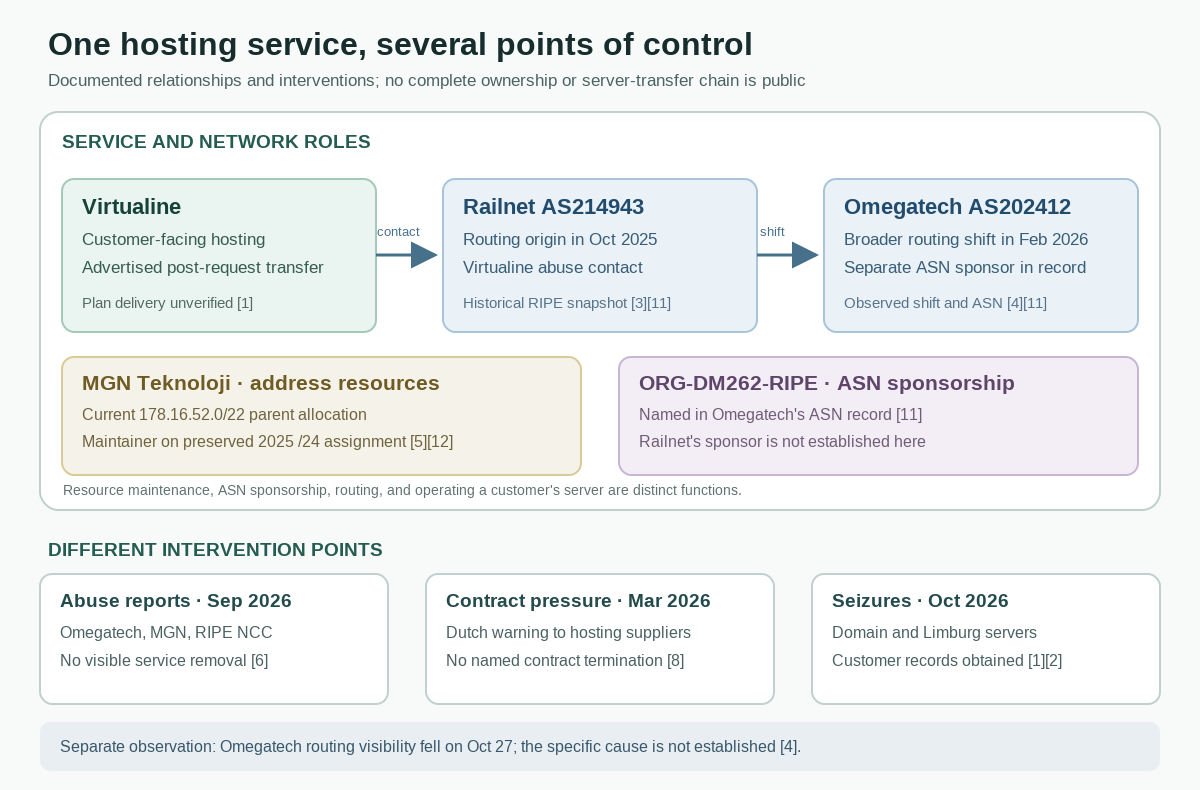
Separately, Silent Push observed that Omegatech’s prefixes had very low routing visibility on October 27, although they had not disappeared entirely. That observation does not identify which authority, if any, changed a route or address range, or separate the effects of seizure from other operator-side failures. Silent Push also captured a response on Virtualine’s alternative domain in which the operator disputed the allegations and claimed that a new brand and website could be established quickly. [4]
That response is evidence of the operator’s stated intentions, not evidence that the service had already resumed. Likewise, the survival of some routing visibility does not establish that criminal customers retained usable services after the operation.
The physical seizure was consequential precisely because it reached beyond a public-facing identity. Replacing a domain or registering an ASN may be relatively straightforward compared with recovering data, replacing unavailable machines, rebuilding application environments, and retaining customers whose records have been obtained by investigators.
Nevertheless, the public record does not establish whether the equipment in Limburg represented Virtualine’s complete hosting capacity, whether other facilities or suppliers remained available, or which customers had operational copies elsewhere.
The October operation can therefore be described as a substantial disruption, but not yet as proof of permanent termination of the entire business.
7. Interrupting the Hosting Business
Virtualine advertised protection against law-enforcement intervention as a commercial feature of its hosting service. That promise becomes more intelligible when placed alongside the infrastructure history: network registrations changed from Metaspinner to Lanedo and Railnet, and later toward Omegatech, while identifiable IP address space and parts of its resource-management arrangements persisted. The transitions demonstrate that the identity of a hosting operation and the infrastructure required to sustain it do not necessarily change together.
The same separation appeared when a researcher attempted to report phishing on Omegatech’s network. The registered organizations were visible, the address allocation could be traced, and the complaint could be directed to a published contact. Yet the reported sequence of referrals produced no intervention visible to the complainant. The record does not establish whether Omegatech simply ignored the reports or whether another participant could have compelled an operational change. It shows that registration validation and referrals did not turn those reports into enforcement.
The Dutch authorities’ response developed along two lines. In March, police attempted to interrupt the commercial supply of infrastructure by encouraging legitimate hosting companies to reconsider their reseller relationships. In October, international investigators intervened directly against the domain, physical servers, cryptocurrency, and customer information associated with the suspected criminal service.
The effectiveness of these measures cannot be judged using the same evidence. A domain seizure demonstrates control of a name, an IP assignment history demonstrates continuity or change in a network resource, and a physical seizure demonstrates that equipment has been removed from operation. None alone establishes the fate of every customer, contract, or service that previously depended on the provider.
It would be too strong to conclude that Virtualine’s historical network migrations were all designed to defeat law enforcement, or that the additional protection plan had been successfully delivered to paying customers. The public record does not provide the contracts, transaction-level evidence, or migration records necessary for those conclusions.
What it does establish is the institutional problem that made the advertised service plausible. The organization selling criminal customers continuity was not necessarily the organization allocating the addresses, sponsoring the ASN, supplying connectivity, or owning the physical equipment. Those functions could remain available, or be replaced separately, as the business changed its registered identity.
That separation is valuable to the legitimate hosting industry because it permits specialization, resale, and flexible infrastructure procurement. Virtualine’s case illustrates how the same structure can complicate intervention when a provider deliberately markets continued service despite criminal complaints.
The unresolved question after the October seizure is not simply whether Virtualine can register another domain. It is whether investigators have interrupted enough of the contractual, technical, and financial relationships through which the business supplied its customers.
Virtualine promised to keep a service running after the company around it changed. The domain and equipment seizures disrupted parts of that capability, while investigators obtained customer records. Whether the business can rebuild the supplier relationships needed to fulfill its promise remains unresolved.
References
Incident and International Investigation
[1] U.S. Department of Justice, Eastern District of Virginia. “Bulletproof” Website Domain Seized in International Law Enforcement Operation. October 27, 2026. Domain seizure, protection-plan advertisement, criminal allegations, payment arrangements, and international cooperation.
[2] Politie Midden-Nederland. Internationale politieactie tegen bulletproof hoster. October 28, 2026. Physical server seizures in Limburg, interruption of virtual machines, and recovery of customer records.
Network History and Organizational Relationships
[3] Recorded Future, Insikt Group. Malicious Infrastructure Finds Stability with aurologic GmbH. 2025, updated November 10, 2025. Metaspinner impersonation, Lanedo reassignment, Railnet, Virtualine-related networks, and upstream connectivity.
[4] Silent Push. Omegatech Is Disrupted, and the Pressure on Bulletproof Hosting Keeps Building. October 27, 2026. Railnet-to-Omegatech migration, routing visibility, and Virtualine’s response to the seizure.
[5] RIPE registration data and historical WHOIS records for 178.16.54.0/24: Historical Metaspinner registration, Omegatech routing listing, the current RIPE parent allocation for 178.16.52.0/22, RIPE’s mnt-by authorization documentation, and Recorded Future’s October 2025 comparison in [3]. These records describe different dates and layers; the current parent allocation does not establish the attributes of an intervening downstream assignment.
[11] RIPE WHOIS registration records for AS214943 / Railnet and AS202412 / Omegatech. Includes organization identifiers, Omegatech’s sponsoring-organization reference, and administrative or technical contacts. Historical and current snapshots must be distinguished.
[12] RIPE NCC. MGN Teknoloji Anonim Şirketi — Member Information. Official RIPE member information.
Abuse Handling and Internet Governance
[6] RIPE Security Working Group. Validated abuse-c that does not handle reports — 91.92.243.0/24 (ORG-OL329-RIPE). September 25–28, 2026. Public complaint by Theo Plooij, correspondence described with MGN and RIPE NCC, correction of the Spamhaus reference, and subsequent policy discussion.
[7] RIPE. RIPE-705: Abuse Contact Management in the RIPE Database. June 2018. Mandatory abuse-contact information and periodic mailbox validation.
[13] RIPE. Policy Proposal 2019-04: Validation of “abuse-mailbox” and its earlier version 1.0. The early version provided for revalidation following reports of incorrect or absent abuse responses; the final April 2020 version excluded assessment of case handling. Withdrawn September 8, 2020 after failing to achieve consensus.
[15] RIPE NCC. RIPE-863: Due Diligence for the Quality of the RIPE NCC Registration Data. July 20, 2026. Registration contracts, organizational identification, and verification of authorized representatives.
Financial Analysis
[10] TRM Labs. FBI Seizes Virtualine Domain After Provider Led Bulletproof Hosting Sector in Illicit Inflows. October 28, 2026. Bitcoin flows, attributed counterparties, criminal-market classifications, and sector-wide transaction activity.
Dutch Law, Policy, and Hosting Industry
[8] Nederlandse Politie. Politie waarschuwt hostingsector voor hosting resellers. March 11, 2026. Warning to hosting providers regarding bulletproof hosting resellers and their commercial relationships.
[9] Minister van Justitie en Veiligheid. Voortgang maatregelen aanpak bad hosting, Parliamentary Letter 2026D35400. July 3, 2026. Digital Services Act obligations, hosting-sector KYC proposals, reseller relationships, enforcement, and European coordination.
[14] Government of the Netherlands. Verkenning aanpak bad hosting. June 27, 2025. Government study of abusive hosting, reseller structures, and potential policy measures.
Evidentiary Scope
This investigation draws on official U.S. and Dutch government statements, research by Recorded Future and Silent Push, historical and current RIPE registration records, public RIPE policy discussions, and cryptocurrency analysis by TRM Labs.
The materials establish different kinds of facts. The Justice Department describes allegations and evidence presented in support of a seizure, rather than a completed criminal adjudication. Network-registration records identify published organizations, resource-maintenance permissions, and routing information, but cannot by themselves establish corporate ownership or the continuity of individual workloads. The September abuse complaint documents the researcher’s public account of the notification process; private communications and internal operational decisions were not independently obtained.
The available evidence does not establish which customers purchased Virtualine’s additional protection plan, whether a documented migration was conducted under that plan, the ultimate beneficial owners of every associated corporation, the complete ownership and contractual arrangements of the seized servers, or the ultimate destination of all payments received by Virtualine.
The article distinguishes between the existence of operational dependencies, the authority exercised by the organizations maintaining them, and the criminal responsibility alleged against the service operator. Those are related but separately verifiable questions, and no one category of evidence resolves all three.