How government procurement, private contractors, vulnerability researchers, and commercial suppliers became part of China’s offensive cyber capability.
Incident Analysis · China · Cyber Espionage · BlueMoon
Analysis based on publicly available information as of October 13, 2026.
Abstract
In late August 2026, the China-aligned group TA412 began delivering an exploit kit against selected organizations in the United States. Within days, other espionage clusters used substantially the same Chrome and Windows exploitation technology with different phishing sites and malware. Proofpoint called the kit BlueMoon. Its common code shows that a capability reached several operators, but the developer, supplier, and terms of distribution remain unknown. [1][2]
The question raised by BlueMoon is therefore organizational as well as technical: where can an offensive capability be produced, and what arrangements allow it to circulate? Leaked i-Soon records describe local-government purchases of cyber products and services; US indictments allege both commissioned and speculative intrusions by contractors; and Sophos telemetry traces exploit testing, deployment, and reuse around its firewall products. These records illuminate different parts of an industry, not a single documented chain leading to BlueMoon. [5][6][7]
This article follows the places where capacity is maintained, the forms in which it can be supplied, and the boundaries between producer, operator, broker, and government customer. Its central finding is that direction of an intelligence operation need not coincide with ownership of the research, software, or commercial organization that makes the operation possible. The evidence establishes several such arrangements in China-linked cases; it does not identify who built or sold BlueMoon.
1. Incident Overview
On August 28, 2026, Proofpoint observed TA412, also known as APT31 or JungleBamboo, delivering BlueMoon through targeted phishing campaigns against US non-governmental organizations, mining companies, and physical commodity trading firms. The phishing links led to operator-controlled sites where, if opened, the kit attempted a three-stage chain. The first vulnerability, CVE-2026-85046, was a type confusion in Chrome’s V8 engine; CVE-2026-87491 crossed the V8 sandbox; and CVE-2026-85880 elevated privileges through the Windows kernel on supported, mostly older builds. The final stage executed an operator-selected command outside the browser’s normal restrictions. [1]
| Vulnerability | Function |
|---|---|
| CVE-2026-85046 | Chrome V8 type confusion |
| CVE-2026-87491 | V8 sandbox escape |
| CVE-2026-85880 | Windows kernel privilege escalation |
The timing mattered. A fix for the first V8 flaw entered public Chromium source on August 7 but did not reach the general stable release until September 3, leaving nearly four weeks in which the patch was visible while many users remained exposed. Proofpoint assessed that the developer likely used public patches to weaponize the browser flaws. The Windows component appeared to have been compiled in 2025, suggesting that an existing capability may have been combined with the newer browser chain. Neither observation establishes the identity of the developer. [1]
TA412 was the first cluster Proofpoint observed using BlueMoon, but it was not the only one. From September 2, UNK_LateNight targeted US aerospace companies and delivered ShadowPad; UNK_DoubleCheck targeted a Vietnamese manufacturer with a Rust-based loader, without a national attribution from Proofpoint; and UNK_QuietRacket targeted organizations in Indonesia and Singapore. Volexity separately documented UTA0560 and UTA0565 using related exploitation components. The groups differed in their lures, delivery sites, redirects, loaders, and command infrastructure. [1][2][3]
Across those deployments, Proofpoint found the same underlying exploit chain and substantially identical orchestration and loading mechanisms. Operators could configure what the kit downloaded after exploitation while retaining their own campaign infrastructure and malware. The technical division is visible: a reusable core crossed the browser and operating-system boundaries, while each operator chose how to reach targets and what to run afterward. The organizational division is not. A sale, common developer, government distribution channel, and informal sharing remain alternative explanations for how the kit reached its users. [1]
BlueMoon identifies operational users while leaving production and supply unknown. The following sections examine procurement records and earlier technical observations separately before comparing what each establishes.
2. Attack Timeline
The chronology combines earlier evidence about production and procurement with the 2026 BlueMoon deployments. The events belong to different cases; their order does not imply that one company supplied another.
| Date | Observed event |
|---|---|
| April 9, 2020 | Sophos later identifies early CVE-2020-15069 exploitation activity on a device exhibiting characteristics of a development environment. |
| June 17, 2020 | The vulnerability is used in widespread attacks against exposed Sophos firewalls. |
| July 14, 2020 | Sophos identifies early malicious payloads associated with the vulnerability on devices belonging to a separate tracking cluster named TStark. |
| February 18, 2021 | The vulnerability is reused against unpatched devices with different payloads. |
| March 2022 | Sophos investigates CVE-2022-1040 exploitation against government and Tibetan-related targets. |
| September 2022 | Sophos discovers CVE-2022-3236 exploitation against financial, government, and security-related targets. |
| November 2023 | A bypass of the CVE-2022-3236 patch appears in operations Sophos attributes with high confidence to a different group. |
| February 2024 | Internal documents attributed to i-Soon become public, exposing contracts, customers, and commercial arrangements. |
| March 25, 2024 | US prosecutors charge APT31-associated individuals and describe a corporate front connected to the MSS’s Hubei organization. |
| October 31, 2024 | Sophos publishes its multi-year Pacific Rim investigation. |
| March 5, 2025 | US prosecutors announce charges concerning i-Soon and other Chinese contract-hacking networks. |
| August 28, 2026 | Proofpoint first observes APT31 using BlueMoon. |
| September 1–4, 2026 | Additional espionage clusters deploy substantially the same exploit technology. |
| September 9–21, 2026 | Proofpoint and Volexity publish analyses documenting common implementation and operator-specific modifications. |
The early Sophos entries show how a technical capability can move from testing to deployment and remain usable after disclosure. The i-Soon and prosecutorial entries show demand, contracts, and commercial relationships. The 2026 entries show common code in several operations. The timeline supplies the evidentiary sequence; the connections between those processes still require their own proof. [1]–[6]
3. Who Pays for Cyber Espionage?
3.1 A government purchase in Taizhou
One view of demand comes from the i-Soon documents leaked in February 2024. Radio Free Asia examined a spreadsheet described as Sichuan i-Soon Contract Accounts (四川安洵合同账目) and reported 120 contracts concluded between 2016 and 2022. At least 60 percent of final customers were government departments, according to its analysis, and listed values ranged from RMB 10,000 to RMB 3.34 million. The original ledger has not been reconciled here with authenticated procurement, payment, or acceptance records, so those numbers remain figures reported from the leak. [7]
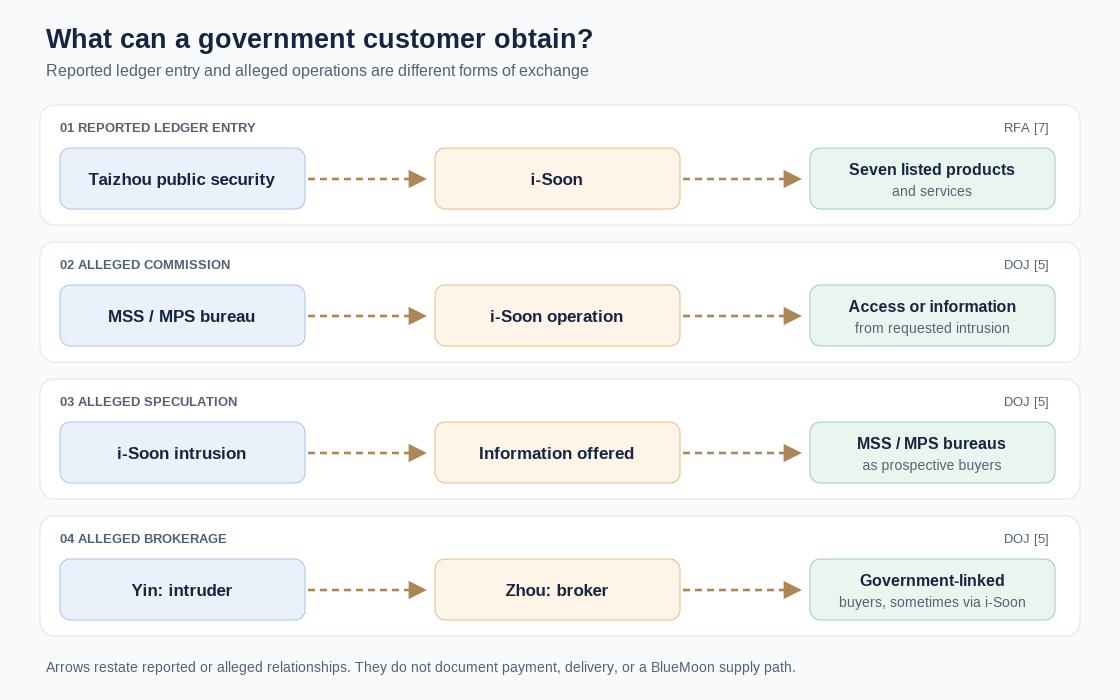
The clearest entry names the Taizhou Municipal Public Security Bureau in Zhejiang Province. In November 2021 it was recorded as purchasing seven products and services for RMB 2.6 million. RFA identified four categories among the seven: [7]
- A Twitter account investigation and tracking system
- A Telegram remote-forensics and investigation system
- An automated penetration-testing platform
- Website penetration services
The other three descriptions and individual prices were not independently established in this investigation.
The entry describes a local public-security customer seeking a bundle of tools and services from an external supplier. Some products addressed account investigation; others addressed testing or penetration. Each would require different software, maintenance, or staff time. The entry does not prove the bureau paid the reported amount, used every item, or commissioned an unauthorized foreign intrusion. It does show the kind of capability a municipal agency could seek through a commercial relationship rather than build wholly within its own department.
3.2 What exactly was being purchased?
The leaked contract books also show why the word contractor is too broad on its own. Germany’s Federal Office for the Protection of the Constitution (BfV) identified customer categories including public security, state security, military organizations, and enterprises. Its report describes contract labels for technical network services, technical cooperation, overseas data inquiries, data purchases, and anti-tracing services. The BfV interprets some labels as likely referring to intrusions or operational concealment; a label is not proof that every listed service was delivered as described. [8]
These arrangements transfer different things. A software purchase gives the customer functionality; a managed service buys work by the supplier; a data contract buys information that may have been collected earlier. A customer receiving a dataset need not own the exploit that produced it, and a customer ordering an operation need not employ the researchers who maintain the tools. The Taizhou entry is evidence of products and services offered to a government buyer, while the BfV’s wider contract analysis shows that access, information, and technical support could be commercial objects in their own right.
3.3 From commissioned operations to speculative intrusion
The March 2025 US indictment of i-Soon describes a still sharper division between the buyer’s decision and the contractor’s initiative. Prosecutors alleged that i-Soon intruded at the request of Ministry of State Security (MSS) and Ministry of Public Security (MPS) customers, but also entered systems on its own initiative and later tried to sell the results. It allegedly offered stolen information to at least 43 MSS or MPS bureaus across at least 31 provinces and municipalities, charged approximately $10,000 to $75,000 for a successfully compromised email inbox, trained government personnel, and offered hacking methods for sale. These are prosecutorial allegations, not judicial findings of guilt. [5]
Commissioned and speculative work create different incentives. In the first, a customer can define a target or requirement before the operation. In the second, the contractor decides where to invest its effort based on anticipated demand and seeks a buyer afterward. The government may remain the principal market without selecting every target or owning every tool. That distinction is central to the production question: a firm able to find targets, intrude, and market the result can maintain an operational capability between government orders.
3.4 The broker between the intruder and the government
A separate prosecution involving APT27-associated individuals describes a further division of labor. US prosecutors alleged that Yin Kecheng conducted intrusions while Zhou Shuai brokered stolen data to customers associated with Chinese government institutions; some information was allegedly sold through i-Soon. The chain in this case runs through at least three commercially distinct roles: [5]
Intruder → Information broker → Government-facing contractor or customer
What moves through that chain is acquired information, not necessarily the exploit or malware used to obtain it.
A broker’s customer relationships can be economically valuable even when the broker does not develop an exploit. Conversely, identifying an intrusion operator does not identify who bought the information or who arranged its sale. The market for results and the market for offensive software can overlap, but the APT27 allegations do not establish that the same organization supplied BlueMoon or any particular technical capability.
3.5 Competitors, collaborators, and subcontractors
The supplier side had its own commercial ties. In 2023, Natto Team reported a Chinese court listing for a software-development contract dispute in which Chengdu 404 Network Technology sued Sichuan i-Soon. US investigators had separately associated Chengdu 404 with APT41-related defendants. The court listing supports the existence of a reported contractual dispute; the software’s purpose and the case’s outcome were not established in the cited account. The Associated Press later described an industry in which competitors could also collaborate or subcontract on government projects. [9]
This matters because an external supplier is not always an isolated team attached to one bureau. Firms can hire, sell to, dispute with, or subcontract to one another while pursuing government work. The documented Chengdu 404–i-Soon relationship does not make either company BlueMoon’s developer. It instead shows that production and contracting can occur among companies before a government customer or operational group appears in the visible record.
4. Where the Exploits Come From
Procurement records show what customers sought; they do not show where a given exploit was made. Sophos’s Pacific Rim investigation offers a different kind of evidence: device telemetry, retrieved files, and reverse engineering that follow attack capability across testing and operational environments. Its observations concern Sophos products, not BlueMoon, and their value is to reveal how a research base can support more than one campaign. [6][13]
4.1 April 9, 2020: the exploit in a test environment
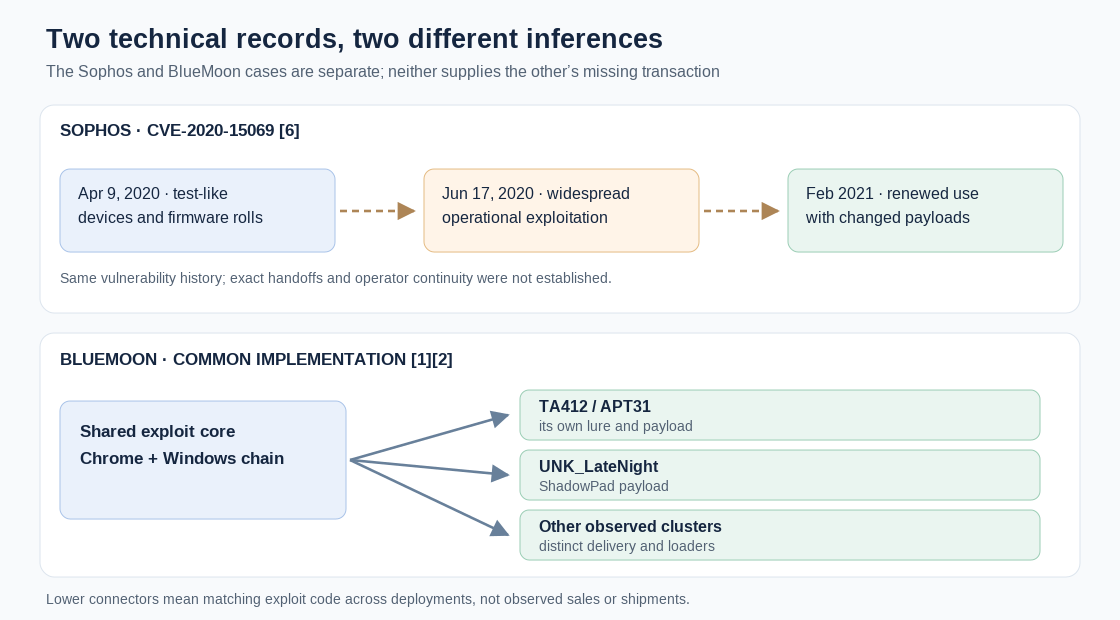
Through retrospective hunting, Sophos traced the earliest observed use of what became CVE-2020-15069 to April 9, 2020. The associated devices were frequently restarted, rolled back to earlier firmware, and run in varying physical and virtual configurations behind shared network infrastructure. Limited internal connectivity and repeated changes to software versions made the environment consistent with exploit testing rather than an ordinary customer’s firewall deployment. [6]
Those observations locate a production function: people with devices, firmware images, and time to test a vulnerability across versions. They do not identify a government contract or prove that the owner of every observed device later ran the campaign. Sophos’s broader investigation assessed with high confidence that exploit research and development occurred in Sichuan, but a geographic assessment should not be turned into a named supplier for this particular test site. [13]
4.2 June 17, 2020: the exploit enters operational use
On June 17, attackers used CVE-2020-15069, a buffer overflow in a custom Apache module, against internet-facing Sophos firewalls. Chained with local privilege escalation, it installed a web shell that waited for inbound commands. Compared with the earlier Asnarök malware, this smaller component reduced reliance on a central command domain and left less client-side evidence of the attacker’s objectives. Sophos later found about 175 anonymizing source IP addresses issuing commands to infected devices. [6]
The April and June observations trace a capability from development-like use to widespread deployment within Sophos’s investigation. The record does not reconstruct the exact transfer between those environments. That missing handoff is precisely why a laboratory observation is evidence of production capacity, but not by itself evidence of a sale or a common chain of command.
4.3 July 2020: another operator identifier appears
On July 14, Sophos identified devices registered to a cluster it named TStark that contained early malicious payloads associated with the same CVE-2020-15069 attack. One physical device had previously been registered by a former researcher at the University of Electronic Science and Technology of China in Chengdu. In August, Sophos retrieved a customized rootkit from a TStark-associated device with code elements previously associated with Winnti; later that month, Sophos and Volexity found overlapping indicators while investigating an organization assisting Tibetan exiles. [6]
The sequence puts research-linked equipment, exploit-related payloads, and later targeting in the same technical history. It does not establish which person developed the exploit, whether TStark bought it, or how code moved between groups. A production base can be visible through test infrastructure and personnel links even when the commercial transfer remains invisible.
4.4 February 2021: the capability survives its original campaign
On February 18, 2021, Sophos observed renewed CVE-2020-15069 exploitation of unpatched and unsupported firewalls. The payloads now included scripts for stealing locally stored credentials and interfering with automatic security updates. The change of payload matters more than the passage of time: an access method already developed for one campaign remained useful against a residual vulnerable population and could support another operational purpose. [6]
The February activity shows the economic value of a developed access method: it could be used again against a residual vulnerable population with a different payload. The telemetry cannot tell whether the same team retained the exploit or another team obtained or reproduced it.
4.5 A second group reuses the attack surface in 2023
Sophos’s later CVE-2022-3236 investigation supplies a more stringent attribution test. The vulnerability was used against financial and government-related targets in September 2022, with backdoors and modified Java components used to obtain credentials. After Sophos patched it, exploitation appeared in November 2023 against certain older firmware versions that had received the fix. Sophos found that malformed JSON could trigger an exception and bypass added validation. The later targets, post-exploitation tools, and infrastructure differed enough for Sophos to assess with high confidence that another group used the bypass. [6]
The second group could have received technical knowledge, inspected the public fix, or developed its own bypass. Shared attack surface cannot distinguish those routes. Sophos’s wider, high-confidence assessment of exploit development in Sichuan and sharing with distinct state-sponsored frontline groups draws on its multi-year investigation rather than this bypass alone. [13]
4.6 From software reuse to exploit supply
BlueMoon offers a different technical signal. Its users did not merely exploit the same published vulnerability: Proofpoint found the same underlying chain and almost identical orchestration and loading mechanisms in differently packaged deployments, and Volexity identified shared exploitation components. Operators changed the lure, hosting, redirects, loader, and final payload while retaining the core that crossed the browser and Windows boundaries. This is evidence of a common technical origin and portable integration point. [1][2]
The industrial finding is that the exploit chain was portable across operators. BlueMoon’s common implementation identifies a reusable technical product, while its different lures and payloads show where each operator could adapt it. The observed code does not identify the producer or distinguish a sale from state distribution or informal sharing. [1][2]
ShadowPad shows what stronger evidence about supply can look like. SentinelLabs found that its controller had hardcoded interfaces for plugins and that observed samples contained different plugin sets. It inferred that the developer controlled those packages and likely sold plugins separately. This is an assessment from software design and sample variation, not an invoice; it concerns a maintained backdoor rather than BlueMoon’s short-lived exploit chain. [14]
5. The Industry That Connects Production and Deployment
The cases now separate into two questions. What durable organizations and institutions can maintain offensive research between individual operations? And what exactly moves from a producer to an operator or government customer? Chengdu’s industry policy, i-Soon’s public business, vulnerability-management rules, and two different software platforms illuminate those questions from distinct records.
5.1 Building permanent technical capacity
A September 2018 Chengdu municipal policy sought to enlarge the local network and information-security industry through research facilities, specialist recruitment, enterprise–university cooperation, procurement, and civilian–military technical collaboration. It was an industrial-development policy for legitimate cybersecurity work. It did not authorize unauthorized intrusions or make every supported firm an intelligence contractor. [10]
Its relevance is institutional rather than accusatory. Vulnerability research requires skilled staff, test devices, software maintenance, and customers willing to sustain those costs after one project ends. A regional cluster of firms, universities, training programs, and public buyers can keep those inputs together. Sophos’s Sichuan research assessment, the TStark registration link to Chengdu, the Chengdu 404–i-Soon dispute, and i-Soon’s Chengdu operations are separate observations of activity in that region. They do not prove a single site, owner, or programme produced all the capabilities in this article. [6][9][13]
China’s 2021 Regulations on the Management of Network Product Security Vulnerabilities add an information-governance layer. Article 7 requires network-product providers to report flaws in their own products to a Ministry of Industry and Information Technology (MIIT) sharing platform within two days of discovery or learning of them; the platform informs other national coordination bodies. Article 10 requires operators of vulnerability-collection platforms to file with MIIT. Article 9 restricts organizations or individuals publishing vulnerability information from supplying unpublished details to overseas recipients other than the product provider, and Article 4 prohibits harmful exploitation. These provisions create a state-supervised route for some private vulnerability information and bring collection intermediaries under administrative oversight. They do not establish that either BlueMoon flaw entered that route; a case-specific reporting or access record would be needed. [12] Prior work, including the Atlantic Council’s 2025 study, has analyzed the broader offensive supply chain. [15]
5.2 i-Soon’s public explanation of its business
A 2022 interview with i-Soon CTO Zheng Huadong shows how the company publicly described its legitimate business before the leak and indictments. It presented law-enforcement investigation services, security platforms, threat research, accumulated datasets, and technical education as continuing lines of work. The interview said it had established an APT research department in 2013, expanded university cooperation from 2017, organized Anxun Cup competitions from 2018, and created Anxun Academy in 2020. Zheng also credited Chengdu’s Qingyang district with financial and policy support and help developing local business relationships. These are the company’s claims and the interviewer’s reporting, not proof that the named programmes conducted intrusions. [11]
The later allegations make the standing organization analytically important. A firm with researchers, trainers, sales staff, data assets, and government relationships can develop and maintain products across contracts, train customers, and market services or results. None of those legitimate capacities alone establishes unlawful activity. The 2025 indictment alleges where some of them were put to offensive use; it should not retroactively convert every employee, competition, or defensive product into part of an espionage operation. [5]
5.3 The exploitation pipeline has several different owners
The observed arrangements can be mapped by function rather than treating every China-linked firm as one supplier. This table identifies the asset held at each stage and the particular record that makes the stage visible.
| Function | What the organization controls | Concrete example |
|---|---|---|
| Government procurement | Budget, requirements, acceptance of products or results | Taizhou contract entry; MSS/MPS customer relationships |
| Technical research | Test environments, vulnerability knowledge, exploit development | Sophos’s observed Sichuan research activity |
| Capability integration | Packaging, loaders, payload configuration, reusable software | BlueMoon’s common exploit chain |
| Operational deployment | Target selection, phishing, infrastructure, post-exploitation | APT31 and other BlueMoon clusters |
| Information brokerage | Marketing and delivering stolen information | APT27-associated allegations and i-Soon |
| Technical maintenance | Research personnel, updates, infrastructure support | Commercial security companies and modular malware suppliers |
The table is a functional map rather than an organizational chart. In the BlueMoon campaigns, the common chain supplied exploitation while operators controlled their delivery sites and final payloads. In the i-Soon allegations, one contractor could both conduct intrusions and sell the resulting information. A function can be supplied by another organization, but a single firm can also occupy several rows. [1][5]
5.4 What crosses each boundary?
The object transferred between organizations matters:
Research → Supplier: vulnerability knowledge, exploit implementations, tests, and technical documentation.
Supplier → Operator: software, managed access, configuration, updates, or technical assistance.
Operator → Broker: acquired information, access, or intelligence products.
Broker → Government customer: information or the ability to satisfy an intelligence requirement.
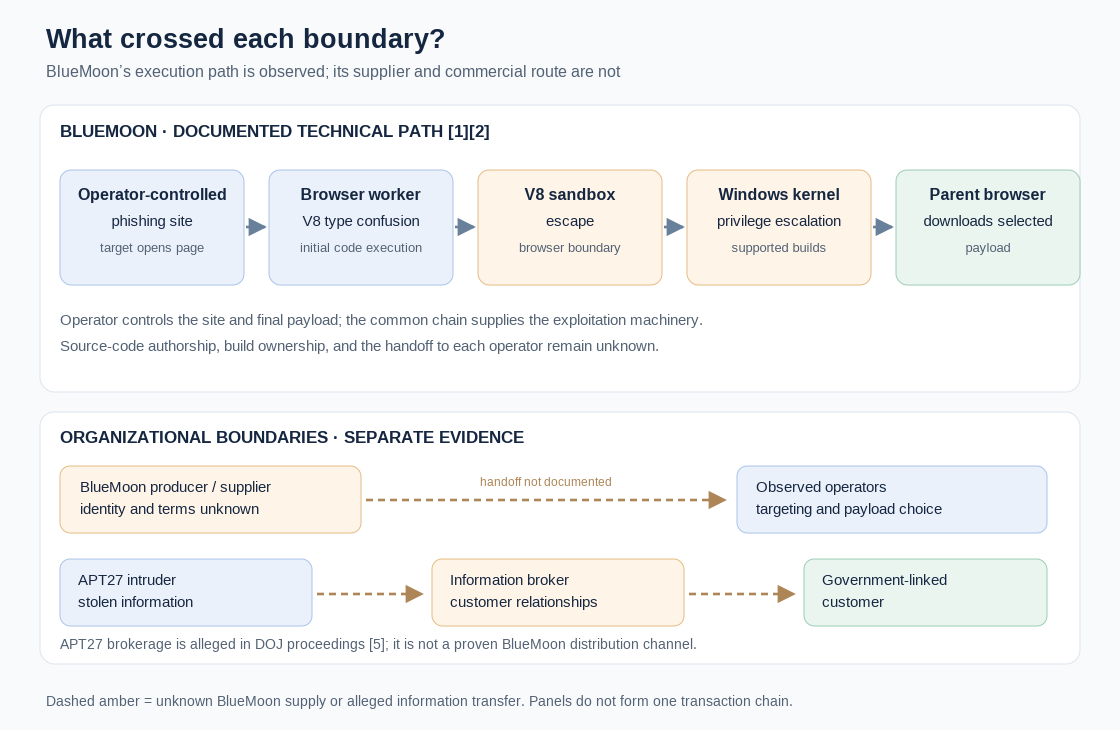
The BlueMoon execution path shows why these functions must be separated. The campaigns used phishing links to actor-controlled pages; when a target opened one, the common code could run in a browser worker, cross V8 and Windows privilege boundaries on supported hosts, and reach the parent browser process to execute an operator-selected download. Proofpoint and Volexity observed the technical interfaces. They did not observe a contract or handoff identifying the developer. The operator could change delivery and payload without necessarily controlling the core exploit, while the core developer could produce the chain without choosing each target. [1][2]
The transfers in the other cases are different. The reported Taizhou entry lists products and services sought by a public-security bureau. Sophos observed development-like activity and operational reuse. Prosecutors described stolen information moving through brokers and government-facing contractors. ShadowPad’s controller and plugin distribution support SentinelLabs’ inference of a restricted software supplier. Each record exposes a different boundary in the industry; together they explain its division of labor without requiring a single firm to connect every case.
5.5 The economic advantage of separating the stages
Exploit development concentrates costs in analysis, debugging, compatibility testing, and updates; deployment requires targeting, phishing infrastructure, and post-exploitation. A standing producer can spread research costs over several uses while operators retain their target knowledge and malware. BlueMoon’s packaging makes this division technically possible, and the i-Soon records show external procurement as an organizational form. Together they show why production and operation can be economically separate. [1][5][7]
Timing can intensify the incentive to distribute a capability. BlueMoon was used in the gap between a public Chromium source fix and the general stable release, when rapid integration was more valuable than an independent effort completed after patching. A commercial seller could respond to that pressure, but so could a centrally managed state distribution channel. ShadowPad represents a different tempo: a maintained platform with plugins and a controller that can support recurring customers. Distinguishing a short-lived exploit from a maintained backdoor explains why the same industry can produce different kinds of goods. [1][14]
5.6 Government demand does not imply complete government ownership
The cases span different degrees of state involvement. US prosecutors alleged that the MSS’s Hubei State Security Department created Wuhan Xiaoruizhi Science & Technology as a front supporting APT31 operations. They described i-Soon as a contractor serving many MSS and MPS bureaus and sometimes acting on its own initiative. The APT27-associated case added brokerage between intruder and customer. These arrangements can coexist: direct operational direction in one case does not imply complete government ownership of every researcher, vendor, or broker in another. [4][5]
Government procurement, industrial policy, and vulnerability-reporting rules can shape demand, local capacity, and information flow. They do not identify who selected a BlueMoon target or who wrote its code. The distinction prevents two opposite errors: treating every security company as an intelligence unit, and treating a state customer as irrelevant because a private firm produced a tool. The effective authority at each boundary depends on who could specify the target, control the code, deploy the payload, and receive the resulting information.
5.7 The limits of industrial attribution
An exploit can identify a method, malware can identify software, infrastructure can identify resources, and target selection can suggest objectives. None alone answers who discovered a flaw, assembled the chain, supplied it, selected the victim, or bought the result. BlueMoon’s common implementation supports a common technical origin, not a common command structure; different payloads support distinct operations, not independent exploit development. ShadowPad shows how a shared platform can make operator attribution harder for the same reason. [1][14]
A stronger investigation would distinguish those five questions with different records: development artifacts and test telemetry for provenance; build and distribution records for supply; phishing and infrastructure records for deployment; and contracts or payment trails for the customer relationship. Disrupting a particular payload or server can stop an operation while the people, code, customer relationships, and demand that supported it remain. That is the practical significance of locating the production base as well as the frontline actor.
6. Conclusion
BlueMoon revealed reusable exploit code across several campaigns within days. Sophos, i-Soon, DOJ, and ShadowPad records expose different production and supply arrangements in other cases. None supplies the missing contract connecting BlueMoon to a named firm. [1][5][6][7][14]
The production base is therefore both geographic and organizational. Chengdu’s policy and the regional cases show how a security industry can sustain staff, facilities, training, and customers, while the 2021 vulnerability rules document a state-supervised channel for some private vulnerability information. These conditions can support durable capacity without proving that any one policy produced any one exploit. BlueMoon’s patch-gap urgency and ShadowPad’s maintained plugins show why the forms of supply also differ: one is a rapidly shared exploitation chain, the other a platform that can be updated and distributed over time. [10][12][14]
China’s government disputes allegations that it sponsors unlawful cyber operations, and its vulnerability regulations prohibit unlawful exploitation. Legitimate cybersecurity companies and researchers cannot be classified as participants in espionage merely because they work in the same technical field. The specific court allegations and technical investigations discussed here warrant a narrower conclusion: in documented China-linked cases, government direction, commercial production, operational deployment, and receipt of intelligence have not always belonged to the same organization. [5][12]
An intelligence agency no longer needs to own every stage of the technical process that produces an intrusion.
This is why an attribution label attached to an attack is only one part of the explanation. To understand how a capability survives the loss of an operator or a server, investigators must ask where its research staff and code reside, what form the transferable product takes, who can authorize its use, and who ultimately pays for it. For BlueMoon, the first and last of those questions remain open. The industry becomes visible by keeping the open links separate from the ones the evidence actually establishes.
China’s cyber-espionage capability is sustained not only by the organizations that conduct intrusions, but also by an industry capable of producing, maintaining, and transferring the technology that makes those intrusions possible.
References
BlueMoon and exploitation research
[1] Proofpoint Threat Research, September 9, 2026. Once in a BlueMoon: Multiple State-Aligned Threat Actors Rapidly Adopt Novel Exploit Chain Using Chrome and Windows Zero-Days.
[2] Volexity, September 9, 2026. Mind the (Patch) Gap: Multiple Chinese Threat Actors Chain 0-day Exploits in Chrome & Windows.
[3] Volexity, September 21, 2026. Mind the (Patch) Gap, Part 2.
[4] US Department of Justice, March 25, 2024. Seven Hackers Associated with Chinese Government Charged with Computer Intrusions and the unsealed indictment, which alleges that the Hubei State Security Department created Wuhan Xiaoruizhi Science & Technology as a front company.
Contractor organizations, government procurement, and intermediaries
[5] US Department of Justice, March 5, 2025. Justice Department Charges 12 Chinese Contract Hackers and Law Enforcement Officers in Global Computer Intrusion Campaigns.
[6] Sophos X-Ops, October 31, 2024, updated December 10, 2024. Pacific Rim: Information for Defenders from a Braid of Interlocking Attack Campaigns. Detailed technical chronology of CVE-2020-15069, CVE-2022-1040, and CVE-2022-3236.
[7] Radio Free Asia, March 1, 2024. 海外发声或被黑客“落地” 中国翻墙网民要担心吗?. Chinese-language investigation of the leaked Sichuan i-Soon contract ledger, including the reported November 2021 Taizhou procurement.
[8] German Federal Office for the Protection of the Constitution (BfV), August 2024. The i-Soon Leaks: Industrialization of Cyber Espionage, Part 4 — Offered Products and i-Soon Customers.
[9] Natto Team, October 27, 2023. i-SOON: Another Company in the APT41 Network. Investigation of a reported Chengdu software-development contract dispute between Chengdu 404 and Sichuan i-Soon. See also the Associated Press’s subsequent investigation of i-Soon’s commercial relationships.
Chinese industrial and corporate records
[10] Chengdu Municipal Government, September 2018. 成都市人民政府办公厅关于加快推进网络信息安全产业体系建设发展的意见. Public industrial policy reproduced from the municipal government’s publication.
[11] 36Kr, September 30, 2022. 「安洵信息」:聚焦实战能力建设,构建数字安全体系. Interview with i-Soon CTO Zheng Huadong on public-security work, threat research, technical education, and local-government support.
[12] Ministry of Industry and Information Technology, Cyberspace Administration of China, and Ministry of Public Security, 2021. 网络产品安全漏洞管理规定.
Broader supply-chain investigations
[13] Sophos X-Ops, October 31, 2024. Pacific Rim: Inside the Counter-Offensive.
[14] SentinelLabs, 2021. ShadowPad: A Masterpiece of Privately Sold Malware in Chinese Espionage.
[15] Atlantic Council, June 25, 2025. Crash (Exploit) and Burn: Securing the Offensive Cyber Supply Chain.
Related Zerot Security Research
[16] Zerot Security Research, October 12, 2026. The Attacker as a Public Company. A separate examination of Integrity Technology Group, its corporate structure, and the infrastructure attributed to Flax Typhoon.
Evidentiary Scope
This investigation distinguishes observed technical behavior, reported commercial records, judicial allegations, and analytical reconstruction.
The BlueMoon exploit chain and its reuse across operational clusters are supported by Proofpoint and Volexity. Its developer, distribution channel, commercial terms, and purchaser remain unknown.
The November 2021 Taizhou procurement is described in reporting on leaked i-Soon contract records. The original contract, proof of payment, and complete list of seven products were not independently authenticated in this investigation.
The Sophos findings on exploit testing, deployment, and reuse derive from device telemetry and reverse engineering. Sophos assessed exploit sharing among distinct state-sponsored groups with high confidence, but did not publicly reconstruct each source-code transfer or contract.
The 2021 vulnerability-management rules establish reporting and disclosure obligations; no record examined here shows BlueMoon entering or leaving a government channel under those rules. SentinelLabs’ description of ShadowPad as privately sold, including the likely separate sale of plugins, is its assessment from technical artifacts and historical relationships, not a documented transaction for every deployment.
The organizational relationships described in US criminal proceedings are prosecutorial allegations unless independently established through other evidence. China’s government disputes allegations that it sponsors unlawful cyber operations.
The commercial model presented here is a reconstruction of independently documented functions. It does not imply that every cybersecurity firm discussed belongs to one command structure or that any named contractor developed BlueMoon.