How criminal operators, recovery firms, negotiators, and insurers became connected through the same transactions—and why no single institution necessarily sees the whole exchange.
Analysis based on publicly available information as of October 12, 2026.
Abstract
On October 7, 2026, the U.S. Department of Justice announced fraud charges against Zohar Pinhasi, the owner of ransomware recovery company MonsterCloud. Prosecutors allege that the company advertised proprietary technology capable of recovering encrypted data without paying criminals, while secretly purchasing decryption keys from the attackers themselves. Between 2018 and 2023, MonsterCloud allegedly charged customers more than $19 million and paid more than $8 million to ransomware operators. [1][2]
Three months earlier, former ransomware negotiator Angelo Martino had been sentenced to 70 months in prison for collaborating with BlackCat ransomware operators. While representing victims, Martino secretly disclosed their insurance information and negotiating positions to the criminals, receiving a share of ransom proceeds. The five victim payments documented in his factual proffer, an agreed statement of facts in his criminal case, totaled approximately $75.25 million. That figure represents the victims’ payments, not Martino’s personal earnings or a measured increase attributable to his misconduct. [3][4]
These cases involved different forms of wrongdoing. They nevertheless reveal the same commercial position: an intermediary entrusted by the victim with information, money, or recovery responsibilities while dealing directly with criminals who control the victim’s data.
That position was not created by the misconduct.
In 2018, the GandCrab ransomware operation already offered discount codes and private communication facilities to professional recovery companies. In 2019, Lake City, Florida, used an insurance-approved negotiator to arrange a ransom payment through a disclosed commercial process. Meanwhile, cyber insurers were developing networks of preferred incident-response firms, negotiating service rates, and influencing the selection of specialists. [5][6]
Ransomware-as-a-Service (RaaS) industrialized the production and execution of cyber extortion. A second, legitimate industry developed around the consequences: insurers, lawyers, forensic investigators, negotiators, recovery specialists, and payment facilitators. The industries are not equivalent, and participation in legitimate recovery does not establish criminal collaboration. But they are economically connected whenever a professional intermediary purchases a decryption key, negotiates with an attacker, or transfers ransom proceeds.
This investigation reconstructs how these commercial relationships emerged, how authority and resources move across a ransomware transaction, and why existing institutions may regulate the service provider without fully observing the service performed.
The central problem is not simply that intermediaries can act dishonestly. It is that a recovery transaction can be distributed across contracts, organizations, technical systems, and communication channels without producing a complete, independently verifiable account of what the intermediary actually purchased, disclosed, negotiated, and transferred.
1. Incident Overview
The MonsterCloud and Martino cases illustrate two ways in which a ransomware intermediary can acquire commercial power from information unavailable to the customer.
In the MonsterCloud case, the disputed resource was the decryption capability itself.
According to the September 23, 2026 indictment, MonsterCloud offered prospective clients an initial analysis phase, typically priced between $2,500 and $10,000. Clients supplied a ransom note and selected encrypted files. MonsterCloud returned decrypted samples, presented as evidence that its proprietary technology could recover the remaining data.
Customers could then purchase a more expensive recovery service.
Prosecutors allege that, in many instances, MonsterCloud obtained the sample decryptions directly from the criminals responsible for the attack. Rather than independently defeating the encryption, the company allegedly used the attacker’s cooperation to demonstrate a technical capability it claimed to possess itself. [2]
The indictment describes an August 2023 transaction in which approximately $8,200 was paid to a criminal while the customer was charged approximately $150,000. In October 2021, another alleged transaction involved a payment of approximately $236,000 to an attacker and a customer charge of roughly $380,000.
A difference between procurement cost and service price does not, by itself, establish fraud. Professional recovery can involve substantial labor, technical verification, financial risk, and system restoration. The alleged deception concerned what the company claimed to be selling and whether the customer understood that the essential recovery capability was being purchased from the attacker.
Martino’s misconduct operated in the opposite direction.
As an employee of a ransomware incident-response company, he received information about victims’ insurance coverage, payment capacity, and negotiation strategies. He also had access to the BlackCat negotiation system through which he communicated with criminals on behalf of those victims.
According to his agreed factual proffer, the ordinary negotiation chat was typically preserved and shared with the victim and his employer. Martino also communicated with BlackCat operators using Tox and a separate intermediary chat available only to him and the criminal participants. [4]
He used that second channel to disclose confidential information and advise the criminals how to maximize ransom payments.
The distinction between the channels was decisive. The victim and employer could examine the formal negotiation record without seeing the additional instructions Martino had supplied to the opposing party.
Martino also participated in separate BlackCat ransomware attacks alongside former cybersecurity professionals, using affiliate access to conduct extortion and share criminal proceeds.
The two proceedings have different evidentiary status. Martino pleaded guilty and was sentenced in July 2026. Pinhasi had been indicted but not convicted as of October 12, 2026; the MonsterCloud conduct discussed here remains the prosecution’s allegations.
These cases should not be treated as proof that the recovery industry is broadly corrupt. They demonstrate something narrower and more useful: the intermediary can control critical information moving in both directions, and a legitimate customer may be unable to reconstruct the complete transaction from the service it receives.
2. Timeline — How Two Ransomware Industries Became Connected
The development of professional ransomware intermediation did not follow a single corporate history. Criminal operators, recovery specialists, insurers, and payment providers established their own arrangements, which increasingly met during the handling of actual incidents.
The following timeline dates documented commercial mechanisms, transactions, and legal proceedings. The MonsterCloud indictment’s overview places the alleged scheme between June 2018 and June 2023, although one example in the same document is dated August 2023. The indictment does not reconcile those dates. [2]
| Period | Documented development | Significance |
|---|---|---|
| December 2, 2018 | Check Point publishes its controlled Dr. Shifro experiment involving a purported ransomware victim and attacker. | Demonstrates how an attacker-controlled key can be repackaged as a separately priced recovery service. |
| December 11, 2018; February 5, 2019 | Coveware documents GandCrab discount codes and private chats for recovery firms, then describes their operation in version 5.1. | Criminal payment infrastructure recognizes professional intermediaries as repeat counterparties. |
| May 2019 | ProPublica investigates recovery firms, including Proven Data and MonsterCloud. | The distinction between independent decryption and payments to criminals becomes a public accountability issue. |
| June 2019 | Lake City authorizes a Ryuk ransom payment arranged by Coveware through an insurance-response process. | Documents a legitimate commercial chain linking victim, negotiator, insurer, and attacker. |
| 2021–2023 | Academic studies document insurer vendor panels, preferential rates, lawyers’ coordination roles, and specialization among response providers. | The legitimate response industry operates through recurring institutional relationships. |
| Around 2022–November 2023 | Martino and co-conspirators begin conducting ransomware attacks around 2022. From April 2023, he also provides confidential victim information to BlackCat participants; in May 2023 he obtains BlackCat affiliate access. | His direct attack participation and misuse of professional access overlap. |
| July 9, 2026 | Martino is sentenced to 70 months in prison. | His criminal collaboration is established through a guilty plea and sentence. |
| October 7, 2026 | DOJ announces the MonsterCloud prosecution. | Alleged misconduct in recovery services becomes the subject of federal fraud charges. |
2.1 Recovery firms became repeat customers
A ransomware victim typically encounters a particular criminal operator only after an attack. A specialist handling many incidents may repeatedly encounter the same operators, ransom-payment systems, and negotiation procedures.
That difference has commercial consequences.
In its May 2019 investigation, ProPublica described how Proven Data made repeated payments to ransomware operators, including those associated with DMA Locker and SamSam. A former employee reported that DMA Locker operators eventually recognized the company’s Bitcoin wallet, allowing payments to be associated with a familiar counterparty. [7]
Check Point Research had documented another form of intermediation in December 2018. Researchers approached Dr. Shifro, a Russian recovery firm, while posing separately as a victim and as the attacker. The firm offered a paid recovery service while negotiating to obtain a decryption key from the supposed criminal.
The published experiment documents the negotiation, not a verified ransom payment. It nevertheless demonstrated the commercial mechanism: the intermediary could purchase access to a criminal-controlled resource and sell recovery to the victim for a separate fee. [8]
GandCrab made that relationship explicit within its payment software.
Coveware documented a discount-code facility intended for recovery companies, along with private chats not visible to other visitors to the same ransom-payment site. In February 2019, the reported discounts ranged from 5% to 20%, and the codes applied to subsequent infections rather than simply discounting the current victim’s demand. [6]
That detail is important. The criminal operator was not merely negotiating one ransom. It had designed facilities for intermediaries expected to return with future business.
Coveware publicly disclosed that it possessed such a code and passed the entire discount to its clients. The system could therefore support transparent professional services as well as undisclosed price manipulation. Possessing access to the facility was not itself evidence of misconduct.
By early 2019, the criminal payment infrastructure already treated a recovery provider as a commercially recognizable participant distinct from the individual victim.
2.2 Lake City: The legitimate transaction becomes visible
On June 10, 2019, municipal systems in Lake City, Florida, were disrupted by Ryuk ransomware. City employees and outside specialists attempted to recover data from backups, but the process was slower and more difficult than expected.
Lake City’s insurance arrangement involved the Florida League of Cities and Beazley. Beazley requested encrypted material and the ransom note so that Coveware, an approved negotiation provider, could contact the attackers.
The original demand was 86 BTC. Coveware negotiated it to 42 BTC, approximately $460,000 at the time the city decided to pay. [5]
On June 24, city officials approved the payment after considering the costs and delays associated with continuing recovery from backups.
The resulting transaction was not simply an insurer sending money to a criminal.
According to ProPublica’s reconstruction, Lake City advanced the necessary funds to Coveware. Coveware converted them into Bitcoin, transferred payment to the attacker, and received a fee for its services. The Florida League of Cities subsequently reimbursed the municipality.
Several distinct decisions were therefore combined into one recovery process. The municipality authorized the expenditure. The negotiator arranged and executed the exchange. The insurance arrangement shaped the financial decision and covered the eligible loss. The attacker was expected to supply a means of decryption; the public account does not establish every technical handoff.
Nothing in this record establishes deception or criminal collaboration by Coveware. Its role is important precisely because the transaction was conducted as a legitimate service.
The Lake City case demonstrates that an organized recovery industry could already connect victims’ authorization, professional services, insurance reimbursement, and criminal payment within one commercially coordinated process.
2.3 The intermediary becomes a criminal participant
The Martino case shows a more severe exploitation of the intermediary’s position.
Beginning in April 2023, Martino communicated with BlackCat operators outside the ordinary negotiation record. He disclosed information about five victims, including insurance limits and negotiation strategies, while continuing to represent them in the visible chats.
The payments documented for those five victims were approximately $16.484 million, $26.793 million, $25.660 million, $6.100 million, and $213,000. Together, they amounted to approximately $75.25 million. [4]
This total measures the ransomware payments associated with the five negotiations. It does not measure the amount that could have been avoided, nor the compensation Martino personally received.
According to the factual proffer, Martino and his co-conspirators had begun conducting ransomware attacks around 2022, before the concealed BlackCat negotiations described above. In May 2023, Martino obtained BlackCat affiliate access. In a separate attack against a medical-device company that month, he and his co-conspirators received approximately $1.274 million and remitted a portion to the BlackCat administrator. [4]
The commercial boundary was crossed in two distinct ways: a victim’s representative supplied confidential information to the opposing side, and the same person participated with co-conspirators in attacks against other victims.
The historical record thus shows three distinguishable forms of participation: an authorized intermediary facilitating payment, an intermediary allegedly concealing the upstream procurement of recovery capability, and an intermediary secretly cooperating with criminals while also participating in attacks.
3. The Two-Sided Ransomware Economy
3.1 Two industries organized around the same incident
Ransomware-as-a-Service is usually described as a criminal division of labor.
A platform operator supplies malware, administration panels, negotiation facilities, and other shared resources. Affiliates acquire access to targets and execute attacks. Revenue is divided according to organizational rules.
This structure allows criminal participants to specialize rather than requiring each attacker to produce and operate every component of an extortion campaign.
But the attack also creates demand for a different collection of specialists.
Victims may employ forensic investigators to reconstruct the intrusion, lawyers to manage regulatory and litigation exposure, negotiators to communicate with criminals, payment facilitators to execute authorized transfers, and recovery engineers to restore systems. Insurers may coordinate access to these services and reimburse qualifying expenses.
The two industries have fundamentally different purposes. One produces unlawful coercion; the other provides services to organizations attempting to recover from it.
They nevertheless interact over resources controlled by the criminal operator.
When data is encrypted and no independent restoration path is immediately available, the criminal may possess the practical ability to supply a working decryptor. In a data-theft case, the attacker may also control the publication channel or the terms of a promise not to disclose stolen information.
The legitimate recovery provider cannot necessarily manufacture those capabilities. Instead, it can negotiate access to them.
This makes the attacker a coercive upstream counterparty in an otherwise legitimate recovery transaction. The attacker created the scarcity through criminal conduct, while the recovery provider may be hired to acquire or work around the scarce resource.
The economic relationship is therefore not ordinary subcontracting. It is a service market partially dependent on resources deliberately withheld through extortion.
3.2 Criminal operators and insurers both recognize repeat intermediaries
GandCrab’s discount codes reveal how criminal operators could distinguish professional intermediaries from one-time victims.
A company that regularly negotiated and paid ransoms could bring recurring transactions, communicate through familiar channels, and reduce uncertainty about payment execution.
On the legitimate side, cyber insurers also developed recurring relationships with incident-response providers.
A 2021 study by Daniel W. Woods and Rainer Böhme examined 29 expert interviews and publicly documented relationships between 24 cyber insurers and response firms. It identified 480 panel listings involving 151 distinct providers. These were publicly listed relationships, not 480 verified contracts or ransomware incidents. [10]
Insurer panels enabled advance selection of specialists, prearranged pricing, and coordination during incidents. Subsequent research at USENIX Security documented how investigators, negotiators, and payment facilitators could be separately engaged, sometimes at preferential panel rates. [9]
The comparison does not imply that the two markets have equivalent objectives.
GandCrab wanted to collect criminal proceeds more efficiently. Insurers sought to manage claims, obtain qualified services, and control recovery costs.
The structural connection is that both could recognize the same professional class of intermediary as a repeat participant.
A recovery specialist might establish legitimacy through insurer approval, contractual relationships, and successful client engagements, while simultaneously acquiring familiarity with the criminal payment interfaces and operators encountered during those engagements.
The same access that makes such a specialist effective for victims can also create opportunities for misconduct when its use is not independently verifiable.
3.3 The incentive problem does not require collusion
One incident can produce distinct flows of money. The attacker receives ransom revenue. A negotiator or recovery provider can earn a contracted fee for legitimate work. The insurer collects premiums for bearing risk but incurs a claim expense when it reimburses a covered loss. Resolving an incident sooner may reduce that expense relative to prolonged interruption; the ransom payment itself is not insurer revenue.
Lake City makes these distinctions concrete. The city authorized the payment, Coveware received a service fee for arranging and executing it, the Florida League of Cities reimbursed the municipality, and the Ryuk attacker received the ransom. [5] The record does not establish that Coveware’s fee rose with the ransom amount or that the insurer profited from paying the claim.
These are not equivalent gains or shared objectives. A provider’s fee can pay for skilled work that helps the victim, even as the same transaction transfers money to the criminal who created the emergency. Good negotiation may reduce the demand; reliable execution can also make collection more predictable for the attacker.
Economic dependence, authorized negotiation, undisclosed conflicts of interest, and criminal conspiracy are therefore different phenomena. The public evidence supports particular interactions to different degrees; it does not establish an industry-wide conspiracy.
4. Architecture of the Transaction — What Actually Crosses the Boundary?
The ransomware recovery process is not a single exchange between victim and attacker.
It is a sequence of authorizations, disclosures, negotiations, financial operations, and technical actions performed by organizations that may possess different parts of the record.
The crucial question is which party controls each resource, which party is authorized to use it, and what evidence reaches the customer or the institutions supervising the transaction.
4.1 A distributed transaction without a complete common record
The three cases involved different organizations and legal outcomes. Figure 1 maps their separate paths rather than combining them into one incident. The Lake City record identifies an authorized payment chain; the MonsterCloud path remains an indictment allegation; and Martino’s concealed communications are described in his agreed factual proffer. [2][4][5]
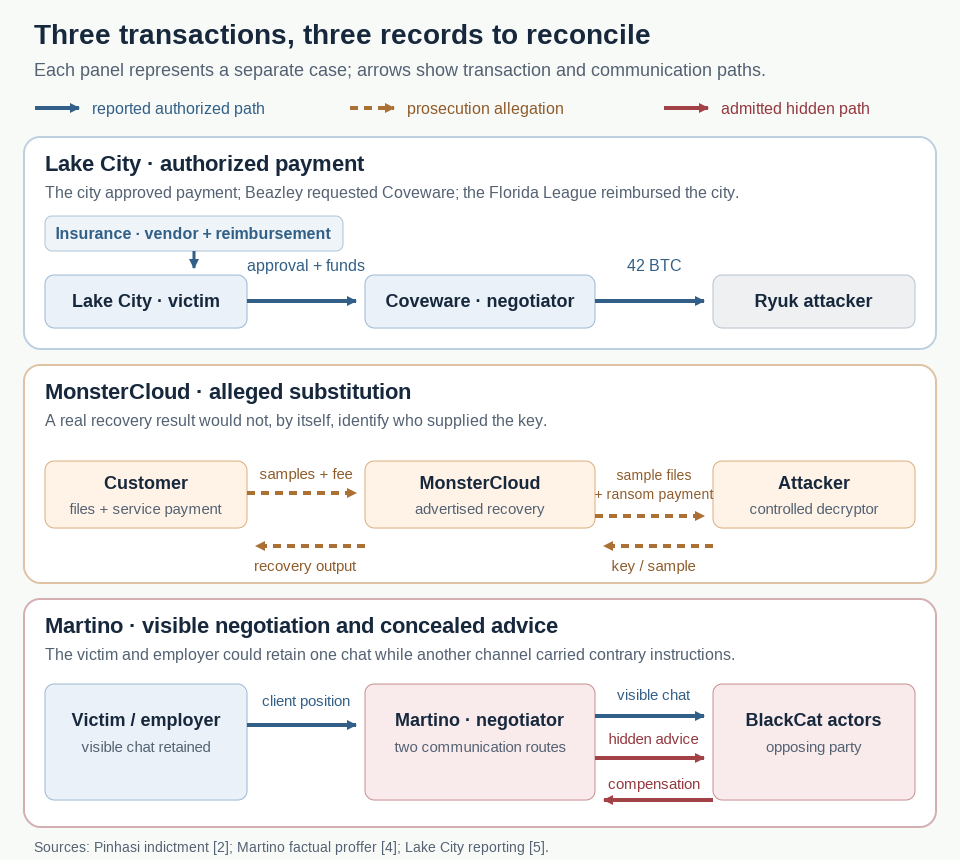
The following table identifies the principal resources and decisions behind those paths. Actual assignments vary by contract and jurisdiction, and multiple functions may be performed by one provider.
| Resource or decision | Origin or controlling party | Intermediary’s potential role | Evidence needed |
|---|---|---|---|
| Decision to pay | Victim and authorized decision-makers | Advise and arrange execution | Authorization record |
| Ransom demand and destination | Attacker | Negotiate price and payment terms | Negotiation and wallet records |
| Decryption capability | Attacker, unless independently recovered | Acquire, test, and deliver decryptor | Provenance and technical recovery record |
| Insurance and settlement information | Victim and authorized representatives | Use information within delegated authority | Information-sharing authorization |
| Currency conversion and transfer | Authorized payer and financial intermediaries | Execute or arrange payment | Transfer records and reconciliation |
| Recovery-service price | Recovery provider under customer contract | Quote and invoice services | Scope, invoice, and material service disclosures |
| Reimbursement | Insurer or insurance arrangement | Submit claim materials | Policy and claims records |
These resources are not interchangeable.
Permission to negotiate does not automatically confer permission to disclose confidential insurance limits. Authority to transfer cryptocurrency does not independently authorize the decision to pay. Possession of a decryptor does not prove that the provider developed an independent decryption technique.
The completed service may appear coherent to the customer even when the information required to verify its production is held by several different parties.
The cases provide three concrete configurations of this problem.
4.2 Lake City: Authorized payment through a professional intermediary
Lake City provides the baseline transaction.
The municipality faced an operational emergency and approved a negotiated ransom. Coveware communicated with the attacker and executed the payment. The insurance arrangement reimbursed the city.
In this configuration, the intermediary’s interaction with the criminal was part of the service the customer had authorized.
The transaction still required different records to establish different facts. Municipal approval established the spending decision. Negotiation records supported the agreed amount. Financial records could establish conversion, transfer, and service fees. Recovery records would establish the technical outcome.
No single one of these records necessarily described the entire incident. But the public record identifies the intended functions of the participants and the authorized purpose of their interactions.
The distinction matters because the problem exposed by the subsequent cases is not the mere existence of an intermediary. It is a divergence between the intermediary’s delegated role and its actual dealings with the attacker.
4.3 MonsterCloud: The origin of the decryption capability was concealed
The MonsterCloud allegations concern a substitution in the production of the recovery service.
The customer was allegedly offered an independently developed recovery capability. The attacker possessed the key needed to restore the encrypted files. MonsterCloud allegedly obtained that capability from the attacker while presenting the resulting output as proof of its own technical methods.
The initial sample-decryption stage was particularly significant.
A decrypted sample functioned as evidence in the customer’s purchasing decision. If the attacker produced the sample, the artifact demonstrated that decryption was possible—but not that MonsterCloud possessed the claimed proprietary capability.
This is an important distinction between a technical result and the independent capability attributed to its producer.
The customer could receive a genuine decrypted file, observe successful recovery, and pay for the service without learning how the capability had been obtained.
According to the indictment, contractual representations and terminology helped preserve this separation. Prosecutors allege that customers were led to believe ransom payments would be avoided, while contacting the criminal was commonly the provider’s first step. [2]
A recovery company can legitimately procure external tools, engage subcontractors, or negotiate for keys when properly authorized. The alleged failure was not merely that an upstream supplier existed. It was that the actual method and source of the critical capability were inconsistent with the representations on which the customer relied.
An invoice and a successfully decrypted file could therefore both be genuine while leaving the alleged deception undiscovered.
Verifying the service would require evidence of how the key or decryptor was obtained, what was paid to the attacker, which recovery work was independently performed, and what the customer had authorized.
4.4 Martino: One negotiation, visible and concealed communication channels
Martino’s conduct illustrates a different failure: the customer could observe a legitimate-looking negotiation while an unauthorized negotiation occurred alongside it.
BlackCat’s platform exposed a negotiation chat through which victims and their representatives communicated with the attackers. The records were typically available to Martino’s employer and the represented victim.
The platform also supported an intermediary chat restricted to Martino and BlackCat participants.
In September 2023, Martino represented a hospitality company attacked by BlackCat. According to his factual proffer, he advised the criminals in the restricted channel to search stolen material for the victim’s insurance information and to continue rejecting settlement offers while he determined what the insurer might approve. [4]
Meanwhile, the visible chat presented him as resisting the attacker and attempting to negotiate a lower payment.
The BlackCat operator subsequently referred to the victim’s insurance coverage in the ordinary negotiation, following the direction Martino had supplied through the concealed channel.
The victim eventually paid approximately $16.484 million.
The problem was not simply that Martino possessed confidential information. Access to the victim’s financial position was part of his professional role.
The failure occurred when he exercised that access for the benefit of the opposing party through a channel excluded from the employer’s and customer’s ordinary record.
A complete transcript of the visible negotiation would still have been incomplete evidence of the negotiation that actually occurred.
Martino’s separate participation as a BlackCat affiliate involved another transfer of authority. Rather than merely advising an attacker, he acquired access to the platform’s criminal operations and shared proceeds from attacks conducted with his co-conspirators.
His case therefore documents two related but distinct abuses: undisclosed collaboration within an ostensibly legitimate service relationship, and direct participation in ransomware operations.
4.5 Three transactions, three different verification questions
The difference between the transactions can be summarized without treating their participants or legal outcomes as equivalent.
| Case | Customer-facing service | Critical underlying activity | Verification problem |
|---|---|---|---|
| Lake City / Coveware | Authorized negotiation and ransom payment | Disclosed interaction with attacker and transfer of funds | Reconciliation of approval, payment, and recovery |
| MonsterCloud | Purported proprietary data recovery | Alleged purchase of attacker-controlled decryption capability | Provenance of the decryptor and truthful description of the service |
| Martino / BlackCat | Negotiation on the victim’s behalf | Secret disclosure of victim information and criminal compensation | Completeness of communications and loyalty to the authorized principal |
The common weakness is not necessarily missing paperwork.
The relevant evidence may be distributed across different systems. Deliberate concealment creates a further problem: the person executing the transaction may use channels that the customer and supervising institutions do not know exist. Reconciling ordinary records alone would not necessarily expose those channels.
Financial records can confirm that money moved without proving that the customer understood what was purchased. A working decryptor can demonstrate a technical result without proving who supplied the capability. A saved negotiation transcript can document one channel without establishing that no other channel existed.
There is no inherent technical reason why every ransomware response must produce a single unified record. Contracts, privacy obligations, legal privilege, and service specialization all shape what can be shared.
But when different records are treated as sufficient evidence of the same transaction, the distinction between authorization, execution, and verification can disappear.
5. Why Existing Institutions Cannot Necessarily See the Whole Transaction
The legitimate ransomware recovery industry is not unregulated or institutionally primitive.
Insurers maintain preferred-provider arrangements, negotiate rates, and review covered costs. Lawyers manage legal risk and coordinate incident response. Financial intermediaries face compliance obligations. Professional service contracts define responsibilities, payment terms, and customer rights.
The difficulty is that these institutions supervise different components of the transaction.
They do not necessarily observe the same facts.
5.1 Insurers govern vendor selection more readily than attacker-facing conduct
Cyber insurers can exercise substantial influence over the incident-response market.
Insurer panels identify preferred specialists, establish contractual expectations, and can reduce the cost and delay of finding qualified assistance during an emergency. Research on cyber-insurance incident response shows how the insurer’s preferred network can shape which firms investigate an attack, conduct negotiations, and arrange payments. [9][10]
Chubb’s published provider guidance illustrates the distinction between approving a service provider and controlling the resulting service.
Its U.S. non-panel provider program requires qualifying providers to be added to a policy before an incident and subjected to an approval process. Its U.K. incident-response guidance explains that policyholders may contract directly with service providers while Chubb assesses costs under the relevant policy. [11][12]
These arrangements establish meaningful governance over vendor participation and reimbursement.
They do not automatically reveal whether a supplier obtained a decryptor from a criminal, whether an employee communicated through an unauthorized channel, or whether the actual service matched the description given to the customer.
No evidence reviewed here establishes that insurers were aware of or participated in the alleged MonsterCloud misconduct or Martino’s criminal collaboration.
The distinction is instead between governing who provides a service and verifying every material action through which that service is produced.
5.2 Legal coordination can divide the technical record
Breach attorneys play an important role because incident-response findings can affect litigation, regulatory reporting, contractual liability, and disclosure obligations.
The USENIX 2023 study documented practices in which lawyers influenced the production and distribution of forensic reports, sometimes preferring oral briefings or limiting written reports to manage confidentiality and litigation risk.
One insurer interviewed in the study reported receiving formal forensic reports in fewer than 5% of its claims. [9]
That observation should not be generalized into a claim that insurers lacked access to all technical evidence or failed to review financial records. The study described particular practices and interviews, not a universal reporting rule.
Legal confidentiality also serves legitimate purposes. Protecting privileged communications can be important during a major incident.
Nevertheless, the research shows why the institution handling reimbursement may not possess the same technical record as the incident investigator, and why neither necessarily possesses the complete attacker-facing communication history.
The fragmentation of evidence can arise from ordinary professional responsibilities rather than an effort to conceal wrongdoing.
The misconduct documented in Martino’s case exploited a further separation: the existence of an undisclosed channel outside the material ordinarily provided to the victim.
5.3 Financial regulation governs transfers, not every claim about the service
Ransomware payments also intersect with financial regulation.
FinCEN’s November 2021 advisory addresses ransomware-related activity involving financial institutions, digital forensic and incident-response businesses, and other intermediaries. Depending on the activity performed, conversion and transmission of funds can implicate money-transmission and Bank Secrecy Act obligations. [13]
OFAC’s September 2021 guidance warns that facilitating ransomware payments can create sanctions exposure when prohibited persons or interests are involved. [14]
These requirements are consequential. They can establish compliance duties, restrict prohibited transactions, and create records of financial movement.
But a financial transfer record cannot independently determine whether a recovery company falsely represented the origin of a decryptor.
Likewise, sanctions screening does not establish that a negotiator refrained from disclosing confidential insurance information through an undisclosed channel.
The regulation of payment addresses a different part of the exchange from the customer’s authorization of the purchased service.
The result is a transaction subject to several legal and commercial regimes without necessarily being verified as a whole.
5.4 The missing object is transaction-level accountability
The cases suggest that stronger governance would have to examine more than the provider’s identity, invoiced amount, or compliance with a payment procedure.
It would need to preserve distinctions between five questions:
- Authorization: What did the victim permit the intermediary to purchase, disclose, negotiate, and transfer?
- Capability provenance: Was recovery achieved through independent technical work, legitimate third-party tools, backups, or a decryptor obtained from the attacker?
- Financial reconciliation: What was actually paid to the criminal, what fees were charged, and which amounts were disclosed and approved?
- Communication integrity: Which channels were authorized and recorded, and what controls addressed the possibility of undisclosed communications or side payments?
- Conflicts of interest: Did any relationship, discount, payment arrangement, or other benefit create incentives inconsistent with the intermediary’s obligations to the customer?
These are not proposed as five universally established regulatory requirements. They identify different facts that would have to be evaluated when assessing whether the actual transaction matched the customer’s authorization.
Nor can complete visibility be assumed achievable merely by requiring more documentation. An intermediary deliberately concealing communications may evade a logging requirement. An attacker may provide misleading technical artifacts. Some information cannot be shared indiscriminately without jeopardizing legal privilege, victim confidentiality, or an ongoing investigation.
The problem is therefore one of designing verifiable responsibilities and escalation procedures across organizational boundaries, not simply collecting every available record.
In 2023, the Royal United Services Institute examined how insurance might govern criminal incentives, drawing a comparison with the longer-established kidnap-for-ransom market. The study identified mechanisms by which insurer relationships, specialist selection, and negotiation practices could influence criminal markets, while also recognizing substantial differences between the two forms of extortion. [15]
The comparison is useful because cyber insurers already have mechanisms for selecting specialists and evaluating their performance.
Those mechanisms could, in principle, support clearer requirements for the disclosure of attacker payments, the provenance of recovery capabilities, independent conflict review, and the documentation of delegated authority.
The public record does not establish that such measures are uniformly implemented across the ransomware-response industry or that they would prevent every instance of misconduct.
Their purpose would be more limited: reducing the ability of an intermediary to substitute an undisclosed transaction for the one the customer believed it had authorized.
5.5 Why transaction-level accountability is difficult
Each institution can perform its assigned task and still leave the whole exchange unverified. An insurer can select a provider and review a claim. A lawyer can protect confidential work. A payment facilitator can document a transfer. An employer can retain the visible negotiation transcript. None of those records alone establishes the source of a decryptor or the absence of another communication channel.
Requiring every participant to hold every record would cut across professional roles, victim confidentiality, and legal privilege. Relying only on the intermediary’s own account leaves the conduct most relevant to MonsterCloud and Martino difficult to test.
The institutional question is who must reconcile the customer’s authorization with evidence of the service actually performed, who can examine supporting material without distributing it indiscriminately, and when an undisclosed payment or contact must be escalated. These are design questions, not controls shown here to be uniformly adopted or sufficient to prevent deliberate concealment.
Specialization makes recovery possible under pressure. It also makes transaction-level accountability a responsibility that cannot be assumed to emerge from separate vendor, claims, and payment checks.
6. Conclusion — Who Can Verify the Transaction?
Ransomware created two industries around the same harm. Criminal operators collect extortion proceeds: RaaS operators develop malware and shared infrastructure, while affiliates conduct intrusions and pursue payments.
The response industry earns lawful fees for services to organizations suffering the consequences. Insurers, lawyers, forensic investigators, negotiators, recovery firms, and payment specialists coordinate the technical, legal, and financial work of recovery. An insurer’s claim payment is a cost of covering the loss, even when a faster resolution can limit that cost.
The two industries have different purposes, legal standing, and incentives. They become connected when professional intermediaries transact with attackers on behalf of victims.
The historical record demonstrates how that connection developed.
GandCrab recognized recovery firms as repeat counterparties and provided facilities tailored to their business. Lake City used a professional negotiator to conduct an authorized ransom payment through an insurance-response process. MonsterCloud allegedly concealed purchases of attacker-controlled decryption capability while selling purportedly proprietary recovery. Martino secretly transferred confidential negotiating information to BlackCat operators and also participated directly in ransomware attacks.
These cases do not establish a unified criminal network or widespread collusion across the response industry.
They demonstrate something more specific: the legitimacy of the intermediary does not establish the integrity of every transaction the intermediary performs.
The governing institutions already supervise substantial portions of ransomware recovery. Insurers can approve vendors and review claims. Lawyers can organize response work and protect confidential information. Financial regulation can impose requirements on the transmission of funds.
Yet these forms of control do not necessarily establish who supplied the decryption capability, what was communicated to the attacker, whether the payment matched the customer’s authorization, or whether the intermediary received undisclosed compensation.
A vulnerability exposed by these cases is the separation between the authority delegated to perform a recovery and the evidence available to verify how that recovery was performed.
A victim can receive a working decryptor without knowing who produced it. An insurer can reimburse a documented service without possessing its complete technical history. An employer can review a negotiation transcript without seeing another channel. And a criminal operator can receive payment through a process that otherwise follows the requirements of legitimate commercial institutions.
No conspiracy is necessary for these relationships to exist. The transaction itself connects them.
That makes the next question for ransomware governance more concrete than whether victims should ever pay.
Who can establish what the intermediary actually purchased, disclosed, negotiated, and transferred—and whether those actions were authorized by the party whose interests the intermediary was supposed to protect?
Until those questions can be answered, the industry’s ability to govern its own providers will remain different from its ability to verify the transactions those providers carry out.
References
Court Records and Criminal Proceedings
[1] U.S. Department of Justice. Known Cybersecurity Expert and Owner of Florida Ransomware Remediation Company Charged with Defrauding Clients. October 7, 2026.
[2] United States v. Zohar Pinhasi. Indictment, Case 1:26-cr-00271-RER. Eastern District of New York, September 23, 2026.
[3] U.S. Department of Justice. Florida Ransomware Negotiator Who Extorted and Attacked Multiple U.S. Victims Sentenced to Prison. July 9, 2026.
[4] United States v. Angelo Martino. Factual Proffer, Case 1:26-cr-20065-KMM. Southern District of Florida, April 14, 2026.
Ransomware Transactions and Intermediary Services
[5] Renee Dudley, ProPublica. The Extortion Economy: How Insurance Companies Are Fueling a Rise in Ransomware Attacks. August 27, 2019.
[6] Coveware. Beware of Dishonest Ransomware Recovery Firms. December 11, 2018; and GandCrab v5.1 Exploit Kit Distribution and TOR Site Features. February 5, 2019.
[7] Renee Dudley and Jeff Kao, ProPublica. The Trade Secret: Firms That Promised High-Tech Ransomware Solutions Almost Always Just Pay the Hackers. May 15, 2019.
[8] Check Point Research. The Ransomware Doctor Without a Cure. December 2, 2018.
Insurance Markets and Professional Incident Response
[9] Daniel W. Woods, Rainer Böhme, Josephine Wolff, and Daniel Schwarcz. Lessons Lost: Incident Response in the Age of Cyber Insurance and Breach Attorneys. 32nd USENIX Security Symposium, 2023.
[10] Daniel W. Woods and Rainer Böhme. How Cyber Insurance Shapes Incident Response: A Mixed Methods Study. Workshop on the Economics of Information Security, 2021.
[11] Chubb. Non-Panel Incident Response Service Providers & Vendors Program.
[12] Chubb. Cyber Incident Response Process.
Financial Regulation and Institutional Governance
[13] Financial Crimes Enforcement Network. Advisory FIN-2021-A004: Ransomware and the Use of the Financial System to Facilitate Ransom Payments. November 8, 2021.
[14] Office of Foreign Assets Control. Updated Advisory on Potential Sanctions Risks for Facilitating Ransomware Payments. September 21, 2021.
[15] Royal United Services Institute. Insurance as Crime Governance: Comparing Kidnap for Ransom and Ransomware. April 2023.
Evidentiary Scope
This investigation distinguishes admitted criminal conduct, unresolved prosecutorial allegations, controlled security research, contemporary investigative reporting, published academic studies, and the author’s structural analysis.
Martino’s misconduct is supported by his agreed factual proffer, guilty plea, and sentencing. The Pinhasi indictment describes alleged conduct that had not resulted in a conviction as of October 12, 2026. The Dr. Shifro investigation was a controlled experiment rather than a completed criminal payment. The Lake City transaction is reconstructed from contemporaneous reporting and participants’ statements.
The public evidence does not establish widespread collusion between ransomware operators and professional recovery firms, misconduct by Coveware in the Lake City incident, or insurer participation in the MonsterCloud allegations or Martino’s criminal conduct. Nor does it demonstrate that all the companies and criminal groups discussed belonged to one interconnected transaction network.
The article’s institutional argument is narrower: documented commercial relationships bring legitimate response providers into repeated contact with criminal operators, while particular cases demonstrate how incomplete transaction visibility can permit the abuse of delegated authority.