How cloud accounts, commercial phishing software, and shared technical services became the foundation of an international criminal industry—and what Microsoft’s October 2026 disruption actually targeted.
Incident Analysis · Cybercrime Infrastructure · Cloud Security · Criminal Markets
Analysis based on publicly available information as of October 15, 2026.
Abstract
On October 14, 2026, Microsoft and Health-ISAC announced a coordinated operation against YAM Store, CoGUI, and Iron Man, three interconnected services supporting international phishing campaigns. According to Microsoft, the ecosystem had enabled more than one billion malicious emails and SMS messages targeting over 75,000 organizations across more than 150 countries since January 2026. The operation involved court-authorized intervention against infrastructure domains, the disabling of more than 20,000 associated accounts, and extensive action against phishing-related cloud resources. [1]
The investigation began with fraudulent messages targeting people in Japan, but tracing the infrastructure behind those campaigns eventually exposed a much larger commercial system. YAM Store supplied compromised or fraudulently obtained Microsoft and Google cloud environments, including accounts, licenses, and storage. CoGUI, Haozi, and Iron Man provided commercially licensed phishing software, while resellers, hosting providers, and downstream operators distributed and deployed these capabilities. The resulting market allowed individual criminals to conduct sophisticated phishing operations without independently developing the software or acquiring every resource required to run them.
The underlying infrastructure was more organized than the websites visible to victims. Microsoft identified systems for discovering cloud environments, administering compromised tenants, and managing domains. Resecurity independently purchased and examined Iron Man, uncovering a development registry, extensive software and template catalogs, licensing services, and shared storage infrastructure. Proofpoint documented thousands of domains being repeatedly created and replaced across related phishing campaigns, while Cloudflare identified hosting resources and application services used by the operators. Together, these investigations provide an unusually detailed view of how phishing capabilities were produced, distributed, and maintained. [2][5][6][7]
Within the investigated ecosystem, attack execution was distributed across customers while important parts of production remained under shared supplier control. Criminal customers could deploy their own phishing sites, but the software they purchased could continue to depend on authorization servers, distribution systems, and other services maintained by its developers. Individual domains were readily replaceable, whereas the infrastructure responsible for producing and supporting them often persisted across multiple campaigns.
The October disruption was directed at these persistent dependencies rather than merely at the fraudulent websites they enabled. This analysis reconstructs the commercial relationships and technical architecture behind the investigated ecosystem, examines how legitimate organizational resources entered its supply chain, and evaluates what the intervention could—and could not—have disrupted.
1. Incident Overview
The scale of modern phishing is usually described in terms of messages delivered, domains registered, or organizations impersonated. These measurements are useful for understanding the volume of malicious activity, but they reveal comparatively little about the infrastructure required to sustain it. A recipient may encounter a fraudulent delivery notification or banking alert that appears to originate from a single criminal operation, although the message is often the final product of several independently supplied services. The website, hosting environment, domain name, delivery mechanism, and software used to collect information may have been obtained from different sources, with the operator purchasing capabilities that would otherwise require considerable technical work.
The investigation announced on October 14 provides an unusually clear view of this upstream economy. Microsoft’s Digital Crimes Unit and Health-ISAC filed a civil action in the U.S. District Court for the Southern District of Florida against Yang Jian, identified in the complaint as the operator of YAM Store, and ten unidentified defendants alleged to have participated in infrastructure brokerage, phishing software development, and downstream criminal operations. The allegations remain part of a civil proceeding rather than final judicial findings of liability, but the accompanying declarations contain evidence from controlled purchases, software investigations, financial tracing, and observations of the underlying infrastructure. [3]
The operation brought together organizations with access to different parts of the ecosystem. Japan’s National Police Agency and Japan Cybercrime Control Center contributed information concerning fraudulent campaigns targeting Japan, while Microsoft investigated cloud resources and marketplace operations. Resecurity examined the software sold to criminal customers, Proofpoint provided observations of phishing campaigns, Cloudflare investigated infrastructure hosted on its services, and TRM Labs supported the financial investigation. These sources did not all observe the same transactions or customers, but their combined evidence helped establish relationships that would have been difficult to identify from individual phishing incidents.
Microsoft reported that the investigated ecosystem had enabled more than one billion malicious communications since January 2026. This figure does not indicate one billion successful compromises or distinct victims, just as the reported 75,000 targeted organizations were not necessarily breached. The intervention itself also involved different categories of action: court-directed control of selected infrastructure domains, the termination of cloud accounts, blocking of phishing destinations, and the disabling of services hosted by cooperating providers. Microsoft reported disabling more than 20,000 associated accounts and blocking more than 100,000 impersonation and fraud domains, while Cloudflare separately suspended accounts and removed associated Workers projects and other resources. [1][7]
The investigation distinguished the suppliers from the criminal operators who purchased their products. Microsoft tracks YAM Store as Storm-3119, an infrastructure broker specializing in cloud accounts and related resources, while it associates the development of CoGUI, Haozi, and Iron Man with activity tracked as Storm-2990. Technical similarities and commercial relationships connect these services, although the available evidence does not establish that every developer, reseller, and phishing operator belonged to one organization. [2]
The significance of the case therefore lies in the relationships between otherwise distinguishable businesses. Rather than requiring a single criminal organization to develop software, acquire cloud environments, register domains, and operate campaigns, the market allowed these functions to be performed by different participants. Understanding the scale of the resulting activity requires examining how those participants exchanged resources and which technical systems continued to connect them after a product had been sold.
2. Attack Timeline
The October intervention followed almost two years of observed activity, during which phishing software evolved, new distribution channels appeared, and investigators gradually moved from individual campaigns toward their suppliers. The Japanese campaigns were especially important because recurring technical characteristics allowed researchers to connect messages impersonating different organizations to common software implementations.
| Period | Documented development |
|---|---|
| Late 2024 | Proofpoint begins tracking high-volume phishing campaigns targeting Japan, later identifying CoGUI as a recurring software component. |
| May 2025 | Public reporting identifies CoGUI, after which researchers observe changes in related software activity and infrastructure. |
| Late 2025 | Japan’s National Police Agency provides Microsoft with information about fraudulent campaigns targeting Japan. |
| January 2026 onward | Microsoft observes extensive malicious messaging associated with the investigated ecosystem across numerous countries and industries. |
| January 2026 | TeamDonut presents research at JSAC2026 connecting CoGUI to the FishingMaster operation and describing subsequent NX/FA activity. |
| June 2026 | Iron Man becomes available through YAM Store; Microsoft investigators conduct controlled marketplace purchases. |
| July–September 2026 | Proofpoint continues observing extensive domain rotation while Microsoft and partners investigate associated cloud and hosting infrastructure. |
| October 7, 2026 | A U.S. federal court enters a temporary restraining order authorizing intervention against identified infrastructure. |
| October 14, 2026 | Microsoft, Health-ISAC, and their partners announce the coordinated disruption. |
Sources: Microsoft [1][3], Proofpoint [6], JPCERT/CC [8][13].
From phishing campaigns to a software industry
Toward the end of 2024, Proofpoint began observing substantial phishing activity targeting Japanese financial institutions, consumer services, and delivery companies. Although the campaigns used different messages and impersonated different organizations, researchers identified recurring characteristics in their landing pages, URL structures, redirect mechanisms, and attempts to restrict automated analysis. These similarities suggested that the campaigns were using shared software rather than independently developed websites.
CoGUI emerged as one of the principal kits involved. Proofpoint subsequently reported detecting and blocking more than 100 million CoGUI-related messages per month, while continued monitoring revealed changes in the software and infrastructure after its public identification in May 2025. The activity persisted despite increased scrutiny, indicating that exposure of the kit did not necessarily terminate the commercial operation supporting it. [6]
At JSAC2026 in January, TeamDonut researchers placed CoGUI within a broader history of Chinese-language Phishing-as-a-Service activity associated with FishingMaster. Their presentation described the evolution of the software and its commercial infrastructure, including activity under the NX and FA names following periods of reduced visibility. The reporting suggested that operators had adapted both branding and technical controls in response to previous investigations, although the precise ownership relationships among the various products remain incompletely established. [8][13]
This history is relevant because it separates the lifespan of individual phishing campaigns from the businesses that produce their software. A particular website may be removed or a campaign discontinued while the developer continues distributing updated versions to other customers. Even a change in product branding may leave the underlying technical expertise, commercial relationships, and development infrastructure substantially intact.
Following the infrastructure upstream
The investigation expanded when repeated characteristics in the Japanese campaigns led researchers toward the resources supporting them. Microsoft identified YAM Store as a marketplace supplying cloud accounts, licenses, storage, and administrative access, while controlled purchases provided evidence that the storefront was conducting actual transactions. Resecurity separately acquired Iron Man through criminal-market contacts and deployed it in a laboratory, allowing investigators to examine the software’s internal behavior and identify services operated by its supplier. [4][5]
These investigations exposed two complementary businesses. One acquired and commercialized access to legitimate cloud resources; the other developed and maintained software that customers could use to deploy phishing operations. The relationship between them made it possible for downstream operators to purchase capabilities that would otherwise require separate expertise in cloud administration, application development, and infrastructure management.
By October 2026, the investigators had identified not only fraudulent websites but also administrative platforms, software distribution services, authorization infrastructure, and payment channels associated with the broader market. The resulting legal action targeted selected parts of that infrastructure, bringing the investigation closer to the systems responsible for sustaining repeated phishing activity.
3. The Business of Phishing
3.1 YAM Store and the commercialization of cloud resources
YAM Store operated as a marketplace for digital resources that could be used by other criminal actors. Its inventory included Microsoft and Google accounts, cloud environments, licenses, and storage, with products differentiated by their subscriptions, available capabilities, and organizational characteristics. Microsoft describes the service as an initial-access broker, although its documented methods extended beyond obtaining credentials for previously compromised environments. [2]
Some of its resources came from existing organizations whose cloud environments had been compromised. Microsoft identified reconnaissance tooling that examined Microsoft 365 tenants, licensing characteristics, and possible opportunities for acquiring access. Once credentials or privileged application access had been obtained, attacker-controlled administration systems could manage accounts, modify permissions, assign licenses, and access storage through authorized cloud APIs used without the legitimate organization’s consent.
Other resources were acquired through fraudulent enrollment rather than the compromise of an existing tenant. Microsoft documented the use of fabricated organizational information, compromised university-associated email addresses, and historical organizational identities to support the creation of cloud environments. These methods crossed different security boundaries, since compromising an established tenant is technically distinct from registering a new organization and requesting access to education or nonprofit programs. Both methods, however, could ultimately produce resources that were offered to buyers through the same marketplace.
The commercial function of YAM Store was to abstract those acquisition methods away from its customers. A buyer selecting an account or license package did not necessarily need to understand the circumstances under which the resource had been obtained, provided it delivered the advertised capabilities. This separation allowed the work of discovering, compromising, or fraudulently registering cloud environments to be performed by a supplier rather than repeated independently by every phishing operator.
Microsoft’s court filings include controlled purchases made during June and July 2026. One documented order concerned an Office 365 A1 product advertised with 5,000 licenses for $200. That amount was the marketplace’s advertised price, not a legitimate Microsoft licensing rate, and the listing alone does not prove that every advertised license was delivered and usable. Nevertheless, the transaction demonstrates how cloud resources ordinarily governed by organizational contracts, identity administration, and subscription entitlements were packaged as commodities available through a criminal storefront. [4]
3.2 Reusing the credibility of legitimate organizations
One particularly revealing acquisition method involved information belonging to organizations that had previously operated legitimate websites. Microsoft’s complaint alleges that the operators used services such as Dropcatch.com to obtain expired domains associated with nonprofit organizations, reconstructed websites using historical organizational details, and employed the resulting identities to support the creation of fraudulent Microsoft 365 tenants. [3]
The complaint illustrates this method with jewishchoice.org, a domain associated with an identifiable British charity. The United Kingdom’s Charity Commission records The Spanish and Portuguese Jews Home for the Aged, registration number 1162974, with Jewish Choice branding and the same website address. The organization had a long history of providing care and accommodation for elderly members of the Jewish community, although its residential care home announced closure in 2021. [10][12]
The website reproduced in Microsoft’s complaint presented a different organizational profile, describing addiction counseling and health-related services rather than the activities documented in the charity’s historical records. It also displayed 5066224 as a charity registration number, whereas the actual number was 1162974. The former corresponds to an identifier used in the Charity Commission’s public record URL, suggesting that information obtained from the official listing may have been reused or reconstructed incorrectly.
The overlap between the real organization’s name, historical domain, and public records makes this a more revealing example than an entirely invented charity. Information accumulated through legitimate activity could remain publicly available long after the organization changed its operations, potentially allowing another party controlling the domain to construct a plausible organizational profile. Microsoft’s broader investigation supports the existence of this procurement method, although the publicly available evidence does not establish the precise transfer history of jewishchoice.org or show which nonprofit eligibility checks were completed for the associated tenant.
The distinction matters because a charity’s legal registration, the ownership of its former domain, and administrative control of a cloud environment are governed by different systems. A domain registration establishes technical control over a name, while a public charity register documents the legal existence of an organization. Neither alone proves that the domain operator has authority to represent the organization when applying for cloud services.
The commercial opportunity identified by Microsoft arose from assembling information and resources from these different systems into an apparently credible organizational identity. Once a cloud environment had been obtained, the result could be managed or sold alongside resources acquired by entirely different methods. The marketplace thus gave historical organizational information a potential economic value disconnected from the legitimate institution’s current activities.
3.3 Phishing software as a commercial product
The second major business involved producing the software used to conduct phishing campaigns. CoGUI, Haozi, and Iron Man supplied reusable implementations of branded landing pages, administrative interfaces, data-collection mechanisms, and controls intended to distinguish intended victims from unwanted visitors or automated inspection.
Iron Man is especially well documented because Resecurity purchased the product and examined it independently. The software used a Go-based backend and could be distributed and deployed as a containerized application. Its administration interface allowed customers to configure websites using templates impersonating organizations in different countries, reducing the need to develop individual pages or supporting functionality from the beginning. [5]
The recovered content catalog contained 2,360 phishing-template entries covering approximately 130 geographical areas, with updates continuing into October 2026. These figures describe available content rather than confirmed attacks against every represented organization, but they illustrate the scale of the product’s reusable material. A customer could select an existing implementation suited to a particular brand or market instead of developing the necessary website and interaction flow independently.
The sales process also involved participants beyond the original developer. Resecurity investigator Shawn Loveland documented Iron Man licensing offered at approximately $199 per month and identified secondary sellers including NX73 and RedFA. One reseller supplied a functioning product, while another transaction resulted in no delivery, demonstrating that the resale market included both genuine distribution and fraud directed at prospective criminal buyers. In a controlled purchase, a seller provided an activation code and a link to a private customer-support channel. [11]
This division of labor separated the developer’s business from the downstream fraud. The software supplier could generate income by maintaining and licensing a product, resellers could earn a margin from distributing it, and customers could operate campaigns without the developer necessarily participating in each attack. The resulting relationships were commercially useful precisely because the participants did not require common ownership or identical technical expertise.
3.4 Payments and the economics of supply
The different businesses generated different kinds of revenue. YAM Store sold access to accounts, storage, licenses, and cloud environments, while software developers and resellers charged for access to phishing kits. Downstream phishing operators sought money or credentials from victims, but their suppliers could receive payment before any particular campaign succeeded.
Microsoft traced payments associated with controlled purchases through wallets linked to the marketplace and identified at least $1.1 million in suspected illicit proceeds connected to the investigated payment infrastructure. The court filings also identify cryptocurrency exchanges in connection with those wallets, allowing investigators to examine relationships between commercial transactions and financial accounts. This amount represents traced activity rather than an audited total of the ecosystem’s revenue, and it should not be equated with the value of fraud committed against victims. [3][4]
The economic importance of this arrangement is that suppliers could sell the means of conducting phishing as a product in its own right. A customer might fail to obtain usable credentials or payments, but the developer could still collect a licensing fee and the infrastructure broker could still earn revenue from selling accounts. By separating the production of criminal capabilities from the outcome of individual attacks, the market supported specialized businesses whose commercial survival did not depend on the success of any one phishing campaign.
4. Architecture of the Phishing Infrastructure
The commercial relationships explain why separate businesses participated in phishing, but the technical evidence reveals how their products remained connected after they were sold. The most important distinction is between infrastructure controlled by individual customers and services maintained by suppliers for use across multiple customers.
A phishing domain might remain active only until it was detected and blocked, whereas a software registry, licensing backend, or cloud-management platform could continue supporting new deployments long after an individual website disappeared. Understanding this difference requires examining the administrative and application-level connections documented by the investigators.
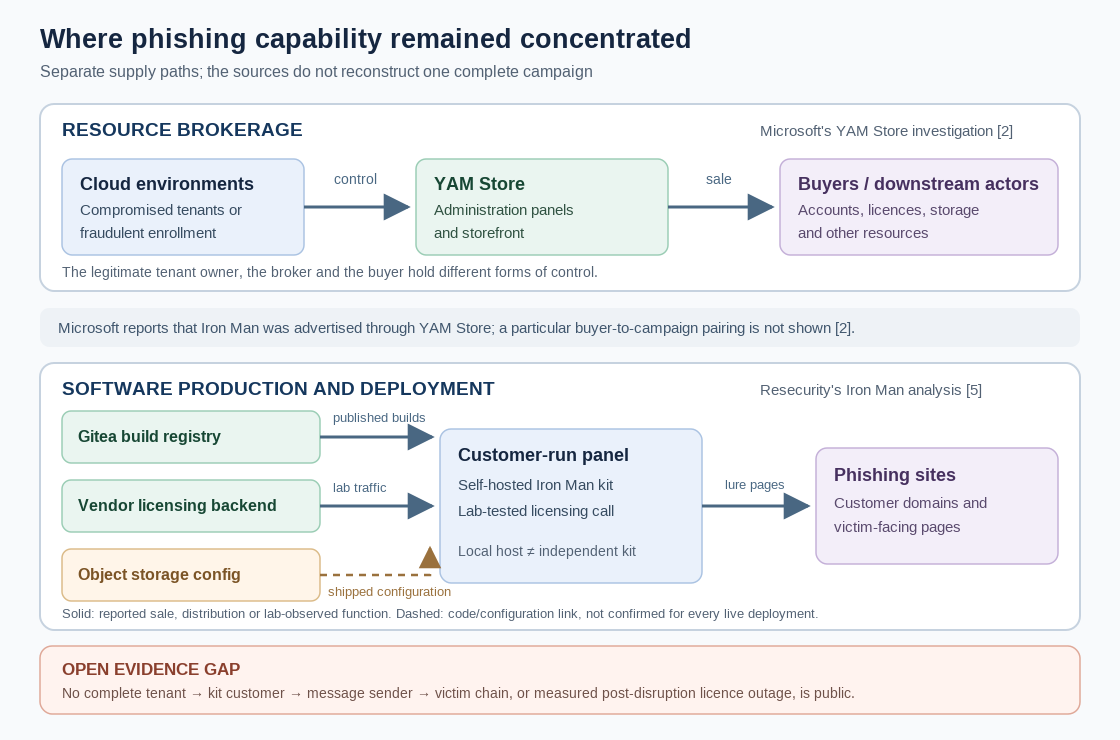
4.1 The cloud-management layer
Microsoft’s investigation identified a management architecture capable of coordinating resources obtained from multiple cloud environments. Storm-3119 used Flask-based reconnaissance tools to investigate Microsoft 365 tenants, licensing arrangements, and potential access opportunities, with collected information subsequently incorporated into attacker-controlled administrative systems. These systems included implementations using PHP, Java/Spring, and Cloudflare Workers. [2]
Some panels authenticated to compromised tenants through application credentials rather than relying solely on interactive employee sessions. This allowed the operators to make programmatic requests through cloud APIs, including account management, licensing changes, and other administrative actions permitted by the compromised credentials. Microsoft also described cases involving Global Administrator access and service principals with permissions to Microsoft Graph and SharePoint resources, enabling unauthorized control over services that otherwise belonged to legitimate organizations.
The resulting infrastructure separated ownership of the cloud environment from the ability to exercise administrative control over it. The legitimate organization remained the customer of Microsoft or Google, while unauthorized actors used compromised identities or applications to manipulate resources and potentially offer them for resale. YAM Store’s management platform provided a way to coordinate these capabilities across different environments instead of treating each compromise as an isolated incident.
This is an important form of concentration. An individual tenant could be recovered or disabled without necessarily affecting the broker’s systems for managing other resources, but disrupting the broker’s shared administration or sales infrastructure could interfere with the commercial operation built around multiple tenants. The marketplace’s value therefore depended not only on obtaining access, but also on maintaining systems that converted disparate accounts and environments into usable inventory.
4.2 The software-production and licensing layer
Resecurity’s analysis of Iron Man provides the clearest technical evidence of customers remaining dependent on a supplier after purchasing its product.
The software was marketed as self-hosted, allowing customers to deploy phishing panels within environments they controlled. Yet investigators found that the deployed application continued communicating with services maintained by the vendor. Resecurity identified a self-hosted Gitea installation containing development repositories and a container registry, whose exposed package listings showed 911 published software versions and eight registered accounts. The eight accounts should not be interpreted as eight verified developers, but the registry and release history demonstrate an actively maintained distribution system rather than a static collection of files. [5]
The licensing infrastructure was more consequential. Resecurity deployed Iron Man in an isolated laboratory, captured its network traffic, and compared the observed requests with configuration artifacts recovered from the vendor’s published container images. This confirmed that the deployed software depended on a vendor-operated authorization backend. In the tested version, the administration interface checked local license state at approximately 20-second intervals, with the server-side process contacting the remote service.
For the developer, this arrangement supported subscription management and continuing control over product access, even when customers operated their own servers. For customers, it meant that control over a local installation did not necessarily provide independence from the software supplier. A deployment might remain technically operational on its own host while relying on an external service to maintain authorization.
The dependency also created a potential point of intervention. Disabling the authorization infrastructure could affect multiple installations that continued to require it, although Resecurity’s tests do not establish the behavior of every released version or prove how many production customers would become unable to operate. The observed architecture nevertheless demonstrates a concrete connection between independently deployed criminal software and a centralized service maintained by its developer.
4.3 Shared storage and the production of phishing content
Iron Man’s supporting infrastructure extended beyond software distribution and licensing. Resecurity recovered configuration information from published builds that referenced S3-compatible object storage, including shared bucket names and static credentials appearing across multiple historical releases. These artifacts exposed aspects of the vendor’s infrastructure configuration and provided investigators with evidence connecting software distributed to customers with common backend services. [5]
The investigators also examined the application binary and identified functions for importing product catalogs, managing country-specific content, and uploading product imagery. These capabilities were relevant to templates designed to imitate purchasing and payment workflows rather than simple login forms. The software could present products to a visitor and record selected items alongside submitted payment information, producing a more convincing imitation of an ordinary commercial transaction.
The shared storage configuration therefore served a recognizable application function. Customers were not merely purchasing a collection of images and forms; they were obtaining software that incorporated content-management and media-handling capabilities supported by infrastructure associated with the vendor.
This does not mean that every victim record was stored centrally. Resecurity also identified configuration pointing to local or internal database instances, and its public findings do not establish a single shared database containing information collected by all Iron Man installations. The supported conclusion is narrower: the distributed software retained common configuration and integrated services that reduced the work required to maintain phishing content across customer deployments.
The same implementation details made the underlying provider infrastructure more visible to investigators. By examining released artifacts rather than individual phishing websites, Resecurity was able to identify supporting services that could not necessarily be inferred from the victim-facing pages alone.
4.4 Domain management and disposable infrastructure
The websites produced by these systems operated on a different time scale from the services that supported them. Proofpoint observed 1,081 CoGUI campaigns involving 13,586 unique domains, alongside 242 CoAceV campaigns using 2,812 domains and 19 CoFish_Ws campaigns using 191 domains. Across the three related families, the company recorded approximately 17,000 unique domains. During the narrower period from July 1 through September 17, 2026, researchers observed 3,788 distinct fully qualified domain names. [6]
These figures describe campaigns observed through Proofpoint’s telemetry rather than a complete inventory of domains controlled by YAM Store. Nevertheless, they show that creating and replacing domains was a recurring operational requirement. When a domain was blocked or became ineffective, the operator could move the campaign to another destination while retaining the software and other supporting resources.
Microsoft separately identified a YAM Store-associated platform for managing DNS, SSL certificates, and domain routing through Cloudflare. Cloudflare’s own investigation found Workers projects, accounts, and other hosting resources associated with the broader operation. The findings establish that centralized domain and hosting-management capabilities existed within the ecosystem, although they do not show that one platform managed every phishing domain observed by Proofpoint. [2][7]
Taken together, the evidence suggests an infrastructure with several layers of replacement. An individual domain could be changed without replacing the phishing software, and a customer could deploy a new website while continuing to use a previously purchased license. The software developer, meanwhile, could distribute updated versions through the same registry and continue authorizing customers through the same licensing backend. An infrastructure broker could replenish its inventory while maintaining its storefront and management tools.
The shorter lifespan of individual phishing sites helps explain why taking down those sites may have limited effects on the capacity to create new ones. The supporting services had different functions, different operators, and often a longer operational life.
4.5 The limits of the reconstructed architecture
Although the investigations establish substantial connections between suppliers and their products, the public record does not describe one universal workflow used by every phishing operator.
Microsoft’s cloud investigation connects YAM Store to resource acquisition, administrative tooling, and marketplace transactions. Resecurity’s laboratory work establishes dependencies between Iron Man installations and vendor-operated services. Proofpoint links campaigns through observed software behavior and domain activity, while Cloudflare identifies resources abused within its hosting and application infrastructure.
These observations are complementary, but they do not amount to a complete transaction record from the acquisition of a particular cloud tenant to a specific successful fraud.
The largest remaining gap concerns message delivery. Proofpoint documented extensive email campaigns, and Microsoft attributed more than one billion malicious communications to the broader ecosystem, but the public reports do not fully reconstruct the mail-sending systems, SMS providers, intermediary accounts, or other delivery infrastructure responsible for those volumes. A phishing kit can generate websites and collect information without directly operating the services that distribute messages to recipients.
It would therefore be misleading to conclude that YAM Store supplied every resource used by every CoGUI or Iron Man customer. The evidence supports a market of interconnected suppliers and operators rather than a single centrally managed organization controlling all stages of the attack.
The architectural finding is more specific: independently operated campaigns could depend on commercial products that retained shared services and administrative dependencies under the control of their suppliers. Those dependencies are documented even though the complete delivery and financial chain remains partly unresolved.
5. What the Takedown Actually Disrupted
5.1 Attacking the suppliers rather than only the websites
The October operation differed from an ordinary phishing-domain takedown because it targeted infrastructure used to supply and maintain criminal capabilities. The court order authorized action against domains associated with the YAM Store marketplace and the supporting systems of the investigated phishing services, while Microsoft, Cloudflare, and other partners implemented additional measures within their respective platforms.
These interventions affected different functions. Removing a phishing website prevents recipients from accessing that particular destination, whereas disabling a marketplace can interrupt the procurement of new accounts or licenses. Similarly, removing a distribution registry can interfere with software delivery and updates, while disruption of a licensing service can affect installations that continue to depend on it.
The temporary restraining order’s appendices identified 34 domain and subdomain entries across five registered domain families associated with the investigated infrastructure. These were not simply 34 ordinary landing pages selected because they impersonated legitimate organizations. They included names associated with storefront operations and technical services used to distribute, deploy, or authorize products. [3]
Microsoft also terminated associated cloud accounts and blocked phishing-related domains, while Cloudflare suspended abusive accounts, disabled Workers projects, and deployed measures against identified malicious scripts. TRM Labs contributed financial intelligence relevant to tracking assets associated with the operation. The response combined judicial authority over selected domains with provider-level control over accounts, hosted workloads, and financial relationships. [1][7][9]
The different actions matter because the ecosystem was built on services controlled by different legitimate organizations. Domain registrars, cloud providers, CDN operators, and financial intermediaries possess different forms of authority over infrastructure, and none necessarily controls the entire chain. A coordinated intervention can target several dependencies simultaneously without requiring one participant to possess end-to-end control.
5.2 Why the shared licensing service mattered
The Iron Man licensing backend is the clearest example of a common technical dependency that investigators could identify and potentially disrupt.
Resecurity established the relationship between deployed software and the vendor’s authorization service through actual execution, captured network traffic, and configuration recovered from published releases. This provides stronger evidence than simply observing similar domain names or identical website templates across campaigns.
If multiple customer installations rely on a common authorization system, action against that system can potentially interfere with deployments operated by different customers on different infrastructure. The operator of an individual phishing website may control its hosting environment but lack the ability to restore a licensing service maintained by the software supplier.
The practical impact nevertheless depends on implementation details that the public investigation does not fully resolve. Resecurity demonstrated the dependency for the examined installation, but did not establish a complete inventory of active customers, the behavior of every release, or the amount of time required for the developer to migrate to another authorization system.
The licensing backend was a technically documented common dependency and a potential intervention point. The available public evidence does not establish whether it stopped serving customers after the intervention or how many deployed installations, if any, became unusable.
5.3 Replaceable infrastructure and the cost of rebuilding
The ability to recreate infrastructure varies considerably across the functions identified in the investigation.
Phishing domains are relatively easy to replace when an operator retains access to working software and suitable hosting. Proofpoint’s observations show that repeated domain creation and rotation were already established operating practices. Marketplace interfaces can also be recreated or moved in principle, while sellers may retain relationships with customers through separate communication channels.
Replacing a software authorization backend or distribution system may involve additional work, particularly when the service’s location or configuration is embedded in applications already distributed to customers. Developers may need to publish new builds, migrate customers, reconfigure supporting services, and restore confidence that subscriptions will continue functioning.
The earlier history of CoGUI indicates that related operators were capable of adapting their branding and infrastructure after public exposure. Consequently, the removal of known domains should not be equated with the permanent elimination of the development expertise or customer relationships supporting the market. At the same time, the ability to rebuild does not mean interruption is inconsequential, since migration requires technical effort, coordination, and potentially the loss of existing customers.
The significance of the October operation will ultimately depend on whether replacing the affected systems proves costly enough to reduce the market’s ability to supply functioning products and resources.
5.4 Measuring the effects of the disruption
A meaningful assessment requires distinguishing the accessibility of seized domains from the continued operation of the services those domains supported.
For YAM Store, the relevant measures include whether buyers can still acquire working resources, whether orders and payments have migrated to replacement channels, and whether inventory can be replenished. For the phishing software developers, the more useful indicators concern access to functioning builds, successful license renewals, continued updates, and the restoration of supporting services.
Downstream campaign activity provides another set of measurements. Researchers can observe whether related software families continue appearing in phishing sites, whether domain-registration patterns change, and whether the volume of malicious messages declines or shifts to successor infrastructure.
None of these outcomes follows automatically from the number of domains seized or accounts disabled. A marketplace might lose its original domain but retain its suppliers, while an authorization server might become inaccessible without every customer installation immediately ceasing operation.
As of October 15, 2026, the available public evidence does not provide a meaningful post-disruption measurement of customer retention, active licensing sessions, software distribution, or sustained phishing volume. The immediate targets of the operation are documented, but its long-term effect on the industry’s productive capacity remains an empirical question.
6. Conclusion — The Production System Behind Phishing
The investigation into YAM Store, CoGUI, and Iron Man reveals an industry in which the acquisition of resources, development of software, distribution of products, and execution of fraud had become partially separate commercial activities. Cloud environments obtained through compromise or fraudulent enrollment could be administered and resold by an infrastructure broker, while phishing software developed by other suppliers could be licensed to operators who had little need to understand its internal implementation.
This separation helps explain how phishing capabilities could be distributed across a large number of otherwise independent actors. Software developers could serve many customers without directly operating their campaigns, and infrastructure brokers could supply resources without controlling how every buyer used them. Commercial intermediaries reduced the amount of expertise and infrastructure investment required from individual operators, allowing capabilities developed or acquired by a relatively small number of suppliers to be reused across many campaigns.
The technical evidence also reveals a limit to that decentralization. Iron Man customers could deploy their own websites while continuing to depend on authorization services operated by the developer. Software distribution, content management, and related infrastructure remained associated with common supplier systems, while YAM Store maintained administration and sales functions for resources originating from multiple cloud environments. These dependencies persisted beyond the lifespan of individual phishing domains, allowing suppliers to maintain commercial relationships across successive campaigns.
The October intervention targeted precisely this distinction between the temporary infrastructure used in individual attacks and the more persistent services that supported their production. By identifying marketplace systems, software-distribution infrastructure, licensing services, and cloud resources, investigators reached beyond the domains presented to victims and acted against several of the mechanisms that allowed those domains to be replaced.
The available evidence does not establish the complete mass-messaging delivery network, the full financial relationships among all participants, or the lasting effectiveness of the disruption. It does, however, demonstrate that large-scale phishing was supported by identifiable businesses with maintained software, customer relationships, administrative systems, and continuing technical dependencies.
The defining feature of the investigated ecosystem was not simply that criminals could purchase phishing tools, but that independently operated attacks relied on supplier-controlled systems for producing and maintaining those tools. The same structure that made phishing capabilities easier to acquire also created common dependencies that investigators could trace and target.
The significance of the October 2026 operation therefore extends beyond the immediate removal of malicious infrastructure. It illustrates how understanding the production and distribution of criminal capabilities can reveal points of intervention that are largely invisible when phishing is examined one fraudulent website at a time.
References
Investigation and court records
[1] Microsoft Digital Crimes Unit. “Disrupting the Service Economy Behind Transnational Cybercrime Operations.” October 14, 2026.
https://blogs.microsoft.com/on-the-issues/2026/10/14/disrupting-the-service-economy-behind-transnational-cybercrime-operations/
[2] Microsoft Threat Intelligence and Digital Crimes Unit. “The Hidden Network: Inside the Phishing Infrastructure Ecosystem Powering Global Cybercrime.” October 14, 2026.
https://www.microsoft.com/en-us/security/blog/2026/10/14/the-hidden-network-inside-the-phishing-infrastructure-ecosystem-powering-global-cybercrime/
[3] Microsoft Corporation and Health-ISAC v. Yang Jian et al. Complaint and temporary restraining order, Case No. 1:26-cv-26998-JEM, U.S. District Court for the Southern District of Florida, October 2026.
https://www.microsoft.com/en-us/corporate-responsibility/customer-security-trust/digital-crimes-unit/notice-of-pleadings/yam-cogui-ironman/
[4] Waymon Ho. Declaration in Support of Plaintiffs’ Motion for Emergency Relief. October 2026. Marketplace purchases, cloud-resource acquisition, and financial tracing.
https://www.microsoft.com/en-us/corporate-responsibility/customer-security-trust/digital-crimes-unit/notice-of-pleadings/yam-cogui-ironman/
Software and infrastructure investigations
[5] Resecurity. “Iron Man & YamStore: Powering a Global Phishing-as-a-Service Ecosystem.” October 2026.
https://www.resecurity.com/blog/article/iron-man-yamstore-powering-a-global-phishing-as-a-service-ecosystem
[6] Proofpoint Threat Research Team. “Disruption Targets Major Chinese-Language Phishing Kits with Japanese Focus.” October 14, 2026.
https://www.proofpoint.com/us/blog/threat-insight/disruption-targets-major-chinese-language-phishing-kits-japanese-focus
[7] Cloudflare Cloudforce One. “Cloudflare Participates in Global Operation to Disrupt the yam.ink Illicit Access Shop.” October 14, 2026.
https://www.cloudflare.com/threat-intelligence/research/report/yam-store-closing-early/
[8] JPCERT/CC. “JSAC2026 Conference Report — Day 2.” February 27, 2026. Discussion of TeamDonut’s investigation into CoGUI, FishingMaster, and related services.
https://blogs.jpcert.or.jp/ja/2026/02/jsac2026day2.html
Institutional and financial records
[9] Japan Cybercrime Control Center (JC3). Announcement concerning cooperation in the October 2026 cybercrime infrastructure disruption. October 14, 2026.
https://www.jc3.or.jp/news/2026/20261014-718.html
[10] Charity Commission for England and Wales. The Spanish and Portuguese Jews Home for the Aged, Charity No. 1162974. Public registration and organizational records.
https://register-of-charities.charitycommission.gov.uk/about-the-register-of-charities/-/charity-details/5066224/full-print
[11] Shawn Loveland. Declaration in Support of Plaintiffs’ Motion for Emergency Relief. October 2026. Iron Man licensing, resale channels, and controlled purchases.
https://www.microsoft.com/en-us/corporate-responsibility/customer-security-trust/digital-crimes-unit/notice-of-pleadings/yam-cogui-ironman/
[12] Jewish News. “Jewish care home in Brent announces closure, calling time on 274-year history.” February 3, 2021.
https://www.jewishnews.co.uk/jewish-care-home-in-brent-announces-closure-calling-time-on-274-year-history/
[13] JPCERT/CC. “JSAC2026 — Abstract.” Conference schedule, January 21–23, 2026.
https://jsac.jpcert.or.jp/archive/2026/abstract.html
Evidentiary Scope
This analysis combines investigative reports, civil court filings, controlled purchases, laboratory software analysis, phishing-campaign telemetry, and public institutional records. The sources document related activity from different perspectives and do not establish a complete transaction history for every participant in the ecosystem.
Allegations concerning named defendants remain allegations in a civil proceeding unless independently corroborated or established by subsequent judicial findings. The temporary restraining order is an interim legal measure rather than a final determination of liability.
The reconstruction distinguishes targeted organizations from confirmed compromises, malicious messages from distinct recipients, advertised products from verified delivery, published software versions from active installations, and traced transactions from total criminal revenue. It does not establish the complete email and SMS distribution infrastructure, the specific eligibility decision associated with the Jewish Choice tenant, common ownership of every software supplier, or the lasting operational impact of the October 2026 intervention.