How a ransomware enterprise governed independent criminals—and why its authority had limits.
Analysis based on publicly available information as of October 11, 2026.
Abstract
On October 7, 2026, German authorities announced the arrest of a Russian national suspected of being a leading member of Qilin, one of the world’s most active ransomware operations. The suspect had been detained in Japan and extradited to Germany following an investigation in which German authorities reportedly infiltrated Qilin’s network and observed its activities for several months.
The arrest raises a question that cannot be answered simply by identifying the organization’s leaders: what kind of organization was Qilin, and what did its leadership actually control?
Qilin operated as a ransomware-as-a-service (RaaS) enterprise, supplying software, administrative systems, negotiation facilities, and publication infrastructure to independent criminal affiliates. Its operators recruited participants, established compensation arrangements, and delegated technical capabilities through a common management platform. Yet affiliates could retain their own personnel, intrusion techniques, access to victims, and commercial relationships with other criminal organizations.
These arrangements constituted an institutional structure. Qilin had rules governing participation, compensation, operational authority, and acceptable conduct. Some were implemented through software, while others depended on continuing cooperation, reputation, and institutions outside Qilin itself.
The limits of this structure became visible in July 2025, when an affiliate publicly accused operator Haise of withholding compensation. The dispute expanded into allegations concerning independent extortion channels, software ownership, and the recruitment of developers. Participants associated with Qilin’s affiliate ecosystem subsequently established The Gentlemen, an independent ransomware operation that recorded a comparable quarterly volume of public victim listings in 2026.
In October 2026, researchers documented a Gentlemen affiliate operating an independent data-leak site and assessed that the affiliate diverted extortion proceeds from the platform. The separate publication channel demonstrated that an affiliate could control part of the victim relationship outside the common platform. Whether it also redirected payments remains unverified.
This investigation reconstructs Qilin’s development through its recruitment rules, personnel structure, technical permissions, payment arrangements, external dispute mechanisms, and organizational fragmentation. It examines how these institutions made cooperation possible among independent criminals, how their rules could be enforced, and what happened when participants retained valuable resources outside the platform.
The resulting distinction is between organizing criminal activity and owning the capabilities required to conduct it. Qilin’s institutions allowed it to coordinate a large network without completely subordinating its participants. That arrangement supported its expansion, but also enabled participants to compete with the platform and establish new organizations.
The October arrest must therefore be understood as an intervention in a distributed institutional structure, not necessarily the removal of a single authority commanding every operation conducted under Qilin’s name.
1. Incident Overview
On October 7, 2026, authorities in Germany’s North Rhine-Westphalia state announced that a suspected leading participant in the Qilin ransomware operation had been arrested and extradited from Japan. Japan’s National Police Agency confirmed its cooperation the following day.
Contemporary reporting described the suspect as a 28-year-old Russian national who had been detained in Japan in May and transferred to Germany in early October. German investigators linked him to a September 2024 ransomware attack against a company in North Rhine-Westphalia, during which the attackers allegedly stole information and threatened to publish it unless a ransom was paid.
The investigation extended beyond the individual attack. According to the German authorities, investigators from the State Criminal Police Office and the specialized cybercrime prosecution unit had infiltrated Qilin and observed the network over several months. North Rhine-Westphalia’s interior minister, Herbert Reul, characterized the arrest as an important achievement against international cybercrime.
The group’s scale made the announcement significant. S2W identified 669 Qilin-associated victim cases during the first half of 2026, while German reporting referred to approximately 4,000 organizations affected by Qilin globally. These figures have different sources and definitions; reported cases and estimates should not be treated as independently verified intrusions.
The suspect’s alleged seniority, however, does not establish the extent of his authority over the organization.
Qilin’s activities involved operators maintaining common infrastructure, affiliates conducting individual intrusions, developers supporting malware and administrative software, and personnel assisting with negotiations and publication. These responsibilities could overlap, but there is no reason to assume that they were concentrated in one person or governed by a conventional chain of command.
A developer responsible for essential software might have had access to systems used by many affiliates without directing their attacks. An affiliate leader might have coordinated numerous victims and substantial payments without administering Qilin’s common infrastructure. A platform operator might have been able to suspend accounts or control official publications while having no direct access to credentials independently acquired by affiliates.
These are different forms of authority.
ZDF reported claims that the suspect had helped build attack systems and had received a share of the ransom. That report does not establish his privileges in Qilin’s common platform. The published law-enforcement material does not identify his administrative privileges, the resources under his exclusive control, or his relationships with other operators and affiliates. It also does not publicly establish that he used any of the operator handles previously identified by security researchers.
The distinction matters because the operational consequences of an arrest depend on which capabilities are interrupted. Removing a person who controls common infrastructure is different from removing a person who leads an independent attack team.
To evaluate the organization behind the arrest, it is therefore necessary to examine more than its personnel hierarchy. Qilin was held together by software, financial arrangements, rules of participation, and commercial relationships that did not necessarily depend on the same individuals.
Sources: Japan National Police Agency, October 8, 2026; ZDF, October 7, 2026; S2W, October 8, 2026.
2. Timeline: The Formation of a Criminal Enterprise
Qilin developed from ransomware activity associated with the name Agenda in 2022 into a major RaaS platform. Its growth was not simply the result of improving ransomware software or increasing the number of targets. It also involved the development of rules, administrative functions, financial arrangements, and relationships through which independent criminals could participate in a continuing enterprise.
Those changes provide a history of how the organization acquired the ability to coordinate people and resources it did not necessarily own.
| Date | Development | Institutional significance |
|---|---|---|
| 2022 | Agenda/Qilin ransomware activity emerges. | Establishment of the software and identity around which a wider operation could develop. |
| March–May 2023 | Qilin recruits affiliates. Group-IB investigates the program and its administrative panel. | Participation terms, compensation, and delegated permissions become visible. |
| July 2023 | Qilin announces that affiliates will receive ransom payments directly and subsequently remit the operator’s share. | The advertised arrangement places first receipt of proceeds with affiliates. |
| 2024 | Qilin expands through attacks conducted under its shared brand. | Growing dependence on distributed attack capabilities. |
| Spring 2025 | Qilin attracts additional participants amid disruption in the wider RaaS market. | Mobility of experienced criminals between competing platforms. |
| May 4–5, 2025 | Qilin advertises legal-pressure, publication, and additional operational support services. | Further specialization of shared organizational functions. |
| July 17, 2025 | An early The Gentlemen ransomware sample containing its dedicated leak-site address is submitted to VirusTotal. | Evidence that an alternative operation was already being prepared. |
| July 22–31, 2025 | Affiliate hastalamuerte brings a compensation dispute against Haise to the RAMP forum. | Conflict over revenue, victim relationships, personnel, and software ownership. |
| August–September 2025 | The Gentlemen develops into an independent RaaS operation. | Former affiliate capabilities are reorganized into a competing enterprise. |
| January 28, 2026 | RAMP displays an FBI seizure notice. | Disruption of an external institution used for recruitment and dispute resolution. |
| May 2026 | Internal communications and backend information belonging to The Gentlemen are exposed. | Direct evidence of how a successor organization distributed personnel and authority. |
| October 5, 2026 | CloudSEK reports independent extortion activity by a Gentlemen affiliate using the name Azazel. | Another case testing control over publication and revenue. |
| October 7–8, 2026 | German and Japanese authorities announce the Qilin arrest; S2W publishes updated organizational research. | The question of leadership becomes a question of effective institutional control. |
2.1 Recruiting Capabilities Instead of Employing Every Attacker
Group-IB’s May 2023 investigation provides a detailed public view of Qilin’s recruitment and management arrangements.
Its researchers had infiltrated the affiliate program in March and examined the administrative panel offered to participants. They also obtained recruitment materials and communicated with an operator identified as Haise.
Qilin advertised a compensation structure under which affiliates would receive 80% of ransom payments of USD 3 million or less, increasing to 85% for larger payments. Its recruitment materials also stated that the program did not operate against targets in Commonwealth of Independent States countries.
These terms were not conventional employment contracts. They established conditions under which otherwise independent criminal actors could obtain services and participate in a shared revenue arrangement.
An affiliate might already possess experience compromising enterprise networks, collaborators capable of conducting intrusions, credentials acquired from previous operations, or relationships with criminal access providers. Qilin did not necessarily have to recruit, train, and supervise those individuals as members of a single internal workforce.
Instead, it could supply common ransomware software, victim-management systems, and supporting services to participants who brought attack opportunities and operational capabilities of their own.
The arrangement reduced the need for each participant to maintain a complete ransomware operation independently. Qilin could benefit from attacks it did not directly organize, while affiliates could benefit from infrastructure they did not have to develop themselves.
This was a mechanism of organizational expansion. By combining external attack capabilities with common services, the platform could increase its activity without acquiring every person and resource involved.
The distinction between participation and ownership would later become central to its internal conflicts.
2.2 The Expansion of Shared Services
As Qilin developed, the functions offered to affiliates extended beyond encryption software.
The original management panel supported victim registration, ransomware generation, publication, payments, and documentation. By May 2025, Haise was advertising an automated “Call Lawyer” service, purportedly allowing affiliates to obtain legal assessments of stolen information and apply additional pressure during negotiations.
The following day, Qilin also advertised file-sharing storage, spam-related services, and a claimed pool of journalists who could assist with public communications and extortion negotiations.
These were announcements by a criminal organization promoting its services, not independently verified evidence of qualified legal professionals or journalists being employed by Qilin. They nevertheless show which activities the platform sought to offer centrally.
An affiliate could conduct an intrusion while relying on common services to help transform the resulting access or stolen information into an extortion case. Ransomware development, victim communication, publication, and administrative support could be performed by different people and managed through different parts of the organization.
Qilin was becoming more than a distributor of software. It provided a continuing organizational environment through which independent attack teams could conduct repeated business.
That expansion created a corresponding governance problem. The more functions Qilin provided, the more it had to coordinate activities whose participants, resources, and economic interests were not necessarily under its exclusive control.
Sources: Group-IB, May 2023; Recorded Future, Dark Covenant 3.0; S2W, October 2026.
3. How Qilin’s Institutions Made Cooperation Possible
The existence of independent criminal participants does not imply the absence of rules. Qilin had recognizable arrangements governing admission, operational authority, compensation, and acceptable conduct.
The more important question is how these arrangements could function when the participants could not rely on ordinary contractual enforcement and did not necessarily surrender control over their own assets.
Qilin’s answer was not a single mechanism. Different kinds of obligations were supported by different forms of control.
The platform could enforce some rules directly through software. Economic arrangements depended on possession of funds, continued access to services, and expectations of future cooperation. Disputes could also be taken to external forums whose influence came from their position within the criminal marketplace.
The organization therefore operated through several overlapping institutions rather than through one comprehensive authority.
3.1 Technical Permissions as Organizational Rules
Group-IB identified six sections in Qilin’s 2023 affiliate panel: Targets, Blogs, Stuffers, News, Payments, and FAQs.
Targets allowed affiliates to maintain information about attacked organizations and generate configured ransomware samples. Blogs enabled the creation and editing of victim disclosures. Payments displayed financial information, while News and FAQs supported the continuing relationship between the platform and its participants.
The Stuffers section was especially revealing because it implemented a personnel-management function.
Affiliates could create accounts for members of their own teams and specify whether those members could view their attacks, build ransomware samples, or access conversations with victims.
These were not merely administrative conveniences. They were organizational decisions expressed through access control.
An affiliate leader could assign responsibility for a particular task without necessarily providing access to every part of the operation. A person responsible for preparing ransomware might not require access to all negotiations. A person communicating with a victim might not need authority to modify the underlying software or administer another affiliate’s accounts.
The platform thus allowed an affiliate to reproduce a smaller hierarchy of responsibility within its own organization.
S2W’s October 2026 investigation identified a newer panel offering target management, guest accounts, support chat, blog creation, and additional services. It also described a Support Team assisting with affiliate operations and identified Haise and XORacle as operator handles.
The two investigations show continuity in the provision of common administration, support, and delegation. They do not establish that the precise permission model remained unchanged between 2023 and 2026.
Nor do they demonstrate the effective privileges possessed by every operator and support account.
Nevertheless, the management software provides direct evidence that organizational authority was partly implemented as technical authority. Participation granted access to specified functions, and further delegation could be controlled through configurable permissions.
The visible controls show how such rules were intended to operate within the panel; the public investigations do not establish whether every permission was enforced server-side or could be bypassed.
3.2 Compensation and the Allocation of Financial Control
Financial arrangements operated differently.
The 2023 Group-IB investigation documented a Payments interface through which affiliates could view balances, transactions, fees, and withdrawal information.
In July of the same year, KELA observed Qilin announcing a payment policy. Ransom proceeds were to be paid directly into affiliate-controlled wallets, after which the affiliate would transfer Qilin’s agreed share.
S2W’s October 2026 report continued to characterize direct receipt of payments and affiliate-managed negotiations as important features of Qilin’s model.
The difference between operator-first and affiliate-first payment flows is fundamental. The observed Payments interface alone does not establish who received funds first in any transaction.
Under an operator-first system, the platform receives the payment and must subsequently distribute the affiliate’s share. Under an affiliate-first system, the affiliate receives the payment and must subsequently transfer the operator’s share.
Both arrangements establish a commercial obligation, but they give the parties different forms of practical control over the money.
An operator receiving payment first could withhold compensation from the affiliate. An affiliate receiving payment first could fail to remit the operator’s portion.
The advertised affiliate-first arrangement therefore transferred some immediate financial control to the party conducting the attack. It may have made participation more attractive to affiliates who were unwilling to entrust all proceeds to the platform.
But it did not eliminate the problem of enforcing payment obligations. It changed which party depended on the other to perform them.
The available sources do not establish the custody of funds in every Qilin case, whether all payments followed the advertised model, or how the organization verified receipts and resolved exceptions.
Those unknowns matter because the existence of a compensation rule does not itself establish the ability to enforce the rule.
Unlike access to a platform account, cryptocurrency already held in an independently controlled wallet could not necessarily be recovered by withdrawing the holder’s membership.
Where direct recovery was unavailable, the value of continued participation could give affiliates a reason to honor their obligations.
3.3 Reputation and External Dispute Resolution
The wider criminal marketplace provided another institution supporting those arrangements.
Forums such as RAMP were used to advertise services, recruit affiliates, find collaborators, and evaluate the reliability of other participants. A reputation for withholding payments or violating agreements could affect an actor’s ability to attract future partners.
This mattered because participants in illegal commercial arrangements could not ordinarily enforce their agreements through the legal mechanisms available to legitimate businesses.
A public complaint on a recognized criminal forum could expose the accused party to reputational consequences. Forum administrators could also impose their own decisions concerning membership or the standing of participants.
These powers were limited. A forum could not necessarily compel a ransomware operator to transfer cryptocurrency, return stolen information, or modify its management systems.
Its influence came instead from the value of access to the broader market and the credibility of its judgments among participants.
This meant that Qilin’s governance did not end at the boundary of its software.
The platform could manage membership within its own program. But the reputation of its operators and affiliates was also formed in institutions that Qilin did not own.
This distinction became visible when an affiliate took its 2025 dispute with Qilin to the RAMP forum.
3.4 Rules Without Complete Control
Qilin’s geographical restrictions and later publication decisions illustrate another limit on institutional enforcement.
Its recruitment advertisements stated that the operation avoided CIS targets. Such restrictions are commonly interpreted by security researchers as attempts to reduce legal and operational exposure in particular jurisdictions. The existence of the policy does not establish that every affiliate complied with it or that Qilin maintained a formal protective relationship with any government.
The difference between announcing a rule and enforcing it becomes clearer in an incident examined by Check Point Research.
In a case described by Check Point in November 2025, Israel’s Shamir Medical Center appeared on Qilin’s official leak site. Israeli researcher Erez Dassa subsequently reported contacting Qilin’s administrators and arguing that association with politically motivated activity could create additional risks for the organization. According to his account, the listing was removed.
This does not establish the complete internal decision process or who conducted the attack.
It does, however, provide evidence that Qilin’s operators could exercise influence over publication through the common platform.
That is a narrower form of authority than preventing an affiliate from carrying out the attack in the first place.
An organization may be able to deny official recognition to an activity without being able to prevent the underlying activity. It may control what appears on its own publication infrastructure while lacking equivalent authority over stolen information retained by an affiliate.
Qilin’s rules thus had different degrees of enforceability depending on the resource involved.
Some restrictions could be implemented directly in software. Others depended on the commercial consequences of noncompliance. Still others could be applied only when an activity passed through infrastructure the central organization actually controlled.
Sources: Group-IB; KELA, August 2023; S2W; Check Point Research, Q3 2025; Recorded Future, Dark Covenant 3.0.
4. Reverse-Engineering the Institutional Architecture
The distinction between rules and their enforcement makes it possible to reconstruct Qilin’s organizational architecture more precisely.
The enterprise did not possess a single kind of authority over its participants. Instead, different actors controlled different resources, and those resources could remain under separate custody even while being used in the same attack.
The documented interfaces make that separation concrete. In Group-IB’s 2023 account, an affiliate used the Targets panel to register a victim and configure a ransomware build. The same panel exposed Blogs for victim disclosures, Stuffers for creating team accounts with selected permissions, and Payments for balances and transactions. Qilin maintained the common panel and its leak site; an affiliate could use those services while its own team conducted an intrusion. S2W’s 2026 investigation described target management, guest accounts, support chat, and blog creation, but did not publish an incident-by-incident map of which affiliate used each function. Group-IB; S2W.
A plausible case path is therefore affiliate access to a victim → victim entry in the common panel → configured malware and negotiation or publication through Qilin’s services → payment under a case-specific arrangement. The first and last steps cannot be filled in from the panel alone. Public research does not establish that every affiliate obtained access independently, that every negotiation passed through Qilin’s interface, or that every ransom went to an affiliate wallet. The July 2023 payment announcement describes a policy, not a transaction ledger. KELA.
The authority boundaries occur where an independently obtained foothold becomes a case in Qilin’s system, where the panel’s delegated permissions let another team member act, where stolen information moves into a publication channel, and where proceeds reach a wallet. The sources describe the components and some of their functions; they do not reconstruct those boundary crossings for the September 2024 German victim or identify the arrested suspect’s role in them.
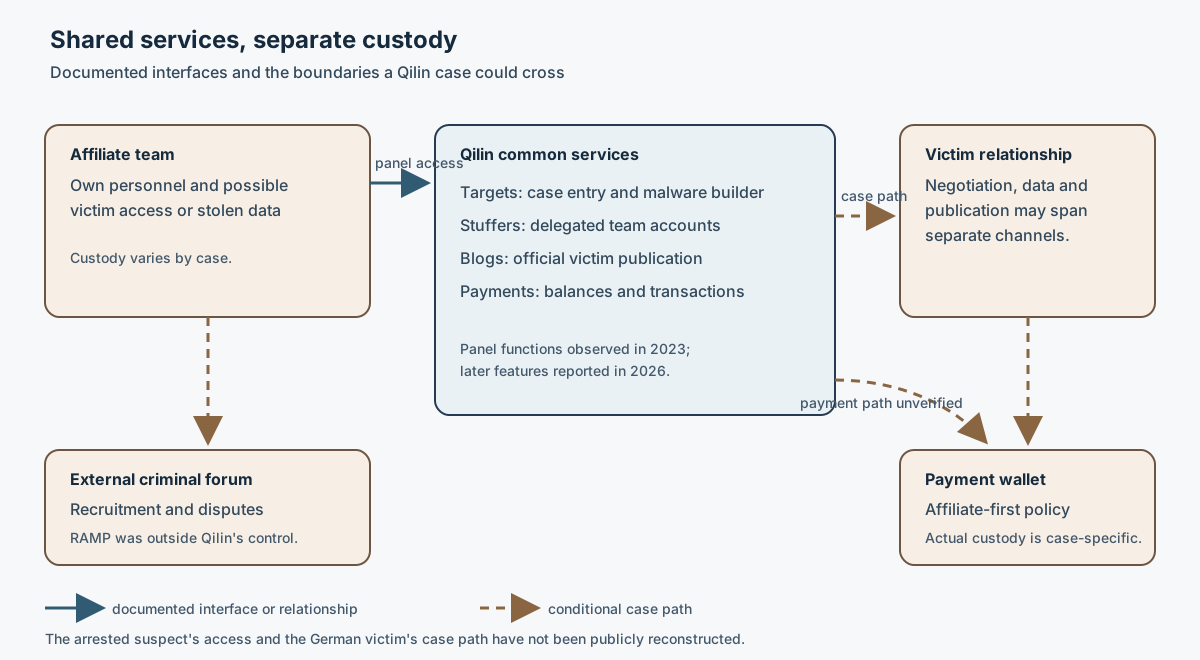
Open Figure 1 at full size (SVG).
4.1 The Resources Behind Organizational Authority
The following table distinguishes the capabilities observed in public investigations from the powers that cannot be inferred simply from participation in the platform.
| Resource | Qilin’s observed or advertised role | Capability potentially retained by affiliates |
|---|---|---|
| Ransomware software | Development and provision of common builds | Configuration, deployment, and use of alternative ransomware |
| Management system | Administration of the common platform and its accounts | Management of their own teams within delegated permissions |
| Initial access | Support or access acquisition through the wider criminal market | Independently acquired credentials, techniques, and access relationships |
| Victim cases | Shared management and negotiation services | Knowledge of the victim, stolen information, and independent contact channels |
| Data publication | Official leak site and publication facilities | Alternative publication sites and separately retained data |
| Payments | Revenue-sharing rules and financial administration | Direct receipt and custody under the advertised affiliate-first arrangement |
| Personnel | Affiliate recruitment and common support | Existing teams, technical knowledge, and relationships with collaborators |
| Reputation | Qilin’s brand and membership arrangements | Independent standing in criminal forums and relationships with other RaaS programs |
These are not necessarily exclusive categories. Qilin’s operators may also have participated directly in attacks, and some affiliates may have depended heavily on its support.
The distinction concerns where a capability was controlled, not whether a particular person was formally classified as an operator or affiliate.
An administrator could revoke a participant’s platform access without necessarily removing credentials the participant had obtained from a victim. An affiliate could maintain its own team and stolen information without owning Qilin’s ransomware builder. A developer could leave one organization while retaining knowledge needed to construct similar software elsewhere, even without taking the original source code.
The personnel hierarchy and the ownership of operational resources therefore did not necessarily coincide.
4.2 Cooperation Without Exclusive Ownership
This division explains how Qilin could organize attacks conducted by people it did not completely control.
The platform supplied common services that multiple participants could use. Affiliates contributed attack capabilities and opportunities that made those services commercially useful.
Each side possessed something the other needed.
For an affiliate, losing access to Qilin might mean losing convenient ransomware software, common negotiation infrastructure, support, or the reputation associated with an established brand. The affiliate could continue independently, but replacing those services might require additional investment and expertise.
For Qilin, losing an affiliate could mean losing the attacks, victim relationships, and revenue that affiliate contributed. The platform could recruit replacements, but it could not necessarily reproduce the departed affiliate’s access, personnel, or technical capabilities.
The relationship created incentives for continued cooperation without necessarily transferring ownership of the underlying resources.
This was the source of both Qilin’s organizational strength and the limits of its authority.
The platform could achieve scale by admitting independent participants. But independence was not simply a temporary condition that disappeared once an affiliate joined. It could persist in the custody of data, money, knowledge, and personnel.
Consequently, a rule governing cooperation might be difficult to enforce after the relevant asset had moved outside the platform’s control.
4.3 Where Enforcement Stopped
The effective reach of Qilin’s institutions can be understood by considering three kinds of separation.
The first was technical separation. Qilin’s administrative system controlled permissions within the platform, but those permissions did not necessarily extend to independently compromised networks or external infrastructure.
The second was economic separation. Qilin could define a revenue-sharing arrangement, but possession of the money might reside with another participant. A contractual expectation was not equivalent to custody.
The third was organizational separation. Qilin could offer membership and support, but an affiliate’s personnel, experience, and external relationships might survive its departure.
These separations were not necessarily defects in the design. They were partly what made the platform attractive to participants unwilling to surrender control over their own operations.
A fully centralized organization might have demanded exclusive possession of victim data, all payment flows, and the complete integration of affiliate teams. Qilin’s documented arrangements instead permitted a substantial degree of independence.
That reduced the barrier to participation while leaving the organization dependent on the continued willingness of others to cooperate.
The important question was therefore not whether Qilin was centralized or decentralized in general. It was which resource could be controlled at the moment a disagreement occurred.
The events of 2025 and 2026 provide concrete cases in which that question became consequential.
5. The Incidents as Tests of Institutional Control
Qilin’s institutional structure is most revealing when cooperation failed.
The public record contains an unusual sequence: a dispute between a Qilin operator and an affiliate, evidence that an independent operation was already being prepared, the growth of that operation into a competing RaaS, and a later incident involving a participant allegedly bypassing the successor platform’s revenue-sharing arrangement.
These events do not establish a single uninterrupted causal chain. But they allow the same problem of control to be examined under different circumstances.
5.1 July 2025: A Dispute Over More Than Compensation
On July 22, 2025, an actor using the handle hastalamuerte filed a complaint against Qilin operator Haise on the RAMP forum.
Recorded Future subsequently documented the exchange in its Dark Covenant 3.0 investigation.
The complainant claimed that their team had attacked fourteen victims during approximately six weeks of participation in Qilin’s program. They described an agreement involving USD 200,000 and alleged that the disappearance of Qilin’s support had resulted in approximately USD 48,000 in lost proceeds.
These were allegations by a participant in a criminal dispute, not independently verified financial losses.
Haise responded with a different account. According to Recorded Future, he accused the affiliate of maintaining a relationship with Devman, a separate actor associated with providing access to corporate networks. Haise alleged that Devman had published victims on its own extortion site before negotiations were completed, had attempted to obtain Qilin’s source code, and had tried to recruit one of its developers.
He also alleged that another affiliate had attacked approximately twenty organizations but refused to publish the cases through Qilin’s official site.
None of these accusations establishes that source code was stolen, developers were recruited, or the disputed victims were transferred as described.
Their importance lies in identifying the resources over which the parties were contesting control.
The complaint began as a disagreement over compensation, but the response concerned ownership of the victim relationship, the right to publish information, access to software, and the mobility of technical personnel.
These were precisely the resources that Qilin’s institutional arrangements did not necessarily place under exclusive central ownership.
5.2 The Victim Relationship as a Separately Controlled Asset
Qilin’s management system could record a victim, support conversations with that victim, and prepare a public disclosure. Yet the victim relationship could include resources outside the platform: stolen data, credentials, knowledge of the target’s infrastructure, and direct communications maintained by an affiliate.
If those resources remained under affiliate control, the affiliate might attempt to continue the extortion independently or transfer the case to another platform.
Qilin could deny the affiliate access to its official leak site. It could not necessarily prevent independently retained information from being published elsewhere.
This is why Haise’s allegation concerning Devman’s separate publication channel matters.
The issue was not simply whether a participant had violated the platform’s preferred procedure. It concerned whether Qilin possessed exclusive control over the activity from which its revenue share was supposed to arise.
The same distinction applies to software and personnel. Even if Qilin retained the source code for its ransomware, it did not necessarily own the technical knowledge of everyone who had worked with the platform. Departing participants could potentially develop alternative tools without possessing a copy of Qilin’s implementation.
The dispute therefore exposed several different limits of institutional control at once.
5.3 The Financial Dispute Cannot Be Reduced to a Single Payment Rule
The complaint also raises an unresolved question concerning Qilin’s advertised financial arrangement.
If the platform consistently required affiliates to receive ransom payments first and subsequently remit its share, why did an affiliate accuse the operator of withholding compensation?
The public record does not establish the answer.
The disputed proceeds may have involved a different arrangement, negotiations controlled by another party, or a loss of expected earnings rather than money already collected. The accusation itself may also have been incomplete or inaccurate.
This uncertainty should be preserved.
It demonstrates that the rules advertised to potential affiliates do not provide a complete record of how money was controlled in actual operations.
The distinction is institutionally important. A revenue-sharing percentage describes the agreed distribution of proceeds. It does not establish who could withhold funds, redirect negotiations, or prevent a payment from occurring.
In a system dependent on independently controlled wallets and victim relationships, the ability to enforce a financial obligation could vary from one case to another.
The July dispute therefore cannot be explained solely as an instance of Qilin failing to follow its own payment policy. It raises the question of whether financial obligations and control of the relevant resources were aligned in that case; the public record does not resolve it.
5.4 The External Forum Could Judge Reputation, Not Reassign Assets
The participants brought their disagreement to RAMP, where the allegations and responses were publicly presented.
On July 31, the forum administration closed the dispute without imposing negative consequences on Haise.
That outcome should not be interpreted as an independent finding that either side’s account was correct. The forum was part of the criminal marketplace, not a judicial institution with verified evidence and legally enforceable remedies.
Nevertheless, its role was significant.
By appealing to RAMP, the affiliate attempted to move a conflict beyond Qilin’s own administration and into a setting where the reputation of both parties could be affected.
The platform operator’s technical control over its own services did not confer equivalent authority over that external institution. Conversely, RAMP’s ability to host and evaluate complaints did not give it custody of Qilin’s source code, stolen data, or financial assets.
This illustrates another limit of governance in the ransomware market: an external institution could influence future cooperation without necessarily resolving the underlying allocation of resources.
The forum itself was vulnerable to disruption. On January 28, 2026, RAMP’s public and Tor sites displayed an FBI seizure notice, removing a major venue for ransomware promotion and criminal networking.
The disappearance of RAMP did not eliminate Qilin or the affiliates that had used it. It demonstrated that the institutions supporting the market were also separable from the organizations participating in it.
5.5 The Gentlemen: Independence Before the Public Breakdown
The next part of the history requires an important chronological distinction.
Barracuda reported that the earliest known ransomware sample associated with The Gentlemen was submitted to VirusTotal on July 17, 2025. The sample already contained the address of The Gentlemen’s dedicated data-leak site.
That was five days before hastalamuerte publicly complained about Qilin on RAMP.
The evidence therefore does not support a simple account in which the July 22 complaint caused preparations for independence to begin. An alternative operation was already being developed before the public dispute.
The record does not establish when the financial disagreement began privately or whether it accelerated the separation. It shows only that the independent infrastructure preceded the public complaint.
Barracuda and other researchers trace The Gentlemen’s origins to ArmCorp, an experienced affiliate operation associated with Qilin as well as other ransomware platforms.
This distinction matters because The Gentlemen should not be described as a direct copy of Qilin or as an organization created solely from Qilin’s resources.
What can be established is that participants experienced in operating through existing RaaS platforms developed an independent service of their own.
The Gentlemen emerged as a private operation in August and began operating as a RaaS in September 2025. During the second quarter of 2026, Check Point recorded 269 victim listings under its name, compared with 279 for Qilin.
The comparison does not establish equal revenue, equal technical capability, or an equal number of verified intrusions. It does establish that the new organization achieved a comparable volume of public extortion activity in less than a year.
5.6 The Successor Institution Was Reconstructed from Its Own Internal Records
The Gentlemen’s subsequent development provides a rare opportunity to compare an established ransomware platform with an organization founded by actors from the affiliate market.
On May 4, 2026, The Gentlemen’s administrator acknowledged claims that its internal backend had been leaked. Check Point later obtained portions of leaked backend data and communications, including chat logs, organizational information, and discussions of tools and operations.
In the leaked material, Check Point identified nine accounts actively communicating within the operation. Separately, its analysis of 29 publicly available ransomware campaigns identified eight distinct affiliate TOX contact identifiers, including the administrator’s. The accounts and identifiers come from different evidence sets; neither figure is a complete census of operators or individual affiliates. Check Point Research.
The apparent principal administrator, zeta88, whom researchers associated with hastalamuerte, had responsibilities extending across software development, platform administration, payments, and direct attack operations. That concentration shows substantial central direction within The Gentlemen; independent affiliate resources did not imply an absence of command.
The Gentlemen advertised a 90/10 revenue-sharing arrangement and maintained services through which other affiliates could participate in attacks.
The internal material also documented the use of AI coding assistants to accelerate the development of administrative software, including a reported rapid construction of the group’s management panel.
These findings do not prove that The Gentlemen inherited Qilin’s source code, databases, or technical architecture. They demonstrate that the functions required to administer a ransomware enterprise could be assembled independently by participants with the relevant experience and resources.
The important continuity was institutional rather than necessarily technical.
The Gentlemen needed to recruit participants, define compensation, provide common services, allocate work, and maintain relationships among people who were not all directly controlled by the core.
Those were substantially the same organizational problems Qilin had faced.
5.7 October 2026: A Similar Constraint Appears in The Gentlemen
On October 5, 2026, CloudSEK published an investigation into a Russian-speaking actor using the handle Azazel, identified by its researchers as an affiliate of The Gentlemen.
CloudSEK had discovered exposed infrastructure associated with the actor, including operational files, storage, and information linked to more than two dozen victim organizations.
The investigation reported that Azazel used resources associated with The Gentlemen while independently operating a data-leak site called LEAKNED.
CloudSEK assessed that the actor was conducting extortion and retaining proceeds outside The Gentlemen’s normal revenue-sharing arrangement.
The separate infrastructure and publication channel were directly examined. The published material does not independently establish every financial transfer, the total proceeds collected, or the complete extent of The Gentlemen’s awareness of the activity. CloudSEK’s report also contains differing descriptions of whether affected victims appeared on both publication sites, so the precise overlap should not be treated as settled.
Even with those limitations, the case provides an important comparison with the earlier Qilin dispute.
In 2025, a Qilin affiliate complained that its operator had failed to provide the expected compensation or support. The operator responded by alleging that participants were using independent publication channels and attempting to appropriate resources from the common platform.
In 2026, researchers investigating a Gentlemen affiliate documented independently operated publication infrastructure and assessed that the affiliate was diverting revenue from its own RaaS operator.
The claimed direction of financial loss was different. In the first case, the public complaint came from an affiliate against the platform. In the second, CloudSEK assessed that an affiliate’s independent activity could deprive the platform of its share; the published evidence does not confirm a diverted payment.
The potential enforcement limit, however, was similar. The independent channel may also have been authorized or tolerated; the public record does not establish what The Gentlemen knew or permitted.
A ransomware platform could define financial obligations and supply the services through which attacks were carried out. But if a participant independently controlled the stolen information, victim contact, or payment channel, the platform’s ability to enforce the agreed distribution of revenue could be limited.
The critical variable was not simply which participant occupied the higher position in the organization. It was which participant possessed the relevant asset when cooperation broke down.
5.8 What the Repetition Actually Demonstrates
The sequence does not show that every RaaS organization will fragment or that The Gentlemen copied its model exclusively from Qilin. ArmCorp had participated in other programs, and the wider market already had comparable arrangements.
The history documents a group of experienced participants moving from an established RaaS ecosystem into an independent operation. That operation reproduced many of the functions required to coordinate affiliates: recruitment, shared tooling, payment arrangements, personnel management, and publication.
Its affiliate subsequently operated an independent publication channel. Such a channel could enable activity outside the platform’s revenue arrangement, but the available evidence does not establish that it was unauthorized or that a payment bypassed the platform. The case illustrates a possible constraint of relying on autonomous participants whose valuable resources are not all under central custody. Their cooperation can depend on incentives, shared services, and reputation as well as technical restrictions.
Sources: Recorded Future, Dark Covenant 3.0; Barracuda, August 17, 2026; Check Point Research, May 13, 2026; Check Point, August 13, 2026; CloudSEK, October 5, 2026; BleepingComputer, January 28, 2026.
6. Conclusion
Qilin’s operators established participation rules, compensation arrangements, administrative permissions, and common services. Affiliates could bring their own teams, attack capabilities, and victim relationships. This division let Qilin expand without constructing every attack team internally. It also gave its rules different points of enforcement: the platform could revoke an account or control its official leak site, but those actions would not necessarily recover independently held credentials, funds, or stolen data.
The July 2025 dispute revealed how these distinctions could become conflicts over compensation, victim relationships, software, and personnel. The subsequent emergence of The Gentlemen demonstrated that participants experienced in one RaaS ecosystem could establish a separate organization providing similar services to others.
The later investigation of Azazel documented an independent publication channel within that successor ecosystem. CloudSEK assessed that it enabled the affiliate to retain proceeds, but a diverted payment has not been verified. Together, the cases show how participants can reconstruct the services of an organization while retaining assets and relationships beyond its control. They do not establish that fragmentation is inevitable or that the July 2025 complaint alone caused The Gentlemen’s formation: a sample bearing its leak-site address already existed before the public complaint.
German investigators identified a suspect they considered a leading participant in Qilin. The publicly available information does not yet establish which common services, personnel relationships, technical resources, or financial mechanisms depended on him.
If the suspect controlled shared infrastructure essential to multiple affiliates, his removal could have consequences across the platform. If his authority was concentrated in individual attack operations, the impact could be more limited to those activities. Access obtained by investigators to the organization’s infrastructure or records could also have effects distinct from the loss of the individual.
The available evidence does not permit those possibilities to be resolved. Identifying a leader and identifying the resources that sustain an organization are different investigative tasks.
Qilin was held together by arrangements through which independent participants could repeatedly cooperate. Its history distinguishes the ability to organize an activity from the ability to enforce exclusive control over the assets, people, and relationships on which that activity depends. Those arrangements made expansion possible; their boundaries also allowed disputes, departures, and the construction of a competing institution.
References
Incident disclosures and law enforcement
- Japan National Police Agency — Russian Ransomware Suspect, October 8, 2026
- ZDF — NRW gelingt Erfolg gegen russische Hackergruppe Qilin, October 7, 2026
Organizational history, recruitment, and administration
- Group-IB — The Qilin Ransomware: Analysis and Protection Strategies, May 2023
- KELA — Qilin Ransomware Gang Adopts Uncommon Payment System, August 2023
- S2W — Inside the Ecosystem, Operations: Qilin Ransomware, October 8, 2026
- Recorded Future — Dark Covenant 3.0: Controlled Impunity and Russia’s Cybercriminals
Governance, institutional conflict, and criminal markets
- Check Point Research — The State of Ransomware, Q3 2025
- BleepingComputer — FBI Seizes RAMP Cybercrime Forum, January 28, 2026