How Britain’s legal aid records survived decades of institutional reform, software replacement, and data protection rules—and what a cyberattack revealed about the state’s control over its own information.
Incident Analysis · United Kingdom · Legal Aid Agency · Government IT · Legacy Systems · Data Protection
Analysis based on publicly available information as of October 16, 2026.
Abstract
On October 14, 2026, the British government disclosed that information stolen during the 2025 cyberattack on the Legal Aid Agency (LAA) included approximately 250,000 records predating 2007. The oldest verified record dated from 1978, nearly half a century before the announcement and 35 years before the agency itself was established. The stolen material also included limited probation information associated with another government organization, HM Prison and Probation Service. [1][2]
The discovery raised a question extending beyond the immediate security failure. Why did records created under earlier administrative arrangements remain within the information estate of a government agency established in 2013, and how had information from different periods and institutions become accessible to attackers?
Britain’s legal aid administration had undergone successive institutional and technological reforms. Responsibility for financial eligibility assessments moved from welfare administration to the Legal Aid Board in 1997, while a new national information system consolidated records previously maintained by regional offices. In 1999, the government explicitly endorsed indefinite retention for certain payment records. Later reforms replaced institutions, introduced new case-management and accounting systems, and transferred applications and data to cloud infrastructure. Each change sought to improve the administration of public money and legal services, but the underlying obligations and historical information did not necessarily disappear with the organizations or technology that had created them.
Data protection rules developed alongside these systems. By 2022, the LAA had a formal schedule specifying when different types of records should be destroyed. Its annual reports acknowledged delays in privacy-related improvements, and its chief executive later testified that legacy technology lacked automatic data-cleaning mechanisms. A government review conducted before the intrusion also called for an unfinished service agreement defining responsibility for legacy technology risks. The attack struck while modernization was underway and those responsibilities were still being formalized. [3][8][9][22]
This investigation reconstructs the institutional history, software architecture, procurement arrangements, and data protection practices behind the breach. It examines how legally justified retention and successive technology projects left historical information whose current accessibility was difficult to assess. The evidence does not show that the oldest record was unlawfully retained or identify the system from which it was stolen. It does show a gap between the responsibility to preserve information and the ability to control access to it across government systems.
1. Incident Overview
The Legal Aid Agency administers publicly funded legal assistance in England and Wales. Its responsibilities include determining eligibility, managing legal aid applications, contracting with solicitors and other providers, paying legal representatives, and recovering contributions or debts arising from funded cases. These activities generate information about people’s finances, legal disputes, criminal proceedings, family circumstances, and interactions with public authorities, often involving individuals who are already in vulnerable situations.
On April 23, 2025, the agency detected unauthorized activity affecting its online services. Initial warnings concerned possible exposure of legal aid providers’ financial information, but subsequent investigation established that the attack was substantially more extensive. On May 16, the LAA confirmed that attackers had obtained significant amounts of personal data, prompting the shutdown of affected services and the introduction of emergency arrangements for processing applications and paying providers. [1][3]
The investigation subsequently identified December 31, 2024, as the earliest known date of attacker access. According to the agency’s annual report, data exfiltration began in January 2025. This means the intrusion had been underway for several months before the agency detected it, although the full sequence of attacker activity has not been publicly reconstructed.
The October 2026 announcement was not a report of another intrusion. It was the result of additional analysis of material already taken during the 2025 attack, which changed the government’s understanding of the types and historical periods of information affected.
1.1 Timeline of the incident
| Date | Documented event |
|---|---|
| December 31, 2024 | Earliest known attacker access to LAA systems |
| January 2025 | Data exfiltration begins |
| April 23, 2025 | LAA detects the cyberattack |
| May 16, 2025 | Agency confirms extensive personal-data theft and shuts down affected services |
| October 23, 2025 | LAA executives explain the intrusion, legacy technology, and notification difficulties to Parliament |
| October 14, 2026 | Government discloses approximately 250,000 pre-2007 records, with the oldest verified record dating from 1978 |
Sources: LAA incident update [1], parliamentary testimony [3], and LAA annual accounts [9].
The government’s October 2026 update clarified that the overwhelming majority of stolen LAA records related to applications, claims, or payments submitted between January 2007 and May 2025, or to cases active during that period. Of the approximately 250,000 earlier records, most dated from the 1990s and 2000s, with only a very small proportion predating 1990. The 1978 record was therefore an exceptional example within a much larger body of relatively recent information, rather than evidence that every historical legal aid record had been compromised. [1]
The distinction between records and people also matters. The 250,000 figure represents records, not necessarily additional individuals, and a single person may appear in multiple transactions or documents. Equally, the presence of a particular type of information among the stolen material does not mean that every person who interacted with the relevant service had that information taken.
1.2 What the oldest information actually represented
The oldest identified material was not described as a collection of complete legal case files. Instead, the October disclosure divided the stolen information into categories corresponding to different administrative activities.
| Historical period | Type of information | Administrative purpose |
|---|---|---|
| 1978–2012 | Benefit status assessments associated with civil legal aid | Verification of financial eligibility |
| 1981–2004 | Payments under the Very High Cost Cases scheme | Criminal defence expenditure |
| 2000–2025 | Solicitors’ claims for legal help and mediation | Remuneration of legal service providers |
| 2010–2017 | Limited probation information associated with HMPPS | Probation administration |
| 2019–2025 | Certain civil legal aid payments and debt-management activities | Accounting and recovery of public money |
Source: LAA October 2026 disclosure [1].
The 1978–2012 category concerned applicants who declared receipt of qualifying welfare benefits when seeking civil legal aid. Depending on the individual record, the information could include names, dates of birth, National Insurance numbers, addresses, and case references. The relevant dates identify historical assessments, but do not necessarily establish when the surviving electronic files were created or which information system originally produced them.
The criminal expenditure records followed a different administrative process. Under the Very High Cost Cases scheme, records of payments to solicitors and advocates could remain relevant to financial administration after the underlying proceedings had ended. Other affected material consisted of particular letters, application details, accounting entries, and logs generated by operational systems.
The government also identified limited probation information associated with HMPPS. More than 99% of this material related to individuals under supervision in 2016–2017, and the government stated that it contained no information about victims of crime. Its presence within the stolen material does not establish that HMPPS itself was breached, and the particular administrative route by which it became accessible in the affected environment remains unexplained. [1]
The ministerial statement accompanying the disclosure explicitly distinguished these partial records from complete legal aid case files. In some instances, only an individual letter or payment record was affected; in others, more substantial information about an application or claim had been obtained. The government stated that no complete record of an individual legal aid case had been stolen. [2]
This distribution is important for understanding the incident. The affected information was not simply a collection of old cases left inside an obsolete database. It represented records generated by several different government functions, some of which had histories extending well beyond the life of the institution currently administering them.
2. How the State Learned to Remember
2.1 The institutions changed, but their obligations continued
The modern system of publicly funded legal assistance in England and Wales developed from the Legal Aid and Advice Act 1949, initially under arrangements involving the Law Society. The Legal Aid Act 1988 subsequently transferred administration to the Legal Aid Board, establishing a public body with responsibility for managing expenditure and legal aid services.
The Access to Justice Act 1999 created the Legal Services Commission (LSC), which replaced the board in 2000. In April 2013, the LSC was abolished and the Legal Aid Agency became an executive agency of the Ministry of Justice under the framework established by the Legal Aid, Sentencing and Punishment of Offenders Act 2012.
These reforms changed the institutional structure through which legal aid was administered. They did not eliminate the underlying financial and legal relationships created by previous decisions, including outstanding payments to practitioners, contributions owed by assisted persons, and government claims secured against property.
An individual may have completed litigation while remaining subject to a statutory charge that can only be discharged when a property is sold or another relevant financial event occurs. The public authority responsible for administering that obligation may therefore need information about a case long after the original legal proceedings have ended.
This was a continuing feature of legal aid administration rather than an accidental consequence of computerization. When the LSC was abolished, the legal framework provided for its responsibilities and outstanding arrangements to continue under the new administration. Certain cases initiated under earlier legislation also remained subject to transitional provisions preserving the operation of previous rules.
The significance for information management is that institutional succession creates a continuing demand for some historical records. But the legal obligation to preserve relevant evidence does not itself specify whether every associated document must remain in the operational application originally used to manage it, or whether a restricted archive or more limited record would suffice.
2.2 The 1997 transfer from welfare administration
One of the most revealing administrative changes took place on April 1, 1997.
Before then, financial eligibility for civil legal aid had been assessed by the Legal Aid Assessment Office, a unit of the Benefits Agency. The office was based in Preston, employed approximately 280 staff, and operated a Special Investigations Unit for cases involving complex financial circumstances. In February 1997, the government informed the House of Lords that responsibility for means assessment would transfer to the Legal Aid Board, with the work integrated into its 13 regional offices by the following year. [4]
The reform was justified as a way to create a more integrated and efficient service. Instead of relying on a separate part of welfare administration to establish whether an applicant qualified financially, the Legal Aid Board would incorporate that assessment into its own processing of applications.
This change reveals an important aspect of the historical relationship between welfare and justice administration. The legal aid system depended on information about benefit eligibility long before the modern LAA existed, and responsibility for determining eligibility could move between institutions without eliminating the need to understand previous assessments.
The transfer did not necessarily mean that every historical Benefits Agency record was copied into a Legal Aid Board database. Parliamentary material identifies the transfer of the assessment function and says that Benefits Agency staff would be reabsorbed by that agency; it does not provide a complete inventory of historical paper or electronic records transferred at the same time. Nevertheless, the reform establishes a concrete administrative route through which the management of benefit-related eligibility information became part of the justice system.
The question of how the 1978 record survived must be considered against this history. Its origin predates the 1997 reform, and it may have passed through several successive systems or administrative classifications. The available evidence does not identify which route it followed.
2.3 A national database replaced regional memory
While responsibility for eligibility assessment was being reorganized, the Legal Aid Board was also introducing its Corporate Information System, or CIS.
The system was deployed between November 1997 and November 1998, replacing older regional applications that relied on ageing hardware and software and were not compliant with the approaching millennium date change. In January 1999, the government described CIS as an integrated case-management application using a single database across the board’s offices. [6]
Its purpose extended beyond technological replacement. Regional administration made it difficult for officials to establish whether an individual had previously sought legal aid elsewhere. In July 1997, the government explained that CIS would assign each assisted person a unique identifier and allow staff to examine their previous legal aid history, thereby helping to prevent multiple applications relating to the same case across different offices. [5]
This was a rational design for a public service responsible for controlling expenditure and applying eligibility rules consistently. By consolidating records nationally, the board improved the ability of officials to examine previous decisions and detect inconsistencies that a regional office might otherwise miss.
The same design also changed the administrative value of historical information. A record created during one application could become relevant to another application years later, while information that had previously belonged to a regional process became part of a nationally accessible history.
In other words, the system did not merely preserve records so that an earlier transaction could be reconstructed. It made previous interactions with the state part of the information used to administer future interactions.
2.4 Indefinite retention was once an explicit policy
A January 11, 1999 parliamentary answer provides an especially clear record of the government’s contemporary approach to retaining information.
The question concerned contribution payments received from legally assisted individuals. The government explained that, after CIS was introduced, payment records for both active and closed cases were maintained on the database, and that the Legal Aid Board’s policy was to preserve those records indefinitely.
Before CIS, an earlier system known as OLIFS had maintained full contribution records for active cases and generated a closing financial statement when a case ended. That statement was retained for six years after closure. [6]
The difference was not presented as an information security issue. CIS was designed to improve control over the Legal Aid Fund, and preserving payment histories served the administrative purpose of making past financial transactions available for future examination.
The policy concerned contribution-payment records, not every form of personal information held by the board. In particular, it does not establish that the 1978 benefit status record was preserved under this rule. The importance of the statement is historical: it shows that indefinite retention of some personal financial information was an affirmative government policy within the original national case-management architecture.
That policy belongs to a period in which the principal operational challenge was consolidating fragmented records and improving access to previous information. Subsequent developments in data protection would place greater emphasis on storage limitation, justification of retention periods, and removing information that was no longer needed.
The institutional problem arose when systems built under earlier assumptions had to operate under later requirements. Changing a retention policy does not automatically change the capabilities or contents of every application, data extract, document repository, and archive that has accumulated information under the previous regime.
3. The Software Behind Legal Aid
3.1 A legal aid application produces more than one record
The LAA’s technology developed through multiple generations of replacement and expansion. CIS continued to support historical civil cases, while the Client and Cost Management System (CCMS) became the principal online system for civil representation applications and related financial processing. By April 2016, CCMS was mandatory for new civil certificated cases.
CCMS was not merely an application portal. The Ministry of Justice describes it as an enterprise resource planning system incorporating case management, provider billing, accounts payable, accounts receivable, and general ledger functions. It also manages payments to legal aid providers and interactions with third-party debt recovery services. [11]
Other components performed related but distinct functions. Contracted Work and Administration (CWA) maintained information about legal aid providers and contracts, while electronic document management services stored documents associated with applications. Separate systems supported criminal legal aid, historical expenditure, financial reporting, and analytical functions.
The resulting architecture can be understood by following the information generated during a legal aid case.
An applicant provides personal and financial information so that their eligibility can be assessed. The agency records an application and may produce correspondence concerning its decision, while supporting documents and evidence are stored and linked to the relevant case. If assistance is granted, solicitors or advocates submit claims that produce further accounting records and payment transactions. If the assisted person owes contributions or a statutory charge remains outstanding, debt-management information may continue to be processed long after the original application.
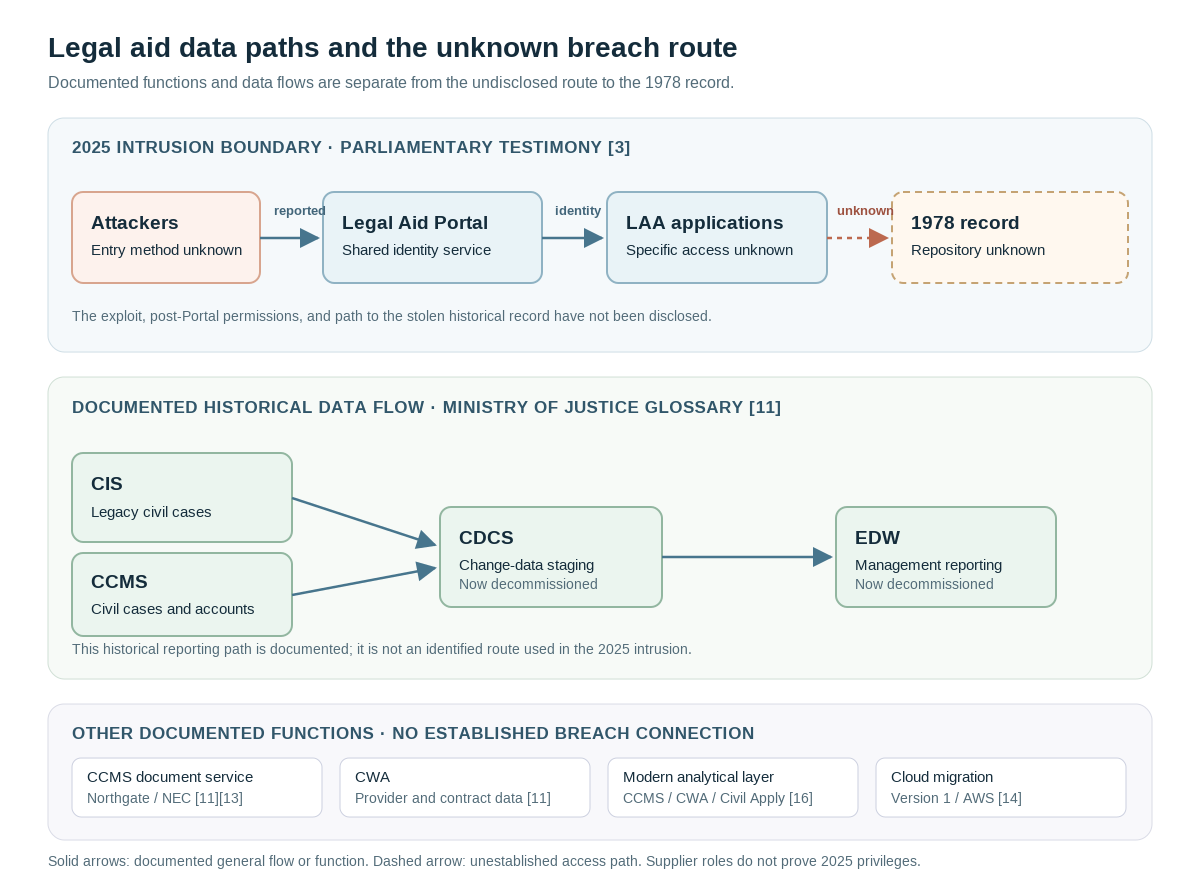
Meanwhile, financial and management reporting can require extracts from these operational systems. The Ministry of Justice’s technical glossary identifies a Change Data Capture Staging system (CDCS) that collected changed data from CIS and CCMS and transferred it to an Enterprise Data Warehouse (EDW), where information from multiple LAA applications was used for management reporting. Both components are now described as decommissioned. [11]
A single administrative relationship can therefore generate information with different operational purposes, storage locations, retention requirements, and access permissions. A document repository, accounting system, and statistical warehouse may all contain information derived from the same legal aid case without representing identical records.
The public descriptions establish that these different data-processing functions existed. They do not establish which of them contained the 1978 record or which repositories were accessed during the 2025 attack.
3.2 Different companies maintained different parts of the system
The agency’s technology was developed and operated through a succession of government projects and supplier contracts.
Capgemini played a role in CCMS development and support. Ministry of Justice expenditure data from April 2013 records a payment of £139,719.60 to Capgemini UK for data migration costs under the Integrated Delivery Programme. In the same period, Northgate Information Solutions received payments for additional project management associated with the programme. [12]
Northgate also provided electronic document and records management services. The Ministry of Justice’s technical glossary identifies the Electronic Documents and Records Management System (EDRMS) used by CCMS as an externally hosted Northgate system. This was a distinct function from the case-management and accounting software itself. [11]
The supplier relationship continued through corporate changes. Northgate Public Services became part of NEC and was subsequently renamed NEC Software Solutions UK. In July 2024, the Ministry of Justice awarded NEC a contract for the LAA EDRM and Mailroom Solution, involving electronic document management, mail handling, and scanning. Public procurement records place the contract value at approximately £1.13 million. [13]
Case processing and document storage thus fell under different contracts.
The same separation applied to later modernization. Version 1 describes working with Amazon Web Services to migrate legacy LAA applications from older hosting environments to cloud infrastructure, providing DevSecOps and infrastructure support while planning further application refactoring. Capgemini continued to support CCMS under a managed-service contract awarded in 2024, valued at approximately £1.73 million. [14][15]
These sources identify historical assignments and contracted services. They do not establish each supplier’s effective privileges in 2025, the movement of any particular record, or a role in the intrusion. They do show that case processing, document storage, infrastructure, and modernization were managed through different projects and contracts.
3.3 Replacing a system does not settle the fate of its data
Replacing an application requires decisions about which information moves, remains in the old system, or can be discarded. In legal aid, a completed case may still have an outstanding debt or statutory charge, so a new system handling current applications need not replace every function required for historical cases.
The LAA’s own technology descriptions reflect this reality. CIS continued to exist as an internal application for legacy case management even after CCMS became mandatory for new civil representation work. The stated intention was to decommission CIS when doing so became practical. [11]
Version 1’s case study describes moving hosted applications to AWS before progressively refactoring them. Infrastructure could therefore change while application behavior remained to be redesigned. [14]
Modernization also involved the analytical estate. The Ministry of Justice’s Legal Aid Data Stabilisation project describes older data services with duplicated logic, inconsistent outputs, and limited documentation. It integrates information from systems including CCMS, CWA, and Civil Apply into a common model, while also providing mechanisms to return transformed data to operational services. [16]
That project addressed a documented reporting problem. Its published description does not show that the 1978 record entered the new model or that the model was used by the attackers.
Consolidating data and replacing ageing platforms can improve reliability. It also requires decisions about record provenance, retention rules, and authorized uses. A migration that keeps applications and payments working does not itself establish that information no longer needed by either service has been identified and disposed of.
4. When Data Protection Met Legacy Software
4.1 The government had rules for remembering and forgetting
By 2022, the LAA had a formal Records Retention and Disposition Schedule agreed with the Ministry of Justice’s departmental records management function. The schedule defined retention periods for operational records, financial information, corporate documents, and other administrative materials, while also addressing the preservation of records relevant to public inquiries. [7]
Its rules were specific rather than uniformly restrictive.
| Record category | Retention requirement |
|---|---|
| Granted criminal legal aid case | Seven years after final payment or discharge of debt, whichever is later |
| Granted civil legal aid case | Three years after final payment, certificate discharge, or discharge of debt, whichever is later |
| Refused application | Three years after the last action |
| Paper copy of a digitized record | Destroyed no later than 30 days after scanning |
| Unspecified records, including copies owned by other business areas | Up to three years |
| Record documenting the destruction of another record | 99 years |
Source: LAA Records Retention and Disposition Schedule, December 2022 [7].
The schedule also recognized circumstances in which normal disposal could be suspended. Records relevant to inquiries such as the Independent Inquiry into Child Sexual Abuse, the Infected Blood Inquiry, and the UK Covid-19 Inquiry were subject to preservation requirements, while information needed for unresolved financial obligations could be retained until the relevant conditions were satisfied.
These exceptions complicate any attempt to judge retention solely from a document’s age. A record created decades ago may remain legally relevant, while a much newer copy may have no continuing purpose once its original transaction is complete.
The schedule nevertheless demonstrates that the agency’s published policy was not to retain all records indefinitely. It required the organization to distinguish categories of information, apply retention periods, recognize exceptions, and destroy records once the relevant conditions were met.
The important question is how those instructions were applied to the actual systems and datasets maintained across different generations of technology.
4.2 Information ownership existed long before the breach
The LAA had formal information governance arrangements from its establishment.
Its 2013–14 annual report described designated Information Asset Owners, an Information Asset Register, and an Information Security Risk Register. Information owners were expected to report on their responsibilities, and security risks were submitted to the Ministry of Justice through established reporting processes. [8]
The UK GDPR and Data Protection Act 2018 subsequently reinforced requirements concerning processing purposes, data minimization, storage limitation, appropriate security, and accountability. The LAA’s privacy notice identifies the Ministry of Justice as the data controller and explains that information may be used for legal aid decisions, payments, audits, and statistical functions, with disclosure to other authorities and service providers where relevant. [17]
These arrangements assigned responsibility for information, but an asset register identifying CCMS or a document service need not inventory every copy created through extracts, migrations, or archives. Nor does naming an owner give that person the technical means or authority to remove every copy. This distinction matters across systems run by different teams and suppliers.
4.3 Data protection improvements repeatedly lost priority to maintenance
By 2020–21, the agency had identified outstanding GDPR remediation work and incorporated necessary changes into its digital development plans. In 2021–22, it continued to identify delays and weaknesses in governance, while reporting that pressure on digital resources had forced priority to be given to keeping existing systems operational. [18][19]
The following year’s report described continuing difficulties obtaining the digital resources needed for GDPR improvements. The agency stated that the increasing risk had been escalated through the Ministry of Justice so that the required work could be prioritized and the consequences of delay mitigated. [20]
The problem persisted into 2023–24, when the agency anticipated further resource pressure affecting data protection remediation and legacy modernization. By 2024–25, its corporate risk reporting continued to classify security, information management, and legacy technology as high-risk areas, despite additional investment and closer cooperation with MoJ Security and Justice Digital. [9][21]
Across several financial years, the agency documented the risk and sought resources while operational maintenance competed for the same development capacity. Data protection work was in its plans; carrying it out across the legacy estate remained the difficulty.
4.4 The software could not automatically enforce every retention decision
During a Public Accounts Committee hearing, LAA chief executive Jane Harbottle was asked why information dating back to 2007 had remained in agency systems. She explained that the problem was associated with legacy technology that lacked automatic data-cleaning mechanisms, while also emphasizing the legitimate need to retain information associated with outstanding debts and statutory charges. [3]
An old record can remain for two different reasons: a continuing legal purpose, such as an unpaid debt, or a system’s inability to identify and remove data whose retention period has expired. Harbottle’s testimony did not establish which reason applied to any particular stolen record.
Lack of automatic deletion does not itself prove a legal violation; manual disposal or restricted archiving may satisfy the rules. But applying those rules across case systems, document stores, financial databases, and extracts requires each copy to be classified and its continuing purpose understood. A record might need to remain in one context but not another. The schedule supplied the policy; implementing it consistently required software capability and operational decisions across the estate.
4.5 Suppliers could enforce requirements without defining them
The contracts in Section 3 assigned development, document management, and infrastructure work to different suppliers. Those services could be delivered without any supplier deciding whether a historical record still had a lawful purpose. That decision belonged to the government, informed by outstanding cases, debts, and evidentiary duties.
A contract may govern a supplier’s handling or deletion of data at the end of its engagement without deciding what happens to the government’s originals or copies under another contract. A migration can preserve data needed by a receiving service while disposal from the source awaits a separate decision. The public record shows no breach of duty by a named supplier; it shows an estate whose information lifecycle crossed contractual boundaries that the agency itself considered difficult to manage. [9]
5. The Government Knew the Risk
5.1 The attackers entered through a system already being replaced
In October 2025, LAA executives disclosed that the attackers had entered through the old Legal Aid Portal, the common identity and access-management service used to authenticate users and provide access to legal aid applications.
Harbottle explained that replacing this component had already become a priority before the incident. The agency had received funding for stabilization and modernization, and development of a replacement identity system was underway when the attack occurred. The new system was subsequently accelerated and deployed in August 2025. [3]
The precise technical mechanism of entry has not been publicly disclosed. Parliamentary testimony does not establish whether the attackers exploited a specific authentication flaw, stole credentials, or used another method to obtain unauthorized access.
The Portal was a shared entry point, but authentication and access to a historical record are separate decisions. Applications and supporting services determine which cases, documents, or accounts an identity can retrieve. The public evidence does not show how the attackers crossed those later boundaries or whether controls behind the Portal limited their access.
5.2 The improvement programme was already underway
The agency’s digital estate had appeared in government risk registers since at least 2021. By 2022–23, it had been assessed as the most complex and fragile within the Ministry of Justice, prompting an initial allocation of approximately £8.4 million to address technical debt.
Further assessments and investment followed. The agency received £10.5 million for stabilization activity during 2024–25, supporting system discovery, technical analysis, preparatory engineering, and improvements to security monitoring. [3][9]
Harbottle testified that new monitoring enabled detection in April 2025; the agency lacked that visibility when the attackers first entered in December 2024. Monitoring improved before the replacement identity system was ready. The record therefore shows risk reduction in progress, with the old entry point still in use during the intrusion.
5.3 The remaining problem was also organizational
A Ministry of Justice review conducted between August and November 2024 identified an outstanding governance measure associated with the Government Internal Audit Agency’s work on legacy technology.
Although the review acknowledged that many audit recommendations had been actioned, it recommended completing a service agreement setting out the roles and responsibilities of the parties involved in managing legacy technology risks. The review also found that regular formal accountability meetings between the LAA and its departmental sponsorship function had not been established when the review began, although the first such meeting subsequently took place in February 2025. [22]
The unfinished agreement does not prove an absence of security responsibility or explain the breach. It does show that the government was still defining who would manage a recognized legacy risk. An information owner could set a retention rule, while a digital team implemented it, funding was approved elsewhere, and a service owner depended on a supplier contract. Turning a recorded risk into a verified technical change required decisions across those boundaries. The LAA’s annual reports show how long that process could take.
5.4 The incident exposed a second problem: identifying whose data had been stolen
The 2025 shutdown disrupted legal aid operations and forced the agency to introduce alternative payment arrangements for providers. Some services operated through separate systems and could continue, while other functions required temporary procedures until the affected applications could be safely restored.
The disruption extended beyond the LAA itself. Parliamentary testimony described how HM Courts and Tribunals Service’s Help with Fees function depended on an LAA interface for automatic benefit verification with the Department for Work and Pensions. When the relevant services were unavailable, the courts had to adopt manual arrangements. [3]
The agency’s technology thus supported services beyond legal aid. Even after obtaining the stolen material for analysis, the government struggled to determine which individuals were represented in it.
The agency’s systems organized information around different business functions and transactions rather than maintaining a complete electronic file for every individual. Investigators therefore had to interpret fragmented records, connect references, and reconstruct the relationships among documents and data entries.
At the October 2025 hearing, Harbottle explained why the government had issued public warnings rather than writing to everyone who might have been affected. Some historical addresses were likely to be outdated, and sending sensitive notices to the wrong recipients could create additional privacy incidents.
This did not show that the original data lacked a purpose. It showed that knowing which assets existed and how data moved between them was insufficient to identify every record held about one person.
By October 2026, the government’s analysis was still changing its understanding of the stolen information. The agency had discovered additional historical categories and limited probation records, despite having worked on the incident for approximately 18 months.
The government allocated £200 million for transformation, recovery, and moving legacy systems onto modern platforms—work extending beyond replacement of the Portal. [2]
6. Conclusion — Who Controlled the Records?
The 1978 record’s age does not establish that it should have been deleted. Outstanding debts, statutory charges, proceedings, and inquiries can justify long retention. Legal aid institutions inherited such obligations as they replaced regional systems, created national case histories, and added new applications and data stores.
The government later adopted explicit retention rules and assigned information owners. Yet its annual reports recorded delays in privacy improvements; its chief executive described legacy systems without automatic cleaning; and a pre-incident review called for clearer responsibility over legacy technology risks. The challenge was to make those decisions effective across systems built for different purposes and under different contracts.
The attackers entered through a shared identity service already being replaced. The stolen information spanned multiple periods and functions, while its fragmented form made it difficult to identify affected people. The intrusion exposed both a security failure and the limits of the government’s ability to account for information it had preserved.
These findings do not establish that a specific historical record was kept unlawfully, that any named contractor violated its obligations, or that deficiencies in retention management caused the attackers to gain access. Those conclusions would require evidence about the original record, its subsequent copies, the relevant retention decisions, and the actual technical route of the intrusion.
What the evidence establishes is a separation between a record’s continuing legal significance, the systems through which it survives, and present-day authority to access or destroy it. Successive institutions can preserve an obligation without preserving a consistent account of who can reach the associated information.
The same problem can arise wherever a public body inherits old duties while replacing the software used to perform them. The obligation may remain clear in law even as records are copied, reclassified, or left in an older service. Each transition requires a fresh account of what must remain and who may use it.
The central question is therefore not whether the government should have forgotten its past. It is whether the public institutions responsible for preserving that past could continue to enforce the distinctions between information that must remain, information that may still be used, and information that should no longer be accessible.
Britain’s legal aid system had compelling administrative reasons to remember. What the cyberattack revealed was how difficult it had become to establish who could still reach what it remembered.
References
Incident investigation and parliamentary evidence
[1] Legal Aid Agency. Legal Aid Agency Cyber Security Incident Data Update October 2026. October 14, 2026.
[2] UK Parliament. Legal Aid Agency Cyber-Security Incident: Data Update. Written Ministerial Statement HCWS376, October 14, 2026.
[3] House of Commons Public Accounts Committee. Ministry of Justice Follow-up: Autumn 2025. Oral evidence, HC 1240, October 23, 2025.
Legal aid institutions and historical administration
[4] House of Lords. Legal Advice and Assistance (Scope) (Amendment) Regulations 1997. Hansard, February 28, 1997.
[5] House of Commons. Legal Aid: Previous Applications and Corporate Information System. Written parliamentary answer, July 31, 1997.
[6] House of Commons. Legal Aid: CIS, Historical Payment Records and Data Retention. Written parliamentary answers, January 11, 1999.
Data protection, retention, and government oversight
[7] Legal Aid Agency and Ministry of Justice. Records Retention and Disposition Schedule. December 2022.
[8] Legal Aid Agency. Annual Report and Accounts 2013–14. Information governance and information asset management.
[9] Legal Aid Agency. Annual Report and Accounts 2024–25: Accountability Report. Legacy technology, data protection compliance, cybersecurity, and transformation funding.
System development and technology suppliers
[10] Ministry of Justice. Guide to Legal Aid Statistics in England and Wales. Historical case-management systems and statistical data sources.
[11] Ministry of Justice. Technical Acronyms and Systems Glossary. Entries covering CIS, CCMS, CWA, CDCS, EDW, and EDRMS.
[12] Ministry of Justice. April 2013 Spending Data. Integrated Delivery Programme payments to Capgemini and Northgate.
[13] Ministry of Justice. LAA EDRM & Mailroom Solution. Contracts Finder open contracting record, July 2024.
[14] Version 1. Supporting Legacy Transformation at the Legal Aid Agency. Supplier case study on AWS migration, infrastructure modernization, and DevSecOps.
[15] Ministry of Justice. LAA CCMS DevOps Managed Service 2024. Contracts Finder open contracting record, August 2024.
[16] Ministry of Justice Data and Analytics Engineering. Legal Aid Data Stabilisation. Case study on legacy data integration, common models, and reverse ETL.
Privacy policy and institutional accountability
[17] Legal Aid Agency. Legal Aid Agency Privacy Notice. Government privacy notice describing processing purposes and information sharing.
[18] Legal Aid Agency. Annual Report and Accounts 2020–21. GDPR remediation and digital development planning.
[19] Legal Aid Agency. Annual Report and Accounts 2021–22. GDPR implementation delays, governance, and digital resourcing.
[20] Legal Aid Agency. Annual Report and Accounts 2022–23. Continuing remediation challenges and escalation of data protection risks.
[21] Legal Aid Agency. Annual Report and Accounts 2023–24: Accountability Report. Legacy technology, information security, and digital-resource risks.
[22] Ministry of Justice. Summary of the Legal Aid Agency Review. Review conducted August–November 2024, published April 30, 2025.
Evidentiary Scope
This investigation is based on publicly available government announcements, parliamentary proceedings, annual reports, procurement records, published technical documentation, and statements by technology suppliers. The October 2026 disclosure establishes the presence of a record dating from 1978 among information stolen during the 2025 cyberattack, but does not identify the specific database or storage environment from which that record was obtained.
Historical parliamentary material documents the transfer of eligibility assessment responsibilities in 1997, the establishment of CIS, and an explicit indefinite-retention policy for certain payment records in 1999. These findings establish institutional and technical practices that could preserve historical information, but do not demonstrate that the particular 1978 benefit status record followed the same route or was subject to the same retention policy.
Public records identify multiple generations of case-management applications, financial systems, document repositories, data warehouses, and supplier contracts. They do not establish that any named supplier’s systems were directly compromised, that a supplier failed to comply with its contractual obligations, or that a particular data migration caused the historical information to be exposed.
Parliamentary testimony identifies the old LAA Portal as the general point of entry and confirms that legacy technology lacked automatic data-cleaning mechanisms. The government has not publicly disclosed the detailed exploit, lateral movement, specific privileges obtained by the attackers, or the sequence through which the individual data sources were accessed.
The existence of historical information does not itself establish a breach of retention obligations. Determining whether a specific record was held beyond its lawful retention period would require knowledge of its category, original and subsequent processing purposes, outstanding financial or legal obligations, preservation requirements, and the actual disposal arrangements applied to each copy.
The investigation’s principal finding is therefore institutional rather than forensic: the British government maintained successive mechanisms for preserving the continuity of legal aid administration, while responsibility for data retention, technical access, modernization, and security assurance developed through different legal, organizational, and contractual processes. The public record establishes that difficulties in coordinating those processes were recognized before the attack. It does not establish the precise causal relationship between those deficiencies and the historical records ultimately stolen.