How America’s bankruptcy courts centralized legal notification, why a contractor’s cybersecurity incident disrupted it nationwide, and how the courts tried to preserve rights without the system they had built.
Incident Analysis · United States · Federal Judiciary · BAE Systems · Bankruptcy · Public Infrastructure
Analysis based on publicly available information as of October 18, 2026.
Abstract
On October 9, 2026, BAE Systems notified the Administrative Office of the U.S. Courts of a disruption affecting the Bankruptcy Noticing Center (BNC), the privately operated service responsible for producing and distributing many official notices from federal bankruptcy courts throughout the United States. The Administrative Office confirmed on October 15 that the disruption resulted from a cybersecurity incident involving BAE Systems. Courts continued accepting filings, processing cases, and entering orders, but notices ordinarily transmitted through the BNC could no longer be delivered through that service. [1][2]
The interruption exposed a distinction that is easy to overlook in ordinary judicial administration. Filing a petition or entering an order can produce legal effects before the people affected receive notice. Yet notice may be necessary to give them an opportunity to respond or to bind them to a particular adverse consequence. A court could therefore continue issuing decisions while the communication needed to contest some of them remained incomplete. [3][13][20]
The federal judiciary had spent decades centralizing this work. The BNC reduced printing, postage, and personnel costs, supported nationwide creditor-address registration, and enabled the growing use of electronic notices. By fiscal year 2010, it was processing more than 170 million notices annually. BAE Systems, which had operated under a performance-based contract since 2008, disclosed a ten-year renewal worth $106 million in its February 2021 report on 2020 results. [4][5][6]
The concentration of these functions had an important legal consequence. In 2019, while considering amendments to electronic-notification rules, the judiciary’s rulemaking advisers explicitly recognized that courts could use creditor addresses registered with the BNC while litigating parties could not access those addresses in the same way. The committee consequently considered separate procedural arrangements for court-issued notices and notices served by parties. [8]
Seven years later, the Southern District of Florida confronted exactly that division. On October 16, it issued an emergency order transferring notification responsibilities to debtors, attorneys, bankruptcy trustees, and the United States Trustee. The same order warned that alternative creditor lists might not contain the electronic or preferred addresses registered with the BNC. It also prohibited adverse action based on failures to respond to affected notices unless legally sufficient notification had been established. [3]
This investigation reconstructs how that arrangement developed, what functions failed, how federal bankruptcy law constrained the response, and which institutions controlled the relevant decisions. The available evidence does not establish the intrusion method, data theft, contractual negligence, or an irreversible loss of legal rights in any particular case.
It does establish a concrete institutional problem: a national judicial service had centralized the practical machinery of legal notification, while the obligations and authority to remedy its failure remained distributed among courts, government institutions, and individual participants in bankruptcy proceedings.
1. Incident Overview
1.1 What stopped on October 9
Late on Friday, October 9, BAE Systems notified the Administrative Office of the U.S. Courts that a disruption was affecting systems used by the Bankruptcy Noticing Center. Bankruptcy courts began publishing warnings on October 13, and the Administrative Office confirmed on October 15 that the disruption resulted from a cybersecurity incident involving BAE Systems. [1][2]
The BNC is a nationwide service that handles the production and transmission of many notices issued by federal bankruptcy courts. It distributes paper mail and electronic notices and maintains related creditor-registration services.
According to the Administrative Office, the incident made BNC-operated systems and websites unavailable, including bnc.uscourts.gov, bankruptcynotices.uscourts.gov, notices.uscourts.gov, and the National Creditor Registration Service (NCRS). Notice production and distribution were halted.
The disruption also affected the processes through which the BNC retrieved notification work from courts and returned certifications of completed service. This meant that the failure extended beyond the delivery channels themselves. It affected the ordinary administrative means by which the court could establish that notification had occurred. [2]
The incident did not amount to a shutdown of the federal bankruptcy courts. Case Management/Electronic Case Files (CM/ECF), the courts’ electronic filing and case-management system, remained operational. Courts continued receiving petitions, registering filings, issuing orders, and maintaining case dockets.
The Notices of Electronic Filing (NEFs) generated through CM/ECF also continued to reach registered users. Attorneys and other participants using the court’s electronic filing system could still receive this category of notification, while recipients who depended on the separate BNC process could not receive their notices through its normal channels.
That separation is important because bankruptcy proceedings involve participants with very different relationships to the court. A law firm may have registered CM/ECF access and monitor an electronic docket every day. An individual creditor or debtor may depend on an official letter or a separate BNC electronic-notification account.
Both may be entitled to notice, but they do not receive it through the same infrastructure.
| Function | Status during the interruption |
|---|---|
| Electronic filing and case registration through CM/ECF | Continued operating |
| Court orders and docket entries | Continued, subject to local processing changes |
| NEFs to registered CM/ECF users | Continued operating |
| Paper notices normally produced by BNC | Interrupted |
| Electronic notices normally transmitted by BNC | Interrupted |
| BNC creditor-registration and address services | Unavailable |
| Ordinary BNC certificates documenting notice | Processing and return interrupted |
Sources: Administrative Office [1], Eastern and Western Districts of Arkansas [2], and Southern District of Indiana [9].
The Southern District of Indiana explained the practical effect in an October 16 FAQ. Court dockets would continue accurately recording filings and judicial activity, even though notices issued by the court might not be served through the BNC. An entry on the docket did not, by itself, demonstrate that the required service had been completed. [9]
A bankruptcy court could therefore have an accurate record of a legally significant event without having successfully informed the people affected by it.
1.2 Why this was a judicial problem
Bankruptcy notices do more than report administrative developments. They inform creditors that a bankruptcy proceeding has begun, identify meetings in which they may participate, announce deadlines for submitting claims, and communicate decisions that can affect debts, property, or the ability to pursue collection.
A notice may be necessary for a creditor to exercise an objection right or protect a claim. It may also establish that a party had an opportunity to respond before the court took a particular action.
The cybersecurity incident did not suspend those legal relationships. Instead, it interrupted one of the mechanisms through which participants learned about them.
The distinction appeared immediately in the emergency orders. Courts needed to identify which notices had not been served, determine who could provide them, and decide whether hearings or deadlines could proceed. These were not questions BAE could settle merely by bringing the application back online.
By October 16, different judicial districts had already adopted materially different responses. Florida reassigned service obligations, Indiana authorized some parties to substitute for the court, Texas addressed the continuation of an automatic stay, and western North Carolina chose to consider requested relief case by case.
The common technical failure had become a series of legal problems requiring judicial decisions.
2. Timeline of the BNC Interruption
| Date | Documented event |
|---|---|
| October 9 | BAE notified the Administrative Office that systems used to process BNC notices were disrupted. [2] |
| October 13 | Bankruptcy courts, including those in eastern and western Arkansas, published warnings that BNC noticing and certification were unavailable. [2] |
| October 14 | The Eastern District of Texas issued General Order 26-2 concerning motions to continue the automatic stay. [15] |
| October 15 | The Administrative Office publicly identified the disruption as resulting from a cybersecurity incident involving BAE Systems. [1] |
| October 16 | Florida issued its emergency notification order; Indiana published guidance on substitute service and creditor meetings. [3][9] |
These dates describe public notifications and orders, not the proven onset of every missed notice. The District of Massachusetts later said that notices requested after October 6 may have been affected. [19]
3. How the Judiciary Built a National Noticing System
3.1 Centralization was a successful administrative reform
The Bankruptcy Noticing Center emerged from efforts during the early 1990s to centralize work traditionally performed by individual bankruptcy court clerks.
Before national processing, producing and mailing court notices required substantial local administrative effort. Courts had to prepare documents, identify recipients, generate addresses, print correspondence, and manage postage and returned mail.
The BNC allowed participating courts to move much of that work into a common process operated under contract with the Administrative Office. Rather than maintaining comparable infrastructure independently across the country, the judiciary could purchase production and distribution at national scale.
The savings were extensively documented.
On October 1, 2008, a new performance-based BNC contract awarded to BAE Systems Information Technology, Inc. took effect. The judiciary’s 2009 annual report stated that the new contract provided additional services at unit prices approximately 36 percent below the previous contract. Assuming ten percent annual growth in program use, the Administrative Office projected more than $50 million in savings over ten years compared with earlier rates. [4]
The improvements continued after the contract transition. Joint debtors sharing an address could receive a single notice rather than duplicate mailings. The BNC also integrated address verification and change-of-address information to reduce unnecessary printing and undeliverable correspondence.
In fiscal year 2010, the BNC transmitted more than 170 million notices, and the judiciary reported cumulative savings exceeding $100 million since 1994. The Electronic Bankruptcy Noticing program alone produced more than $7 million in printing and postage savings during that year. [5]
These figures describe genuine improvements in administrative efficiency. The national service reduced repetitive work and enabled notification at a scale difficult to reproduce economically in every court.
The arrangement also became a durable contractual relationship. In its February 2021 announcement of 2020 results, BAE Systems disclosed a ten-year renewal of the BNC contract with a lifecycle value of $106 million. [6]
By the time of the October 2026 incident, bankruptcy notification had been administered through national contracting arrangements for more than three decades.
3.2 The next reform moved notices from paper to electronic systems
Centralized printing and mailing were only the beginning. As more creditors acquired the ability to receive electronic documents, the judiciary pursued another reduction in administrative expense.
On June 29, 2018, the Judicial Conference’s Committee on Court Administration and Case Management (CACM) submitted a proposal to amend Federal Rule of Bankruptcy Procedure 9036.
The letter was explicit about the objective. The judiciary’s fiscal year 2019 budget included approximately $14 million for bankruptcy noticing, and only about 43 percent of notice recipients were using electronic delivery. CACM had established a cost-containment subcommittee chaired by bankruptcy judge Marvin Isgur to identify ways to reduce that expenditure. [7]
The committee considered expanding mandatory electronic notification for organizations receiving large numbers of court notices.
An earlier proposal would have required recipients of at least 100 notices within a month to accept electronic delivery. But that proposal encountered an obstacle in 11 U.S.C. §342(e) and (f), which allowed certain creditors to designate an address for bankruptcy notifications.
An administrative rule could not simply override the statutory right to receive notice at a designated address. The revised proposal therefore preserved that right while creating a mechanism through which the Administrative Office could designate electronic notification arrangements for high-volume recipients.
The change illustrates how technical modernization depended on decisions by different parts of the judiciary. CACM approached the matter through administrative costs; the bankruptcy rulemaking committee had to reconcile the proposal with statutory notification rights; and the Administrative Office and BNC would operate the resulting program.
Rule 9036 was amended in 2021 to accommodate mandatory electronic notification for high-volume paper-notice recipients. The Administrative Office subsequently lowered the qualifying threshold, reaching 25 paper notices in a calendar month in December 2023. [10][11]
Under the program, qualifying organizations can be required to enroll in electronic notice delivery. After the applicable transition process, recipients that do not register an address may have notices made available through an electronic account established by the BNC, subject to the statutory exceptions.
This was no longer merely an optional electronic alternative to the postal service. For some recipients, an electronic service administered through BNC could replace regular paper delivery.
The motivation remained understandable: repetitive printing and postage were expensive, while many large creditors had systems capable of handling notices electronically.
But the expansion increased the number of legally significant communications whose ordinary delivery depended on the centralized program.
The public cost-containment documents describe the expected savings and the legal requirements governing electronic delivery. They do not, by themselves, establish what independent nationwide fallback capacity was required when BNC processing became unavailable.
4. The Architecture of Bankruptcy Notice
4.1 From case record to recipient and proof of service
A bankruptcy petition typically includes a list of creditors and addresses. But the address supplied by the debtor may not be the address at which a creditor has requested to receive bankruptcy-related notices.
Section 342 allows qualifying creditors to designate particular notification addresses. A financial institution might direct bankruptcy correspondence to a specialized department rather than a branch office or its ordinary billing address.
The BNC’s National Creditor Registration Service supports this system of preferred addresses. The BNC can substitute registered addresses when preparing notifications, using information that may not appear in the debtor’s original creditor list. [12]
Consequently, the process of producing a valid notification is more complicated than attaching a document to an email or printing the address stored in CM/ECF.
The court must determine which parties require notification, which delivery methods are legally permissible, and which addresses have priority. It must then produce and transmit the document and preserve an appropriate record of service.
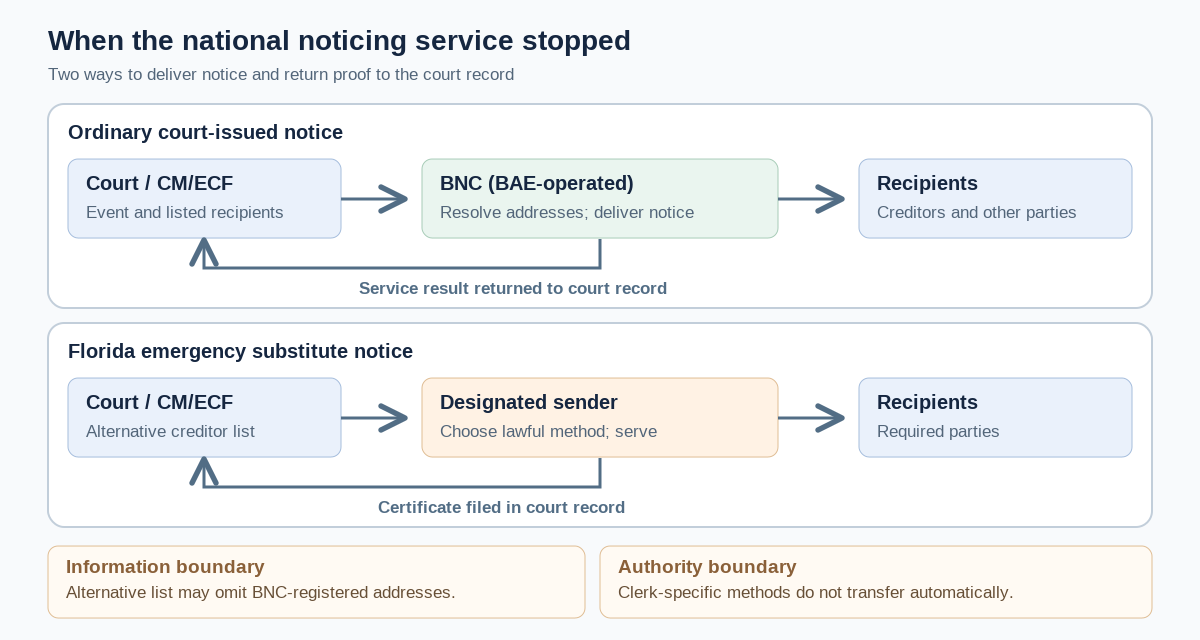
At a functional level, the workflow was:
| Processing stage | Information or function |
|---|---|
| CM/ECF | Case events, filed documents, listed creditors and parties |
| BNC intake | Notices and recipient information collected for processing |
| Address and delivery resolution | Preferred creditor addresses, electronic registrations, postal processing |
| Distribution | Electronic delivery or printing and mailing |
| Certification | Service results returned for inclusion in the court record |
The BNC therefore transformed case information into legally relevant notification. Figure 1 compares that ordinary route with the substitute route described in Florida’s emergency order. These are documented functional paths; the BAE-operated system’s internal topology and any attacker-accessible network path remain unknown.
4.2 The information and authority boundaries identified in 2019
The most revealing document in this investigation predates the incident by seven years.
In an April 2019 agenda book for the Advisory Committee on Bankruptcy Rules, committee staff discussed the practical implementation of the proposed electronic-notification system. Their discussions involved bankruptcy judges, Administrative Office personnel, and the Bankruptcy Noticing Working Group.
One distinction became particularly important: courts could access addresses registered with the Bankruptcy Noticing Center, while parties to bankruptcy proceedings did not have the same access.
The committee therefore considered treating court-issued electronic notices separately from notices served by parties. It also proposed leaving the detailed administration of the electronic-notification program to the Administrative Office and BNC, rather than encoding every operational requirement in the procedural rules. [8]
Another memorandum in the same agenda book examined proposed changes for individual-debtor cases, including service of process on creditors. It reported a second limit: information supplied through BNC was unavailable to private parties, and access to that information alone would not have let them serve a BNC registrant without additional consent. A proposal to let debtors’ lawyers use the BNC database was rejected. The committee also declined a proposed clerk-maintained address register because it would burden clerks and could add conflicting addresses without resolving which one controlled. [8]
These were related but distinct constraints. Information access determined whether a party could identify a BNC-registered destination. Legal authority determined whether that party could use the same electronic method or satisfy a different service requirement. Under the current Rule 9036, the clerk’s BNC-registration and high-volume-recipient methods are expressly excluded from the methods available to an entity serving notice on its own; documents governed by Rule 7004 follow separate service-of-process rules. A court designation, another valid address, or the recipient’s consent may provide a lawful route in a particular case, but possession of an address database alone does not. [8][10]
The committee was not predicting a cybersecurity incident. It was deciding which actors could use particular addresses and delivery methods. Those choices meant that BNC’s role could not be reproduced merely by copying its records to every participant who might later be asked to give notice.
5. How the Outage Tested Legal Notice
5.1 A court’s obligation survives its contractor
The source of the notification obligation lies in federal law, not in BAE’s contract.
Title 11 of the United States Code establishes the central framework for bankruptcy proceedings. Section 342 governs important aspects of notice, including designated creditor addresses, while Federal Rule of Bankruptcy Procedure 2002 identifies many circumstances in which notice must be provided to creditors and other interested persons.
Courts may designate others to perform particular notifications when permitted by law. That makes centralized contracting possible, but it does not turn contractual performance into the sole criterion for valid legal notice.
A court order may be accurately recorded while notification remains incomplete. Conversely, notification may sometimes be legally effective without proof that a recipient actually opened or read the document.
Rule 9036(d), for example, generally provides that electronic notice or service is complete upon filing or sending, but is ineffective if the sender receives notice that it did not reach the recipient. [10]
A failed BNC process does not become effective notification merely because the underlying document exists in a docket.
5.2 When legal effect precedes, or depends on, notice
The phrase bankruptcy notice covers several legally different events. The BNC’s failure did not suspend them all in the same way. The first question is what the governing statute or rule makes legally operative: filing, entry on the docket, completed notice, or a meaningful opportunity to respond.
Some consequences arise without prior delivery of a notice. Under 11 U.S.C. §362(a), the filing of a bankruptcy petition ordinarily operates as an automatic stay, subject to statutory exceptions and limitations. Rule 9021 makes a bankruptcy judgment or order effective when it is entered under Rule 5003. Neither event waits for the BNC to send a letter. [13][20]
Other consequences expose the danger of that separation. Rule 9022 requires the clerk to give notice of the entry of a judgment or order, but expressly provides that lack of notice generally does not affect the time to appeal, except as Rule 8002 permits. The usual bankruptcy appeal period is fourteen days from entry; extensions are available only under defined conditions and are excluded for certain orders. [13]
Thus a decision can become effective and the time for challenging it can begin while its intended recipient has not received the notice normally used to learn of it. An undelivered BNC item is not proof of completed service, but neither does it automatically stop an entry-based clock.
Notice can also bear directly on whether a particular loss of rights may be imposed. Section 523(a)(3) supplies a statutory example: when a debt was not listed or scheduled in time for a creditor to file a timely claim and, where applicable, seek a dischargeability determination, the debt may be excepted from an individual debtor’s discharge unless that creditor had notice or actual knowledge of the case in time. This provision does not mean that a delayed BNC notice, by itself, makes a scheduled debt nondischargeable. It shows that the law sometimes makes timely notice or actual knowledge part of the test for a substantive consequence. [20]
The validity of a claims deadline, for example, may also depend on whether a creditor received notice satisfying statutory requirements and constitutional due process. Courts may have authority to postpone hearings, order additional service, or grant specified extensions. Which remedy is available depends on the proceeding and the source of the deadline.
The constitutional principle is longstanding.
In Mullane v. Central Hanover Bank & Trust Co. (1950), the Supreme Court held that notice must be reasonably calculated to inform interested persons of a proceeding and allow them an opportunity to respond.
In City of New York v. New York, New Haven & Hartford Railroad Co. (1953), the Court held that a city with known claims in a reorganization proceeding could not lose those claims through a deadline for which it had not received legally adequate individual notice. [14]
The Court also rejected the argument that the city’s general knowledge of the reorganization obliged it to discover the claims deadline for itself. That is a narrower and more useful lesson than treating every form of knowledge as equivalent to notice of a specific event. Section 523(a)(3) expressly makes timely notice or actual knowledge relevant to its own discharge rule; City of New York tested the adequacy of notice of a particular claims bar. The inquiry has to follow the rule governing the consequence at issue. [14][20]
The second case also illustrates the relationship with state and local government. Municipalities and state agencies can be creditors in federal bankruptcy proceedings, and their tax claims, liens, or other property interests may depend on receiving proper notice.
Neither precedent makes every unnotified action automatically void. The result depends on the governing rule, the recipient’s actual knowledge, the nature of the right involved, and the adequacy of the notice under the circumstances.
The legal problem is therefore asymmetrical. Filing and entry can continue to create duties or start clocks, while the ability of an affected person to participate may depend on a notice that the ordinary system failed to deliver. Treating the docket entry as proof of notice would erase that difference. Treating every missed BNC transmission as automatically voiding every court action would erase the equally important differences among governing rules. The outage required courts to determine, notice by notice, which legal effect had already occurred, which recipient had been adequately informed, and which remedy the law allowed.
The BNC served bankruptcy courts across the country, but those courts retained authority over individual proceedings and local administration, subject to federal statutes and procedural rules.
The October 2026 orders show how that distinction operated.
| Court | Principal emergency response |
|---|---|
| Southern District of Florida | Reassigned defined notification duties, required certificates of service, and restricted adverse action based on insufficient notice |
| Southern District of Indiana | Authorized voluntary substitute service at the participant’s expense and preserved creditor participation in Section 341 meetings |
| Eastern District of Texas | Continued the automatic stay for an additional thirty days in specified repeat-filing cases |
| Western District of North Carolina | Declined to issue a district-wide order and directed affected parties to seek relief case by case |
Sources: Florida Administrative Order 2026-06 [3], Indiana FAQ [9], Texas General Order 26-2 [15], and western North Carolina’s outage notice [16].
5.3 Florida: reallocating notice and protecting participation
On October 16, 2026, the Southern District of Florida issued Administrative Order 2026-06 in response to the BNC interruption.
The order required debtors, attorneys, trustees, and other designated participants to carry out certain notifications normally administered through the court and BNC. It instructed those responsible to verify service or provide the required notification themselves and file a certificate of service. [3]
But the court also needed a way for these participants to obtain recipient addresses while BNC-related services were unavailable.
The accompanying instructions explained how to retrieve alternative creditor and party lists directly from CM/ECF.
They then warned that those lists might not contain addresses registered with the BNC’s Electronic Bankruptcy Noticing program or the National Creditor Registration Service.
Parties were told to examine the lists and ensure that all legally required recipients were served, including persons absent from the creditor list.
The correspondence with the 2019 committee document is direct. The Florida order reassigned defined notification duties while warning that the alternative data available to the new senders might omit addresses used by BNC. It documented the information gap in practice. The earlier rulemaking record shows why supplying those addresses would not, by itself, settle every question about who could use a particular electronic method or perform service of process. [3][8][10]
This does not establish that every manual notification was legally defective. A party may have another valid address or another legally sufficient method of service. Nor does it prove that preferred-address data had been lost or corrupted.
The Florida order designated responsible persons for specified notices; it did not establish that every substitute sender lacked legal authority. It showed that reassigning work did not automatically give them BNC’s recipient data, delivery arrangements, or completed-service record.
The same distinction applied to proof of service. In its emergency order, the Florida court made clear that sending a document to the unavailable BNC for processing did not establish that notice had been given. A responsible party had to verify completed service or carry it out and certify the result.
The ordinary process had combined recipient resolution, delivery, and service documentation within a specialized national operation. The emergency procedure separated those activities and required participants to establish which lawful method they could use and what had actually been served.
Florida’s order temporarily displaced parts of its local notification arrangements. The United States Trustee became responsible for certain notices previously served by the clerk on its behalf, Chapter 7 trustees acquired specified service responsibilities, and debtors or their attorneys were directed to serve commencement notices and other documents in defined circumstances.
The court preserved duties that could not legally be delegated by the clerk, and required new certificates identifying service carried out through substitute procedures.
This placed additional work on several participants. It also crossed an institutional boundary: the United States Trustee belongs to a Department of Justice program, while the national BNC contract is administered within the federal judiciary.
A service failure in one branch’s administrative infrastructure thus affected the work of officials in another branch of government.
The order also addressed the legal consequences of delayed notice.
Section 8 of Administrative Order 2026-06 stated that the order did not alter statutory or rule-based deadlines, and that existing hearing dates remained effective unless the court ordered otherwise.
The court then imposed an important protection: no adverse action could be based on a person’s failure to respond to an affected notice or act by a deadline stated in that notice unless the court determined that notification had been provided in accordance with applicable law. [3]
A court might lack authority to extend a particular statutory deadline merely because its notification contractor had suffered an outage. It could nevertheless refuse to impose an adverse consequence for failure to respond where the required notice had not been provided, to the extent permitted by law.
Parties seeking additional relief were instructed to identify the affected notice, explain how the delay or failure affected them, and request a specific remedy through the relevant bankruptcy case.
This was not a general suspension of the legal system, nor a declaration that all actions taken during the outage would be invalid.
It was an effort to maintain proceedings while preserving the legally required opportunity to participate.
The order also addressed unrepresented debtors. A person unable to comply with the new notification requirements could request procedural assistance or seek relief from the court, but merely filing a request did not automatically extend a deadline or postpone a hearing.
That provision demonstrates the burden created by substitute service. A person who had relied on the court’s national notification system might now need to obtain addresses, mail documents, file proof of service, and understand when additional judicial permission was required.
The court could provide a legal route for relief. It could not make the administrative work disappear.
5.4 Indiana: allowing substitute service
The Southern District of Indiana allowed certain parties seeking judicial relief to undertake notification that would ordinarily pass through BNC.
A participating party could assume the cost without obtaining additional authorization and would act as the court’s designee for that notice. The party had to comply with service requirements and file a certificate documenting the recipients, method, and date. [9]
The court did not make substitute service universally mandatory under that provision. It warned that, where legally sufficient notice could not be completed, hearings or other proceedings might be delayed.
For meetings of creditors under 11 U.S.C. §341, the court adopted a related distinction. Trustees could convene meetings as scheduled, but when required notice had not been given, they were to adjourn rather than conclude them. Creditors would retain the opportunity to participate after proper notification.
The court could continue performing useful administrative work without treating an inadequately notified proceeding as complete.
5.5 Texas: the automatic stay and the statutory hearing limit
The Eastern District of Texas faced a different consequence involving the automatic stay.
Section 362 of the Bankruptcy Code generally restricts debt-collection activity after a bankruptcy petition is filed. In certain repeat-filing cases, §362(c)(3) provides for termination of the applicable stay after thirty days unless its continuation is obtained under the statutory procedure.
That continuation ordinarily requires notice and a hearing completed within the statutory period. The BNC interruption made it more difficult to notify creditors of the relevant motions and hearings.
On October 14, the Eastern District of Texas issued General Order 26-2. For cases filed on or after September 14, 2026, in which a motion to continue the stay under §362(c)(3)(B) had been filed, the order continued the automatic stay for an additional thirty days beyond its otherwise applicable termination, permitting the court to hold a hearing after proper notice. [15]
This response went beyond rescheduling notices. The automatic stay restricts certain creditor enforcement actions, so continuing it changes the legal positions of creditors and debtors, potentially including actions involving property interests under state law.
Section 362(c)(3)(B), however, conditions continuation of the stay on notice and a hearing completed before the initial thirty-day period expires. The general order announced an additional thirty days of protection for a defined set of pending motions even though the outage impaired the notice needed for those hearings. Whether this mechanism was within the court’s authority, and how it operated in any particular case, cannot be resolved from the general order alone. [15]
The technical failure thus reached a second boundary: a judicial remedy intended to preserve a hearing may itself confront a statutory time limit. The order demonstrates the stakes of that boundary without establishing that the court acted unlawfully or that a particular creditor or debtor lost a right.
5.6 North Carolina: case-by-case relief
The Western District of North Carolina chose not to enter a district-wide administrative order.
Its public notice instead directed parties and attorneys seeking relief from the BNC interruption to file appropriate motions, which the court would consider individually. [16]
This did not mean the district had an independent BNC service or had escaped the outage. It reflected a different approach to legal relief.
The contrast between districts should not be mistaken for proof that one response was necessarily defective. Cases and local procedures differ, and federal bankruptcy law leaves room for different forms of administration.
Nevertheless, the contrast establishes an important feature of the incident.
The notification infrastructure was national, but the legal consequences had to be addressed by courts exercising authority within particular proceedings and statutory limits.
The Administrative Office could coordinate the technical response with BAE Systems. It could not, by restoring the contractor’s service or publishing a general operational announcement, resolve every question about notification and legal deadlines across all pending bankruptcy cases.
6. Responsibility and Recovery of Legal Notice
6.1 The responsibility was divided before the incident
The BNC was not an independently designed private product that federal courts happened to use. Its role developed through a combination of legislation, rulemaking, national judicial administration, procurement, and local court practice.
Congress established the underlying bankruptcy laws, including rights and deadlines that notification procedures support. The Supreme Court’s rulemaking process, involving the Judicial Conference and congressional review, established procedural mechanisms for carrying out those obligations.
The Judicial Conference and Administrative Office developed the national notification program and its contracting arrangements. BAE operated the services under contract. Individual courts retained responsibility for the proceedings before them and for determining the legal consequences of inadequate notice.
These responsibilities served different purposes and were not interchangeable.
| Responsibility | Principal institution | What the interruption exposed |
|---|---|---|
| Establish rights, obligations, and statutory deadlines | Congress | Legal requirements remain despite failure of an administrative system |
| Develop procedural rules | Judicial rulemaking institutions | Notice methods must remain compatible with statutory rights |
| Design and administer national notification | Judicial Conference and Administrative Office | Critical address and processing functions had been centralized |
| Operate contracted BNC services | BAE Systems | Normal notice production, delivery, and certification were interrupted |
| Determine relief in individual cases | Bankruptcy courts | Each court had to act within the powers available under federal law |
| Carry out substitute notification | Debtors, attorneys, trustees, and other designated parties | Responsibility could be reassigned without equivalent access to information and systems |
The 2018 and 2019 rulemaking records make the first part of this allocation especially clear.
The judiciary’s administrative committees promoted electronic notification to reduce expense. The rules committee examined legal compatibility and the differences between the capabilities of courts and parties. Detailed implementation was left to the Administrative Office and BNC.
This was not an absence of institutional design. It was an identifiable series of decisions about what should be governed by legislation, procedural rules, centralized administration, and a contractor-operated service.
The open question is how those same institutions accounted for a failure of the national service.
6.2 The judiciary had recognized third-party cybersecurity risks
The Administrative Office’s fiscal year 2026 budget justification recognized growing attacks against judiciary supply chains and third-party partners. A 2022 Government Accountability Office report identified gaps in the Administrative Office’s enterprise-wide IT oversight and recommended a Chief Information Officer, among other changes. [17][18]
Neither document audits the BNC or shows that a management weakness caused this incident. They establish general institutional awareness of external IT risk, while leaving BNC-specific continuity requirements unverified. The public 2018–2019 rulemaking materials document costs, recipient preferences, and legal compatibility; they do not establish the recovery-time requirements or fallback procedures in BAE’s later contract.
6.3 A service contract is not a substitute for a judicial continuity plan
The existence of a ten-year, $106 million contract does not establish what service availability BAE promised or which contingency measures the judiciary purchased.
The full 2020 contract, its performance work statement, service-level provisions, subcontracting arrangements, and disaster-recovery requirements have not been verified in this investigation.
It would therefore be premature to conclude that BAE breached a contractual availability obligation, that the Administrative Office failed to require adequate recovery measures, or that cost reductions directly reduced the system’s security.
But a contract can be evaluated against the institutional function it supports.
For a conventional delivery service, the relevant question might be how quickly queued correspondence can be processed after an interruption. For the BNC, the problem includes whether courts can independently identify all required recipients, obtain legally appropriate addresses, document notification, and reconcile the consequences of delayed service.
These are different requirements, even when they depend on the same software.
An effective continuity arrangement would need to account for both operational recovery and the legal state of proceedings during the interruption. The emergency orders establish that courts had to implement alternatives; they do not establish whether a non-public national plan existed, what it prescribed, or whether it functioned as intended.
6.4 Recovery creates another legal problem
The Southern District of Indiana’s October 16 guidance addressed what would happen when BNC services returned.
The clerk’s office would need to review outstanding notices and coordinate resumed service to avoid unnecessary duplicates and notices containing hearing dates or deadlines that had become inaccurate. Florida’s emergency order similarly required coordination to handle the backlog without inconsistent notification. [3][9]
This is not ordinary message-queue recovery.
A court notice describes a legal event within a proceeding that may continue changing while delivery is interrupted. A hearing might be postponed, an order modified, a notice manually served, or a deadline treated differently under a subsequent judicial order.
Automatically transmitting every document retained during the interruption could therefore produce duplicate notices or communications referring to legal conditions that no longer applied.
For each affected notice, reconciliation would have to compare the current case event and deadline with the recipient list, the method actually used, any substitute certificate of service, and any later court order. It must distinguish work never processed from work completed but not certified, and from documents already delivered through substitute procedures. These are requirements inferred from the documented interruption and court guidance, not a verified description of BNC’s recovery plan. [3][9]
The record must preserve what actually happened to each notice rather than merely present an apparently complete backlog after the fact.
As of the October 16 public guidance reviewed here, a definitive restoration timetable had not been announced. The available evidence does not demonstrate how the reconciliation process ultimately performed or whether specific parties suffered irreversible harm.
Those results remain matters for subsequent investigation.
7. The Limits of Delegating Legal Notice
The Bankruptcy Noticing Center was an administrative success. It reduced repetitive work, improved the treatment of creditor addresses, and enabled electronic delivery at national scale. The judiciary’s financial reports document substantial savings.
That efficiency depended on more than a contractor printing and mailing documents. The BNC resolved preferred addresses, selected delivery channels, transmitted notices, and returned service information. The 2019 rulemaking record shows two boundaries built into this arrangement: parties lacked access to some BNC-held address information, and access alone would not authorize every method of electronic notice or service of process.
The October 2026 interruption made the first boundary visible in Florida. The court transferred specified notification duties while warning that substitute creditor lists might omit BNC-registered addresses. The second boundary remained a legal question for each method and proceeding; the order did not make all substitute service invalid.
The consequences extended beyond dispatch. Bankruptcy law does not make every effect wait for notice: a petition can trigger the automatic stay, and entry can make an order effective and start an appeal period. But insufficient notice can prevent a creditor from having a fair opportunity to protect a claim or contest a proposed action. Texas continued the automatic stay for certain pending motions, bringing an outage remedy into potential tension with a statutory hearing deadline. Indiana’s recovery guidance showed why resumed service required comparing the backlog with changed case events and notices already served by other means. Restoring the delivery system alone could not establish which legal notifications were still due. [13][14][20]
Congress defined rights and deadlines; judicial rules determined permissible methods; the Administrative Office managed the national service; BAE operated it; and individual courts addressed the legal consequences of its interruption. The public record does not establish the full contract or continuity plan, the eventual reconciliation results, or a loss of rights in any particular case.
The courts could continue deciding cases, but they could not assume their decisions had reached the people entitled to notice. Reassigning the work did not automatically transfer the information, legal authority, and service record needed to complete it.
References
Incident and emergency court operations
[1] Administrative Office of the U.S. Courts. Cybersecurity Incident Disrupting Bankruptcy Court Operations. October 15, 2026.
[2] U.S. Bankruptcy Courts, Eastern and Western Districts of Arkansas. Bankruptcy Noticing Center Service Interruption. October 13, 2026.
[3] U.S. Bankruptcy Court, Southern District of Florida. Administrative Order 2026-06: Bankruptcy Noticing Center Service Interruption. October 16, 2026. Particularly §§2–11 and Attachment 1.
[9] U.S. Bankruptcy Court, Southern District of Indiana. Bankruptcy Noticing Center Service Interruption: Update and FAQs. October 16, 2026.
[15] U.S. Bankruptcy Court, Eastern District of Texas. General Order 26-2: Motions to Continue the Stay During BNC Service Interruption. October 14, 2026.
[16] U.S. Bankruptcy Court, Western District of North Carolina. BNC Outage. October 2026.
[19] U.S. Bankruptcy Court, District of Massachusetts. BNC Notice & Service Disruption. Notice stating that requests after October 6 may have been affected; accessed October 18, 2026.
History, contracts, and rulemaking
[4] Administrative Office of the U.S. Courts. Business Improvements, Studies, and Activities — Annual Report 2009. Bankruptcy Noticing Contract.
[5] Administrative Office of the U.S. Courts. Business Improvements — Annual Report 2010. Bankruptcy Noticing.
[6] BAE Systems plc. Preliminary Announcement 2020. February 25, 2021; p. 26, BNC contract renewal.
[7] Judicial Conference, Committee on Court Administration and Case Management. Suggestion 18-BK-D: Revisions to Expand Electronic Bankruptcy Noticing. June 29, 2018.
[8] Advisory Committee on Bankruptcy Rules. Agenda Book, April 4, 2019. Especially agenda pp. 103 and 134–135, on court and party access, consent for service, and proposals for database access.
[10] Federal Rules of Bankruptcy Procedure. Rule 9036 — Electronic Notice and Service. Including the 2019, 2021, and 2024 amendments and committee notes.
[11] Administrative Office of the U.S. Courts. Bankruptcy Noticing. Mandatory Electronic Bankruptcy Noticing procedures and eligibility.
[12] U.S. Bankruptcy Court, Southern District of Florida. Clerk’s Instructions for Preparing, Submitting and Obtaining Service Matrices. Preferred creditor addresses and NCRS substitutions. See also the U.S. Bankruptcy Court for the Northern District of Iowa’s Notice of Preferred Address for the NCRS designation mechanism.
Federal bankruptcy law and constitutional requirements
[13] Federal Rules of Bankruptcy Procedure. Official rules, amended through December 1, 2025, particularly Rules 8002, 9021, and 9022.
[14] Supreme Court of the United States. Mullane v. Central Hanover Bank & Trust Co., 339 U.S. 306, 1950; and City of New York v. New York, New Haven & Hartford Railroad Co., 344 U.S. 293, 1953 (official United States Reports copy).
[20] Office of the Law Revision Counsel, U.S. House of Representatives. 11 U.S.C. §362(a) (effect of filing a petition) and 11 U.S.C. §523(a)(3) (unscheduled debts, timely notice, and actual knowledge).
Additional statutory framework: 11 U.S.C. §342 (notice), 11 U.S.C. §362 (automatic stay), and Federal Rule of Bankruptcy Procedure 2002.
Oversight and institutional accountability
[17] U.S. Government Accountability Office. U.S. Courts: Action Needed to Improve IT Management and Establish a Chief Information Officer. GAO-22-105068, July 2022.
[18] Administrative Office of the U.S. Courts. FY2026 Congressional Budget Justification — Judiciary Information Technology Fund. Third-party and supply-chain cybersecurity risks.
Evidentiary Scope
This investigation is based on publicly available official court notices, judicial administrative orders, rulemaking records, statutes, procedural rules, corporate disclosures, and government oversight documents.
Descriptions of the BNC’s historical architecture refer to the capabilities and arrangements documented at the stated dates. They do not establish that every internal software component or contractual condition remained unchanged in October 2026.
The incident’s initial access vector, attacker identity, possible data exfiltration, and complete technical scope remain unverified. The full terms and performance requirements of BAE’s 2020 contract have not been established. The existence or absence of a non-public national BNC legal continuity plan likewise cannot be determined from the documents reviewed.
The court orders demonstrate emergency responses and potential legal consequences. They do not establish that a particular person suffered an irreversible loss of rights, nor that a particular emergency measure has been upheld or rejected in subsequent litigation.
No conclusion that BAE Systems, the Administrative Office, or a particular court acted negligently is drawn solely from the interruption. The institutional findings concern documented allocations of authority, information access, and operational responsibility.