From stolen Twitter accounts to Wall Street: how the ability to exercise someone else’s authority became a criminal industry.
Incident Analysis · Social Engineering · The Com · Identity Security · Cybercrime Markets
Analysis based on publicly available information as of October 13, 2026.
Abstract
In August 2026, Reuters identified a social-engineering campaign targeting Blackstone, Bridgewater Associates, Apollo Global Management, KKR, CME Group, and other major American financial institutions. Attackers had prepared fraudulent authentication websites targeting more than 200 companies across several industries. They impersonated corporate IT support, contacted employees on personal mobile phones, and presented credential theft as a mandatory security update. [1] The campaign was tracked by Google Threat Intelligence Group as UNC6671. Its operators used voice phishing and adversary-in-the-middle authentication infrastructure to obtain enterprise sessions, access connected cloud applications, extract sensitive information, and pursue extortion under several criminal brands. [2][3]
The underlying technique was not new: in 2020, attackers impersonated Twitter’s IT support personnel and obtained access to internal administrative systems, eventually seizing valuable user accounts. By 2022, LAPSUS$ was openly recruiting employees willing to provide corporate credentials or approve authentication requests. Scattered Spider subsequently developed specialized identity-intrusion capabilities and entered commercial relationships with established ransomware operators. [6][8][9] Across these episodes, the capabilities became more specialized and easier to combine.
In July 2026, Okta published an investigation of Work Panel, a criminal operations platform that divided voice-phishing campaigns among callers, managers, and administrators. Callers could persuade employees to authenticate without seeing the credentials they helped capture. Managers controlled authentication sessions and collected information. Administrators controlled infrastructure and supervised the workforce. Commercial databases, telephone services, and automated provisioning supplied additional capabilities. [4] This was more than an improved phishing kit. It was a system for separating the acquisition of access from the people, tools, and infrastructure used to produce it.
The online criminal ecosystem known as The Com helped connect people, skills, reputation, and criminal opportunities, although it was not a single hierarchical organization and the public evidence does not establish that it centrally directed the Wall Street campaign. This investigation examines a common capability traded across related criminal markets: causing legitimate systems to produce the effects of someone else’s authority for parties who were not entitled to direct it. To understand that capability, we must ask who had the authority to cause an operation, as well as whether a user was authenticated and the system accepted it.
1. Incident Overview
On August 6, 2026, Reuters reported that hackers had targeted major American financial institutions with fraudulent websites designed to capture employee authentication credentials. The targets included Blackstone, Apollo Global Management, Bridgewater Associates, Bain Capital, KKR, TPG, CME Group, Clearlake Capital, and Moody’s. Google had identified 72 malicious root domains associated with the campaign. Reuters used internet intelligence services to investigate company-specific subdomains and identified targeting infrastructure directed at more than 200 organizations over approximately five weeks. [1] Those figures describe the scale of targeting, not the number of successful intrusions.
The presence of a fraudulent sign-in page bearing a company’s name does not establish that an employee used it or that the attackers gained access to the company’s systems. A confirmed intrusion became public later that month, however: on August 21, Apollo disclosed that a social-engineering attack had resulted in unauthorized access to certain cloud platforms between July 6 and July 10. The exposed information included personal identifiers such as names, dates of birth, contact information, home addresses, and Social Security numbers. [14]
Apollo did not publicly reconstruct the complete intrusion sequence or identify which of the extortion brands associated with UNC6671, if any, had carried out the incident. Google’s investigations of the wider campaign provide the technical model. The attackers contacted employees while impersonating their organization’s IT help desk. Some calls spoofed the legitimate support number. The callers described an urgent requirement to register passkeys or update multifactor authentication and directed employees to fraudulent websites resembling corporate SSO portals.
The attacker-controlled infrastructure relayed authentication information to the legitimate identity provider. In investigated intrusions, operators captured credentials and MFA responses, obtained authenticated sessions, and sometimes registered additional authentication devices to preserve access. The resulting sessions could then be used to reach applications already available to the victim’s account, including Microsoft 365, SharePoint, OneDrive, and other business SaaS environments. Scripts collected sensitive documents and records. The operators subsequently threatened to publish stolen information unless the organization paid. [2][3]
Much of this process used legitimate functionality: the identity provider accepted authentication responses, cloud applications recognized the account’s existing permissions, and file services returned information the account was entitled to access. Those technical decisions did not necessarily establish whether the person directing the operations had legitimate authority to request them. The attackers exploited that gap, which connects the 2026 campaign to an earlier market for stolen accounts, fraudulent administrative services, SIM swaps, insider cooperation, and enterprise access.
2. Attack Timeline
UNC6671’s 2026 activity illustrates how a reusable intrusion procedure could be applied across industries, connected to different extortion brands, and supported by persistent operational infrastructure.
| Period | Observed activity | Significance |
|---|---|---|
| January–February 2026 | UNC6671 conducts voice-phishing intrusions; BlackFile emerges as an extortion identity and launches a data-leak site. | Enterprise identity compromise becomes the basis for a recurring extortion operation. |
| April–May | The operation targets manufacturing, healthcare, real estate, insurance, and other sectors. | The same intrusion procedure is reused across organizations. |
| May 11 | BlackFile announces that it is shutting down under that name. | The public brand ceases without proving the underlying capability has disappeared. |
| June 27 | Redact claims that a former affiliate appropriated the BlackFile identity. | Control of an extortion brand and its negotiations becomes disputed. |
| June–July | Domain deployment continues and targeting increasingly concentrates on high-value enterprise information. | Infrastructure and victim selection become more specialized. |
| July 6–10 | Apollo later reports unauthorized access to certain cloud platforms. | A confirmed financial-sector intrusion occurs during the campaign period. |
| July 28 | Okta publishes its Work Panel investigation. | The internal management of voice-phishing operations becomes visible. |
| August 6–7 | Reuters and Google disclose the scale of the campaign and the overlapping extortion brands. | Shared capabilities and financial-sector targeting become public. |
| August 11–18 | GuidePoint investigates the operational infrastructure; NiceNIC reviews associated domain registrations. | Technical and registrar records expose operational dependencies. |
| August 21 | Apollo’s breach becomes public. | The difference between targeting evidence and confirmed compromise becomes especially important. |
Sources: Reuters, Google GTIG, Okta, GuidePoint Security, NiceNIC, and Apollo breach reporting. [1–5][13][14]
2.1 A repeatable intrusion procedure
Google’s May 2026 investigation documented UNC6671’s operating method before the financial-sector campaign attracted widespread attention. The initial social-engineering calls were typically conducted by callers hired by the threat actor. They targeted employees’ personal mobile phones, reducing exposure to corporate communications controls. The supposed transition to passkeys or updated MFA provided a plausible explanation for why the employee was being asked to complete an unusual authentication procedure. When credentials were entered, the attackers used them against the legitimate identity service and guided the employee through subsequent authentication challenges. The objective was to establish access that the identity provider would recognize.
Once the session existed, the operation moved into the enterprise’s SaaS environment. Google observed the use of Python and PowerShell scripts to collect information from Microsoft 365 services. Attackers queried internal search functions for terms indicating valuable information and used authenticated sessions to retrieve documents from SharePoint and OneDrive. In one investigated case, automated activity accessed or downloaded more than one million files. [3] The initial phone call was therefore only one stage of the attack. It converted a fraudulent human instruction into an authenticated technical state. That state subsequently became the basis for collecting information through legitimate application permissions.
2.2 The extortion business survived changes in branding
In May, BlackFile announced that it was ceasing operations under its existing identity. On June 27, Redact claimed that the change followed a dispute with a former affiliate who had appropriated the BlackFile brand and was conducting unauthorized negotiations. According to Redact’s own statement, the breakaway participant had caused confusion about which extortion messages represented the legitimate operation. Redact consequently introduced designated Tox and PGP identities for future communications. [2]
The explanation is a criminal group’s claim, not an independently established account of the dispute. Nevertheless, the problem it describes is revealing. Extortion depends on the victim believing that the person demanding payment actually possesses the stolen information and can influence whether it will be disclosed. A recognizable criminal brand helps establish that credibility. If several parties claim to represent the same organization, the victim cannot easily determine which one has the relevant authority.
The attackers had obtained access by impersonating trusted personnel. Their own business then faced a comparable problem: other people could impersonate the authority to negotiate on their behalf. Google subsequently identified common infrastructure, targeting patterns, and techniques associated with BlackFile, Redact, Falcon, Helix, and Pink. The observations support a shared intrusion ecosystem. They do not establish that every brand was controlled by a single owner or command structure. A public extortion identity was not necessarily the organization that performed the initial intrusion.
2.3 Why the campaign moved toward financial information
Google observed a change in targeting during the first half of 2026. Earlier activity covered a wide range of large enterprises. In June, the targets increasingly included technology, transportation, and hospitality organizations. By July, private-equity firms, law firms, and credit-rating agencies had become prominent. GuidePoint independently identified more than 104 company-specific subdomains targeting at least 83 distinct organizations. Approximately 40% of the organizations in its dataset belonged to financial-services-related sectors. [5]
The change is economically intelligible. Private-equity firms hold information about potential acquisitions, financing, investment portfolios, and investors. Law firms retain contracts, privileged communications, transaction documents, and litigation strategy. Financial institutions and ratings agencies hold records whose disclosure can create substantial commercial and regulatory consequences. An attacker does not need access to every system in such an organization. One sufficiently privileged cloud identity may expose information whose confidentiality is valuable to the institution and its counterparties.
The public record does not identify the person who ordered the shift toward financial services. It also does not establish that multiple organizations were selected because they participated in the same confidential transaction. What the record does show is a change in targeting consistent with an assessment of the potential value of information accessible through enterprise identities. The operation was not merely concerned with whether a credential could be obtained. It was concerned with what that credential could subsequently authorize.
3. The Market for Stolen Authority
The 2026 campaign did not create the commercial value of unauthorized authority. Earlier criminal markets had already demonstrated that control over an account, the ability to alter an authentication state, or cooperation from an authorized employee could be bought, sold, or supplied as a service. These episodes do not establish a single organization’s continuous history. They show how different capabilities for obtaining authorized outcomes became commercially useful.
3.1 OGUsers: Selling administrative outcomes
In the late 2010s, online markets developed around desirable social-media accounts, particularly accounts with short or rare usernames known as OG handles. OGUsers became one venue for those transactions. The apparent commodity was a username. But obtaining a valuable account could require more than knowing its password. An attacker might need to change the account’s registered email address, redirect recovery information, recover a suspended account, or persuade someone with administrative access to modify the platform’s internal records.
Brian Krebs documented advertisements in July 2020 offering services such as changing the email address attached to a Twitter account for approximately $250 in Bitcoin. Other offers concerned the acquisition or recovery of specific accounts for larger sums. [7] These were advertised services, not a verified record that every proposed transaction was completed. The 2020 Twitter incident, however, provided evidence of actual negotiations involving access to valuable accounts.
Krebs examined communications between a figure known as Kirk and intermediaries seeking to resell desirable Twitter usernames. The reporting included cryptocurrency addresses associated with the negotiations and the wider compromise. The important economic object was not merely the account name. It was the ability to produce an account state recognized by Twitter. The purchaser did not need to own Twitter’s administrative tools. The purchaser needed someone capable of causing those tools to produce the desired outcome. A legitimate platform’s control function had become the means of supplying a criminal product.
3.2 Twitter in 2020: From impersonation to administration
The New York State Department of Financial Services subsequently reconstructed the Twitter breach in a 26-page investigation. On July 14 and 15, 2020, attackers telephoned Twitter employees while impersonating the company’s IT department. They claimed to be addressing VPN problems during a period when employees were working remotely. The explanation was plausible because employees were routinely using VPN connections and sometimes needed assistance with them. The attackers directed employees to a fraudulent VPN sign-in site. Credentials were captured and used against Twitter’s legitimate systems, while some employees were induced to approve MFA challenges.
NYDFS found no evidence that the employees knowingly assisted the attackers. [6] Crucially, the initial compromised employee did not have the administrative permissions required to take over user accounts. The attackers used the initial access to learn about Twitter’s internal environment and identify personnel with more valuable permissions. After reaching the relevant administrative systems, the attackers could change the state of accounts belonging to other people. Desirable usernames were acquired for resale. Prominent accounts were later hijacked and used to conduct cryptocurrency fraud.
The sequence crossed three different boundaries. First, the attacker impersonated IT support and induced a legitimate employee to authenticate. Second, the authenticated access was used to discover more privileged internal capabilities. Third, those capabilities were used to alter third-party accounts without their owners’ authorization. The attack converted social-engineering access into administrative authority, and administrative authority into an asset that could be sold. The market was not simply trading secrets. It was trading outcomes generated by a legitimate system’s privileged functions.
3.3 LAPSUS$: Paying the person who already had access
By 2022, LAPSUS$ was pursuing a different route to similar outcomes. Microsoft documented the group’s use of SIM swapping, phone-based social engineering, purchased credentials, stolen sessions, and direct recruitment of employees and contractors. The group publicly advertised offers to pay employees, suppliers, and business partners who would provide credentials, approve MFA requests, or permit remote access to corporate systems. [8] The distinction from the OGUsers market was significant. Instead of buying an account after it had been taken over, a criminal could recruit someone whose existing position already granted access to the desired system.
The employee’s permission was technically valid. The employee’s decision to provide that permission to an unauthorized external party was not. An organization might authorize its employee to access an application, approve a business workflow, or use an internal administrative interface. That authorization does not include a general right to sell the operation to someone else. Yet an identity provider or application may still accept the action because it originates from the employee’s legitimate account. The attacker acquired the ability to cause an authorized operation without acquiring the legitimate authority to request that operation. LAPSUS$ made that distinction commercially explicit.
3.4 Scattered Spider: Access becomes a service
The activity Microsoft tracked as Octo Tempest, overlapping with reporting on Scattered Spider, demonstrated further specialization. In its earlier operations, the group targeted telecommunications providers and business-process outsourcing organizations and sold SIM-swap capabilities to other criminals. A SIM swap changes which device controls a telephone number. When that number is used for authentication or account recovery, the change can allow an attacker to gain access to other accounts. The customer of such a service does not need to operate the telecommunications network.
The customer needs a provider capable of causing the network to recognize a different number-to-device relationship. By 2023, Octo Tempest had expanded into enterprise data theft and extortion. Microsoft reported that the group became an affiliate of ALPHV/BlackCat, an established ransomware-as-a-service operation, during the middle of that year. [9] That relationship separated intrusion capability from the infrastructure used to monetize it. The access specialist did not necessarily need to develop ransomware, operate a data-leak site, or create a payment and negotiation system.
Those capabilities could be supplied by another criminal enterprise. The commercial relationship demonstrated that separately developed attack capabilities could be combined into a larger operation. Another case provides direct judicial evidence of collaboration. In April 2026, Tyler Buchanan pleaded guilty to participating in a conspiracy involving phishing attacks against company employees and the theft of virtual currency. According to the United States Department of Justice, the conspirators used fraudulent corporate authentication sites, with captured credentials sent to a Telegram channel controlled by participants in the operation.
Information obtained from company intrusions was subsequently used in attacks against individual cryptocurrency holdings. Buchanan admitted involvement in the theft of at least $8 million in virtual currency. [10] The initial corporate intrusion was not necessarily the final commercial product. Access to one organization could generate information useful for subsequent crimes. This created an additional market relationship: compromised enterprise information could become an input into another actor’s fraud.
3.5 The Com: A market without a single headquarters
The FBI describes The Com as an interconnected collection of predominantly English-speaking online networks. Its participants are associated with a range of activities including account theft, hacking, cryptocurrency crime, extortion, coercion, and violence. The FBI distinguishes broad subsets known as Hacker Com, IRL Com, and Extortion Com, while noting that relationships and participants overlap. [11] The Com is not presented as a single corporation with stable management.
Its importance lies partly in the ability of participants to develop reputations, find collaborators, acquire technical knowledge, and enter new criminal operations. A person who specializes in voice phishing may work with someone who manages infrastructure. Another participant may provide stolen access, while a different group supplies extortion services. These relationships need not require long-term membership in one organization. Unit 42 assessed with moderate confidence that CL-CRI-1116, a financially motivated intrusion cluster overlapping with BlackFile and UNC6671 reporting, was likely associated with The Com. [12]
This is an intelligence assessment, not proof that The Com collectively directed the 2026 attacks against financial institutions. Nor does it establish a continuous personnel chain from OGUsers through LAPSUS$ and Scattered Spider to UNC6671. The stronger conclusion concerns the circulation of capabilities. The Com illustrates how criminal knowledge, reputation, labor, and cooperation can persist beyond any particular group’s name. The network can help assemble an operation without being its centralized command authority.
4. Architecture — How Authority Is Transferred
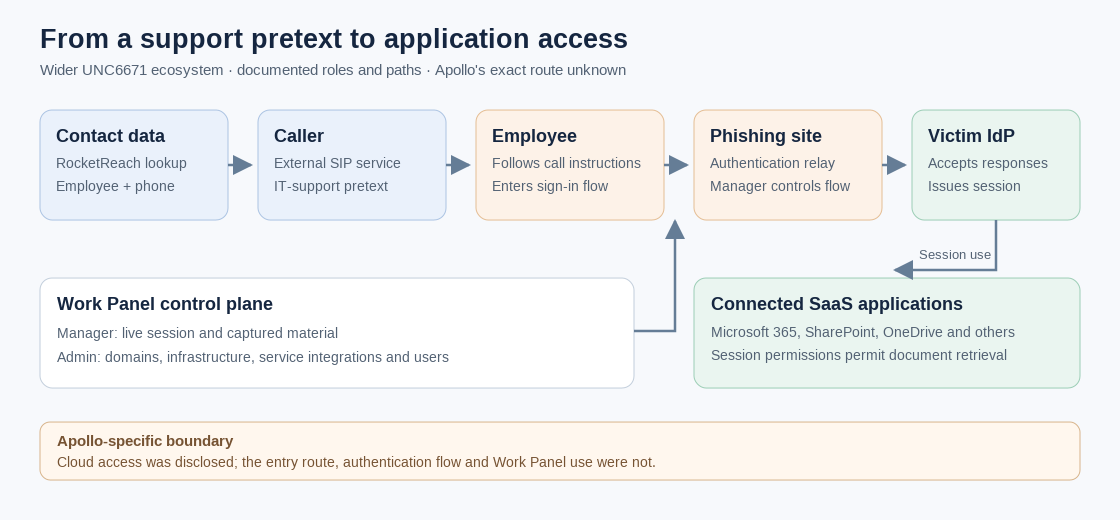
The historical transactions explain how the market developed. The technical architecture explains why the market has something valuable to sell. The recurring problem is that several different meanings of authority can be collapsed into one successful system operation. The documented campaign path begins with contact information, a caller and a spoofed support request. In the Work Panel deployments examined by Okta and GuidePoint, the caller and manager used separate interfaces while a phishing site and authentication relay interacted with the victim’s identity provider. Google’s UNC6671 investigations then observed attacker-controlled sessions reaching connected SaaS applications and retrieving files. These reports describe the wider campaign and its infrastructure; Apollo has not disclosed enough technical detail to establish that this complete path was used in its July intrusion. [2–5][14]
4.1 Technical authorization and legitimate authority are different
Here, technical authorization means a system’s decision to allow an operation under its configured rules and permissions. Legitimate authority means that the person causing that particular operation is entitled to request it in the relevant organizational or business context. A successful technical authorization decision does not, by itself, establish that entitlement. An accepted operation therefore raises three related questions: who authenticated, what the system permits that identity or session to do, and who was entitled to cause the action in its actual context.
The answers can diverge. An administrator may possess the technical permission to change an account’s email address without having legitimate authority to perform that change for a stranger. An employee may possess valid credentials without being authorized to provide an attacker with access to the account. A cloud service may return documents to an authenticated session without establishing that the access serves the account holder’s or employer’s intentions. The attacker exploits these differences.
| Operation | Technical check the system may complete | Legitimate authority left unresolved |
|---|---|---|
| Account recovery | A recovery procedure has been completed | Whether the person requesting recovery is entitled to control the account |
| MFA approval | An accepted authentication challenge was satisfied | Whether the user understood and authorized the underlying access |
| Device-code authorization | A valid user completed the approval flow | Whether the client receiving the token was the one the user intended to authorize |
| SaaS document retrieval | The session possesses permission to read the document | Whether the data access is consistent with authorized business use |
This does not mean technical authentication and authorization are ineffective. It means each mechanism establishes a particular property, not every property that would make an operation legitimate. The attacker has not acquired legitimate authority. The attacker has acquired the ability to control an effect that the system produces under someone else’s authority. “Stolen authority” is shorthand for that mismatch, not a claim that legitimate authority itself was transferred.
4.2 Two directions of social engineering
The 2020–2026 incidents illustrate two important directions of attack. In the first, the attacker impersonates an employee or account owner to persuade a real administrator to change authentication state. This includes help-desk attacks intended to trigger password resets, MFA changes, or recovery procedures. The genuine administrator performs the privileged operation under a false belief about who requested it. In the second, the attacker impersonates an administrator or trusted support function to persuade a real employee to authenticate or grant access.
The genuine employee performs the operation under a false belief about who directed it. These attacks can produce similar outcomes, but they cross the organizational boundary from opposite directions. The first manipulates the person who can modify authority. The second manipulates the person who already possesses it. Both seek to make a legitimate system accept an outcome selected by an unauthorized party.
4.3 Work Panel made the operation divisible
Okta’s July 2026 Work Panel investigation provides unusually concrete evidence of how this capability became an organized service. Work Panel was a multi-tenant application intended for voice-phishing operations. It combined company research, contact lookup, telephone-service configuration, phishing-site deployment, live session management, captured-credential review, and audit logging. [4] It was not simply a cloned authentication page. The platform enforced three distinct roles on the server.
| Role | Operational responsibilities | Access boundary |
|---|---|---|
| Caller | Find assigned contacts and conduct voice-phishing calls | Cannot access captured credentials or other callers’ sessions |
| Manager | Manage callers, monitor active sessions, control authentication-page progression, collect credentials | Controls assigned workforce and captured session data |
| Admin | Configure domains, infrastructure, external APIs, users, and deployment-wide settings | Controls the broader operational platform |
The most revealing feature was the separation between the caller and the captured credentials. The caller could convince an employee to authenticate, but the resulting information was delivered to the manager’s interface. The caller did not receive the authentication credentials and could not inspect the activity of other callers. The manager could control the live authentication flow while the caller maintained the conversation. The administrator could manage the deployment infrastructure and supervise personnel. These were not merely different user-interface views. Okta reported server-side enforcement of the roles. This division served two purposes.
First, it made the activity more operationally efficient. A manager could supervise multiple calls without personally conducting every conversation. Second, it protected the criminal operation against its own workforce. A caller who could not access the credential archive had less opportunity to sell the results to a competitor or use them independently. The platform’s access-control system therefore governed not only the execution of the attack but also control over its output. The attacker was using identity and permission controls internally to acquire the identities and permissions of other organizations.
4.4 Commercial data and services supplied the components
Work Panel incorporated RocketReach, a legitimate commercial B2B contact-data service. A caller could search for a company and retrieve employee contact details, job titles, and professional information. That data helped identify plausible recipients for the help-desk impersonation. [4] The platform also supported the use of external SIP calling services and automated domain deployment. Its administrative functions could interact with NiceNIC for domain registration, Cloudflare for DNS and related infrastructure, and other services used to deploy phishing environments. The operational significance was not that these external providers were part of the criminal organization. They offered legitimate general-purpose services.
The criminal operator connected them into a workflow that produced unauthorized access. Contact data helped select employees, the telephone service carried the call, and the phishing infrastructure presented an interface resembling the organization’s identity system. A manager coordinated the authentication interaction, after which the victim’s identity provider issued a session that the attacker could control. Because these functions could be supplied by different services and workers, no single component needed to contain the entire criminal capability.
4.5 Authentication could succeed while the wrong client received authority
Microsoft’s September 9, 2026 investigation makes the distinction between authentication and authority particularly clear. The researchers investigated several related passkey-themed social-engineering patterns, including conventional adversary-in-the-middle phishing and device-code phishing. Microsoft tracked multiple actors in this wider ecosystem, including Storm-3121 and Storm-3032. [16] In a conventional AiTM operation, the attacker controls a fraudulent authentication interface and relays the user’s credentials or non-phishing-resistant MFA responses to the legitimate service. The resulting session can then be obtained or reused by the attacker. Device-code phishing involves a different operation.
The victim may use the genuine Microsoft authentication page, but is deceived into completing a device authorization flow initiated by an attacker-controlled client. The authentication page is genuine. The user may authenticate successfully. Nevertheless, the resulting token can be issued to the attacker’s client. The problem is not necessarily a counterfeit login page. It is the authorization of the wrong client. This example should not be read as proof that every UNC6671 intrusion used device-code phishing. Microsoft’s September investigation described a wider set of actors and attack patterns.
Its significance is architectural. The operation demonstrates that authenticating the correct user is not sufficient if the system’s authorization workflow can be manipulated into granting access to an unintended party. FIDO2/WebAuthn authentication provides important resistance to conventional phishing proxies by binding authentication to the legitimate relying-party origin. But phishing-resistant authentication and control over client authorization, device enrollment, and account recovery are distinct security properties. Protecting one does not automatically establish the others.
4.6 The acquired session converted into application authority
Google’s UNC6671 investigations also reveal the importance of what happens after authentication. The attackers used compromised cloud sessions to access applications already available to the victim. They searched internal resources for sensitive information and used scripts to automate collection. Google observed direct retrieval of SharePoint file contents through HTTP requests using valid session cookies. Some of these actions appeared as FileAccessed events rather than conventional FileDownloaded events. The distinction affected what defenders could observe.
A security operation that mainly monitored explicit download events might fail to recognize large-scale retrieval through another application path. The application had correctly returned information to a session with the appropriate permissions. But that successful permission check did not establish that the document retrieval represented legitimate business activity. The social-engineering operation had crossed another boundary. The attacker first acquired control over an authenticated session. It then used the application’s normal authorization rules to collect information. The same enterprise integration that made the legitimate user productive could increase the value of a compromised session.
5. The Economics and Organization of the Market
5.1 Different things were being traded
Calling every part of this ecosystem a market for stolen passwords would conceal its actual structure. Several different capabilities were being exchanged. “The market for stolen authority” is an analytical model for several related markets with a common product characteristic: the ability to cause an accepted outcome through someone else’s identity, access, or administrative position. The evidence does not establish one unified exchange, a common owner, or a single supply chain connecting every example.
| Capability | Example | Evidence of commercialization |
|---|---|---|
| Account-state modification | OGUsers account-control offers | Advertised prices and transaction-related communications |
| Insider cooperation | LAPSUS$ recruitment | Public offers to pay employees and suppliers |
| Identity intrusion services | Octo Tempest SIM-swap operations | Microsoft-documented sales to other criminals |
| Extortion infrastructure | ALPHV affiliate operations | Documented cooperation between intrusion actors and RaaS operators |
| Managed phishing operations | Work Panel | Multi-tenant design intended for sale to independent operators |
| Labor for live intrusion attempts | Hired voice-phishing callers | Operator roles and recruitment evidence |
| Monetization of stolen information | UNC6671 and associated extortion brands | Observed extortion activity and cryptocurrency receipts |
The strength of the evidence varies. OGUsers advertisements demonstrate offers and some associated negotiations, not a complete accounting of sales. Microsoft documented actual criminal collaboration and insider recruitment. Okta demonstrated that Work Panel was designed to be sold to multiple operators, but the public investigation did not establish its full customer list, actual contract prices, or total license revenue. The existence of a commercially organized capability is therefore stronger evidence than a claim that every particular transaction can be reconstructed.
5.2 Work Panel governed the ownership of criminal output
The most revealing economic detail in Work Panel was its internal access-control design. Okta found that administrators could inspect operator activity, review audit logs, and monitor callers’ interfaces. The software limited what the workforce could see, including the credentials captured through its activities. The author of the platform had evidently anticipated a problem familiar to legitimate businesses: employees and contractors do not automatically share the owner’s interests. In this case, the problem was acute. The caller might have performed the decisive social-engineering interaction. Yet if the caller could keep the credentials, the caller might independently exploit or resell them. The platform reduced that risk by separating the labor that produced access from control of the resulting information.
The caller performed the persuasive work, while the manager received the captured authentication material and the administrator retained control over the platform and infrastructure. This arrangement made it easier to recruit callers without giving them control of valuable assets. Okta also documented recruitment of fluent English-speaking callers through underground channels, including offers of performance-based payment. The operation had developed mechanisms resembling workforce management, internal supervision, access control, and ownership of production output. The distribution of authority inside the criminal organization had become an explicit software feature.
5.3 Shared infrastructure did not prove shared ownership
GuidePoint’s investigation provided evidence of centralized infrastructure management within part of the UNC6671 ecosystem. It linked phishing domains, a Work Panel backend, SMTP infrastructure, and a probable operator file-storage environment through a common NiceNIC registrant identifier. It also identified related services hosted on Private Layer infrastructure, including several authentication-relay servers and a Nextcloud instance. [5] The suspected use of Nextcloud for internal files was an inference based on the exposed service. GuidePoint did not establish the contents of every repository or the identities of its users.
Nevertheless, the infrastructure was consistent with sustained operational activity. NiceNIC’s own August 18 review added a registrar-side perspective. The company examined 50 domains from Google’s published indicators for which it was listed as registrar. All 50 had been registered through API workflows. By August 18, all were subject to hold status in NiceNIC’s records. [13] NiceNIC also cautioned that automated domain registration is a legitimate practice and that its reviewed records could not support a single reliable response-time calculation across all cases.
These findings establish automation and coordinated infrastructure within observed portions of the campaign. They do not establish that all domains, callers, brands, or payments belonged to a single beneficial owner. A registrar account, an operational deployment, an intrusion team, and an extortion brand are separate objects. The public record does not fully identify the contractual relationships between them.
5.4 Extortion brands became another form of authority
The BlackFile–Redact dispute shows how the same problem of authority appeared within the criminal business itself. A victim considering an extortion payment needs to know whether the negotiating party actually controls the stolen information. The negotiation has an implicit question of authorization: is this person entitled, within the criminal operation, to make the promises and demands being presented? Redact’s introduction of designated messaging identities and a PGP key was an attempt to establish the authenticity of its negotiating position. That does not establish the truth of its allegations against a former affiliate.
It does show that criminal reputation can become an operational asset. The brand communicates an asserted relationship between a negotiator, stolen information, and the capability to disclose or withhold it. If another actor can appropriate the name, that relationship becomes uncertain. Google observed overlapping intrusion infrastructure associated with several brands, while Microsoft separately tracked parts of the wider ecosystem as Storm-3121 and Storm-3032. The evidence supports multiple cooperating, overlapping, or splintered activities rather than one securely identified corporate hierarchy. The ability to perform an intrusion and the authority to negotiate its proceeds could be controlled by different actors.
5.5 Revenue was measurable; distribution was not
Google examined 18 BlackFile-associated Bitcoin addresses receiving 141.65 BTC between January 7 and May 12, 2026. The total represented approximately $10.69 million at the time of the transactions. Some payments continued after BlackFile announced the end of operations under that name. Google also observed initial ransom demands commonly ranging from $1 million to upwards of $3 million, with substantial reductions during negotiations. [2] GuidePoint, working with TRM Labs, independently reported more than $8 million in payments associated with 15 wallets attributed to multiple relevant extortion brands. Its observed average payment was approximately $600,000. [5]
These figures cannot safely be added because the wallet sets and investigative periods may overlap. They demonstrate substantial extortion receipts. They do not establish the operation’s net profit, the compensation of individual callers, the revenue received by Work Panel’s developer, or the final beneficiaries of the payments. This is an important evidentiary limit. A functioning criminal division of labor can be observed without its complete financial accounting becoming public. The technical structure tells us which capabilities were separated. The financial record tells us that the wider activity generated substantial revenue. It does not yet connect each separated capability to a precise share of that revenue.
5.6 Why sophisticated enterprises remained valuable targets
The market was enabled not only by criminal specialization but also by the structure of legitimate enterprise IT. SSO centralizes identity management. SaaS integration allows employees to reach many applications through a common account. Cloud storage and business platforms make information accessible across organizational functions. These are legitimate architectural decisions with substantial operational and security benefits. But they can also concentrate the value of a compromised identity. One authentication session may provide access to multiple applications, depending on the user’s existing permissions. The value of compromising that identity depends on the information and operations available behind it.
Financial institutions are particularly interesting because some employees work with confidential transaction records, investor information, private-company data, and commercially sensitive communications. Not every account has broad permissions, and the available evidence does not establish that the attackers obtained all of these categories of information from the named financial firms. The economic incentive nevertheless becomes clear. A criminal operator who can obtain access to a valuable enterprise identity may be able to acquire information that creates substantial pressure on the organization. The intrusion capability is reusable, while the value of its output varies with the target. A market capable of repeatedly acquiring authenticated access can therefore concentrate on institutions where the expected value of successful access is high.
5.7 The security boundary had been recognized for years
Financial regulators had been warning about these problems long before the August 2026 disclosures. NYDFS investigated the 2020 Twitter incident and documented the role of help-desk impersonation, employee authentication, and privileged administrative access. In September 2024, it warned about attackers impersonating employees to persuade real IT help-desk personnel to reset credentials or change authentication factors. In February 2026, it warned about targeted voice-phishing attacks in which criminals impersonated IT support and directed employees toward fraudulent authentication procedures. [6][15]
The direction of impersonation changed, but the underlying relationship remained. The system recognized a legitimate administrator or user. The attacker manipulated the instructions that person believed they were following. This problem cannot be addressed solely by requiring stronger passwords or adding another generic authentication step. A secure identity architecture must distinguish account recovery, authenticator registration, delegated client authorization, privileged administrative operations, and ordinary application access. Each can establish or transfer different capabilities.
A phishing-resistant authenticator provides an important guarantee about authentication origin. It does not automatically determine whether a separate device-authorization request is legitimate or whether a user is being deceived into changing security settings. Similarly, valid SaaS permissions do not automatically establish the legitimacy of unusual, automated data collection. The practical security question is therefore more specific than whether the employee recognized a suspicious call. It is which operations can create or transfer technical access, what evidence is required to authorize those operations, and how the organization detects when accepted access is used outside its intended purpose.
6. Conclusion — Who Authorized the Authority?
The August 2026 Wall Street campaign was not evidence that criminals had suddenly discovered how to deceive employees over the telephone. It illustrated the maturity of a market that had been developing for years. In the OGUsers era, valuable accounts and the ability to alter their ownership or recovery state became objects of trade. The 2020 Twitter compromise demonstrated how impersonating an internal support function could lead from an ordinary employee’s authentication to privileged administrative control. LAPSUS$ made the recruitment of authorized employees part of its access strategy. Scattered Spider-associated operators developed specialized identity-intrusion capabilities and commercial relationships with other criminal enterprises.
Work Panel organized voice phishing into a managed production process. It separated callers from captured credentials, managers from infrastructure ownership, and deployments from the software used to create them. The Com supplied one social environment in which expertise, reputation, labor, and collaboration could circulate, without requiring every operation to belong to one permanent hierarchy. These developments were not a continuous history of a single group. They were a history of increasingly separable and reusable capabilities. The common object was control over the effects of authority.
Criminals obtained the ability to cause legitimate systems to accept operations that the criminals themselves had no legitimate right to request. An account administrator could change an account’s state. An employee could authenticate. An identity provider could issue a token. A SaaS application could return a document. The systems could perform these operations correctly according to their technical rules. The attack succeeded when the conditions under which those operations were requested no longer corresponded to their intended authority. That distinction also explains why the market could develop without requiring every participant to own or compromise the underlying technology.
A caller did not need to own the identity provider. An access broker did not need to operate the victim’s cloud environment. An extortion negotiator did not necessarily need to perform the original intrusion. The ability to produce a trusted result could be separated from the system that trusted it, and from the person who ultimately profited from it. Modern enterprise infrastructure increased the value of that capability by concentrating information and business operations behind authenticated identities. Criminal specialization reduced the effort required to acquire those identities and exploit their permissions.
The result was an industry organized around making other people’s technically valid access produce outcomes selected by unauthorized actors. In the 2026 campaign, the phone call, authentication relay, cloud session, and extortion operation could each be handled by different people or services, while the exact path into Apollo remained undisclosed. The boundary exposed by the wider campaign is the one between a technically accepted operation and the legitimate authority to cause it. Understanding that boundary is necessary to evaluate what new authentication technology can guarantee, and what still depends on the surrounding authorization workflow.
References
Financial-sector campaign and criminal infrastructure
[1] Reuters. Hackers Targeted US Private Equity, Other Firms Including Blackstone, CME, Data Shows. August 6, 2026.
[2] Google Threat Intelligence Group. UNC6671 Rebrands: Multi-Brand Vishing Extortion Targets Financial Services and Enterprise Cloud Environments. August 6, 2026.
[3] Google Threat Intelligence Group. Welcome to BlackFile: Inside a Vishing Extortion Operation. May 15, 2026.
[4] Okta Threat Intelligence. Behind the Scenes of a Vishing Operation. July 28, 2026.
[5] GuidePoint Security. Bird Watching: Characterizing Falcon-branded Extortion Operations. August 2026.
The development of markets for account control and enterprise access
[6] New York State Department of Financial Services. Twitter Investigation Report. October 2020.
[7] Brian Krebs. Twitter Hacking for Profit and the LoLs. July 2020.
[8] Microsoft Security. DEV-0537 Criminal Actor Targeting Organizations for Data Exfiltration and Destruction. March 22, 2022.
[9] Microsoft Threat Intelligence. Octo Tempest Crosses Boundaries to Facilitate Extortion, Encryption, and Destruction. October 25, 2023.
[10] U.S. Department of Justice. British National Pleads Guilty to Hacking into Companies and Stealing at Least $8 Million in Virtual Currency. April 17, 2026.
Criminal networks, institutions, and authorization boundaries
[11] FBI Internet Crime Complaint Center. The Com: Theft, Extortion, and Violence Are a Rising Threat to Youth Online. July 23, 2025.
[12] Palo Alto Networks Unit 42 and RH-ISAC. Extortion in the Enterprise: Defending Against BlackFile Attacks. April 23, 2026.
[13] NiceNIC. Security Review of 50 Domains Identified in Google Threat Intelligence’s UNC6671 Report. August 18, 2026.
[14] Reuters. Apollo Global Reveals Data Breach After Hackers Target Financial Firms. August 21, 2026. See also the California Attorney General’s listing of Apollo Management Holdings’ breach notification.
[15] New York State Department of Financial Services. Cybersecurity Threat Alert — Social Engineering of Institutions’ IT Help Desk Personnel, September 27, 2024; and Cybersecurity Advisory — Targeted Vishing Attacks, February 6, 2026.
[16] Microsoft Security Research. Passkey-themed Social Engineering Leads to Identity and Cloud Compromise. September 9, 2026.
Evidentiary Scope
This investigation relies on publicly available incident reports, court records, regulatory investigations, registrar disclosures, and threat-intelligence research as of October 13, 2026.
The list of financial institutions targeted in August 2026 does not establish that every named organization was compromised. Apollo’s confirmed cloud intrusion has not been publicly linked conclusively to a specific UNC6671 extortion brand or a complete technical attack sequence.
The cases involving OGUsers, LAPSUS$, Scattered Spider, The Com, and UNC6671 demonstrate recurring mechanisms, overlapping criminal environments, and documented commercial relationships. They do not establish a continuous chain of personnel or centralized leadership across all the groups.
Unit 42’s association of overlapping BlackFile activity with The Com is an assessment made with moderate confidence, not a judicial finding that The Com directed the Wall Street campaign.
The Work Panel role model is documented by Okta, and GuidePoint identified relevant infrastructure in the UNC6671 ecosystem. This does not identify every user of the software or establish the contracts between its developer and individual operators.
Observed cryptocurrency receipts establish that substantial funds entered wallets associated with the extortion activity. They do not establish the profit margin of the operation or identify the distribution of proceeds among callers, administrators, affiliates, developers, and negotiators.
The article’s central claim concerns the increasing commercialization and division of capabilities for producing authorized outcomes within legitimate systems. It does not assume that every capability was sold through the same market or that every participant belonged to the same organization.