How Alpine Linux updated GitLab without fixing its Ruby runtime—and used independent build records to establish the integrity of its releases.
Incident Analysis · GitLab · Ruby · Software Supply Chain · Build Infrastructure
Analysis based on publicly available evidence as of November 3, 2026.
Abstract
On October 20 and 21, 2026, an attacker attempted to exploit CVE-2026-97229 against the GitLab instance operated by Alpine Linux. The attack caused eight worker crashes, four of which indicated that the exploit had progressed partway through its execution chain. Although Alpine found no evidence that arbitrary code execution succeeded, incomplete logs prevented it from ruling out that possibility, leading the project to rebuild its GitLab server.
GitLab had released a fix on October 12, but Alpine initially installed an unpatched version. Even after upgrading to GitLab 19.3.6 on October 22, the vulnerability remained because the underlying defect was in Ruby’s Onigmo regular-expression engine. GitLab had patched the Ruby interpreter bundled with its official distributions, whereas Alpine’s independently built container used the distribution’s standard Ruby package. The product version had changed without the necessary correction reaching the executable runtime.
The possible compromise of Alpine’s source-management server also raised a separate question about the integrity of its distribution. Alpine compared source commits against records outside GitLab, including an independent developer clone and 45 package builders, and verified packages and stable releases produced during the initial attack period. Its package-signing keys were not stored on the GitLab server, allowing the project to assess its released software separately from the uncertain security state of the server.
This incident reveals a distinction within software supply chains that version numbers and signatures alone cannot resolve. A correction can exist in an upstream release without being incorporated into a downstream executable, while a potentially compromised source-management system can still leave enough independent evidence to verify particular released artifacts. This analysis reconstructs the failed patch propagation, the technical vulnerability, and the build and distribution systems that determined what Alpine could establish after the attack.
1. Incident Overview
Alpine Linux operates gitlab.alpinelinux.org as part of the development infrastructure for its Linux distribution. The service hosts source repositories, merge requests, issue discussions, and CI/CD workflows, including development activities associated with aports, the repository containing the package recipes from which Alpine’s software distribution is built.
On October 20, 2026, an attacker registered an account and began probing the GitLab service. The principal attack occurred the following day, when malicious CI configurations triggered eight GitLab worker crashes accompanied by HTTP 502 errors and failed CI jobs. Alpine determined that four of the crashes represented attempts that had progressed through part of the exploitation process before failing at a subsequent stage. The attacker also downloaded Alpine’s custom GitLab container image, which Alpine interpreted as a possible attempt to adapt the exploit to its particular runtime environment. [1]
The affected server was running GitLab 19.3.4, which lacked the October 12 correction for CVE-2026-97229. Alpine upgraded to 19.3.6 on October 22, but discovered four days later that the vulnerability remained present. The reason was not an overlooked change to GitLab’s application code: the security correction had been incorporated into the Ruby interpreter distributed with GitLab’s official packages, while Alpine’s custom image continued to depend on its separately maintained Ruby package.
Alpine found no evidence that the attacker’s code had executed successfully. The retained logs did not show private information being returned through web or API requests, and investigators found no unexpected files, processes, hooks, or keys. However, some background-job records and the former container filesystem were unavailable, and neither Alpine nor its hosting provider retained the outbound network connection records necessary to establish whether an attacker-controlled process had communicated externally. Successful exploitation could also have left no worker crash. [1]
The project therefore treated the server as potentially compromised rather than interpreting the absence of evidence as proof of safety. On October 27, it restricted GitLab access and began rebuilding the service on a new server. By October 29, GitLab had reopened on version 19.3.7 with Ruby 3.3.13; the recovery also involved replacing internal secrets, resetting passwords and two-factor authentication, invalidating access tokens, and requiring project maintainers to renew sensitive integration credentials. [2]
The incident contained two separate security problems. One was the attempted exploitation of a native memory-corruption vulnerability in a production service. The other was determining whether that potentially compromised service had affected the source code and distribution artifacts used by a substantially larger population of Alpine users.
Here, the software supply chain is the sequence of handoffs that turns source changes into running services and software delivered to users. One path carried Ruby’s regular-expression compiler fix toward Alpine’s GitLab container; another carried Alpine’s aports recipes through package builders, release archives, and the Docker Official Images process. The incident tested whether the fix actually crossed the first path and whether records outside GitLab could establish what had crossed the second.
2. Timeline — Three Independent Patch Schedules
The sequence of events is easier to understand when the activities of Ruby, GitLab, and Alpine are considered separately. Ruby developed corrections for the regular-expression compiler, GitLab incorporated selected fixes into its bundled interpreter, and Alpine maintained its own package and container release process.
| Date | Event | Significance |
|---|---|---|
| September 25 | Ruby’s regular-expression compiler correction was merged upstream | The relevant source-level fix was available |
| Early October | GitLab backported Ruby compiler fixes into its packaging | GitLab’s official runtime acquired corrections independently of a new Ruby maintenance release |
| October 12 | GitLab published fixed versions, including 19.3.5 | CVE-2026-97229 was addressed in official GitLab packages |
| October 13 | Alpine installed GitLab 19.3.4 | The deployed environment remained vulnerable |
| October 20–21 | The attacker submitted malicious CI configurations | Eight workers crashed; four attempts progressed partway through exploitation |
| October 22 | Alpine upgraded to GitLab 19.3.6 | The standard Ruby runtime remained unpatched |
| October 23 | Ruby released 3.3.13, 3.4.12, and 4.0.9 | Upstream maintenance releases incorporated the relevant fixes |
| October 24 | Alpine completed its initial artifact-integrity checks | External source and build records supported verification of specified releases |
| October 26 | Alpine discovered the vulnerability remained | The failed transfer of the Ruby correction became apparent |
| October 27–30 | GitLab was closed, rebuilt, and reopened | The service and associated credentials were replaced |
Sources: Alpine’s incident report, GitLab release announcements, Ruby’s security statement, and upstream source history. [1][2][3][4][5]
One detail complicates the first upgrade. A CERT-EU advisory published on October 12, citing GitLab’s release notice, listed 19.3.4 as the corrected release for the 19.3 branch. GitLab’s current announcement instead identifies 19.3.5 and explains that 19.3.4 had a separate bug affecting merge request pages when the Ona integration was enabled. These public records conflict on the corrected 19.3-branch version; they do not show whether GitLab revised its notice or CERT-EU misstated it. [4][18]
Alpine acknowledged installing 19.3.4 in error, but the available evidence does not establish whether CERT-EU’s version list influenced that decision. This initial selection problem differs from the October 22 failure: the later upgrade installed GitLab 19.3.6, while Alpine’s separately supplied Ruby runtime still lacked the compiler fix.
A second complication emerged when Alpine republished its own GitLab container. According to its incident report, the alpinelinux/gitlab:19.3.6 image published on October 27 contained Ruby 3.3.13, whereas copies of the same tag obtained before that date remained vulnerable. Thus, two images identified by the same GitLab version and container tag could contain different security-relevant code. [1]
The resulting timeline cannot be represented by a single sequence of product-version numbers. The correction existed in Ruby’s source history, entered GitLab’s distribution through a backport, and reached Alpine’s runtime through a later, separate package update.
3. How the Fix Failed to Reach Alpine
3.1 GitLab fixed the runtime it distributed
CVE-2026-97229 concerns the compilation of regular expressions supplied through GitLab CI configuration. Under particular conditions, specially constructed expressions could corrupt memory in Ruby’s Onigmo engine and lead to arbitrary code execution within the GitLab server. GitLab assigned the issue a CVSS 3.1 score of 10.0 and provided corrected releases on October 12. [4]
The relevant correction was developed in Ruby’s upstream repository and subsequently backported into GitLab’s own Ruby builds. GitLab’s Cloud Native GitLab project recorded patches for the Ruby 3.3 and 3.4 branches, together with checks that the resulting binaries contained the compiler changes. The backport allowed GitLab to distribute a corrected Ruby interpreter without waiting for the next upstream Ruby maintenance release. [7]
Consequently, an interpreter reporting Ruby 3.3.12 could be patched or unpatched depending on the package’s build history. The version string identified the upstream release used as a starting point, but it did not identify the additional corrections applied by GitLab’s packaging process.
This distinction is particularly important for software built from source or assembled into custom containers. GitLab’s release designation described the security state of its own supported distribution artifacts, not every possible combination of GitLab application code and an externally supplied interpreter.
3.2 Alpine built Ruby independently
Alpine’s standard Ruby package is defined in aports through an APKBUILD recipe that fetches an upstream Ruby source archive, checks its expected hash, applies distribution-specific patches, and builds the resulting package. It is not generated by GitLab’s CNG or Omnibus packaging systems.
The October 22 GitLab upgrade therefore did not automatically incorporate the Ruby compiler corrections that GitLab had applied to its bundled interpreter. Alpine’s application code and Ruby runtime were maintained through different build processes, even though both components were necessary for the running GitLab service.
Alpine’s package history makes the later correction identifiable. On October 26, commit 7e185fba upgraded the Edge Ruby package to 3.4.12 and recorded several security fixes, including CVE-2026-97229. The relevant older branches received Ruby 3.3.13 or 3.4.12 according to their supported Ruby series. [8]
The distinction between upstream versions and backports also appears in vulnerability identification. Ruby’s October 23 announcement mapped four GitLab CVEs to three Ruby source changes:
| GitLab vulnerability | Underlying Ruby defect | Ruby change |
|---|---|---|
| CVE-2026-89078 | Double free during regular-expression parsing | #13332 |
| CVE-2026-93577 | Integer overflow in compiled-pattern size | #19020 |
| CVE-2026-97229 | Integer overflow in GitLab CI regular-expression compilation | #19020 |
| CVE-2026-110264 | Overflow of internal identifiers with large repetitions | #16801 |
CVE-2026-93577 and CVE-2026-97229 thus correspond to the same underlying Ruby correction, while other GitLab disclosures depended on different patches. Ruby also explained that it had not initially requested separate Ruby CVE identifiers, citing an unresolved question about whether its regular-expression compiler was expected to handle attacker-controlled input safely. [3]
For a downstream maintainer, the practical problem was determining which source corrections were required, which packages carried them, and whether those packages were the ones actually executed. The GitLab application release number, the Ruby interpreter’s version string, and the CVE identifiers did not individually answer those questions.
The October 22 upgrade failed at precisely that point: GitLab’s required compiler correction existed, but Alpine’s running interpreter did not contain it.
4. Inside the Ruby Regular-Expression Compiler
4.1 The application validated one representation, then Ruby compiled another
Rapid7 independently developed a working exploit for CVE-2026-97229 against an unpatched official GitLab 19.4.1 CE image. Its reproduction showed how a malicious CI configuration could reach Onigmo’s vulnerable compiler and ultimately execute commands under the GitLab git operating-system account. This demonstrates the vulnerability’s technical exploitability, but does not establish that the attacker targeting Alpine used the same method or achieved the same result. [6]
Rapid7’s demonstrated route required the attacker to place both the malicious CI configuration and a specially named repository path on a public branch, which required project write access. A subsequent CI lint request could then select that branch and trigger evaluation without authentication. GitLab rated the vulnerability as requiring no privileges, but Rapid7 could not establish an attack route without the setup privilege from its public reproduction; the original vulnerability report remained private. Alpine’s attacker had registered an account and submitted malicious CI configurations, but the available incident evidence does not identify the exact project permissions or trigger used in those attempts. [1][4][6]
The relevant GitLab functionality evaluates regular expressions against repository file paths as part of CI rule processing. GitLab applied several checks to the submitted expression, including restrictions on source length, repetition structure, and compiled program size. However, the validation did not cover every representation that Ruby could subsequently generate.
Rapid7 found that an inline regular-expression comment could prevent GitLab’s source-level scanner from recognizing a large repetition count. The malicious pattern could therefore pass the application’s initial restrictions while remaining short enough to satisfy its source-length checks. When matching began against a repository path containing certain UTF-8 characters, Ruby recompiled the expression for UTF-8, expanding POSIX character classes into a substantially larger internal representation.
The critical point was the separation between validation and execution. GitLab had examined the source expression and an initially compiled form, but the later UTF-8 compilation created a different internal program whose size was not subject to the same application-level checks.
4.2 The integer overflow had a concrete size threshold
Rapid7’s reproduction provides a precise example. After UTF-8 expansion, the repeated body occupied 37,151 bytes, while the repetition count was 57,805. Their product was:
That value exceeds the maximum signed 32-bit integer, 2,147,483,647, by 29,908 bytes.
The vulnerable Onigmo code used a multiplication when deciding whether a repeated expression was small enough to expand into generated instructions. When the signed arithmetic overflowed, the result could appear to satisfy the compiler’s expansion condition, causing it to generate a program much larger than the condition was intended to permit.
The essential decision was equivalent to:
(tlen + SIZE_OP_PUSH) * qn->upper
    <= QUANTIFIER_EXPAND_LIMIT_SIZE
The correction in Ruby PR #19020 replaced the multiplication-based bound test with an overflow-resistant comparison using division:
#define IS_EXPAND_LIMIT_OK(tlen, n) \
  ((n) <= 0 || \
   (tlen) <= QUANTIFIER_EXPAND_LIMIT_SIZE / (n))
The patch also introduced an upper bound on compiled-program size, preventing internal instruction offsets from exceeding the numerical ranges on which later compiler operations depended. This limit was approximately 512 MiB for the relevant signed-integer representation. [6][9]
Rapid7 traced how this size error became code execution in its test image. The overflow also distorted the destination of a jump in the generated regular-expression program. Rather than skipping an alternative, the Onigmo VM jumped into a character-class bitmap whose bytes the attacker had shaped through the expression. Data meant to describe a character class was then interpreted as VM instructions. [6]
Those controlled instructions manipulated the VM’s saved backtracking state and used a pointer into Ruby’s native code to redirect the matcher’s return through a command-execution path. Rapid7 observed the resulting command running as GitLab’s git operating-system user. That service identity was distinct from an ordinary GitLab login and did not itself establish administrator control of Alpine’s builders or possession of its distribution-signing keys. This is an explanation of Rapid7’s laboratory exploit, not evidence that Alpine’s attacker reached the same control-flow transition or any further system. [1][6]
The failure was therefore not merely an expensive regular-expression match. It broke the compiler’s size assumptions and allowed generated data to cross into VM instruction execution in Rapid7’s reproduction. Ruby explicitly stated that Regexp.timeout did not protect against these defects because the dangerous operations could occur during compilation, before the matching timeout provided any protection. [3][6]
The boundary is consequently more specific than a general warning against accepting untrusted regular expressions. An application can restrict which inputs it accepts, but the language runtime must still maintain the validity of its own internal structures as it transforms those inputs. In this case, the combination of an application-level validation gap and a native compiler defect made remote code execution possible.
Alpine’s custom deployment retained the compiler defect even after the GitLab application update, so the application’s corrected release designation did not accurately describe the security of the runtime performing the operation.
5. Alpine’s Build and Signing Infrastructure
5.1 The official build path is separate from GitLab CI
The significance of the possible GitLab compromise depends on Alpine’s distribution architecture. The project does not simply build and publish all official packages inside the GitLab CI workers that process ordinary merge requests.
Alpine’s historical production system uses dedicated builders coordinated by aports-build. Each builder maintains a local package repository for its assigned architecture and release, while completed packages are synchronized to dl-master.alpinelinux.org, the central Tier 0 distribution server. From there, three geographically distributed Tier 1 servers and the wider mirror network distribute packages to users. Alpine documented this architecture in its 2024 post-mortem concerning a separate repository-synchronization failure. [10]
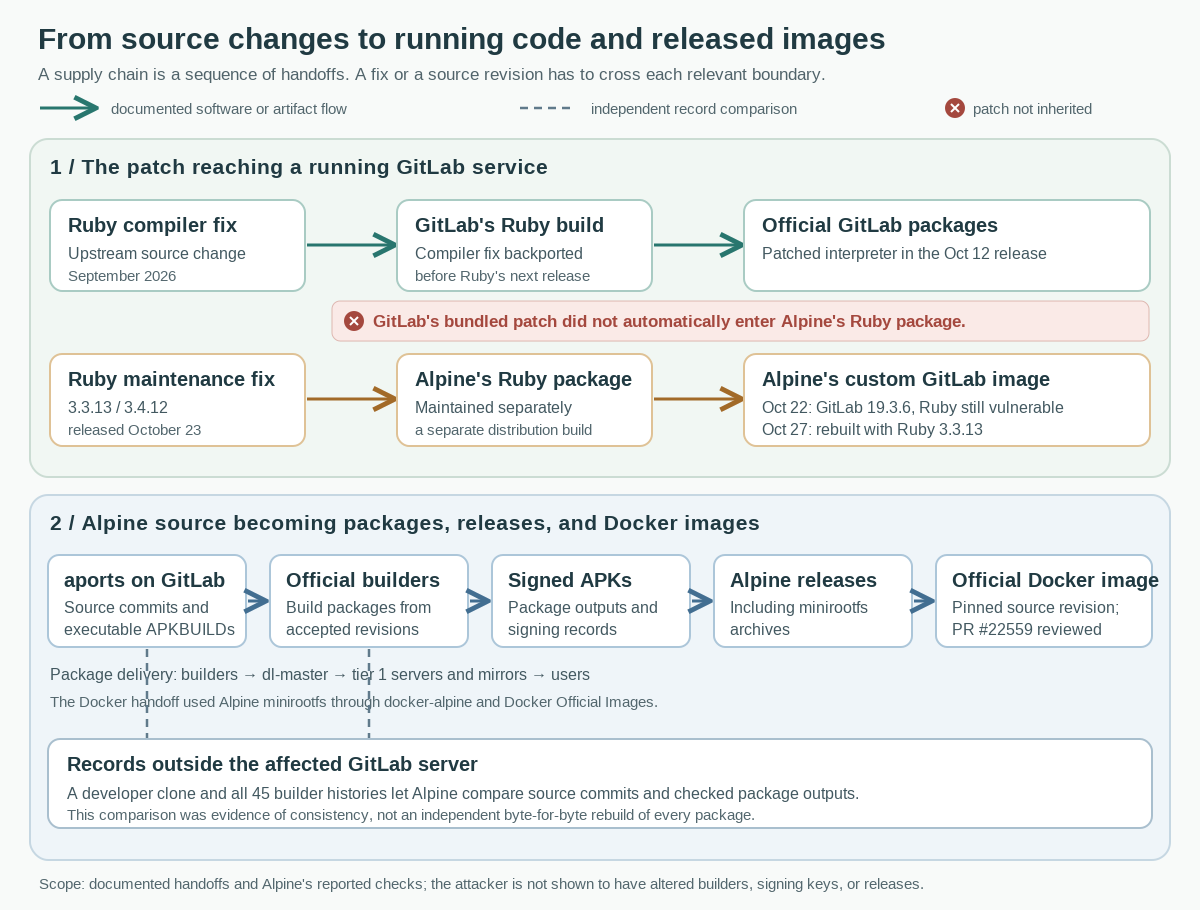
Figure 1 puts the two handoff paths beside one another. The upper path shows why a corrected GitLab release did not itself correct Alpine’s separately supplied Ruby. The lower path follows aports into packages, releases, and Docker’s pinned image source. Its dashed lines represent Alpine’s later comparison with developer and builder records; those records were evidence for checking the production path, not another way to produce packages.
The publicly available aports-build 1.6-series implementation shows a builder following a configured Git branch, retrieving changes, and invoking buildrepo to determine which packages require rebuilding. The buildrepo implementation changes into each selected package’s directory and invokes abuild -r -m; abuild then resolves and sources that directory’s APKBUILD as shell code. These are distinct steps connecting accepted source history to commands executed in the build process. [11][12][19]
Three operations illustrate the relationship between source management and package production:
# aports-build: obtain the configured source branch
git checkout "$git_branch"
git pull || return 1

# abuild: load the package recipe
. "$APKBUILD"

# abuild: sign the generated control archive
abuild-sign -q control.tar.gz
The middle operation is particularly important. An APKBUILD is a shell program containing functions used to prepare, build, test, and package software; it is not merely a passive manifest describing a source archive. Once a recipe has been accepted for a build, its instructions become executable operations within the builder’s environment. [11][12][19]
This does not establish that a GitLab compromise would automatically compromise the official builders. An attacker would first need to cause an unauthorized source change to be accepted into the branch or revision those builders consumed, overcoming whatever repository and operational controls governed that process.
Nevertheless, the code identifies the relevant dependency: the security of a builder executing trusted recipes rests partly on the legitimacy of the source history it accepts. Simply placing a builder on a different machine from GitLab does not independently authenticate every change entering that builder.
5.2 Package signatures authenticate outputs, not every upstream decision
Alpine’s abuild process records metadata about the package and its origin, including a Git commit associated with the recipe’s directory. It also calculates a hash of the package data and signs the control archive. The recorded commit generally identifies the last change affecting the package directory, rather than the complete repository state at build time. [12]
These records provide useful evidence for connecting a binary package to a source revision. However, the commit value is generated by the build environment, and the package signature authenticates the resulting package according to the configured signing authority. Neither independently proves that the source change was properly authorized or that every build dependency behaved as intended.
Alpine explicitly stated that the keys used to sign its official packages and releases were not, and had never been, stored on the affected GitLab server. This was an important protective boundary: the possibility of executing code on GitLab did not by itself imply possession of the distribution’s signing keys. [1]
The public production configuration does not establish whether every official builder separated recipe execution from access to signing credentials through an additional host, user, or service boundary. That question should not be resolved by assuming that all builders used a particular generic abuild configuration.
The distinction matters because source authorization and package signing address different stages. A valid signature can authenticate an artifact produced by a legitimate signing process without independently proving that every source change entering that process was intended.
5.3 The earlier distribution failure illustrates the scope of publishing authority
A different Alpine incident in October 2024 provides a useful comparison. An architecture-detection failure left the architecture variable empty in aports-build, causing an rsync operation to target a broader directory than intended. Its deletion behavior consequently removed packages for other architectures from the central Edge repository, with the changes propagating to mirrors. Alpine restored the missing repositories from the builders and added a check that stopped synchronization when the architecture was empty. [10]
This was an availability incident rather than a source-code compromise, and it had no established causal relationship with the October 2026 attack. Its relevance is that it exposed the authority exercised by production builders: beyond executing package recipes, they could change the contents of the central distribution repository.
The two incidents therefore illuminate different boundaries within the same infrastructure. In 2024, an incorrect publication target allowed a legitimate builder to affect unrelated repositories. In 2026, a potential compromise of source management required Alpine to establish whether the source revisions accepted by its builders remained legitimate.
Both cases make the actual permitted operations of the production infrastructure more important than the mere existence of separate servers.
6. How Alpine Verified Its Distribution
6.1 Evidence existed outside the potentially compromised server
When Alpine investigated the October attack, it could not use GitLab’s own current database as conclusive evidence that the server’s source history had remained unchanged. If arbitrary code execution had succeeded, an attacker might have been able to alter repository content or associated records, depending on the privileges obtained.
Alpine therefore examined records that were not controlled by the affected server. For aports commits added from October 20 through 22, it verified that each arrived through a recorded push by a known developer, then compared that history with an independent developer clone and records retained by all 45 package builders. According to the official report, these external records were outside the attacker’s reach. [1]
The investigation also traced packages built from October 20 through 24 across all architectures to the verified source commits. The four stable releases published on October 21—Alpine 3.21.9, 3.22.7, 3.23.7, and 3.24.3—were reported to derive from the same verified history. Their release artifacts included ISO images and minirootfs archives subsequently used in official Alpine Docker images.
The verification was possible because the source-management server was not the only location where evidence of accepted source history and resulting builds existed. Local Git repositories and package-builder records provided a basis for comparison that did not depend entirely on reconstructing the potentially compromised GitLab host.
6.2 The release tags themselves were not signed
An additional examination of the public aports Git objects shows that the four October 21 stable-release tags were annotated but not cryptographically signed. GitHub’s tag-object API reports verification.reason: unsigned and no signature for each of v3.21.9, v3.22.7, v3.23.7, and v3.24.3; the four individual records are linked in [13].
The tags identified release commits, but their author and tagger metadata did not constitute independent cryptographic evidence that an authorized maintainer had approved those revisions. A Git object hash establishes the identity of the referenced content, while a valid signature from an independently trusted key would establish an additional relationship between that content and the signing authority. [13]
This finding helps explain Alpine’s announced plan to introduce signed release tags so that releases could be verified independently of GitLab. It does not mean that the published ISO images or APK packages lacked signatures: those artifacts are authenticated through separate signing mechanisms. The missing property was an independently verifiable cryptographic authorization attached directly to the release’s source revision.
Nor would signed tags alone necessarily provide a complete account of software provenance. Builders would need to verify those signatures against trusted keys, and the relationship between the authorized source revision, build inputs, and output artifact would still need to be established.
6.3 The conclusions have different evidentiary limits
Alpine’s initial checks were performed on October 24, covering commits added October 20–22 and packages built through October 24. Since the GitLab server remained vulnerable until October 27, Alpine said it was extending the same verification through that later date. The official incident and recovery notices examined for this analysis do not contain an equally detailed completion statement for the extended period. [1][2]
This limitation should not be confused with evidence of tampering. Alpine reported that its inspected artifacts were intact, while the public documentation provides a narrower account of the period for which those checks had been completed.
A separate limitation concerns the type of assurance supplied by independent records. Matching package metadata and source commits with retained developer and builder histories provides evidence about consistency and provenance, but it does not necessarily amount to byte-for-byte reproduction of each package from independently reconstructed build environments.
Similarly, several builders agreeing on a source revision is valuable evidence against later alteration of GitLab’s history, but it would not by itself reject a malicious change that all of those builders had accepted before preserving their records.
Within those limits, Alpine’s investigation established a meaningful distinction: the GitLab server required replacement because investigators lacked sufficient evidence to exclude compromise, whereas the checked distribution artifacts could be evaluated using evidence preserved outside that server.
7. From Alpine Releases to Docker Official Images
The October 21 releases also entered another organization’s software publication process. The official Docker alpine image is constructed from Alpine’s minirootfs archives, through the alpinelinux/docker-alpine repository and the Docker Official Images project.
For Alpine 3.24.3, the Docker source repository recorded the minirootfs files, their SHA-512 hashes, and architecture-specific Dockerfiles in commit 5aec467fb81238bae9441eea2edb000655d7044f. The x86_64 Dockerfile constructed its filesystem directly from the corresponding Alpine minirootfs archive, using FROM scratch and adding the tarball to the image.
At 22:09 UTC on October 21, Natanael Copa opened Docker Official Images PR #22559, proposing to replace the previous Alpine 3.24.2 source revision with the new 3.24.3 revision. Docker maintainer yosifkit approved the change at 22:16 UTC, and the PR was merged at 22:17 UTC. The substantive change to library/alpine updated the version tags and pinned Git commit. [14][15]
This was an identifiable downstream approval by a maintainer outside the Alpine project. The public PR establishes that Docker’s official image definition was deliberately updated to use a particular Git revision, but it does not document an independent examination of all upstream Alpine package builds or the 45 builders involved in Alpine’s later incident investigation.
The docker-alpine preparation scripts also show what was checked at the input boundary. They retrieve minirootfs archives using Alpine’s release metadata and compare the downloaded files against the published SHA-512 values. The examined scripts do not verify the detached OpenPGP signatures available for Alpine’s minirootfs archives. [16]
That distinction requires careful interpretation because the minirootfs itself was generated from Alpine packages installed through apk, which uses the distribution’s package-signing trust model. Docker’s checksum verification was not the only protection in the overall production chain, and its absence of a direct GPG verification step does not establish that the resulting image was unsafe.
The relevant difference is what each stage actually authenticated. Alpine’s package signatures authenticated packages under Alpine’s signing keys; its release signatures could authenticate particular release archives; Docker’s checksum check identified the downloaded archive relative to the published metadata; and the Docker Official Images review authorized a pinned source revision for downstream construction.
These operations were related, but the approval at one stage did not automatically prove every upstream fact. In particular, a checksum obtained from the same distribution channel as the file it identifies does not independently establish who authorized that file, even though it helps detect discrepancies between the file and its recorded metadata.
The public evidence nevertheless supports the integrity of the October 21 releases within the scope of Alpine’s completed checks. There is no finding that the attacker altered the minirootfs consumed by Docker. What the downstream records add is a precise account of how an Alpine release moved from its own build and publication infrastructure into another organization’s reviewed, version-pinned distribution process.
The case therefore extends beyond one GitLab instance without requiring a claim of downstream compromise. A Linux distribution’s source-management and build systems produce artifacts that become inputs to other software suppliers, and each subsequent handoff creates its own evidence of content, authorization, and origin.
8. Conclusion — The Patch and the Proof
GitLab had incorporated the Onigmo correction into the Ruby interpreter distributed with its official products, but Alpine maintained a different runtime through its own package and container-building process. Updating the GitLab application therefore left the vulnerable compiler in place. Even after the correction eventually reached Alpine’s container, the same 19.3.6 tag could refer to images with different security properties depending on when they had been obtained.
The subsequent investigation confronted a different problem. Alpine could not establish that its GitLab server had resisted exploitation, but it could examine source commits and packages against independent records held by developers and builders. The fact that the signing keys were outside the GitLab server limited one direct consequence of a potential compromise, while the externally preserved histories made it possible to test whether the verified releases corresponded to the expected source revisions.
Alpine’s response addressed both sides. Its announced improvements included checking security updates for patches to external components used in custom builds, retaining additional operational logs, and introducing signed release tags that could be verified independently of GitLab. In this case, those changes target the precise gaps the investigation exposed: a correction absent from the running Ruby and release verification that had to rely on records outside the affected GitLab server. [1]
Sources
[1] Alpine Linux — GitLab security incident: attempted exploitation of CVE-2026-97229 (October 28, 2026). Official incident reconstruction, attempted exploitation, patch propagation, artifact-integrity checks, and remediation plans.
[2] Alpine Linux — GitLab is back: what you need to do (October 30, 2026). Rebuild, credential reset, and recovery procedures.
[3] Ruby — Regexp compilation fixes related to GitLab’s CVEs (October 23, 2026). Ruby fixes, CVE mappings, affected use cases, and maintainer statements.
[4] GitLab — Critical Patch Release: 19.4.2, 19.3.5, 19.2.8 (October 12, 2026). CVE-2026-97229, affected versions, and corrected release information.
[5] GitLab — Critical Patch Release: 19.5.1, 19.4.3, 19.3.6 and related versions (October 21, 2026). Subsequent security updates and bundled Ruby corrections.
[6] Rapid7 — GitLab CI/CD Regex Integer Overflow: Technical Analysis (October 2026). Independent exploit reproduction, project-write prerequisite, unauthenticated CI lint trigger, and the transition from an overflowed VM jump to native code execution.
[7] GitLab Cloud Native GitLab — Merge Request !3129. Ruby compiler patch backports and build validation.
[8] Alpine aports — main/ruby: security upgrade to 3.4.12, commit 7e185fba. Distribution Ruby update and recorded CVE corrections.
[9] Ruby — Pull Request #19020. Overflow-resistant compiler bounds and generated-program size limits.
[10] Alpine Linux — Post-mortem: Missing Edge Packages on Mirrors (October 28, 2024). Official builder and mirror architecture, previous synchronization failure, and recovery.
[11] Alpine aports — aports-build, 1.6-series source. Git retrieval, package-build coordination, and publication.
[12] Alpine abuild 3.17.0 — abuild.in. Executable package recipes, build metadata, package generation, and signing operations.
[13] Alpine aports — October 21 annotated tag objects: v3.21.9, v3.22.7, v3.23.7, and v3.24.3. Each GitHub tag-object record identifies its target commit and reports verification.reason: unsigned with no signature.
[14] Alpine docker-alpine — Commit 5aec467. Alpine 3.24.3 minirootfs content used in the Docker image build.
[15] Docker Official Images — Pull Request #22559 (October 21, 2026). Docker source revision update, maintainer approval, and merge history.
[16] Alpine docker-alpine — Release retrieval and validation scripts. Checksum verification and Docker release preparation; see also fetch-latest-releases.lua.
[17] The Hacker News — Attacker Tried to Exploit Alpine Linux’s GitLab (October 2026). Contemporary reporting on GitLab’s corrected release version and the custom-Ruby deployment issue.
[18] CERT-EU — Critical Vulnerability in GitLab CE and EE (October 12, 2026). Contemporaneous advisory citing GitLab’s release notice and listing 19.3.4 before the current notice identified 19.3.5.
[19] Alpine lua-aports — buildrepo.lua at commit 827cb09. The package-directory handoff and invocation of abuild by buildrepo.
Evidentiary Scope
This article distinguishes the following findings and limitations:
Attempted exploitation, not confirmed intrusion. Alpine documented malicious requests, eight worker crashes, and evidence that several attempts progressed partway through exploitation. It did not confirm arbitrary code execution or data exfiltration, and missing operational records prevent a definitive conclusion that neither occurred.
Confirmed patch-propagation failure. Alpine explicitly documented that updating GitLab to 19.3.6 left its custom deployment vulnerable because the Ruby interpreter was separately supplied. GitLab’s backport records and Alpine’s Ruby package history provide independent technical context for that failure.
Independent technical reproduction. Rapid7 demonstrated code execution against an unpatched official GitLab image. Its results explain a technically viable exploitation path, but are not evidence that the same payload succeeded against Alpine.
Artifact verification with a documented time limit. Alpine reported verifying October 20–22 source additions and packages constructed through October 24 using evidence outside GitLab, including records from 45 builders. It stated that verification would be extended through October 27, but the examined public notices do not give the same detailed completion account for that later period.
Production infrastructure limitations. The reviewed aports-build 1.6-series and abuild 3.17.0 sources explain relevant build, signing, and publication operations. They do not establish every host-specific authorization control used by Alpine’s production builders, nor do they fully characterize the newer 1.7-series implementation.
Signing and downstream approval. Alpine confirmed that its official package and release signing keys were not stored on GitLab. The reviewed Docker records establish a pinned source revision and a separately approved downstream release change, but do not demonstrate a complete independent audit of Alpine’s upstream build environment.
No evidence reviewed for this analysis establishes that the attacker compromised Alpine’s package builders, stole official signing keys, or modified the distribution artifacts examined by Alpine. The confirmed findings are the attempted GitLab exploitation, the failure to propagate the Ruby correction into Alpine’s deployment, and the existence of independent records supporting Alpine’s specified artifact-integrity checks.