How maintenance, synchronization, and response paths in security software let lower-privileged writers influence administrative work.
Analysis based on publicly available information as of October 20, 2026.
Abstract
On October 14, 2026, Japanese security vendor EG Secure Solutions disclosed CVE-2026-106931, an OS command injection vulnerability in the statistics function of SiteGuard Server Edition. The company confirmed exploitation in the wild and warned that successful exploitation could allow commands to execute as root or SYSTEM on the server running the web application firewall. The affected statistics function was enabled by default. [1][2]
The location of the vulnerability is significant. SiteGuard is installed to examine and protect web traffic, but the affected component was responsible for compiling operational statistics about that traffic. Software intended to observe attacks had itself become a possible route to administrative control of the protected server.
Similar problems appeared elsewhere in 2026. Wazuh disclosed vulnerabilities in which configuration received through cluster synchronization could be executed by a root log collector, while fields extracted from security alerts could influence privileged response operations. Pi-hole disclosed a local privilege escalation involving a logrotate configuration that its own maintenance process converted into a root-owned file before scheduled execution. [5][6][7][8][9]
These disclosures describe different technical failures and do not establish a common attack campaign. The Wazuh and Pi-hole advisories document routes from lower-privileged actors to administrative operations; SiteGuard establishes the privileged outcome of a statistics-function vulnerability while leaving its input path undisclosed. The common question is therefore broader than whether observed data becomes a command: who can change any input that a privileged maintenance, synchronization, statistics, or response task will later interpret? The answer may lie in a different process, file operation, or point in time from the eventual root execution.
1. Incident Overview
SiteGuard Server Edition is a host-based web application firewall developed by EG Secure Solutions. Unlike a standalone network appliance, it runs on the web server itself, integrating with supported environments including Apache, Nginx, and IIS.
This arrangement allows an organization to inspect incoming web traffic and maintain attack-detection records without deploying separate firewall hardware. Alongside request inspection, the product provides administrative functions for managing detection rules, reviewing logs, and examining statistics.
On October 14, 2026, EG Secure Solutions announced that the statistics function contained an OS command injection vulnerability, CVE-2026-106931. The company stated that exploitation had already been confirmed.
According to the advisory, affected installations included SiteGuard Server Edition versions from 2.20 onward when the statistics function was enabled, subject to specified version exclusions. The function was enabled by default. The corrected versions were 8.00 Update5 for supported Apache, Nginx, and IIS installations outside FreeBSD, and 7.00 Update6 for the FreeBSD editions. Replacement patches were also provided for customers unable to upgrade, including those using unsupported versions. [1]
Successful exploitation could permit arbitrary commands to execute with root or SYSTEM privileges.
The published CVSS v4.0 vector includes AV:L/AC:L/AT:N/PR:L/UI:N, with a base score of 8.5. These exploitability metrics describe a local attack requiring low privileges, not an established unauthenticated attack performed solely through an ordinary HTTP request. The advisory did not identify the attacker’s initial access, the exact input that reached the vulnerable command operation, or the organizations affected by the confirmed exploitation. [1][2]
Nevertheless, the result was administrative execution through a function whose apparent purpose was to produce statistics about detected web attacks.
1.1 Statistics processing had historically run as root
The product’s history provides useful context.
On February 12, 2016, Sakura Internet published a technical guide to SiteGuard Lite, the earlier name of SiteGuard Server Edition. The guide explained the product’s statistics function and showed how detection information was aggregated for presentation in the administrative interface. [3]
The statistics were updated every hour through a shell script registered in root’s crontab:
0 * * * * cd /opt/jp-secure/siteguardlite;./siteguardlite_statistics.sh
The same guide described an optional monthly operation for clearing statistics and preserving the preceding reporting period, also scheduled under root.
An August 2016 Sakura Internet service notice documented a software defect in the statistics script. A shell arithmetic expression could not correctly handle the month value 08, causing statistics processing to report an error. The incident was not a security vulnerability, but it independently confirmed that the historical implementation depended on scheduled shell processing. [4]
These materials do not establish that the vulnerable 2026 implementation uses the same script. The product has undergone substantial development, and the vendor’s current advisory does not disclose the internal command injection mechanism.
What they do establish is that privileged execution was historically part of the architecture used to maintain WAF statistics.
This raises a straightforward design question. A WAF may need elevated permissions to load protection components, modify security settings, or manage system-level resources. But calculating the number of detected attacks, generating statistics, and preparing graphs do not inherently require unrestricted operating-system authority.
The historical configuration performed these administrative and analytical functions within a privileged operating environment. The October 2026 vulnerability demonstrates the consequences that command injection in such an environment can have, even though the exact connection between the historical and current implementations remains unverified.
1.2 Fixing the statistics function also affected incident investigation
EG Secure Solutions said it had notified customers with direct support contracts on September 29, before the public advisory on October 14. The public record does not establish when customers using intermediaries received equivalent instructions. [1]
The vendor also instructed administrators to preserve diagnostic information before upgrading or patching because remediation could remove traces of exploitation. [1][14] That warning matters to this investigation: the undisclosed SiteGuard input and command path cannot be inferred from a historical cron script, and affected operators needed to retain the evidence that might identify how the privileged function had been used.
2. The Recurring Failures of Privileged Maintenance
The SiteGuard incident becomes more interesting when compared with other failures involving log collection and maintenance.
Wazuh and Pi-hole provide particularly useful examples because their public advisories describe how lower-privileged inputs reached root-executed operations.
2.1 Wazuh Cluster Synchronization Became Root Execution
Wazuh is an open-source security platform that collects events from endpoints and systems, analyzes them, and supports automated responses to detected threats.
In clustered deployments, Wazuh synchronizes files and configuration between manager nodes. On March 17, 2026, the project disclosed CVE-2026-25770, a vulnerability in this synchronization mechanism. [5]
The wazuh-clusterd service accepted file operations from authenticated cluster peers and wrote the received files using the privileges of the wazuh system user.
Under the affected default permissions, that account could modify the manager’s principal configuration file, /var/ossec/etc/ossec.conf.
The problem was what happened when another component read that file.
The wazuh-logcollector process ran as root and supported configuration entries specifying commands whose output should be collected. An attacker possessing the necessary cluster credentials could overwrite the configuration with a command-based collection entry. When the privileged log collector subsequently processed the configuration, the specified command could execute as root.
The cluster credentials authorized participation in synchronization. They were not supposed to confer arbitrary root execution on the manager. Yet the configuration file connected those two levels of authority.
Wazuh corrected the vulnerability in version 4.14.3.
On August 7, the project published another advisory describing a related issue in merged-file synchronization. The earlier fix had restricted one file-transfer path, but a separate processing mechanism still allowed authenticated peers to influence files outside the intended synchronization directory, including configuration consumed by the privileged log collector. The second issue was corrected in version 4.14.6. [6]
The recurrence matters because the vulnerable relationship was not confined to one network message handler. Multiple synchronization operations could affect a configuration file that controlled root-executed behavior.
A fix restricted one route into the file. Another route remained.
2.2 Wazuh Security Alerts Could Control Privileged Operations
Wazuh’s Active Response functionality exposed a different boundary.
Unlike statistics processing, Active Response is explicitly intended to perform administrative operations. It can respond to security alerts through firewall commands, account-management operations, and other configured actions.
Such operations may legitimately require root or comparable privileges. The question is therefore not why the response mechanism has administrative authority, but how it decides which operations and targets are authorized.
On August 18, 2026, Wazuh disclosed CVE-2026-54085. Several Active Response scripts accepted srcip values extracted from alert JSON without applying the IP-address validation used elsewhere in the product. The values could then be passed to firewall and routing utilities. Another script accepted a dstuser field with insufficient username validation before invoking account-management commands. [7]
The same day’s advisory for CVE-2026-54083 described a related flaw in ip-customblock. That script constructed a path beneath /ipblock/ using the srcip value. Without proper validation, directory traversal sequences could direct privileged file creation or deletion outside the intended directory. [8]
The consequences were different from those of the cluster synchronization vulnerability. The advisories established argument injection, unintended privileged file operations, and account-management effects, not an unconditional route to arbitrary root code execution in every deployment.
Exploitation also depended on the ability to supply suitable event data and trigger a matching response rule.
Even with those restrictions, the architecture is revealing. A field intended to describe an observed security event could become an argument to an administrative utility or the name of a filesystem object modified by root.
The monitoring platform had converted information about an apparent attacker into instructions for acting against that attacker. The vulnerability arose where the information was accepted without sufficient validation for its new purpose.
2.3 Pi-hole Root Maintenance Trusted a Replaced Configuration
Pi-hole’s July 2026 privilege escalation involved neither cluster synchronization nor security-alert parsing.
Pi-hole provides DNS filtering and maintains logs associated with its DNS service. Its principal service operates under the less privileged pihole account, while some startup and log-maintenance functions require root privileges.
On July 6, 2026, a GitHub security advisory described CVE-2026-50130, a local privilege escalation from the pihole user to root. [9]
The affected logrotate configuration was stored at /etc/pihole/logrotate.
Although the file was owned by root, its parent directory was writable by the pihole user. Under Unix filesystem rules, write permission on a directory can allow a user to remove and replace an entry even without write permission on the original file.
An attacker executing as pihole could therefore replace the logrotate configuration with a file containing instructions under the attacker’s control.
Ordinarily, logrotate’s configuration ownership checks would help prevent a root process from loading such a file. Pi-hole’s startup maintenance undermined that protection.
A root-executed prestart script contained an operation that changed the configuration’s ownership back to root:root. The script did not establish that the file’s contents had originated from a trusted administrator. The advisory also explains how an attacker with code execution as pihole could cause this step to run: that user could terminate the service process running under the same account, and systemd’s restart policy would invoke the prestart hook again. No administrator restart was required. [9]
The replacement consequently acquired the expected ownership while retaining attacker-supplied contents.
A subsequent root-scheduled pihole flush operation invoked logrotate, which interpreted the configuration and could execute its firstaction shell instructions with root privileges.
The advisory documented the complete local escalation and identified Pi-hole Core 6.4.3 as the corrected release. [9]
The distinctive failure was not merely that root read an untrusted file. Pi-hole’s own maintenance process changed the file’s ownership in a way that caused a later security check to accept it.
The operation intended to maintain the correct permissions of a configuration had instead allowed lower-privileged input to pass as trusted configuration.
3. Why Privileged Work Exists Alongside Observation
Logging and monitoring systems often operate with elevated privileges for understandable reasons.
A host-level monitor may need to inspect processes belonging to different users. A security product may require access to protected logs and system configuration. A log-maintenance service may need to rotate files belonging to other services and instruct those services to reopen their logs.
These requirements frequently lead to privileged daemons, root-scheduled maintenance jobs, or helper processes that perform administrative operations.
But the functions grouped under monitoring are not all equivalent.
Statistics processing primarily reads and aggregates information. Active response deliberately changes system state. Log maintenance combines both forms of work. Each creates a different reason to use privileges and a different opportunity for those privileges to be misapplied.
3.1 Statistics inherited the privileges of host-level management
The historical SiteGuard cron configuration demonstrates how statistical processing could be incorporated into the same privileged operating environment as the security product.
The script counted and organized detection information, while root scheduling ensured that the operation had access to the necessary installation files and runtime state.
Such a choice can simplify deployment by avoiding a separate permission model for every statistics file or administrative operation. The historical guide does not establish why the product’s developers chose root scheduling.
But it also exposes statistics processing to consequences that would not exist under a tightly restricted account.
If a data-processing component can invoke arbitrary commands with root privileges, a command injection in that component can affect the entire host, even when its legitimate purpose is only to produce reports.
The key question is whether the statistical workload actually requires the administrative permissions it inherits.
3.2 Log maintenance combines file access with command execution
Linux logrotate provides an especially clear example of how different privileges coexist within one maintenance operation.
The utility supports an su directive that performs log rotation under a specified user and group. This is useful when rotating files in directories controlled by less privileged applications.
However, the logrotate manual states that action scripts such as prerotate, postrotate, and firstaction execute with the privileges of the user invoking logrotate, independently of the su directive. A root-invoked rotation can therefore perform ordinary file operations under a restricted account while still executing its hooks as root. [12]
There is a legitimate reason for this design. Rotating a service’s log may require a privileged reload command afterward.
The danger appears when an attacker can affect the configuration defining those hooks, the files selected for processing, or the values passed to subsequent operations.
This separation makes the authority of the configuration writer as important as the account running logrotate. The rotation task’s privilege may be justified by a reload hook; it does not authorize a less privileged actor to select that hook.
3.3 Monitoring may be expected to repair what it observes
Traditional monitoring platforms also illustrate why administrative privileges become attached to observation.
Nagios Core supports event handlers that execute commands in response to changes in host or service state. Its documentation includes examples such as restarting failed services and performing recovery operations. Event handlers normally execute with the privileges of the Nagios process, although administrators can grant specific additional privileges when required. [11]
The project has long warned that monitoring infrastructure can become a route into other systems. Its security documentation specifically discusses the risks of allowing attackers to submit fabricated check results or external commands, which may trigger event handlers. [10]
When automatic recovery is enabled, monitoring software inherits permissions associated with repairing the systems it observes. Unlike statistics aggregation, those permissions may be necessary for the assigned operation. Their legitimacy does not establish that every actor who can influence a check result is authorized to select a recovery action or its target.
4. Architecture of the Privilege Boundary
The documented paths connect a writer to a later, more privileged interpreter. In Wazuh cluster synchronization, an authenticated peer sent file content to wazuh-clusterd, which could write ossec.conf; a subsequent wazuh-logcollector reload interpreted command-bearing configuration as root. [5][6] In Active Response, alert JSON supplied srcip or dstuser to a configured response script, which passed the value to an administrative utility or used it in a path. [7][8] In Pi-hole, the pihole account could replace a directory entry; a root prestart step restored root ownership, and a later root-invoked logrotate read the replacement. [9] SiteGuard’s 2026 advisory identifies a vulnerable statistics function and the possible administrative result, but does not disclose an equivalent input-to-execution path. [1][2]
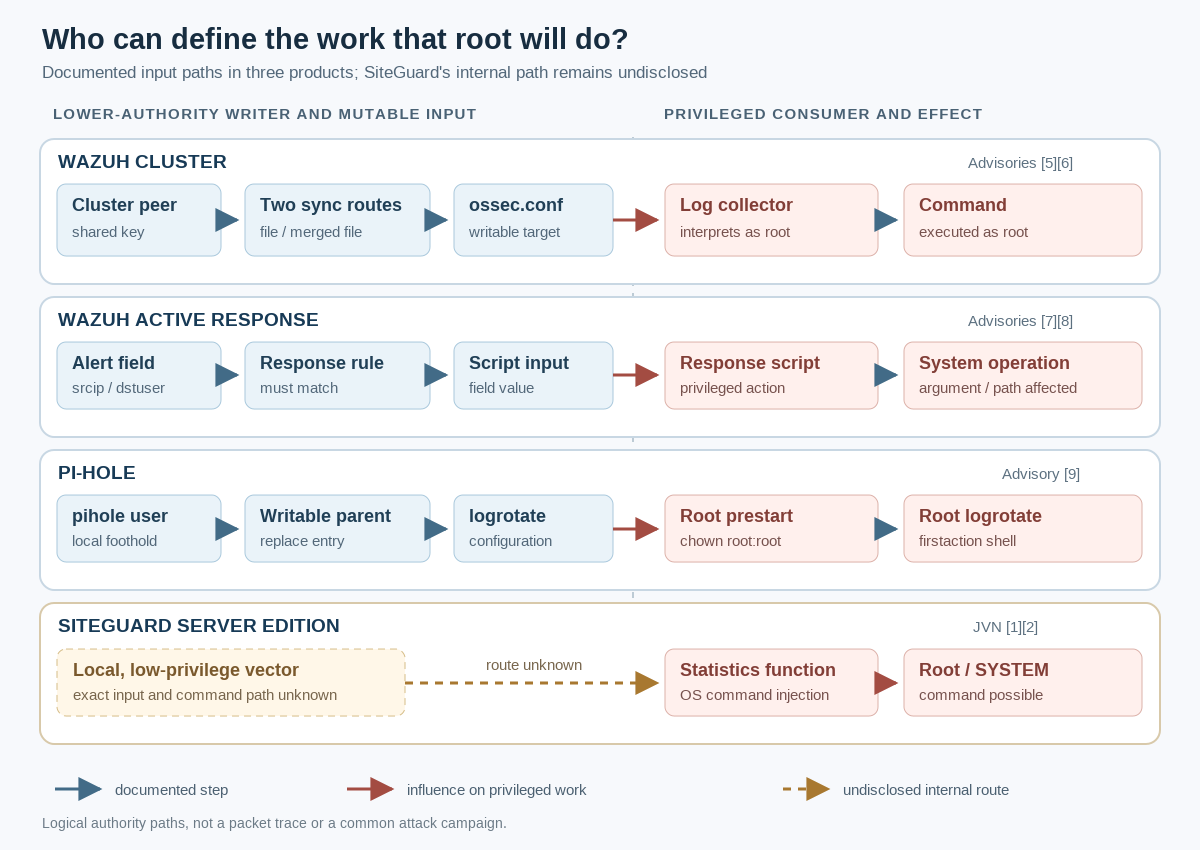
Open Figure 1 at full size (SVG).
| Product | Lower-privileged control | Privileged consumer | Result |
|---|---|---|---|
| SiteGuard | Exact injection source not disclosed | Statistics processing | Potential root/SYSTEM command execution |
| Wazuh cluster | Authenticated synchronization of configuration | Root log collector | Root command execution |
| Wazuh Active Response | Alert fields including srcip and dstuser | Privileged response scripts | Argument injection, file operations, account-management effects |
| Pi-hole | Replacement of logrotate configuration | Root prestart maintenance and root logrotate | Root shell execution through a configuration hook |
These are three distinct forms of control: writing executable configuration, supplying an operation parameter, and replacing a file that privileged maintenance will later trust. Only the Active Response case begins with a field extracted from an observed event. The common structure lies in the distance between authority to change an input and authority to execute the task that consumes it.
4.1 The writer and executor have different authority
The decisive permission is often held by a writer that does not itself run as root. Cluster credentials permitted Wazuh synchronization, but the same channel could alter configuration interpreted by a root collector. The pihole account could replace a root-owned directory entry without permission to edit the original file. Neither permission was equivalent to authorization to define a root command.
Reviewing only the executing process’s account, the original file’s owner, or the network-facing service misses that distinction. The boundary is the complete write path into the object that the privileged task interprets.
4.2 Time and normalization can hide the writer
The write and the privileged action need not occur together. Wazuh consumed synchronized configuration on a later reload; Pi-hole processed its replacement after a root ownership change and a scheduled maintenance step. SiteGuard’s 2016 statistics job also illustrates delayed processing, though it does not establish the timing or path of the 2026 exploit. [3]
By execution time, the immediate input can look like an ordinary local configuration or a correctly owned file. Pi-hole shows why that appearance is insufficient: root ownership was restored to attacker-chosen contents. The investigator must trace who selected those contents before the file acquired its final metadata or reached the privileged consumer.
5. Mapping the Attack Surface of a Privileged Observer
The cases suggest a practical way to examine another security or system-management product. Start from its privileged work, then trace backward to every actor who can change what that work will read. This is a research method inferred from the documented incidents, not a claim that every product with these features is vulnerable.
5.1 Inventory work that runs with administrative authority
List the tasks that perform statistics updates, log rotation, configuration synchronization, event handling, recovery, or service maintenance. For each, identify the entry point, execution account, trigger, and operation it is meant to perform. A timer, reload, or service startup may be the point of execution even when the relevant input was written much earlier.
This inventory reaches beyond the detector itself. A WAF’s statistics job, a manager’s log collector, and a DNS filter’s rotation hook may have different reasons for running with elevated privileges. An analysis that stops at the privilege of the main daemon can miss these secondary jobs.
5.2 Trace every writer of each input
For each privileged task, identify the files, configuration entries, alert fields, and command parameters it consumes. Then ask which account, peer, API, parent directory, or maintenance operation can create, modify, rename, or replace them. Authentication to one interface establishes who can use that interface; it does not establish authority over every object the interface can reach.
The second Wazuh cluster advisory makes this search concrete. Restricting the original file-transfer handler left another synchronization path able to reach ossec.conf. [5][6] The object of protection was the configuration interpreted by root, so the review had to include all supported writers to that object. Pi-hole shows that a file’s ownership must be checked together with the directory operations and later maintenance steps that determine its contents. [9]
5.3 Follow the input to its final interpretation
Finally, determine whether the privileged consumer treats an input as data, a configuration directive, an executable hook, a path, or an argument to a system utility. Wazuh’s Active Response advisories show why validation must be specific to the final use: some scripts checked srcip with get_ip_version(), while others passed the field to firewall tools or incorporated it into a path without equivalent checks. [7][8]
Nagios documents the same analytical need in a different setting. Its security guidance warns that fabricated check results can trigger event handlers and advises against running the monitoring daemon as root. Macros derived from check output, including $HOSTOUTPUT$ and $SERVICEOUTPUT$, can be substituted into operational commands; their safety depends on the command context in which they are used. [10][11] Its 2026 changelog records further sanitization and macro fixes, without establishing the same root-execution chain as Wazuh. [13]
The method applies as a question to backup tools, antivirus systems, endpoint detection agents, and other administrative software: which lower-privileged writer can alter an input that a later privileged job treats as an instruction? The answer requires the actual product’s code, permissions, deployment configuration, and execution path; these cases alone do not establish a flaw in those other products.
6. Architectural Implications
The documented failures impose two separate obligations: grant each privileged task only the authority its operation requires, and keep the authority to define that operation out of weaker input paths. A restricted service account helps with the first obligation. It cannot by itself satisfy the second when the service writes material later interpreted by root.
6.1 Separate the analytical task from the administrative task
Statistics aggregation, report generation, configuration changes, and service repair should be evaluated as separate operations. SiteGuard’s historical root-scheduled statistics job shows why that separation is worth examining; the public advisory does not show which permissions its 2026 implementation required. [1][3]
Where only a maintenance step needs administrative authority, that step can have a narrow interface instead of lending root privileges to an entire analysis pipeline. Where the task genuinely requires root, its inputs still need limits appropriate to the operation they can cause.
6.2 Protect the privileged object across every update path
A configuration that directs a root process must be protected at all of its write paths, not just at the point where root reads it. Wazuh’s second cluster flaw demonstrates the consequence of leaving a sibling synchronization route to the same configuration after the first route was restricted. [5][6]
This requires an inventory of direct edits, synchronized updates, generated files, replacements, and reloads. Possession of cluster synchronization credentials should not thereby authorize an actor to define arbitrary work for the privileged log collector.
6.3 Preserve provenance through maintenance
Ownership, mode bits, and a valid input format are properties of an object at one moment. They do not establish who chose its contents. Pi-hole’s prestart step restored the expected owner to a replacement configuration, making a later check accept text selected by the pihole user. [9]
The design condition is to prevent lower-privileged replacement of privileged configuration, or to establish trusted contents and keep them protected until the privileged interpreter uses them. A check followed by another opportunity to replace the file would leave the same boundary open. For alert fields, the corresponding condition is to validate each value for its final role as an address, username, path component, or command argument. Retaining hostile data as evidence and accepting it as an administrative parameter are different decisions.
6.4 Keep the unproven SiteGuard path open
For SiteGuard, the public evidence still does not identify the vulnerable input, the command construction, or the initial route used in confirmed exploitation. The 2016 root cron script is historical context, not the demonstrated mechanism for CVE-2026-106931. [1][2][3]
An incident investigation would need the affected version’s implementation, relevant permissions, task configuration, and preserved diagnostic records to determine which actor could reach the statistics function and how. The vendor’s evidence-preservation warning makes those records consequential, but does not establish that attackers altered or deleted them. [1][14]
7. Conclusion
The Wazuh cluster and Pi-hole cases do not require an attacker’s log entry to become a command. In one, cluster synchronization could write configuration that a root collector later executed; in the other, root maintenance gave expected ownership to a configuration replaced by a less privileged account. Wazuh Active Response shows the separate route in which an event field did become a privileged operation’s parameter.
These mechanisms locate the authority error before root execution. The person or process that could change the privileged task’s input was not necessarily authorized to choose the task’s behavior. The paths to that input were distributed across synchronization handlers, directory operations, ownership changes, response rules, and delayed jobs. Fixing only the final command or one ingress path can leave the underlying authority relationship intact.
SiteGuard adds a consequential but narrower observation: a WAF statistics function could be exploited for root or SYSTEM command execution, while its public input path remains unknown. It cannot be used as proof of the specific write paths documented for Wazuh and Pi-hole. [1][2]
A monitoring product can expose a second administrative interface through its maintenance and response machinery. To find that interface, trace who can change each input a privileged task will later interpret, across every process and point in time between the writer and the executor.
References
SiteGuard incident and product history
[1] EG Secure Solutions. “SiteGuard Server EditionにおけるOSコマンドインジェクションの脆弱性(緊急).” October 14, 2026. Official advisory for CVE-2026-106931, including affected versions, confirmed exploitation, corrections, notification history, and evidence-preservation instructions.
https://eg-secure.co.jp/siteguard/news/alert-202610-1
[2] JPCERT/CC and IPA. “JVN#88474777: SiteGuard Server EditionにおけるOSコマンドインジェクションの脆弱性.” October 14, 2026.
https://jvn.jp/jp/JVN88474777/
[3] Sakura Internet. “SiteGuard Liteの詳細設定 ~SiteGuardシリーズでセキュリティ強化(その2)~.” February 12, 2016; updated June 28, 2019. Historical statistics processing and root crontab configuration.
https://knowledge.sakura.ad.jp/4148/
[4] Sakura Internet. “SiteGuard Lite Ver3.00 Update1 における不具合につきまして.” August 2016. Historical statistics-script error.
https://cloud.sakura.ad.jp/news/2016/08/02/siteguard-lite-trouble/
Wazuh and Pi-hole vulnerabilities
[5] Wazuh. GHSA-r4f7-v3p6-79jm, CVE-2026-25770. “Privilege Escalation to Root via Cluster Protocol File Write.” March 17, 2026.
https://github.com/wazuh/wazuh/security/advisories/GHSA-r4f7-v3p6-79jm
[6] Wazuh. GHSA-gh4h-fx78-q8xc. “Merged-file header path traversal in cluster sync allows arbitrary file write under WAZUH_PATH in Wazuh manager.” August 7, 2026.
https://github.com/wazuh/wazuh/security/advisories/GHSA-gh4h-fx78-q8xc
[7] Wazuh. GHSA-mvh4-g699-984j, CVE-2026-54085. “Missing input validation in multiple active response scripts allows argument injection.” August 18, 2026.
https://github.com/wazuh/wazuh/security/advisories/GHSA-mvh4-g699-984j
[8] Wazuh. GHSA-m4mf-qmhf-8vj6, CVE-2026-54083. “Path traversal in ip-customblock active response allows arbitrary file creation and deletion.” August 18, 2026.
https://github.com/wazuh/wazuh/security/advisories/GHSA-m4mf-qmhf-8vj6
[9] Pi-hole. GHSA-h8w9-qx2v-wrww, CVE-2026-50130. “Local privilege escalation from pihole user to root via /etc/pihole/logrotate.” July 6, 2026.
https://github.com/pi-hole/pi-hole/security/advisories/GHSA-h8w9-qx2v-wrww
Monitoring and log-processing architecture
[10] Nagios Core Documentation. “Security Considerations.” Guidance concerning monitoring privileges, untrusted check results, event handlers, and dangerous macro substitutions.
https://assets.nagios.com/downloads/nagioscore/docs/nagioscore/3/en/security.html
[11] Nagios Core Documentation. “Event Handlers.” Version 4 documentation describing event-driven command execution and associated permissions.
https://assets.nagios.com/downloads/nagioscore/docs/nagioscore/4/en/eventhandlers.html
[12] logrotate Project. “logrotate(8).” Manual covering log rotation, su, and script execution privileges.
https://man7.org/linux/man-pages/man8/logrotate.8.html
[13] Nagios Core. “Nagios Core 4.x Changelog.” Releases 4.5.13 and 4.5.14, May and August 2026.
https://www.nagios.org/projects/nagios-core/4x/
Additional SiteGuard advisory
[14] JPCERT/CC. “SiteGuard Server EditionにおけるOSコマンドインジェクションの脆弱性(CVE-2026-106931)に関する注意喚起.” October 14, 2026. Official alert confirming the advice to preserve diagnostic information before updating.
https://www.jpcert.or.jp/at/2026/at260032.html
Evidentiary Scope
This investigation draws on vendor advisories, project security disclosures, product documentation, historical operating instructions, and published release notes. The disclosures were made independently; the cited materials do not establish a shared attacker or exploitation campaign.
For SiteGuard Server Edition, public evidence establishes CVE-2026-106931, confirmed exploitation, the affected statistics function, and the potential for arbitrary OS command execution as root or SYSTEM. The published CVSS vector specifies local access with low privileges. The exact vulnerable input and the initial access used in observed exploitation have not been publicly reconstructed in the cited material.
The 2016 SiteGuard Lite documentation establishes historical root-scheduled statistics processing. It does not demonstrate that the 2026 vulnerability exploited the same script or execution architecture.
For Wazuh, the cluster synchronization vulnerabilities require the relevant cluster credentials, while the Active Response vulnerabilities require a suitable event-processing path and an enabled response rule. The Active Response advisories document argument injection, unintended file operations, and account-management consequences; they do not establish unrestricted root code execution through every affected script.
For Pi-hole, the published vulnerability requires code execution as the unprivileged pihole user, the affected directory and ownership behavior, and the privileged maintenance sequence. The advisory does not demonstrate unauthenticated remote root execution through ordinary DNS requests.
Nagios and logrotate are included as documented examples of how monitoring outputs and log-maintenance configurations interact with privileged operations. Their ordinary functionality does not itself constitute a vulnerability.
No independent exploit reproduction or source-code audit of the vulnerable SiteGuard implementation was conducted for this article. The comparison demonstrates recurring privilege relationships in logging and monitoring systems, but does not establish their prevalence across all deployed products.
The central finding is limited to what the documented mechanisms support: monitoring and maintenance components can become paths to administrative execution when lower-trust inputs are allowed to determine operations performed under the components’ stronger privileges.