How a BeyondTrust zero-day turned legitimate remote maintenance into an intrusion route and exposed the authority companies delegate to support systems.
Incident Analysis · BeyondTrust · Remote Support · Privileged Access · Managed Services · Security Governance
Analysis based on publicly available information as of October 18, 2026.
Abstract
On October 15, 2026, BeyondTrust disclosed CVE-2026-102764, a critical vulnerability in its Remote Support product. Google Threat Intelligence Group and Mandiant reported that ARMORY CASTLE, a suspected China-linked espionage actor, had exploited the vulnerability as a zero-day in late August. BeyondTrust identified two affected customer environments: one hosted by the company and another operated by a customer. [1][2][3]
The intrusion did not end with control of the vulnerable appliance. Mandiant reconstructed an operation in which the attacker installed a web shell, obtained root-level privileges, manipulated persistent system configuration, and attempted to extract stored credentials. The attacker then used compromised administrator credentials to enter Remote Support’s legitimate management interface, where two categories of Jump Item permissions were changed from No Access to Administrator. Investigators subsequently observed remote support sessions to internal computers and the transfer of documents through the product’s ordinary file transfer functionality. [1]
The attacker also installed BARECLAW, a network tunneling tool, and modified the appliance’s reverse-proxy configuration to make the tunnel reachable through the existing public web service. The same compromised system was therefore used in two ways: as an authorized remote support platform whose permissions had been altered, and as a network intermediary operating outside the ordinary support-session authorization process.
The case raises two questions about delegated maintenance authority: who can change the rules for a support connection, and whether the endpoint owner can withdraw access without relying on the compromised support platform. This investigation examines the commercial arrangements that distribute maintenance authority, reconstructs Remote Support’s access-control architecture, and tests both against the observed attack.
The contracts and deployment examples illuminate possible authority structures. The user_changed event and subsequent sessions establish that the attacker manipulated legitimate authorization and reached systems beyond the appliance, although the public record does not identify every endpoint the changed roles could reach.
1. Incident Overview
BeyondTrust Remote Support, formerly known as Bomgar, is designed to let IT departments and support providers troubleshoot and administer computers across network boundaries. The product supports interactive assistance as well as persistent access to devices whose users are absent. Its management appliance coordinates support personnel, connection permissions, endpoint access, session functionality, and audit records.
That combination makes the appliance a particularly consequential system to compromise. It does not simply host a public-facing application; it participates in deciding which people may operate computers elsewhere in an organization.
BeyondTrust’s BT26-05 advisory describes CVE-2026-102764 as an improper origin validation vulnerability in an internal messaging component, classified as CWE-290. The component did not adequately verify the origin of messages it received, allowing an unauthenticated remote attacker to perform unauthorized file operations under certain conditions. The vulnerability received a CVSS v4 score of 9.3 and affected supported Remote Support versions through 26.2.3. [2]
The immediate failure was therefore not a universal bypass of endpoint authentication. It concerned the boundary between incoming messages and the appliance’s internal file operations. The eventual consequences depended on what an attacker could do after manipulating those files and gaining execution capabilities within the appliance.
Mandiant’s investigation identified exploitation in late August 2026, followed by activity demonstrating substantial knowledge of BeyondTrust’s internal utilities, configuration files, and administrative interfaces. Google attributed the operation to ARMORY CASTLE, formerly tracked as UNC5221, based on the group’s tooling and established operational patterns. The attribution identifies a suspected China-linked espionage actor, rather than proving the direct involvement of a particular government organization in the incident. [1]
2. Attack Timeline
BeyondTrust’s October 16 incident update provided the following chronology.
| Date | Documented event |
|---|---|
| August 29, 2026 | A zero-day was exploited against one BeyondTrust-hosted Remote Support instance and one customer-managed appliance. |
| September 27 | Intelligence about exploitation of another security vendor initiated additional threat hunting. |
| September 28 | BeyondTrust identified the compromised hosted instance and contained it within 27 minutes of detection. |
| September 30 | Mandiant shared findings from the customer-managed environment, corroborating BeyondTrust’s investigation. |
| October 8 | BeyondTrust released the BT26-05 patch. |
| October 9 | The patch had been applied to Remote Support SaaS environments. |
| October 15 | BeyondTrust coordinated public disclosure of the vulnerability and associated investigation; Google Cloud published Mandiant’s detailed technical report. |
| October 16 | BeyondTrust updated its incident account. |
Sources: BeyondTrust BT26-05 [2], BeyondTrust incident report [3], Google/Mandiant [1].
As of its October 16 update, BeyondTrust stated that it knew of the two affected customer environments and had not observed additional attacker activity since August. This describes the company’s findings at that time rather than an independently established worldwide limit on exploitation. [3]
The company’s account also disclosed an important monitoring failure. Sensors detected privilege escalation during the intrusion, but an automated triage system provided by a third-party security vendor closed the alerts as false positives. The incident was ultimately identified through proactive threat hunting. The available evidence therefore indicates that at least some malicious activity generated security signals, but the process responsible for evaluating those signals failed to escalate them. [3]
3. The Business of Delegated Access
Remote Support may be operated by an internal IT department or supplied through a service provider. The October investigation does not identify the victims’ contractual arrangements. The examples here distinguish a commercial right to provide maintenance from approval for a particular task. Section 4 examines who can change the technical requirement for that approval.
3.1 A remote support platform may serve organizations that do not own it
A company needs someone to maintain its computers. It may assign that work to an internal IT department, contract with an outside support provider, or purchase a managed service in which an MSP operates the support infrastructure. The people who authorize the work, manage the software, perform the maintenance, and own the computers can belong to different organizations.
BeyondTrust explicitly supports these arrangements.
Its published Managed Service Provider Software License and Subscription Agreement permits an MSP to use BeyondTrust products to provide services to customers. Section 1.1(d) also permits the MSP to grant access rights to its customers and subcontractors in connection with those services. The MSP remains responsible to BeyondTrust for contractual breaches committed by parties receiving those rights. [7]
This agreement establishes a possible structure in which BeyondTrust provides the product, an MSP operates or manages it, and separate customer organizations receive maintenance services. Subcontractors can also participate under the MSP’s arrangements.
The agreement shows how the product can form part of a commercial service rather than an appliance controlled exclusively by the endpoint owner.
In those arrangements, authority may be divided across several layers. The customer owns the system requiring maintenance. The MSP may manage the support personnel and connections. BeyondTrust supplies software and, for hosted deployments, operates the service infrastructure.
The contractual division of responsibility does not necessarily reveal which organization can change an individual Jump Item Role, modify a session policy, or disable the appliance.
Those are questions about the implemented authority structure, not simply the identities of the contracting parties.
3.2 A contract can authorize access in advance
A service agreement can grant standing permission for remote maintenance without deciding how a particular support session is approved.
NetSystems, a U.S. managed IT services provider, publishes a Master Services Agreement that grants the provider a continuing right to access customer network systems remotely without obtaining separate permission whenever a connection is established. The agreement also requires customers to provide the network access and resources necessary for contracted maintenance. [8]
That approach is understandable from an operational perspective. A provider responsible for monitoring systems, applying updates, and responding to failures may not be able to obtain an individual approval for every routine connection. Advance authorization allows maintenance to occur promptly, including when the customer is unavailable.
The same agreement illustrates another aspect of outsourcing. Unless a specific order provides otherwise, it places responsibility for determining appropriate network protection measures on the customer and contains limitations on the provider’s responsibility for third-party criminal activity. The agreement also recognizes exceptions, including negligence and willful misconduct, in relevant liability provisions. [8]
The published terms do not establish the terms of any individual customer order or of an October victim.
Still, the allocation is instructive. The provider may receive continuing operational access while the customer retains substantial responsibility for protecting the network through which that access is exercised.
Those allocations can coexist, with individual service orders assigning more specific duties.
But it exposes a question that a contract alone does not answer: if the provider’s maintenance infrastructure is compromised, which party still possesses the technical ability to restrict or terminate its access?
The answer depends on whether the customer has retained controls outside the provider’s management environment.
3.3 Individual tasks can still require approval
The Keller Group case study illustrates a different layer: approval for particular tasks within an ongoing maintenance relationship.
BeyondTrust’s published customer case study describes Keller’s use of Endpoint Privilege Management, Privileged Remote Access, and Remote Support alongside ServiceNow. The company sought to consolidate a fragmented set of support tools and improve control over access across its geographically distributed operations. [9]
According to the case study, Keller uses Remote Support and ServiceNow integrations to let engineers request additional, time-limited permissions for specific support tasks. Requests can be approved through the ServiceNow interface, after which the engineer receives the necessary access.
The company also uses unattended access for field computers. This shows that approval workflows and persistent support capabilities can coexist within the same operating environment. A standing maintenance agreement could authorize the relationship while a workflow grants additional rights for particular tasks. [9]
The case study does not disclose the full technical configuration of Keller’s authorization controls. It therefore cannot establish that ServiceNow approval would remain mandatory if an attacker obtained complete administrative control of Keller’s Remote Support instance.
The relevant boundary is the one examined in section 4.4: who can change the requirement for approval inside Remote Support.
3.4 The U.S. Treasury had already experienced a related failure
The significance of vendor-controlled maintenance authority had emerged in an earlier BeyondTrust-related incident.
In December 2024, the U.S. Treasury Department notified lawmakers that an attacker had obtained a key used by BeyondTrust to secure a cloud-based service providing remote technical support. According to the department’s account, the stolen key allowed the attacker to bypass the service’s security protections, remotely access Treasury employee workstations, and retrieve unclassified documents. [10]
The compromised service was subsequently taken offline.
The 2024 incident and the October 2026 intrusion involved different initial weaknesses. The Treasury case concerned a compromised service key, while the newer incident began with a vulnerability in an appliance’s internal message processing and developed into host-level compromise and manipulation of administrative permissions.
The similarity lies in the relationship between the maintenance infrastructure and the computers being protected. In both cases, compromise of a system entrusted with remote support authority created a route to endpoints that the attacker did not initially control.
The later intrusion adds an important detail: the attacker did not merely obtain a capability that had already been granted. The actor also manipulated the administrative records through which the maintenance platform decided what a legitimate account was allowed to do.
4. Architecture of Remote Support Authority
The commercial right to maintain a system becomes effective through the appliance, its endpoint connections, and its authorization rules. The documented product paths establish what the platform can do; they do not by themselves identify the affected customers’ configurations.
4.1 Persistent access is part of the product’s purpose
Remote support platforms exist because conventional network and endpoint boundaries can make maintenance difficult. A technician may need to diagnose a computer in another office, connect to a server without an interactive user session, or retrieve files from a system behind a corporate firewall.
BeyondTrust addresses these requirements through several access mechanisms. A Jump Client can maintain a persistent relationship between a managed endpoint and the Remote Support infrastructure, allowing authorized support personnel to reconnect later. Jumpoints, referred to as Gateways in newer documentation, provide another method of reaching systems inside a network through an intermediary. [4]
These mechanisms confer different technical capabilities.
A computer with a persistent Jump Client can be available for unattended support without its user initiating a new request. A Gateway can mediate connections to systems that do not have their own installed Jump Client, depending on the protocols, credentials, and network routes configured. The number of installed agents therefore does not necessarily define the number of systems reachable through the support infrastructure.
The software also centralizes information needed to operate these connections. It maintains records of connection targets, support personnel, groups, access policies, and session activity. Depending on the deployment, it can integrate with credential management, identity providers, and ticketing systems.
This consolidation has genuine operational and security benefits. Organizations can replace ad hoc remote access tools with a managed service, apply consistent permissions, and retain records of support activity. Endpoints need not always expose their own management interfaces directly to the internet.
Yet the same infrastructure becomes a concentration of operational authority. If the central system is compromised, the attacker may obtain not only a network foothold but also information and capabilities intended for authorized maintenance.
4.2 An authorized connection is the result of several decisions
Remote Support does not use a single permission to determine everything a technician can do.
Jump Groups organize connection targets and associate them with users or groups of support representatives. Jump Item Roles govern the management and use of those connection objects. Jump Policies impose additional conditions on access, while Session Policies determine which operations are permitted once a session is established. [4][5]
The functions can be distinguished as follows.
| Control | Decision |
|---|---|
| Jump Group membership | Which collection of systems is available to a representative |
| Jump Item Role | Whether the representative may start a session or modify aspects of a connection |
| Jump Policy | When and under what conditions access may begin |
| Session Policy | Whether operations such as file transfer or command execution are permitted |
| Endpoint authentication | Whether credentials and other conditions satisfy the destination system’s requirements |
The product’s Jump Item Roles can distinguish ordinary session initiation from substantially more powerful administrative functions. The documented permission set includes the ability to edit a Jump Item’s assigned Jump Policy, Session Policy, connection destination, port, Gateway, and authentication information. These permissions are individually configurable. [4]
A technician allowed to start a session therefore need not be able to change its restrictions. Equally, a sufficiently privileged administrator may have the ability to modify both the connection and the restrictions that apply to it.
The distinction becomes critical when the administrative system itself is compromised. An attacker with permission to change an access policy occupies a different position from an attacker attempting to satisfy that policy as an ordinary user.
4.3 The actual reach of a role depends on its context
BeyondTrust’s access model distinguishes Default, Personal, Teams, and System Jump Item Roles.
The Default role applies where a Jump Group relationship uses the representative’s default permissions. Personal applies to the representative’s own personal Jump Items, while Teams governs personal Jump Items associated with lower-ranked members of a team. System applies to other Jump Items and may allow access outside ordinary group relationships. [5]
More specific Jump Group assignments take precedence over general default roles. The product documentation explicitly distinguishes a directly assigned role for a particular user and Jump Group from roles inherited through Group Policy or user defaults. [4]
This matters for interpreting the incident. Changing a user’s Default role to Administrator can increase access across multiple Jump Groups that rely on that default, but it does not necessarily override every explicit role assigned elsewhere.
Likewise, increasing a Teams role does not automatically establish access to every endpoint registered in the appliance. Its scope depends on the relevant team relationships, the objects concerned, and other applicable permissions.
The cited 24.3 and 25.1 documentation describes product behavior, not the exact configuration of either affected environment in 2026. The published audit fields and session records are the incident-specific evidence used below.
Remote Support was designed to support these distinctions. The attacker manipulated the system responsible for evaluating them.
4.4 Who controls the requirement for approval?
BeyondTrust documents an integration in which access to a Jump Item can require a ticket ID approved by an external IT service management system.
Under this workflow, the appliance sends information about the access request to the external service. The external system evaluates the request and returns an approval or denial decision. This allows the approval itself to be made outside the Remote Support appliance. [6]
However, the product documentation also explains that the ticket-ID requirement is enabled through a policy configured in Remote Support’s administrative interface. Removing the requirement from that policy disables the external approval step for access governed by the policy.
This reveals two different administrative capabilities.
One organization may possess the authority to approve a requested connection, while another administrator possesses the authority to decide whether approval is required at all.
If both capabilities are effectively controlled by the compromised maintenance platform, external approval does not necessarily constitute an independent technical boundary. If the customer controls a separate network or endpoint restriction that the maintenance administrator cannot change, the arrangement is different.
The October investigation does not establish that ARMORY CASTLE disabled ticket approval or manipulated an external ITSM system. It does show that the attacker altered application-level permissions. The contracts and deployment example in section 3 illustrate the first two layers; the power to change the approval rule is a third.
The diagram combines these documented control points with the two paths later observed in the intrusion. The incident evidence for those paths is examined in section 5.
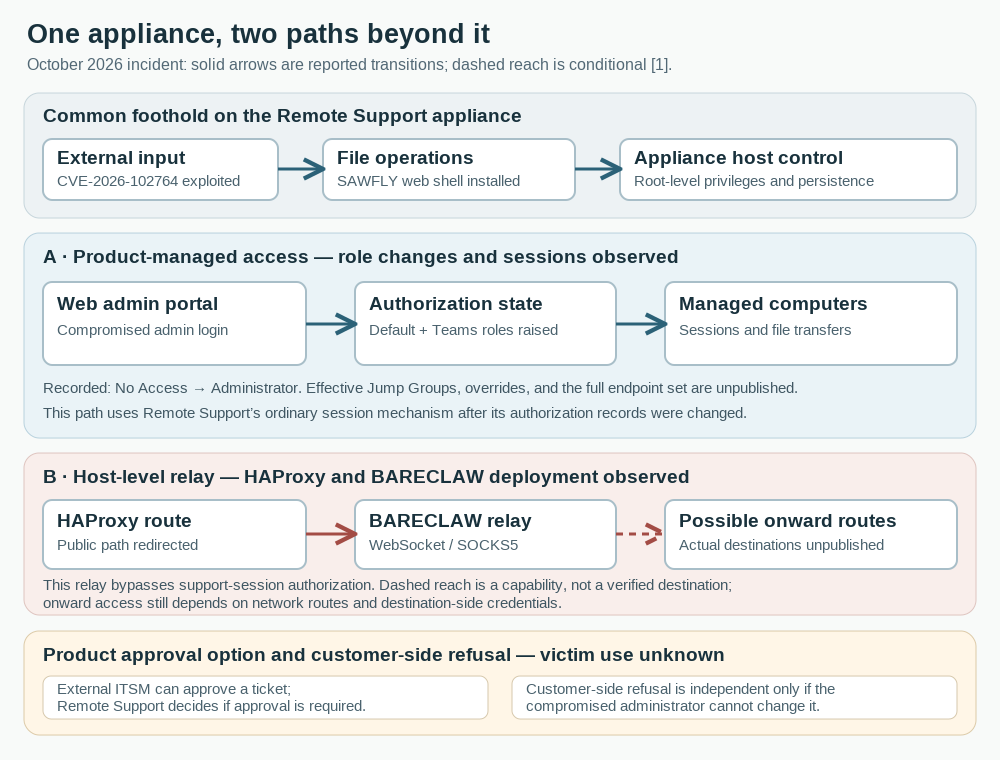
5. How the Attacker Used That Authority
Against that architecture, Mandiant’s investigation documented a series of transitions from the initial vulnerability into progressively broader capabilities.
| Stage | Confirmed activity | Security boundary crossed |
|---|---|---|
| Initial exploitation | Unauthorized file operations through CVE-2026-102764 | External input and internal appliance processing |
| Execution | SAWFLY web shell installation | Application processing and OS command execution |
| Privilege escalation | Root-owned SUID shell and persistent privileged configuration | Service account and host administration |
| Credential access | Attempts to extract secrets through native utilities | Appliance operation and sensitive credential storage |
| Application administration | Login using compromised administrator credentials | Host compromise and legitimate management authority |
| Permission changes | Default and Teams roles raised to Administrator | Restricted support account and elevated Jump authorization |
| Internal access | Legitimate support sessions and document downloads | Support infrastructure and managed endpoints |
| Network tunneling | BARECLAW and modified HAProxy configuration | Appliance host and additional network destinations |
Source: Mandiant incident reconstruction [1].
The sequence is significant because the attacker did not rely on a single access method throughout the intrusion. After obtaining host-level privileges, the actor continued into the product’s administrative interface and used it to modify the permissions governing normal remote support activities.
Mandiant then observed access to internal computers and the download of documents, including software inventory information, through the built-in file transfer service.
The attack consequently crossed two different boundaries. The vulnerable appliance first became an attacker-controlled host, and the attacker then used its administrative environment to reach other systems through legitimate maintenance functions.
The distinction between these boundaries is essential to understanding both the intrusion and the difficulty of removing the attacker afterward.
5.1 From a web shell to control of the appliance
Mandiant identified SAWFLY, a custom PHP web shell, following exploitation of CVE-2026-102764. The malware used encrypted communication to receive commands and return their results, allowing the attacker to operate inside the appliance’s web application environment. [1]
The web shell initially ran under an unprivileged service account. The attacker subsequently created a root-owned SUID copy of a system shell, obtaining a persistent mechanism for executing commands with elevated privileges.
Mandiant also documented changes to the appliance’s configuration regeneration system. A startup script modified the persistent sudoers template and invoked BeyondTrust’s native configuration utility to regenerate the active configuration. This preserved passwordless administrative privileges for the service account even when ordinary configuration files were recreated.
The technique was specific to how the appliance maintained its operating environment. Instead of relying solely on changes to transient system files, the attacker modified the files and processes that would reproduce those changes.
The report demonstrates the resulting host-level control, although it does not fully explain every prerequisite that allowed the initially unprivileged account to create the root-owned SUID executable. That part of the escalation chain cannot be independently reconstructed from the published evidence.
The attacker also attempted to retrieve credentials from BeyondTrust’s native secrets infrastructure, using the bt-secrets administrative utility to query vault information. Recovered commands show attempts to access both site-specific and broader appliance-level secrets. Mandiant also documented subsequent deletion of associated logs. [1]
These actions show the importance of the appliance as a credential target. A system responsible for administering other computers may hold or broker credentials valuable for reaching them.
However, the public report does not establish the complete set of credentials successfully extracted through these commands, nor does it prove that the administrator password used in the next phase originated from this particular extraction attempt.
5.2 The administrative login changed the nature of the intrusion
Mandiant recovered a successful login to the Remote Support web administration portal using compromised administrator credentials. The attacker tested membership in the product’s Administrators Group Policy before adopting a different approach to maintaining access.
Rather than relying only on continued membership in the broad administrative group, the actor changed the Jump Item permissions assigned to a compromised account.
The published user_changed event contains the following fields.
| Audit field | Recorded value |
|---|---|
old_permissions:jump_item_role:default:name | No Access |
new_permissions:jump_item_role:default:name | Administrator |
old_permissions:jump_item_role:teams:name | No Access |
new_permissions:jump_item_role:teams:name | Administrator |
The corresponding role IDs changed from 1 to 3 in both cases. These are actual fields from the Mandiant investigation, not a reconstructed example. [1]
This event is the central piece of evidence in the incident.
The attacker was no longer limited to operating the vulnerable host from outside the product’s normal administrative workflow. The actor had entered the management environment and altered the product’s recorded authorization for a legitimate account.
Mandiant describes the resulting access as unrestricted authorization to initiate sessions against downstream systems populated within the appliance. That characterization reflects the investigators’ understanding of the affected environment, but the published audit excerpt by itself does not establish the complete set of endpoints covered by the change.
Only the Default and Teams role changes appear in the excerpt. The applicable Jump Group assignments, more specific role overrides, and complete definition of the Administrator role in the victim environment have not been published.
The difference is material. An Administrator role may contain several individually configured permissions, and a general default may be overridden by a role assigned directly to a particular Jump Group. Establishing every newly reachable endpoint would require those configuration details.
Nevertheless, Mandiant observed that the attacker subsequently established Remote Support sessions to internal systems. During those sessions, the actor obtained file-system access and used the product’s native file transfer facility to download internal documents from a user’s desktop environment. [1]
This makes the incident different from a purely theoretical administrative takeover. Both the manipulation of authorization records and actual access to internal computers are supported by forensic evidence.
The attack demonstrates how unauthorized control of a maintenance platform can be converted into actions that the platform processes through its legitimate support mechanisms.
5.3 The attacker also turned the appliance into a network tunnel
The second access method did not depend on Jump Item permissions.
Mandiant identified BARECLAW, a custom SOCKS5 tunneling tool that used WebSocket communication to relay TCP connections. The attacker deployed it on the compromised appliance and modified HAProxy, the reverse proxy responsible for routing traffic between the appliance’s public interfaces and internal services. [1]
The modified configuration recognized a new URL path and forwarded matching requests to a local backend where BARECLAW was listening. The tunnel therefore became reachable through the appliance’s existing public web service, without requiring the attacker to expose its internal listener as a separate internet-facing service.
The security consequence was different from that of a legitimate support session.
With the modified Jump Item roles, the attacker used product-managed connections governed by Remote Support’s authorization system. With BARECLAW, the attacker used the appliance’s operating-system and network position to relay traffic through a separate mechanism.
The tunnel did not automatically supply credentials for every destination or prove unrestricted access to the internal network. Its potential reach depended on the routes, firewall rules, and destination-side authentication available from the compromised appliance. Mandiant did not publish a complete list of systems accessed through it.
Even with that limitation, BARECLAW shows why reversing the application-level permission changes would be insufficient to remove the entire intrusion. The attacker had established a communication path that existed outside the authorization records modified in the administrative interface.
The two mechanisms also leave different kinds of evidence. Legitimate Remote Support sessions can generate application-level records of the representative, endpoint, session activity, and file transfers. The tunnel instead required analysis of host configuration, network traffic, and artifacts left by the attacker.
Mandiant observed systematic deletion of appliance logs, further increasing the importance of records stored outside the compromised host.
The same appliance had become both a compromised authority over maintenance connections and an unauthorized network intermediary.
6. When Maintenance Authority Must Be Withdrawn
6.1 Removing the permission change is not sufficient
The immediate response to an incident involving a compromised administrator account is straightforward in principle: disable the account, terminate unauthorized sessions, and restore the correct permissions.
In this case, such actions would address only part of the problem.
The attacker had changed Jump Item Roles, used Remote Support to access internal endpoints, attempted to obtain secrets, established root-level persistence, and deployed a network tunnel. These activities generated different kinds of risk, and each requires a different form of recovery.
| Confirmed activity | What recovery must establish |
|---|---|
| Jump Item Role modification | Unauthorized permissions and other management changes have been identified and reversed |
| Remote sessions and file transfers | Accessed endpoints, transferred files, and possible downstream compromise have been investigated |
| Credential access attempts | Credentials potentially exposed through the appliance have been identified and rotated where necessary |
| SAWFLY and privileged persistence | The compromised host has been restored from a trustworthy state |
| BARECLAW and HAProxy changes | Unauthorized network access paths have been eliminated |
| Log deletion | Available evidence has been reconstructed from independent sources where possible |
Mandiant’s remediation guidance reflects this distinction. It recommends patching affected versions, reviewing configuration changes against a pre-exposure baseline, investigating support-session activity, rotating credentials, and rebuilding appliances with confirmed or unresolved host-level compromise. [1]
For such appliances, restoring the user database is not equivalent to restoring the operating system. Likewise, eliminating a web shell is not equivalent to proving that the credentials used during the intrusion remain confidential.
The attacker’s use of the product’s legitimate support capabilities means that the investigation must also include the endpoints those capabilities reached.
6.2 Revocation must account for persistent endpoint relationships
Remote Support can create access relationships that outlive an individual support session.
For example, the product allows appropriately authorized representatives to deploy or pin Jump Clients so that computers can be accessed during future sessions. The Jump Client remains a managed access mechanism until it is removed or otherwise becomes unavailable. [4][11]
The lifecycle of a Jump Client is distinct from the lifecycle of the representative account that created or used it.
The distinction becomes more pronounced for offline endpoints. BeyondTrust’s deployment documentation explains that removal actions may be deferred until an offline Jump Client next connects to the appliance. It also documents platform-specific behavior in which local software or manually configured startup mechanisms can remain after an administrative removal operation. [11]
This does not mean an offline client necessarily remains authorized to establish a new session. The relevant product registration, endpoint files, and ability to authenticate to the appliance are distinct states.
It means that a change made in a management interface does not necessarily prove that the corresponding endpoint has already received and executed the change.
For a compromised maintenance platform, this creates an evidentiary problem. An administrator may be able to remove access in the product’s database while remaining unable to verify the state of every endpoint without independent endpoint-management information.
The October Mandiant report does not show that ARMORY CASTLE deployed additional Jump Clients or used session pinning to create persistence on new endpoints. Those operations are not established parts of the attack.
They are relevant because they identify capabilities that incident responders must consider when evaluating whether unauthorized administrative activity created lasting relationships beyond the original compromised account.
6.3 The customer may possess a separate means of refusal
An organization does not have to rely exclusively on Remote Support’s internal authorization to govern access to its computers.
For certain connection methods, the destination operating system may independently authenticate credentials. A customer-controlled firewall may prohibit communication between a Gateway and sensitive systems. An endpoint management platform operated independently of the support provider may be able to remove or disable the remote support agent. [4][11]
The effectiveness of these controls depends on who can change them.
If the compromised support administrator also possesses credentials for the customer’s firewall or endpoint management system, the controls may not remain independent. If the customer has kept those administrative capabilities separate, the attacker cannot necessarily override them by changing a Jump Item Role.
Network architecture also matters. Jump Clients can establish connections outward to the management appliance, allowing remote support without inbound internet access to each computer. Blocking unsolicited incoming connections to the customer network is therefore not enough to prevent all legitimate Remote Support access.
A customer seeking to stop an untrusted support platform must consider the actual communication mechanisms involved, including direct Jump Client connections, intermediary Gateways, and any separate traffic paths created through the compromised appliance.
In the October incident, BARECLAW illustrates the limits of relying solely on the application’s authorization interface. Disabling a representative account would not itself remove software or configuration changes made at the host level.
Mandiant accordingly recommends isolation through network controls outside the appliance, restrictions on appliance egress, external logging, and rebuilding compromised hosts from clean images. It also recommends re-enrolling relevant Jump Clients, Gateways, and representative consoles to invalidate existing enrollment tokens. [1]
These measures address different capabilities rather than treating the administrator account as the only source of access.
6.4 The organization must reconstruct what was authorized during the intrusion
The central forensic task is not simply determining which account was compromised. It is reconstructing what that account, and the attacker controlling it, caused the system to authorize or execute.
BeyondTrust’s audit and reporting features can record user changes, Jump Item activity, session initiation, and file transfers. Mandiant specifically recommends reviewing role changes alongside support-session records and identifying endpoints accessed during the exposure window. [1]
In the October case, the published audit event provides a useful starting point. The Default and Teams role changes establish that an account acquired elevated Jump Item permissions. The subsequent session records establish that the attacker reached internal endpoints and retrieved files.
Reconstructing the complete effect would require connecting those observations to the Jump Groups, effective role assignments, session policies, credentials, and endpoints present at the time.
Records retained only on the appliance cannot automatically be treated as complete, because the attacker had root-level access and deleted logs. Externally preserved Syslog records, identity-provider records, network telemetry, endpoint logs, and independent configuration backups become especially important.
The need for multiple evidence sources also reflects the organizational relationships behind the system. A customer may possess endpoint logs while a provider possesses the support-session records. A SaaS operator may control appliance-level telemetry that is unavailable to the customer’s own administrators.
The organization responsible for assessing an incident may therefore need information held by several different parties before it can establish the full extent of the access that occurred.
The same problem appears during recovery. A provider may be able to revoke product-level access, while only the customer can independently confirm that its endpoint restrictions and credentials have been restored. Neither party’s records necessarily provide a complete picture by themselves.
7. Who Controls the Right to Enter?
The October 2026 BeyondTrust intrusion began with unauthorized file operations on a Remote Support appliance. Its decisive expansion came when the attacker obtained host-level privileges, entered the administrative interface, and changed a compromised account’s Default and Teams Jump Item Roles from No Access to Administrator. Mandiant’s user_changed event records those changes; subsequent support sessions and file transfers establish actual access to internal computers.
The actor also installed BARECLAW and changed HAProxy routing to relay traffic through the same appliance outside Remote Support’s session authorization. The public record does not disclose every endpoint reachable through the changed roles or every destination reached through the tunnel. It does establish two distinct ways in which a compromised maintenance system could carry the attacker beyond the original host.
The case separates three decisions that are often treated as one: a contract may authorize maintenance, a workflow may approve a particular task, and a platform administrator may determine whether that approval is required. BeyondTrust’s documented ticket integration places the approval decision in an external system while leaving the requirement for approval configurable inside Remote Support. The October attacker is not known to have changed that requirement, but did change legitimate application permissions.
Revocation crosses another boundary. Reversing a role change does not remove host-level persistence, a network tunnel, potentially exposed credentials, or endpoint agents whose state may not yet match the management database. A customer-controlled restriction can provide an independent means of refusal only if the compromised maintenance administrator cannot change it. The affected customers’ independent controls have not been published.
The observed role change and internal sessions give this question concrete stakes. Once the system entrusted with granting maintenance access is compromised, the endpoint owner needs a way to change, refuse, and verify the withdrawal of that access without depending on the compromised system’s own judgment.
References
Incident investigation and October 2026 disclosure
[1] Google Threat Intelligence Group and Mandiant. “ARMORY CASTLE Exploits BeyondTrust.” Google Cloud, October 15, 2026. Technical investigation documenting exploitation, SAWFLY, privilege escalation, credential access attempts, Jump Item Role changes, internal support sessions, BARECLAW, and remediation guidance.
https://cloud.google.com/blog/topics/threat-intelligence/armory-castle-exploits-beyondtrust/
[2] BeyondTrust. “BT26-05: Improper Origin Validation in an Internal Messaging Component.” Security Advisory, October 15, 2026. CVE-2026-102764.
https://www.beyondtrust.com/trust-center/security-advisories/bt26-05
[3] BeyondTrust Security Team. “ARMORY CASTLE and BT26-05: What Security Teams Need to Know.” October 15, 2026; updated October 16, 2026. Incident chronology, affected environments, detection failures, and investigation.
https://www.beyondtrust.com/blog/entry/bt26-05
Remote Support architecture and authorization
[4] BeyondTrust. “Jump Client Guide.” Remote Support 24.3 documentation. Includes Jump Client operation, Jump Groups, Jump Item Roles, policies, and management permissions.
https://docs.beyondtrust.com/rs/v24.3/docs/jump-client-guide
[5] BeyondTrust. “Group Policies.” Remote Support 25.1 documentation. Includes the Default, Personal, Teams, and System roles and their intended scope.
https://docs.beyondtrust.com/rs/v25.1/docs/cloud-group-policies
[6] BeyondTrust. “Require a Ticket ID.” Remote Support documentation. External ITSM authorization requests and configurable approval requirements.
https://docs.beyondtrust.com/rs/docs/ticketid-workflow
Contracts, service providers, and organizational practice
[7] BeyondTrust Corporation. “Software License and Subscription Agreement — Managed Service Provider.” Particularly Section 1.1(d), concerning access rights granted to MSP customers and subcontractors.
https://www.beyondtrust.com/msp-eula
[8] NetSystems. “Master Service Agreement.” Particularly the Provider Access, Remote Access, and Network Security and Malicious Events clauses.
https://netsystemsinc.net/master-service-agreement/
[9] BeyondTrust. “Keller Group’s Efficiency and Security Go Hand-in-Hand with BeyondTrust.” Customer case study describing the integration of Remote Support, Privileged Remote Access, Endpoint Privilege Management, and ServiceNow.
https://www.beyondtrust.com/resources/case-studies/keller-group
Historical incident and endpoint management
[10] Reuters. “US Treasury Says Chinese Hackers Stole Documents in ‘Major Incident’.” December 30, 2024. Based on the U.S. Treasury Department’s notification to Congress regarding compromised BeyondTrust remote support infrastructure.
[11] BeyondTrust. “Deploy Jump Clients.” Remote Support 24.3 documentation. Installer validity, persistent endpoint registration, removal behavior, and offline endpoint considerations.
https://docs.beyondtrust.com/rs/v24.3/docs/deploy-jump-clients
Evidentiary Scope
This investigation relies on the October 2026 technical report by Google Threat Intelligence Group and Mandiant, BeyondTrust’s security advisory and incident chronology, official Remote Support documentation, published commercial agreements, a vendor case study, and historical reporting on the 2024 U.S. Treasury incident.
The October incident’s confirmed activities include exploitation of CVE-2026-102764, installation of SAWFLY, host-level privilege escalation and persistence, attempts to extract appliance secrets, administrative authentication using compromised credentials, modifications to Default and Teams Jump Item Roles, legitimate Remote Support sessions to internal endpoints, document transfers, installation of BARECLAW, HAProxy modification, and deletion of appliance logs.
The published user_changed event establishes two role changes but does not provide the complete Jump Group membership graph, every applicable policy, or the full permissions associated with the Administrator role in the victim environment. Mandiant confirmed actual internal access, but the complete set of endpoints accessible following those changes cannot be reconstructed independently from the published evidence.
The recovered credential-extraction commands establish attempted access to stored secrets. They do not establish the complete set of credentials successfully obtained, nor do they independently prove the origin of the administrator credentials used during the intrusion. The technical report also does not fully reconstruct every prerequisite in the initial privilege-escalation sequence.
BARECLAW’s deployment and routing configuration were documented by Mandiant, but the complete set of destinations reached through that tunnel has not been published. Its network implications should not be confused with evidence of specific additional endpoint compromises.
BeyondTrust’s MSP agreement, NetSystems’ standard contract, and Keller Group’s deployment case study illustrate different layers of legitimate maintenance authority, not the October victims’ arrangements. They support no legal conclusion about responsibility for this incident.
The discussion of independent customer-controlled restrictions and revocation mechanisms is based on documented product behavior and network architecture. It identifies security boundaries that may exist in particular deployments, not controls confirmed to have been present or absent in the affected environments. The behavior of existing sessions after changes to account permissions, and the exact effect of endpoint or network revocation measures, may require additional testing.
The 2024 U.S. Treasury incident is a separate case and does not establish a shared vulnerability, attacker, or campaign with the October 2026 intrusion.
The central conclusion is accordingly limited to what the combined evidence supports: a compromised remote support management system can allow an attacker to modify legitimate access permissions and use those permissions to reach managed computers, while host-level compromise may create additional access paths outside the product’s normal authorization system. Whether a customer can independently restrict and revoke those capabilities depends on the authority and technical controls retained outside the compromised platform.