How PHP2Shell exposed the difference between identifying a vulnerability and maintaining the software that must survive its repair.
Incident Analysis · PHP · CVE · Open Source Security
Analysis based on publicly available information as of October 24, 2026.
Abstract
On October 21, 2026, PHP released emergency updates for two critical runtime vulnerabilities, CVE-2026-109618 and CVE-2026-109619, after researchers demonstrated remote code execution. Developers had recognized the out-of-memory problem behind the first in 2024, but a repair with consequences for compatibility, availability, and extensions remained unsettled. The PHP Foundation later attributed the delay to the security team’s decision process and limited engineering capacity. [1][2][3]
PHP2Shell raises a question broader than whether a vulnerability had a name or a documented handling procedure. Discovery, assignment under the Common Vulnerabilities and Exposures (CVE) system, confidential repair decisions, implementation, and delivery belonged to participants with different information and authority. The article reconstructs how those stages were meant to join, why a known defect stalled before repair, and how disclosure coordination came under strain as the fix moved toward downstream users. Successful identification and exploit validation coexisted with an unresolved repair decision and limited control over release timing.
1. Two Failures in PHP’s Runtime
PHP performs substantial work beyond executing application code. It parses incoming HTTP requests, initializes internal structures, allocates memory, handles errors, and releases resources when a request ends. The PHP2Shell vulnerabilities involved these operations rather than defects in an individual application’s business logic.
1.1 CVE-2026-109618: An interrupted operation left invalid state behind
The first vulnerability involved PHP’s handling of out-of-memory (OOM) conditions. Historically, an allocation failure could cause longjmp() to abandon the current execution context while an internal structure was only partially initialized; later cleanup might then treat that incomplete structure as valid and corrupt memory. Under Apache’s mod_php, an attacker could reach the vulnerable state during automatic HTTP request parsing, so request shutdown might process invalid state before application-specific PHP code had executed.
Researchers demonstrated remote code execution under default mod_php settings. [2] Successful exploitation would execute with the affected worker process’s operating-system authority; access to files, application secrets, or other services would depend on that worker’s permissions and credentials, and the report does not establish host administrator access. The official advisory also identified potentially susceptible application-dependent paths in other PHP server interfaces, but exploit validation differed among them and did not establish universal remote-code-execution capability across PHP deployments.
1.2 CVE-2026-109619: A later request could access memory from an earlier one
The second vulnerability involved the lifetime of internal references. A PHP worker can handle multiple HTTP requests, retaining some global structures while releasing each request’s own memory at its end. If a persistent structure temporarily refers to request-owned memory, PHP must clear that reference before the memory becomes invalid or a later operation can reach it. Certain fatal-error and shutdown sequences left the reference in global state after its owning request ended, allowing a later request on the same worker to encounter it before normal initialization replaced it.
The resulting use-after-free condition could lead to remote code execution under specified circumstances. [3] The official advisory describes two necessary operations: one leaves request-owned state accessible beyond its intended lifetime, and another consumes it after the memory has been released. The vulnerabilities thus involved different failures—an operation interrupted before its state became valid in the first case, and a reference accessible after its memory became invalid in the second—but both exposed assumptions about runtime state during exceptional paths that the repair would have to address.
2. Timeline of a Delayed Repair
2.1 In 2024, developers recognized the first signs of the problem
In 2024, the PHP project underwent an external security audit conducted by Quarkslab, organized through the Open Source Technology Improvement Fund and funded by Germany’s Sovereign Tech Agency. While fixing one of the audit findings, a PHP core developer contracted by the PHP Foundation identified the first signs of the out-of-memory problem later assigned CVE-2026-109618. The Foundation states that possible exploitation was considered, but no concrete attack vectors had been established. Other security issues had more clearly demonstrated consequences. [1]
The repair presented substantial technical difficulties: some approaches would break backward compatibility, while others could introduce denial-of-service conditions or require changes across third-party PHP extensions. The security team used a consensus-based decision process, and the Foundation says that these competing risks, together with a shortage of developers who knew the interpreter deeply, made an approach hard to select. Work stalled and restarted repeatedly, a delay the Foundation later described as a structural failure of decision-making and resources.
Developers had therefore recognized an unsafe condition without agreeing on how to change a fundamental runtime mechanism; there was no finished patch merely waiting for release.
2.2 In August 2026, exploit evidence changed the priority
On July 30, 2026, security firm Calif began auditing PHP through an arrangement supported by OpenAI’s Patch the Planet program. OpenAI says Calif used GPT-5.6 Sol in identifying a critical flaw. On August 11, researcher Ryan A at Calif reported an unconditional remote-code-execution path involving the same root cause identified in 2024. OpenAI independently reported the underlying problem, and later work from OpenAI and Wiz established further attack vectors. [1][16] The full security consequences were now substantially clearer. From August 11 onward, the PHP Foundation says the issue became the highest priority for its security developers.
The condition had not appeared suddenly in August; the new evidence changed the understanding of its consequences and the urgency of a repair. It did not remove the engineering difficulty of preventing memory corruption without introducing unacceptable behavior elsewhere.
2.3 In October, publication depended on distributors being ready
The coordinated disclosure was originally scheduled for October 22 at 14:00 UTC. AWS later reported a PHP2Shell exploitation attempt against a MadPot honeypot on October 17, while the embargo still held; AWS did not establish how the actor learned of the flaw or whether such an attempt would have succeeded on a real system. [20] That observation precedes the publicly documented identifier leak. It means the planned disclosure date cannot be assumed to mark the first possible attack, but it does not prove that the confidential report channel was breached.
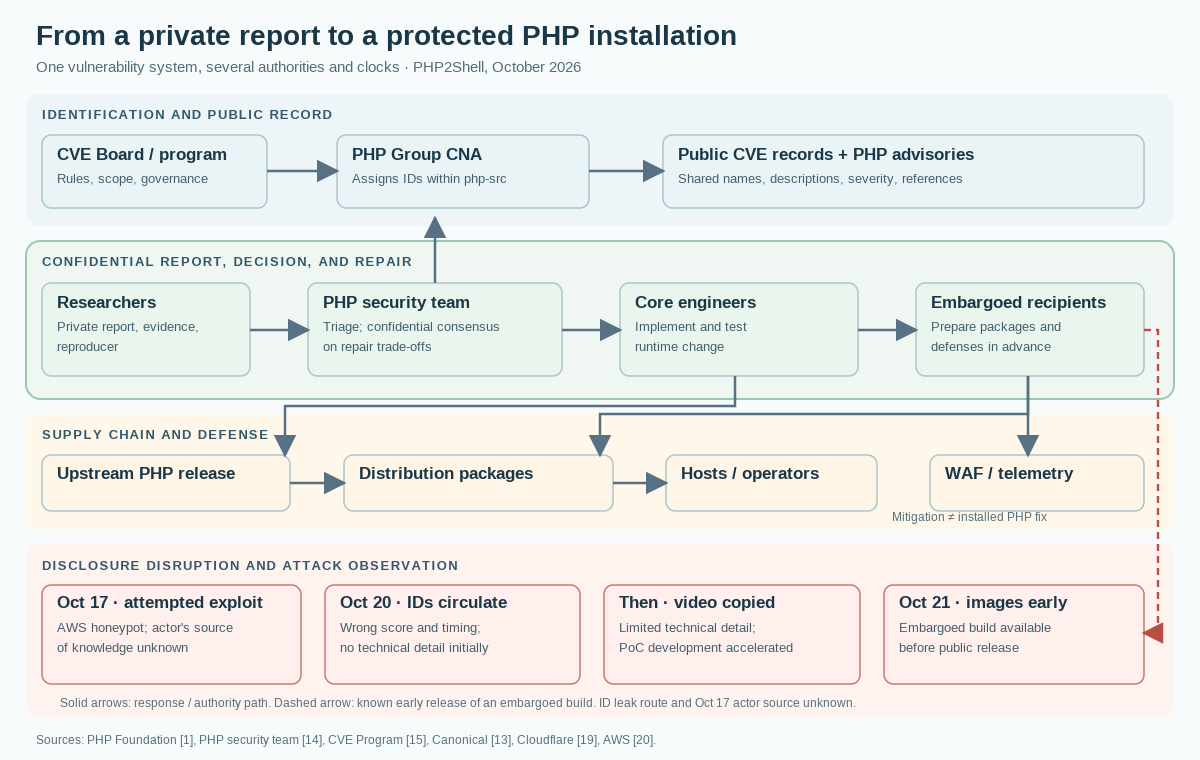
At about 15:00 UTC on October 20, the two CVE identifiers began circulating publicly with an incorrect 10.0 score and release time. According to the Foundation, no technical details accompanied that initial circulation. PHP moved its preannouncement to 19:30 UTC and advanced the release to October 21 at 14:00 UTC; distributors were still preparing packages, so immediate full disclosure would have left many users without a straightforward update. After the preannouncement, Calif accidentally published a demonstration video revealing limited technical details, and copies circulated. Chainguard then released patched images at 07:41 UTC on October 21, ahead of the embargo, making a binary version of the fix available for analysis. [1] The initial ID leak, video, and early images were different disclosure events with different information content; the source of the ID leak is unknown.
AWS found further attempts against its sensors from about 02:00 to 08:00 UTC on October 21, before PHP’s coordinated release, and said it could not tell whether they would succeed in real deployments. Cloudflare also reported attack traffic against customers and attempts to vary request payloads; its web application firewall (WAF) protection was enabled by default from 03:02 UTC. [19][20] At 14:00 UTC PHP released versions 8.2.35, 8.3.36, 8.4.27, and 8.5.12. The Foundation said it had not identified a functional exploit in the public proofs of concept it examined at release time; that narrower assessment does not negate AWS’s and Cloudflare’s separately scoped attack observations. [1] Recognition, exploit proof, repair, disclosure, package delivery, and observed attempts each had their own clock.
3. How CVE Became a Naming System
3.1 The original problem was identifying the same vulnerability across different systems
In their paper Towards a Common Enumeration of Vulnerabilities, dated January 8, 1999, MITRE researchers David E. Mann and Steven M. Christey described an interoperability problem. Security scanners, intrusion detection systems, vendor advisories, and vulnerability databases often used different names for the same defect, leaving organizations to determine whether several reports referred to one vulnerability or many. Integrating those sources without a common reference could require a separate mapping between every pair of databases.
For n databases, the number of possible pairwise relationships grows as n(n−1)/2. A common enumeration reduced that burden by letting each database map its own records to a shared identifier, making the number of required mappings grow linearly. CVE provided that reference. [4] The first public CVE List launched in September 1999 with 321 records; its purpose was to let independently maintained systems identify the same vulnerability, without requiring every security product to store identical information. [5]
3.2 The original paper anticipated the mismatch between identifiers and repairs
Section 4.3 of the 1999 paper examined the level of abstraction appropriate for identifying vulnerabilities. An intrusion detection system might describe a recognizable attack, a scanner a particular affected configuration, and an automated patch-management system the individual components and repairs it needs. The authors recognized that the last task might require finer-grained information than CVE. In Section 5.1, they described CVE as a logical bridge between independently maintained databases; Section 6.3 acknowledged that mapping through that bridge could lose precision. [4]
The authors accepted that trade-off to solve the immediate interoperability problem with a simpler enumeration rather than a complete taxonomy of security information. Their distinction between identification and patch management matters here: the limits of CVE’s role were part of its design, not a later discovery that its designers had mistaken an identifier for a repair.
3.3 Repair procedures were developed separately
The subsequent history of vulnerability management did not stop at naming. ISO/IEC 30111 established requirements and recommendations for processing and remediating reported vulnerabilities. ISO/IEC 29147 addressed vulnerability disclosure, while ISO/IEC TR 5895:2022 provided guidance for vulnerability handling involving multiple organizations. Other systems developed ways to describe severity, affected products, and remediation status. The Common Security Advisory Framework and its VEX profile, for example, support machine-readable communication about whether specific products are affected, unaffected, fixed, or still under investigation. [6][7][8][22] These systems formalize different tasks: processing reports, coordinating disclosure, and communicating product status to operators.
They developed alongside CVE’s shared identifier. Each supplies information or a procedure at the level its task requires. To see what this division meant for PHP, it is necessary to follow how CVE assignment moved closer to maintainers and how reports reached them.
3.4 PHP could name vulnerabilities inside a private repair process
The CVE Program itself had to adapt as the number of reported vulnerabilities grew. Its 25th-anniversary history describes a centralized model in which MITRE made virtually all assignments after Editorial Board review; as volume grew, that hub became a bottleneck. The Editorial Board evolved into the CVE Board, which governs the program’s strategic direction, policies, and rules. In 2016, a federated model distributed assignment and record publication to CVE Numbering Authorities (CNAs) within defined scopes. [15] The board’s authority concerns the identifier system. It does not approve PHP’s allocator design or direct the PHP security team. The federation brought naming closer to product knowledge and spread the record workload, while leaving each maintainer to supply the technical judgment and repair.
PHP illustrates the resulting workflow. The PHP Group has been a CNA for php-src since 2019, so its security team can assign CVE IDs without waiting for an outside service. PHP’s repository directs reporters to a private GitHub security advisory or security email, and says reports remain private until publication. [17] The team says a person reads and attempts to reproduce each report, checks its classification policy, and, when a fix is ready, publishes the advisory and CVE on its own schedule. That independence mattered while the GitHub advisory review queue took weeks for some reports, according to the team. [14] The private report may contain a reproducer and technical details needed for repair; a reserved identifier is a reference to the issue, not a public exploit description or a guarantee that code is fixed. The published CVE Record and upstream advisory then give distributors, scanners, WAF providers, and operators a common reference for their more specific version, configuration, package, and deployment decisions. CVE rules expressly attach IDs to vulnerabilities rather than fixes; a vulnerability can receive an ID even without a fix. [18]
The confidentiality of this process matters as much as the ability to assign an ID. Reporters and a limited set of maintainers must investigate and repair the defect before the wider PHP community can inspect it; selected distributors may receive the patch under embargo so packages are ready at disclosure. [1][14] PHP’s security team includes volunteers and Foundation-funded developers but operates separately from the Foundation. The Foundation described consensus inside that security team over a risky repair, not a public vote of the whole PHP community or a decision by the CVE Board. [1][14] The model put specialized engineering judgment and a project-wide compatibility choice inside a small confidential group. It also depended on downstream parties honoring an embargo while preparing packages and defenses. Figure 1 separates those decision and information paths.
3.5 Discovery accelerated while repair still required agreement
By October 2026, the PHP security team said AI tools had made reports much cheaper to write and sharply increased the number it received. Since July 1, it had published 15 CVEs and closed 106 reports as invalid, duplicate, or not reproducible. Those 106 are not identified as AI-generated reports; the figures show the team’s triage workload, not a measured AI error rate. PHP had used Claude Mythos in an earlier scan and added Daybreak Red to help trace proofs of concept and group reports that share a root cause. It also used sanitizer builds and reproductions across supported platforms, while people made the vulnerability decisions and reviewed patches. [1][14]
OpenAI says Calif used a model while finding a critical PHP flaw; the Foundation reports that Calif’s August RCE demonstration and separate reports from OpenAI and Wiz made the older OOM concern’s consequences clear. [1][16] The allocator condition had been recognized before those investigations, and the public record does not link AI to the October ID leak. Faster discovery and cheaper reporting increased the work entering the private channel, while a sound repair still required the team to agree on the engineering trade-offs. The next section follows the change PHP eventually made.
4. The Architecture of PHP’s Repair
4.1 The repair changed the meaning of memory-allocation failure
The out-of-memory vulnerability was difficult because allocation failure can interrupt operations that are not prepared to stop halfway through. An internal operation might allocate memory and initialize several fields before exposing a completed structure to other parts of the runtime. If allocation fails before completion, code that assumes the structure is valid must never reach it; PHP’s previous bailout mechanism could violate that requirement. The repair therefore changed failure handling itself, introducing a way to defer an out-of-memory error until a safer execution point instead of immediately escaping through the old bailout path.
A separate hard memory limit makes the process terminate rather than continue beyond a safety boundary. Together, these changes altered the contract between the allocator and its callers: operations that had relied on abrupt interruption now needed to handle allocation failure explicitly so the interpreter could raise the deferred error safely. The repair consequently reached components beyond the immediately vulnerable path wherever they depended on the allocator’s previous behavior.
4.2 Two CVEs, one major coordinated repair
The principal upstream correction appeared in commit 3584a98, Avoid state corruption via bailout, which explicitly addressed both CVE-2026-109618 and CVE-2026-109619. [9] Five credited contributors changed 389 files, adding 10,759 lines and removing 988; a substantial portion of the additions were regression tests. Diff size is not a direct measure of engineering cost, but the breadth shows that the change reached out-of-memory handling as well as initialization and reset behavior across the interpreter and its extensions.
The vulnerabilities received separate identifiers because they described different security failures, yet their principal repair was coordinated because the runtime mechanisms were connected. This is the distinction anticipated by the original CVE proposal: the unit used to identify a vulnerability need not be the unit of engineering work needed to repair it. One vulnerability may demand changes across many components, while several vulnerabilities may depend on the same underlying correction.
A CVE describes a security problem. A repair changes a system. The relationship between them is not inherently one-to-one.
4.3 Expat exposed a mismatch after the security release
The consequences of changing the allocator became visible almost immediately. On October 21, a contributor opened PHP Issue #24492 after functions including sprintf(), pack(), and bin2hex() terminated the process at the new hard memory limit where they had previously produced a PHP memory-exhaustion error. [10] The reported paths had not been converted to the fallible allocation interface; the report did not, however, establish a new remote-code-execution vulnerability or show that the behavior was remotely reachable under default server configurations.
The issue identified an observable change in the runtime’s response to memory pressure, and PHP’s XML extension supplied a more specific case. Depending on its build configuration, the extension can use libxml2 or Expat. With Expat, PHP supplies allocation functions through XML_ParserCreate_MM() using wrappers around emalloc() and erealloc(). After the security change, those wrappers could keep treating allocation as non-fallible until the hard limit was reached, reportedly terminating the process with exit code 137.
With libxml2, the equivalent test produced the ordinary PHP memory-exhaustion error. The distinction lay in the allocation contract used by the two parser integrations, rather than in the XML document: the security repair had changed that contract, but Expat’s integration still relied on the previous behavior.
4.4 The proposed correction showed what had been missed
On October 21, a contributor opened Pull Request #24516 to make the Expat allocation wrappers fallible. [11] Because Expat already handles allocation failure, PHP’s new fallible functions could return failure to the parser instead of forcing immediate process termination. Expat could then stop parsing and return control to PHP, allowing the pending memory-exhaustion error to be raised as intended. The contributor identified two existing tests that detected the behavior when PHP was built with Expat:
ext/xml/tests/oom_xml_parse_ns.phptext/xml/tests/gh14637.phpt
According to the pull request, PHP’s continuous integration did not include a job building the XML extension with Expat, so the existing tests did not exercise the affected configuration in the reported CI setup. The contributor tested the correction against multiple supported branches; the pull request received code-owner approval on October 23 and remained open as of October 24. The evidence establishes a configuration-dependent behavioral mismatch and a proposed correction, without showing that the mismatch permitted remote exploitation in ordinary deployments.
The original security defect arose because PHP’s failure-handling mechanism could violate assumptions made by other operations. Once the repair changed that mechanism, the Expat report exposed another component that still depended on its former behavior. Shipping the security repair did not end the work of keeping the changed allocator and its consumers consistent.
Sources: PHP commit [9], Issue #24492 [10], and PR #24516 [11].
5. Who Could Decide, and Who Had to Deliver?
5.1 The participants had different authority
PHP2Shell involved researchers, the PHP security team, core developers, the PHP Foundation, release managers, distributions, and hosting providers, each with a different role. Researchers could establish the existence and consequences of a defect; core developers investigated the runtime and implemented changes, while the security team worked to select an acceptable repair. The Foundation could fund that work and support coordination; distributions prepared packages for the versions they maintained, and operators installed those packages and restarted affected services.
The work crossed three distinct constraints: knowledge of what the defects could do, authority to choose among repairs with different costs, and capacity to implement, test, and distribute the chosen change. AI-assisted research and other independent reports strengthened the evidence about impact without selecting an acceptable memory-management contract. That choice required the security team’s decision process, while carrying it through required core developers, release managers, and downstream distributors. PHP’s CNA status gave it control over assigning the identifiers, but no participant controlled the entire transition from evidence to deployment.
5.2 PHP Foundation funded maintenance without governing the language
The PHP Foundation’s 2025 transparency report provides a measure of its institutional capacity. In 2025, the Foundation received $730,534 in contributions and reported $784,376 in expenses. At year-end, it had 11 contracted developers working full-time or part-time. Foundation-funded developers authored approximately 42% of PHP core commits during the year. [12] These figures describe the Foundation, not the total worldwide investment in PHP. They do, however, show that a comparatively small funded organization made a substantial contribution to maintaining a widely used language runtime.
The PHP security team says it mixes community volunteers and Foundation-funded developers while operating separately from the Foundation. [14] The Foundation explicitly states that it does not govern PHP or control the technical decisions of its development community. Its funding could increase engineering capacity for the repair, but could not itself determine which compatibility or availability costs the PHP project should accept. The split between paid work and project authority is publicly described; the record does not establish that an undisclosed contract term or conflict of interest caused the delay.
5.3 The decision bottleneck was not merely a shortage of money
The Foundation identified two causes of the delayed OOM repair: too few available core developers with deep interpreter knowledge, and the security team’s difficulty reaching consensus among technically imperfect alternatives. The constraints reinforced each other because every proposed change needed both specialists who understood its effects across the interpreter and extensions and a decision to accept its costs. In a confidential security process, that decision rested with a small group rather than an open community discussion, while the specialists had competing responsibilities. The consensus process struggled to select an option.
The repair effort was repeatedly interrupted. Since then, the Foundation has established an Ecosystem Security Team, added security personnel, and begun moving security decisions toward majority-based procedures rather than requiring consensus. It also expects cases stuck on hard trade-offs to reach Foundation leadership sooner. [1] These changes address decision-making and escalation around a confidential repair, though the Foundation’s leadership does not thereby acquire the PHP project’s technical authority. The public account does not identify every proposed repair or objection, or the precise point where each decision stalled.
The record supports the Foundation’s acknowledgement of an organizational failure without showing that any particular developer prevented an otherwise straightforward fix. Recognizing the unsafe condition in 2024 did not settle the trade-offs; even after later exploit evidence made repair urgent, the project still needed a decision and people able to implement it.
5.4 The repair crossed another boundary during distribution
Once the upstream changes were ready, the PHP project still depended on downstream organizations. Linux distributions maintain their own supported versions and may backport security corrections without adopting the latest upstream version number; hosting providers and operators then have to deploy the relevant packages. An upstream patch was therefore not yet a protected installation, which helps explain the October 20–21 disclosure difficulty: PHP had to coordinate publication with distributors whose packages were not all ready at the same time.
Canonical published updates for supported Ubuntu releases on October 21, including packages maintained through its own support arrangements. [13] Cloudflare supplied WAF mitigations before the upstream release, including default protection from 03:02 UTC on October 21, but explicitly told customers to update PHP: a filter at the edge reduces exposure to known request patterns without changing vulnerable interpreter code on the origin. [19] Other distributors, hosts, and operators followed their own schedules. Their use of the same CVE IDs helped link advisories, rules, and packages, while their distinct roles determined whether a specific running service was actually protected.
5.5 What the shared identifier specified, and what others had to establish
CVE’s precision lies in its ability to let independent parties refer to the same identified vulnerability. The two PHP2Shell IDs maintained that distinction between an OOM corruption path and stale global state, even though a single major commit addressed both. [2][3][9] A published record or upstream advisory can add severity, affected products, and references, but those fields do not make the identifier a complete statement about every runtime configuration, every downstream package, or whether an observed request succeeded. The incorrect 10.0 score attached to the prematurely circulating IDs shows the danger of treating a bare name and an unverified claim as an authoritative advisory: PHP’s published score was 9.2, and the technical details had not initially leaked. [1] A security engineer still had to decide whether a particular server interface and configuration was exposed, whether a distribution had backported the fix, whether a WAF detection matched a real attempt, and whether the running PHP process had actually been replaced. [2][3][13][19]
Those are distinct artifacts and authorities. The confidential report and reproducer gave PHP’s team evidence to classify and validate; the CNA ID and public advisory named and described the flaws; the source commit changed the allocator and its callers; downstream packages and images made that change deployable; operator inventory and telemetry determined exposure and response on real installations. [1][9][13][14] No upstream participant could know the state of every host. A correct common identifier could therefore coexist with incomplete product status, a delayed package, or a supported integration that the reported CI configuration did not exercise, as the Expat follow-up showed. [11]
5.6 Confidentiality had a limited perimeter
The private workflow gave PHP time to choose a repair and prepare releases across supported branches, but it also had to expand advance knowledge to researchers, release managers, distributors, and defensive providers. Each recipient could help put a fix or mitigation in place; each additional boundary made the embargo harder for PHP to control. The ID circulation, Calif video, and Chainguard images described in Section 2.3 exposed different kinds of information, so one generic account of a “leak” obscures how the window narrowed. [1] The source of the first ID circulation remains unknown. PHP could advance its own advisory, but it could neither withdraw the circulating artifacts nor make every downstream party release at the same moment.
Confidentiality also did not establish attacker ignorance. AWS’s October 17 honeypot attempt preceded the documented ID circulation, and how the actor learned of the flaw remains unknown; later AWS and Cloudflare observations establish attempts, not confirmed production compromise. [19][20] PHP’s team had not identified a functional public proof of concept in the material it reviewed at release time, a narrower observation compatible with those provider reports. [1] The response therefore had to preserve preparation time for defenders without assuming that the embargo guaranteed safety. AI assistance affected discovery and triage, but no public source ties it to the disclosure breaches or the pre-leak attempt.
6. What a Vulnerability Identifier Cannot Assign
The PHP Group’s CNA authority worked as intended: it could name two distinct flaws without waiting for an outside assignment queue, and independent research clarified their impact. Neither success settled the confidential choice between risky repairs. Consensus stalled when the consequences were uncertain, and stronger evidence later made the decision urgent without removing its costs. [1][14] The subsequent Expat report showed a different limitation after the patch shipped: a supported integration could remain outside the CI configuration that tested the changed allocator contract. [11]
The release decision faced still another boundary. Downstream access was necessary to prepare packages and mitigations, but early circulation of different artifacts narrowed the time in which that preparation could remain confidential. AWS’s earlier observation meant that even an intact embargo could not be treated as proof that attackers lacked a path; its evidence does not establish how the actor learned of the flaw or whether a real system was compromised. [1][20] The case demonstrates uneven capacity and authority across a response, with no single participant able to make validation, repair, distribution, and secrecy advance together.
CVE gave those participants a precise shared reference. It could not resolve PHP’s repair trade-offs or control the timing of every downstream release. Identification and exploit validation succeeded while other parts of the response stalled or escaped coordination; success at one stage did not guarantee the outcome of the whole. That is what a CVE cannot fix.
References
PHP2Shell and Technical Evidence
[1] The PHP Foundation. Today’s PHP Security Release, and How We’re Strengthening PHP Security. October 21, 2026.
[2] PHP Project. RCE via OOM Corruption — CVE-2026-109618. October 21, 2026.
[3] PHP Project. RCE via Stale Global State — CVE-2026-109619. October 21, 2026.
[9] PHP Project. Avoid State Corruption via Bailout — Commit 3584a98. October 2026.
[10] PHP Project. Issue #24492 — Hard Memory Limit and Changed OOM Behavior. October 21, 2026.
[11] PHP Project. Pull Request #24516 — Make Expat Allocators Fallible. October 21, 2026.
[14] Alexandre Daubois, The PHP Foundation. How the PHP Security Team Handles Your Reports. October 14, 2026.
[16] OpenAI. Patch the Planet: Global Response Coordination as Agents Uncover Critical Vulnerabilities. October 21, 2026.
[19] Cloudflare. Cloudflare Deploys Protections against php2shell Vulnerability. October 21, 2026.
[20] Amazon Threat Intelligence. PHP2Shell Exploitation Prior to Public Disclosure in MadPot. October 21, 2026.
[21] PHP Project. Informational Advisory: Session Upload Progress. October 23, 2026.
CVE History and Vulnerability-Handling Standards
[4] David E. Mann and Steven M. Christey. Towards a Common Enumeration of Vulnerabilities. MITRE, January 1999.
[5] CVE Program. History of CVE.
[6] ISO. ISO/IEC 30111:2019 — Vulnerability Handling Processes.
[22] ISO. ISO/IEC 29147:2018 — Vulnerability Disclosure.
[7] ISO. ISO/IEC TR 5895:2022 — Multi-party Coordinated Vulnerability Disclosure and Handling.
[8] OASIS. Common Security Advisory Framework 2.0.
[15] CVE Program. CVE Program 25th Anniversary Report. October 2024.
[17] PHP Project. Security Policy for php-src.
[18] CVE Program. CVE Numbering Authority Rules, version 4.2.6. Effective October 20, 2026.
Governance, Funding, and Distribution
[12] The PHP Foundation. Impact and Transparency Report 2025. May 27, 2026.
[13] Canonical. PHP2Shell — Critical Vulnerability Fixes Available. October 21, 2026.
Evidentiary Scope
The PHP Foundation’s October 21 statement is the primary source for its account of the 2024–2026 repair process. The complete internal deliberations and individual rejected repair proposals have not been independently reconstructed.
The original out-of-memory concern was identified while addressing a finding from the 2024 Quarkslab audit. This article does not assume that separately redacted findings in that audit correspond to the PHP2Shell vulnerabilities.
The two CVEs describe distinct defects. Their inclusion in a coordinated repair commit does not make them one vulnerability or establish that every implementation change was necessary for both.
This article focuses on those two October 21 CVEs. On October 23, PHP issued a separate informational advisory about an unusual session upload progress configuration and said it would publish a full advisory for CVE-2026-115560 with the next regular release; the October 21 fixes did not resolve that distinct issue. [21]
The PHP Foundation and the individual security advisories describe different levels of exploit validation for PHP-FPM. This article does not assume identical exploitability across all PHP server interfaces.
Issue #24492 and Pull Request #24516 document contributor-reported behavior and a proposed correction. Their existence does not establish an additional remotely exploitable vulnerability or universal production impact. The Expat case is used to illustrate a reported dependency on the allocator’s previous behavior.
The Foundation’s financial figures describe its own operations, not the total resources invested in PHP development worldwide. Commit counts, staffing numbers, and patch size are not treated as direct measurements of the engineering cost of PHP2Shell.
The PHP security team’s July–October counts describe all reports it classified, not the number of AI-generated reports. OpenAI’s account attributes AI assistance to Calif’s research, while the Foundation’s account attributes the release decision to the PHP project; neither source establishes that AI caused the October ID leak or disclosure errors.
The source of the first public circulation of the two CVE IDs is unknown. The Foundation states that it initially included no technical details; its later account identifies a mistakenly published video, possible circulation of mitigation advice, and Chainguard’s early patched images as separate events. The diagram marks only documented information crossings and does not infer a single leak route.
AWS reports attempts against its MadPot honeypot on October 17 and October 21, and explicitly does not establish the actor’s information source or success against real systems. Cloudflare reports attack traffic and WAF observations against customers. These observations are evidence of attempts within each provider’s telemetry, not a measured number of successful production compromises. The Foundation’s statement about not finding functional public proofs of concept at release time is scoped to the material its team examined.
The article’s conclusion concerns the distinction between standardized vulnerability-handling procedures and the organizational capacity required to perform difficult repairs. It is an analysis of the documented record, not a conclusion attributed to the CVE Program or the PHP Foundation.