Based on publicly available information as of October 13, 2026.
Abstract
On September 1, 2026, security journalist Brian Krebs reported that a criminal service called Nexus was offering access to more than 153 million driver’s-license records from the United States and Canada. The service allowed customers to search for individuals and purchase identity-document records, some containing front and back images as well as infrared and ultraviolet scans. Krebs traced several records to identity checks performed during ordinary commercial transactions. Their timestamps corresponded to visits to Hertz rental counters and a Planet 13 cannabis dispensary. Both businesses had documented relationships with IDScan.net, a Louisiana-based identity verification provider.
IDScan.net subsequently confirmed unauthorized access to part of the cloud environment supporting its VeriScan platform between April 4 and September 2, 2026, without establishing that every Nexus record originated from that intrusion or disclosing either the access method or the number of affected individuals. The dependency exposed by this incident had developed over more than a decade: by 2015, IDScan.net was already selling cloud-based visitor management that combined information across locations, recognized returning visitors, and analyzed visit histories for marketing. Over the following decade, historical search, document-image review, configurable retention, and fraud intelligence made that existing archive more capable and more useful to customers. Centralized cloud storage was also presented as a security improvement over keeping personal information on individual devices.
During the intrusion window, on May 1, IDScan.net described historical scan logs as an intelligence resource for future verification decisions. Identity evidence collected for a particular transaction had become material for an accumulating platform, valuable to customers and potentially to an intruder. The public record does not show a failure of VeriScan’s document-authentication algorithms; it raises a different question about why a temporary check became a long-term archive and how the decisions supporting that archive changed the consequences of unauthorized access.
1. Incident Overview
On August 31, 2026, a source alerted Brian Krebs to Nexus, a new service advertised on the Russian-language cybercrime forum Exploit. Its operators claimed searchable access to more than 153 million driver’s-license records from the United States and Canada, more than 10 million other identification-card records, over three million travel or international identity-document records, and approximately 579,000 medical-card records. [1] Rather than offering a single database dump, Nexus let users search for individuals, inspect partially redacted previews, and purchase particular records; a search without parameters returned approximately 11.5 million pages of roughly 15 results each.
The result count suggested a large searchable index, though neither the number of distinct people nor the authenticity of every underlying record was established. A person may present the same license at different locations or on different dates, generating several scan events associated with one identity. Nexus’s introductory sales thread offered an unusually revealing sample: Krebs’s own Virginia driver’s license, represented by six front and back image files from ordinary, infrared, and ultraviolet scans. Their filenames carried timestamps corresponding to a trip he had taken in June 2025.
With their permission, Krebs searched for the licenses of friends and relatives. Nine people whose documents appeared confirmed traveling on or around the recorded dates, and several had rented vehicles from Hertz. His mother’s license appeared with image timestamps only seconds apart from his own; both had handed their cards to the same Hertz representative. Krebs could not recall whether the representative scanned them, so the correspondence with the rental transaction supports a connection without identifying the device or exact workflow. Another sample offered a more direct connection to scanning equipment.
Privacy researcher Zach Edwards found a license record corresponding to a Las Vegas visit and recalled that Planet 13, a cannabis dispensary, had scanned his ID. IDScan.net had announced an identity verification agreement with Planet 13 in 2022 and listed Hertz among its customers. [1] Together, the timestamps, images, and business relationships led Krebs to identify IDScan.net as a likely source. The FBI’s New Orleans field office opened an inquiry on September 1, while IDScan.net said it was investigating.
Shortly after the report, Nexus’s website displayed a service-unavailable message for reasons that remain unknown. IDScan.net then acknowledged unauthorized access in a notice first published on September 4 and updated on September 29: its investigation placed access to part of the VeriScan cloud environment between April 4 and September 2 and did not identify other IDScan.net products as involved. [2] Depending on how customers used VeriScan, potentially affected information could include names, contact details, birth dates, and government-issued identification numbers.
The notice disclosed neither the intrusion method nor the specific cloud systems affected, the number of records copied, or the number of distinct individuals exposed. Two findings therefore need to remain separate: Krebs observed genuine identity documents offered by Nexus and traced several samples to businesses associated with IDScan.net, while the company independently confirmed unauthorized access to its VeriScan cloud platform. This strongly connects the marketplace discovery to the provider’s business but does not establish that the whole advertised collection came from one intrusion or one database.
Even with that relationship unresolved, the confirmed cloud access matters because IDScan.net held sensitive information generated during ordinary transactions across several industries. The affected environment belonged to the provider, whereas the information originated in encounters between individuals and businesses that had delegated identity verification to it.
2. Attack Timeline
The chronology requires distinguishing three events that are easily conflated: when an identity document was scanned, when unauthorized access occurred, and when a record became available through the criminal marketplace.
| Date | Event | Evidence |
|---|---|---|
| June 2025 | Krebs and his mother present their licenses during a Hertz rental transaction. Corresponding image timestamps later appear on Nexus. | Krebs’s investigation |
| April 4, 2026 | Beginning of the unauthorized-access period subsequently identified by IDScan.net. | IDScan.net |
| May 1 | IDScan.net publishes an article promoting accumulated scan logs as fraud intelligence. | IDScan.net |
| August 31 | Nexus is advertised on Exploit and brought to Krebs’s attention. | Krebs |
| August 31–September 1 | Nexus’s displayed driver’s-license record count increases by nearly 400,000. | Krebs |
| September 1 | Krebs publishes his investigation. The FBI opens an inquiry. IDScan.net learns of possible unauthorized access. | Krebs, IDScan.net |
| Shortly after September 1 | Nexus’s website becomes unavailable. | Krebs |
| September 2 | End of the unauthorized-access period later identified by IDScan.net. | IDScan.net |
| September 4 | IDScan.net publishes its initial incident notice and notifies certain customer organizations. | IDScan.net, customer notices |
| September 21 | Canada’s Privacy Commissioner announces an investigation. | Canadian regulator |
| September 29 | IDScan.net updates its disclosure with the April 4–September 2 intrusion window. | IDScan.net |
| October 3 | Harborside and Urbn Leaf publish detailed customer notifications. | Customer notices |
| October 9 | IDScan.net updates its Master Services Agreement. | IDScan.net |
Sources: KrebsOnSecurity [1]; IDScan.net [2][10][14]; Harborside and Urbn Leaf [3][4]; Office of the Privacy Commissioner of Canada [5].
2.1 An old scan is not evidence of an old intrusion
The June 2025 image timestamps and the April 2026 start of the intrusion window describe potentially different events. If the timestamps record when the documents were scanned, the images could have remained in a cloud account until an attacker gained access months later; that explanation requires prolonged retention, not prolonged attacker presence. Nexus’s operators nevertheless claimed more than a year of continuous exfiltration, whereas IDScan.net’s disclosed investigation identified an access period of approximately five months. [1][2]
Those accounts cannot be combined into a single established timeline. The operators might have exaggerated, obtained old records during a later intrusion, or drawn on earlier access or additional sources; the public evidence does not distinguish among those possibilities. Krebs also saw Nexus’s displayed inventory rise by nearly 400,000 records in about 24 hours, but an increase in marketplace listings does not date the theft itself. Previously obtained records could have been imported during that interval.
2.2 The customer notices established what a verification record could contain
Customer organizations supplied the most detailed public descriptions of potentially affected records. Harborside, a California cannabis retailer notified by IDScan.net on September 4, disclosed on October 3 that its stores used VeriScan to scan and verify IDs. The information potentially involved included names, addresses, birth dates, sex, ID numbers, issuing jurisdictions, issue and expiration dates, and document control numbers. Harborside also identified front-of-card images showing photographs and signatures, along with the time, store, approximate scanner location, and document-authenticity result for a scan.
Harborside reported no indication that payment information, Social Security numbers, or purchase history were involved, and cautioned that not every field was necessarily affected for every customer. [3] Related brand Urbn Leaf published a similar notice that day, so the two notices do not represent independent corporate groups. [4] Together they show the kind of record VeriScan could preserve: beyond an immediate validity result, a scan could connect a person’s identity with a location, device, time, and authentication outcome.
At a cannabis dispensary, even the fact of a visit may carry privacy implications; other sectors can likewise make a transaction’s location and timing sensitive. A Massachusetts notice from PeoplesBank extended the concern to banking: it described IDScan.net as a third-party identity verification provider and warned that IDs scanned at its banking centers before September 2026 might have been exposed. [6] These examples do not establish that every organization using IDScan.net hardware transmitted its documents to the same cloud system.
IDScan.net has offered local and customer-managed database configurations, so storage location depends on the product and deployment. [7] The confirmed VeriScan cases nevertheless illustrate a shared dependency: institutions with different purposes relied on an outside platform to process and preserve information first collected during their own customer interactions.
3. How Identity Verification Became a Data Business
3.1 2015: From checking documents to remembering people
Founded in 2003 around identity scanning and verification, IDScan.net had moved beyond authenticating a document by August 2015. Its announcement of VeriScan Online for Android described a cloud service that aggregated information from devices and locations in one dashboard; the product family was already available for Windows and iOS. [8] Advertised uses included visitor management, age verification, event marketing, banned-person and alert lists, and cross-location reporting. The dashboard could distinguish new from returning visitors, count their visits, and show the geographical areas from which they came. Those functions depended on records that survived the individual check and could be linked to later encounters.
Document authentication answers questions at the moment an ID is presented: is it genuine, has it expired, and does its holder meet an age threshold? Visitor management instead asks whether the person appeared before, visited another location, was previously denied entry, or belongs on a warning list. Answering those questions requires continuity across encounters, so the system must be able to recognize someone after the initial check ends.
Continuity can be implemented through identifiers or limited records without keeping every original document image. It still creates an operational reason to retain information beyond one verification event. The service IDScan.net was marketing in 2015 already depended on an identity archive; the archive was not a sudden consequence of the 2026 breach. The next decade developed that existing capability, extending how customers could search, analyze, retain, and act on records from past checks.
3.2 2019: Legal compliance became part of the product
In July 2019, IDScan.net acquired IDScanningLaws.com, a resource tracking U.S. state laws on identity scanning and personal-information storage. [9] The acquisition addressed a problem for customers operating across bars, banks, retail, transportation, and other regulated settings: one location might have to inspect an ID while being prohibited from retaining certain details, whereas another might have to preserve specified records. Multi-state operators faced those differences across locations, giving the provider a role beyond capturing and validating documents.
Legal guidance could help customers decide when information might be collected, retained, and reused; in some jurisdictions, the answer would call for less collection or earlier deletion. Retention therefore became part of IDScan.net’s business and product strategy rather than an issue left entirely to the customer after verification. The acquisition announcement does not, by itself, establish which compliance functions the company ultimately implemented.
3.3 2023: Historical data became easier to search and manage
An April 2023 VeriScan Cloud update expanded the ways customers could use the historical records that had been commercially valuable since at least 2015. [11] Customers could customize scan-history views, filter records, and export them as CSV files for analysis of demographics, behavior, visit patterns, and marketing opportunities. Photo-based history review let a business narrow records by a name or visit date and compare photographs with security footage. The documented workflow involved human review of a photo collection; it does not, by itself, establish an automated facial-recognition search.
The same update introduced more flexible collection and retention policies, including settings for individual locations. IDScan.net described a multi-state cannabis operator applying stricter collection rules where required while retaining richer information where permitted. That flexibility reflected a commercial tension: historical records could support marketing, returning-customer recognition, fraud prevention, and regulatory reporting, while deletion reduced exposure but could remove functions customers wanted. VeriScan treated retained information as a resource to manage and reuse after verification.
3.4 Centralized storage was also a security strategy
The redesigned VeriScan for Windows, announced in March 2023, offered a security rationale for centralization: retained personal information would reside in the provider’s protected cloud rather than on individual computers or employee devices. IDScan.net promoted remote device deactivation and centralized management as ways to reduce exposure from lost or compromised endpoints. [12] Scattered copies on separately managed workstations can indeed be stolen, infected, misconfigured, or left accessible to former staff, while a managed service can make access administration, monitoring, and recovery more consistent.
Moving data away from a store’s workstation transfers the storage responsibility to another system. If that system serves many organizations, the quality of its customer separation, privileged access controls, storage protection, and limits on data reachable through a compromise becomes consequential across those organizations. Centralization can be safer than poorly maintained local installations, but its benefit depends on how well the provider enforces those boundaries.
Unauthorized access in 2026 was confirmed in part of the VeriScan cloud environment. Although the public record does not identify a failed safeguard, it places the incident in the system that IDScan.net had promoted as a way to reduce endpoint exposure.
3.5 May 2026: The archive became a fraud-intelligence loop
On May 1, 2026, IDScan.net published What Your ID Scan Logs Can Tell You About Fraud Trends, arguing that scans held value beyond catching a fake ID at the point of entry. [10] Each scan could add document, device, location, time, and authentication-result information to a searchable database, with images where supported, visit history, and tags. The company described using accumulated records to identify repeat offenders or coordinated attempts, evaluate seasonal patterns, train staff, and adjust verification rules.
Demographic analysis, customer segmentation, and operational planning were also promoted. In this account, retained information became an input into future verification decisions through a recurring process:
- A person presents an identity document.
- The system records the identity attributes, context, and result.
- Historical records are analyzed for recurring patterns or anomalies.
- The analysis informs future alerts, operating policies, and verification decisions.
- Subsequent scans add more information to the historical dataset.
A scan record could thus serve purposes beyond the transaction that created it. More history offered more opportunities to identify recurring behavior, though whether it improved decisions would depend on data quality, relevance, and use. IDScan.net’s proposition explicitly favored accumulated history as an intelligence resource. Its explanation appeared on May 1, inside the period that the company would later identify as the unauthorized-access window.
Nothing in the public record shows that IDScan.net knew of the intrusion when it published the article or that the attacker used the fraud-intelligence functions it described. The timing instead makes the architectural tradeoff visible: records accumulated to improve future customer decisions were held in a cloud environment that, according to the later investigation, an unauthorized party could access. Their historical value to customers also increased the amount of past information potentially exposed.
4. Architecture — How a Scan Became a Persistent Identity
4.1 Verification, history, and identity are different data objects
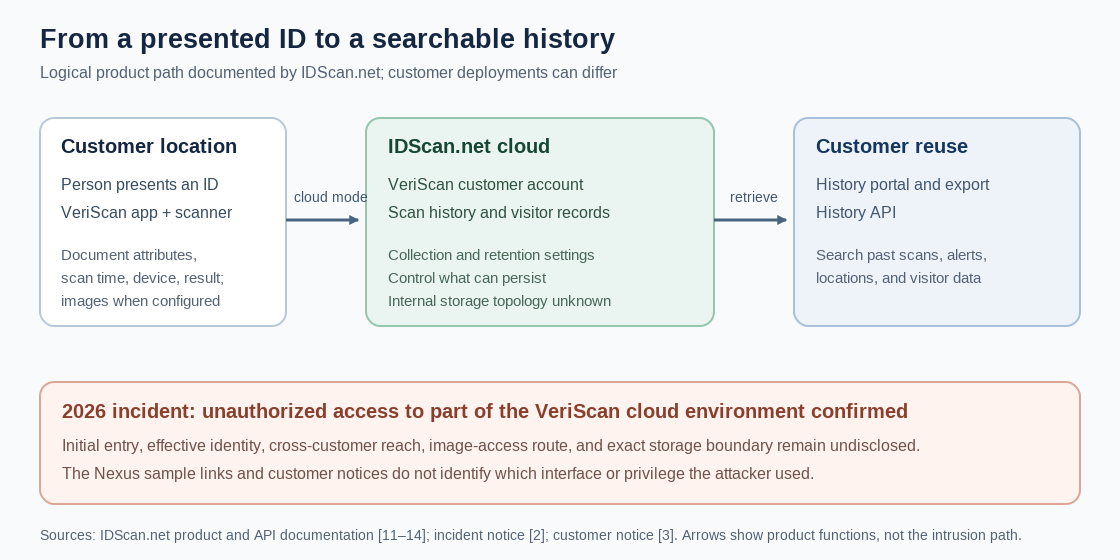
VeriScan’s technical documentation allows the logical architecture to be reconstructed without assuming knowledge of its internal database implementation. The platform distinguishes several kinds of information. [13][14]
| Data layer | Examples | Operational purpose |
|---|---|---|
| Document data | Name, birth date, ID number, expiration, issuing jurisdiction | Interpret and identify the presented document |
| Verification result | Authentication status, validity, alerts | Support the immediate decision |
| Scan history | Timestamp, device, store, scan identifier | Preserve the event |
| Visitor profile | Returning identity, tags, groups, visit associations | Support continuing recognition |
| Images and attachments | Cropped photos, front and back images, related documents | Provide supporting evidence |
| Reporting and API | Filters, exported history, aggregate analysis | Reuse stored information |
The documented History API retrieves scan records by date range and page; its example response includes identity attributes, local and UTC timestamps, location and device identifiers, alerts, and authentication statuses. [14] Collection settings separately distinguish cropped ID or live photographs from higher-resolution front and back document scans. [13] A single commercial interaction can therefore yield a verification result, an event record describing where and when the scan occurred, and potentially a persistent identity record that supports recognition on later visits.
Each object serves a different purpose. A business may need evidence that an age check occurred without keeping a full license image indefinitely, or recognize repeat visits without retaining every attribute printed on the card. A disputed transaction could justify a temporary high-resolution image without justifying the same retention period for every scan. The security question is how each object is limited by the purpose, authority, and useful lifetime of the function it serves.
4.2 The retention defaults favored accumulation
The current VeriScan Cloud documentation provides unusually direct evidence about that design choice. [13] New accounts default to collecting all available data and retaining all records in the cloud without automatic deletion. Customers on certain higher-tier plans can change the collection and retention policies. Basic customers cannot change the default data-collection mode through the documented settings, and automatic retention-policy options are similarly restricted.
| Retention capability | Basic | Premium | Enterprise |
|---|---|---|---|
| Stop collecting personal data through the documented policy | No | Yes | Yes |
| Collect anonymized data only | No | Yes | Yes |
| Automatically delete all records after a specified period | No | Yes | Yes |
| Retain selected or anonymized data after purging PII | No | No | Yes |
The ID Authentication plan offers additional policy options. These published settings do not establish what every affected customer collected or retained during the incident, and other deletion mechanisms or legal requirements may apply. They do show the product’s current starting point: new accounts collect available data and retain records unless a customer can and does choose a narrower policy. That default is understandable for a product built around historical search and fraud analysis, yet it puts the burden of limiting the archive on configuration or other deletion processes.
Without such a change or removal process, the historical dataset can keep growing. The 2025 document images Krebs found are consistent with long-lived records, though they do not reveal the retention policy that preserved them.
4.3 The difference between preserving identity and preserving the document
Recognizing a returning visitor requires a persistent relationship between encounters, but that relationship need not reproduce the original document. A controlled identifier and limited supporting attributes may suffice for some uses, while a suspected forgery, chargeback, or recordkeeping duty may justify retaining specified evidence for a defined period. Separating these purposes makes it possible to ask which data each function actually needs and for how long.
One narrower design would return only whether a person met the required age threshold, keep a minimal receipt of the check where needed, and delete the source image after a short, defined interval. If a business needs visit history, a limited identifier scoped to that customer could link encounters without exposing the full license record to routine history queries. Evidence required by law or for a documented dispute could be held in a separate store, with access limited to the roles that need it and an expiry tied to that purpose. These are design alternatives, not a description of VeriScan’s implementation; the necessary evidence and period depend on the transaction and applicable duties.
Verification, repeat-visit recognition, and exceptional evidence retention need neither the same access to the original image nor the same retention period. VeriScan’s commercial evolution made all three useful to additional business functions within one information system. That expansion can keep the original document relevant long after a transaction ends, and the scale of a breach depends partly on whether the system preserves the distinctions among those uses.
4.4 Customer permissions are not the same as infrastructure isolation
Public documentation describes customer accounts, administrator permissions, locations, devices, and access to historical records. Those are application-level boundaries: a business can restrict staff access to records, settings, or exports and manage several locations without necessarily sharing visitor records with unrelated businesses. The documentation does not reveal the provider’s infrastructure boundaries, however, including whether customers had separate databases, storage, or encryption keys and which privileged services could reach more than one account.
IDScan.net’s March 2026 Data Processing Addendum describes access controls, encryption, monitoring, audits, and differentiated permissions intended to prevent unauthorized use of personal information. [15] Those contractual safeguards do not supply incident forensics. Multiple affected organizations could reflect access to shared infrastructure, several compromised accounts or credentials, or another route; the public evidence does not identify an IDOR flaw, broken tenant isolation, or a compromised administrator account.
The unanswered technical question is what authority let the attacker reach the affected records: that of an application user, an integration, a service component, or a privileged infrastructure role. Authentication and authorization logs, storage-access evidence, or a detailed forensic report would be needed to identify the boundary crossed. What the public record does establish is the customers’ dependence on the provider to protect identity data they no longer managed directly.
4.5 Nexus’s images reveal a missing part of the reconstruction
The public History API example shows identity attributes and scan metadata, but not the full set of high-resolution, infrared, and ultraviolet images Krebs observed on Nexus. Their presence does not show that the API was abused: a separate image-access function, another service path, or storage access could account for them, and no route has been established. That gap matters because rich document imagery changes the consequences of exposure beyond those associated with names, addresses, and ID numbers alone.
Authentic front and back images, facial photographs, signatures, and additional scan modalities can be useful to an attacker even though possessing them does not guarantee successful impersonation or bypass of another verifier. VeriScan may have correctly judged a document genuine; protecting the evidence it retained around that judgment is a separate guarantee.
5. What the Breach Exposed
5.1 Fraud prevention created a reason to accumulate more evidence
IDScan.net’s May 2026 account of fraud intelligence makes the incentive to retain records clear. Linking events across time can reveal suspicious IDs used at several locations, repeated invalid documents, or patterns that a single check would miss; visitor histories can also support operational security, disputes, and customer management. These are legitimate uses, yet their value increases the product’s dependence on historical comparison and makes retention part of what customers buy. The resulting tension is between accumulating evidence for future decisions and limiting the information reachable in a compromise.
Some security and regulatory functions require records, so the practical question is which historical relationships must persist and whether they require every original personal detail for the same duration. A fraud-intelligence loop can make additional scans useful to future analysis; without equally deliberate deletion and data-separation rules, it can also enlarge the archive of identity evidence.
5.2 Centralization changed the scale of responsibility
Centralization also redistributes responsibility. The customer organization decides why and on what basis an ID is collected, while the cloud provider may operate the systems that process, store, and protect its data. To the person presenting the card, the encounter still appears to be with a store, bank, or rental company, even though another organization may hold the resulting record and the person may have no direct relationship with it.
IDScan.net’s March 2026 Data Processing Addendum reflects that division by describing the company as a processor or service provider and the customer as a controller or another instructing processor, depending on the circumstances. [15] It provides for return or deletion when data is no longer needed for the services or within a specified period after contract termination, subject to exceptions. Those terms allocate duties without proving that every record, backup, or secondary processing system followed a particular deletion schedule.
An individual could therefore present an ID to one institution while another retained technical control of the resulting record. A provider compromise can affect people whose original interactions occurred outside the provider’s own premises, making each customer’s decision to delegate verification a dependency on the provider’s retention and access controls.
5.3 A post-incident contract addresses secondary use
The Master Services Agreement updated on October 9, 2026 defines Customer Data to include information and images from government-issued IDs and, subject to applicable law, permits its use to develop, train, and improve services, including AI systems. [16] This raises a distinct lifecycle question about secondary copies and derived material, but the text postdates the intrusion: it does not establish the terms governing affected customers at the time, that exposed documents were used for training, or that secondary use contributed to the breach. The Data Processing Addendum and product-specific terms may also constrain such processing.
5.4 Regulation can require a check without requiring an identity archive
Law can require an identity check while limiting what remains afterward. An age-restricted business may need to confirm eligibility, but some jurisdictions restrict retention of the information obtained in doing so; Illinois’s Cannabis Regulation and Tax Act distinguishes the check from collecting, recording, retaining, and using a purchaser’s personal information. [17] Regulated financial services may face different recordkeeping duties, so no single retention period fits every verification context.
Against that variation, a default of collecting everything and retaining it without automatic deletion requires customers to determine whether the default suits their own legal and operational purpose. Subscription tiers that restrict alternative settings also constrain how they can act on that decision. The age-result, limited visit identifier, and separately protected evidence store described above show that a check, a useful history, and legally required proof need not inherit one collection rule, access path, or deletion date. This is not evidence that IDScan.net or a particular customer violated a retention law; it identifies which parts of the archive follow from a particular duty and which reflect choices about operating the business.
5.5 Litigation exposed the divided responsibility
Litigation following the incident named both the technology provider and businesses using its services. A proposed class action filed in the Western District of Texas on September 7 named Hertz and IDScan.net; another filed in the Eastern District of Louisiana on September 23 named IDScan.net, Hertz, and Planet 13. [18][19] The complaints are allegations, not findings of negligence, contract breach, or the cause of any theft. They do, however, contest an arrangement in which one business requested an ID and a separate technology company processed the resulting information.
Operational duties split between those organizations, but accountability after exposure may be contested. Harborside’s October notice illustrates the customer-side response: although it did not describe an intrusion into its own systems, the company said it was reviewing retention policies, privacy practices, and oversight of vendors handling customer information. [3] Its review reached the decision to collect and share the information, a boundary that precedes any technical control inside the provider’s cloud account.
5.6 The remaining unknown is the precise authority that failed
Public evidence supports reconstruction of the business and data architecture but leaves the exploit unresolved. Stolen credentials, a software flaw, an administrative interface, or compromised infrastructure could have provided entry, and records from different customers might have been reached through one privileged route or several separate compromises. The record does not establish that every Nexus item came from VeriScan or identify a specific failure in customer separation, storage protection, or deletion beyond the unauthorized cloud access the company confirmed.
Those limits matter when assessing how the attacker entered or which authority failed, but the consequences of access can still be traced through documented choices. Historical functions encouraged accumulation; centralized operation offered management and endpoint-security advantages; APIs and reports let customers search and reuse records; and contracts divided collection, processing, protection, and deletion duties among organizations. Together they produced a long-term information asset whose protection depended on the provider, even though the incident’s exact technical failure point remains undisclosed.
6. Conclusion — What Did Identity Verification Actually Guarantee?
The established facts of the 2026 IDScan.net incident are narrower than the advertised scale of Nexus. Its operators claimed more than 153 million driver’s-license records; Krebs verified genuine documents and traced several to transactions associated with IDScan.net, while the company confirmed unauthorized access to part of its VeriScan cloud environment. The number of distinct affected people, the full relationship between Nexus’s inventory and that intrusion, and the access method remain unknown. The platform’s development is more visible: by 2015, IDScan.net was already selling cross-location visitor histories and returning-customer analysis alongside document scanning.
Legal guidance on collection and retention entered its business by 2019; by 2023, searchable and exportable history, configurable retention, and centralized storage had expanded the existing archive. In May 2026, the company described using accumulated scan histories to improve future fraud detection and operating decisions. Each addition addressed a recognizable business need and gave information from a temporary check another possible use. The platform consequently had more to protect than the immediate answer to whether a presented document and its attributes could be trusted for one transaction.
A historical identity platform must also protect records of past checks, the relationships among them, and the privileges through which they can be retrieved. Correctly authenticating a document does not secure that retained history, and the value of historical analysis does not give every original image the same reason to persist. By the time of the incident, information collected to establish identity had become an operational resource that could include document images and scan evidence long after the transaction, visit, and immediate verification purpose ended.
Unauthorized access to the environment holding those records placed past transactions within the incident’s potential scope. The public evidence does not show that VeriScan misjudged a document’s authenticity; it shows the security consequence of preserving evidence around those judgments. Identity verification had become an identity archive, and protecting that archive required a guarantee distinct from the ability to establish identity at the counter.
References
Incident reporting and official disclosures
[1] Brian Krebs, FBI Probes Service Selling 153M+ Drivers Licenses, KrebsOnSecurity, September 1, 2026. Original examination of Nexus, searchable records, document images, scan timestamps, connections to Hertz and Planet 13, and FBI involvement.
[2] IDScan.net, Notification of Data Security Incident, initially published September 4, updated September 29, 2026. Official investigation findings concerning the intrusion window, affected platform, and potential categories of personal information.
[3] Harborside, Notice of Data Breach, October 3, 2026. Detailed description of potential identity-document, image, scan-location, and authentication-result exposure.
[4] Urbn Leaf, Notice of Data Breach, October 3, 2026. Related retail-brand notification describing information processed by VeriScan.
[5] Office of the Privacy Commissioner of Canada, Privacy Commissioner of Canada Launches Investigation into a Data Breach Involving Stolen Identification Details, September 21, 2026. Official investigation of safeguards and breach notification under PIPEDA.
[6] PeoplesBank, Notice of Third-Party Data Security Incident, Massachusetts consumer-protection breach-notification records, 2026. Banking-sector example of third-party identity-verification exposure.
Historical development of the identity verification business
[7] IDScan.net, VeriScan Desktop — The Setup Tab. Documentation distinguishing local database files, SQL Server configurations, and cloud-based storage.
[8] IDScan.net, IDScan.net Releases Cloud Scanning Solution for Android, August 19, 2015. Early cloud-based visitor management, multi-location aggregation, marketing information, and visitor-history reporting.
[9] IDScan.net, IDScan.net Acquires Legal Resource IDScanningLaws.com, July 17, 2019. Integration of state-specific legal requirements into the identity scanning business.
[10] IDScan.net, What Your ID Scan Logs Can Tell You About Fraud Trends, May 1, 2026. Description of historical scan records, searchable databases, fraud intelligence, recurring patterns, and the use of past events to inform future verification.
[11] IDScan.net, Product Update: New Features in the VeriScan Cloud Portal, April 10, 2023. Scan-history filters, exports, photo-based review, retention controls, and location-specific compliance settings.
[12] IDScan.net, VeriScan for Windows Gets a Major Facelift, March 2023. Centralized cloud storage, removal of retained PII from endpoint devices, visitor-history functions, and document-image attachments.
Technical architecture, data protection and contractual boundaries
[13] IDScan.net, How Can I Control What Visitor Data Is Collected and Retained?, VeriScan Cloud support documentation. Data collection defaults, retention options, plan restrictions, and distinctions between images and attachments.
[14] IDScan.net, VeriScan Cloud API Manual — History. Public specification of scan-history fields, date filtering, pagination, and authentication-result metadata.
[15] IDScan.net, Data Processing Addendum, updated March 7, 2026. Controller/processor relationships, return and deletion obligations, audit provisions, and organizational and technical security measures.
[16] IDScan.net, Master Services Agreement, updated October 9, 2026. Customer Data definition, service-improvement and AI-training permissions, security obligations, and post-termination data access.
Regulation and litigation
[17] Illinois General Assembly, Cannabis Regulation and Tax Act, 410 ILCS 705/10-20. Statutory provisions governing identity checks and the collection, recording, retention, and use of purchaser information.
[18] U.S. District Court for the Western District of Texas, Hasenzahl v. Hertz Corporation et al., No. 5:26-cv-05735, filed September 7, 2026. Civil litigation naming Hertz and IDScan.net.
[19] U.S. District Court for the Eastern District of Louisiana, Pugh et al. v. IDScan.net, Inc. et al., No. 2:26-cv-02134, filed September 23, 2026. Civil litigation naming the identity provider and commercial customers.
Evidentiary Scope
This article is an independent analysis of publicly available incident reporting, vendor disclosures, product documentation, contractual terms, regulatory announcements, and court records. It does not rely on private access to Nexus’s complete dataset, IDScan.net’s cloud infrastructure, internal forensic reports, authentication logs, or customer-specific storage configurations. Nexus’s advertised record counts have not been independently established as the number of distinct affected individuals. The full correspondence between Nexus’s inventory and the confirmed VeriScan intrusion remains unknown. IDScan.net has confirmed unauthorized access to part of the VeriScan cloud environment, but it has not publicly established the initial intrusion method or the precise authorization and storage boundaries crossed by the attacker.
The architecture discussed here is a logical reconstruction from documented product features. It does not establish the actual database topology, storage-provider configuration, encryption-key hierarchy, or cause of the incident. The current VeriScan retention documentation establishes published product defaults and available controls, not the historical configuration of every affected customer. The October 9, 2026 Master Services Agreement is a post-incident document. Its terms cannot be assumed to have governed the intrusion period, and its provisions concerning AI development do not establish that compromised identity documents were actually used for model training. Civil complaints are allegations, not judicial findings. The regulatory investigations discussed here were ongoing as of the research cutoff.