How PingCAP’s breach exposed the difference between completing a security procedure and securing the authority left behind.
Incident Analysis · PingCAP · TiDB · Cloud Security · Credentials · Incident Response
Based on public information available as of October 26, 2026.
Abstract
Between September 9 and October 7, 2026, an attacker used compromised credentials to move through PingCAP’s internal GitHub repositories, Google Cloud infrastructure, Jira support system, and cloud storage. The attacker obtained source code, customer-related records, SQL editor history, billing information, and diagnostic material, although an independent investigation found no evidence of access to data stored in customers’ live TiDB databases. PingCAP’s 2025 SOC 3 report described documented security responsibilities, access reviews, multifactor authentication, code-change approvals, and incident-response procedures for a defined managed-service system and its supporting functions.
The intrusion did not establish that those controls were absent. It showed how credentials retained in legitimate operational materials could extend an attack into other systems: keys in Git history and Terraform state opened paths into cloud services, while AWS credentials supplied through customer support allowed access to S3 buckets containing diagnostic data. Earlier incidents at Okta, Cloudflare, and CircleCI reveal related limits in remediation, from a rotation campaign that left usable credentials behind to a provider identifying customer secrets it lacked the authority to revoke.
These cases do not establish that a handoff was absent inside PingCAP. They establish a narrower problem worth testing: completing the operational task does not, by itself, show that the resulting security state was examined and brought to an acceptable end. Sometimes that requires a transfer between parties with different information and authority; in other cases it requires a decision about whether a technically permitted operation serves its intended purpose.
1. The Database Company and Its Internal Data
PingCAP develops the open-source distributed SQL database TiDB and operates TiDB Cloud as a managed service. Customers rely on the company not only to store and query database contents but also to run monitoring, configuration management, billing, diagnostics, and technical support. Those activities produce additional information about customers and their systems, which became central to the October 2026 intrusion.
According to NebuSec, the external firm that investigated the intrusion, the attacker obtained source code and records from internal analytics, storage, and support systems. The material included customer contacts, contracts, billing records, SQL editor history, AI interactions, gateway connection logs, and cluster configuration information. [1] These records can describe how a customer operates its database without revealing every row stored in it: query history shows the text a user entered, configuration describes connected systems, and support records can contain diagnostic SQL, logs, connection details, and credentials.
Within the production environments it reviewed, NebuSec found no evidence of attacker command execution, persistence, or access to data stored in live customer TiDB databases. That limits what can be said about a production database compromise, while leaving the exposure of information collected and retained in surrounding systems intact.
1.1 Not all exposed credentials had the same protection
The exported internal data included encrypted TiDB Cloud API-key values whose encryption key was not exposed; investigators concluded that the stored values could not be turned into usable API credentials without it. That protection did not extend to every credential retained elsewhere. The investigation found service-account private keys in Git history and plaintext Terraform state, while AWS credentials supplied by customers through Jira support tickets were used to reach S3 buckets holding TiDB diagnostic data. [1] The contrast is between a protected class of stored API-key values and directly usable credentials preserved by different development and support processes.
2. From GitHub to Customer Credentials
The attack proceeded through credential discovery, authentication, cloud API operations, and data collection, rather than through a demonstrated exploit of the TiDB database engine.
2.1 The initial access and internal expansion
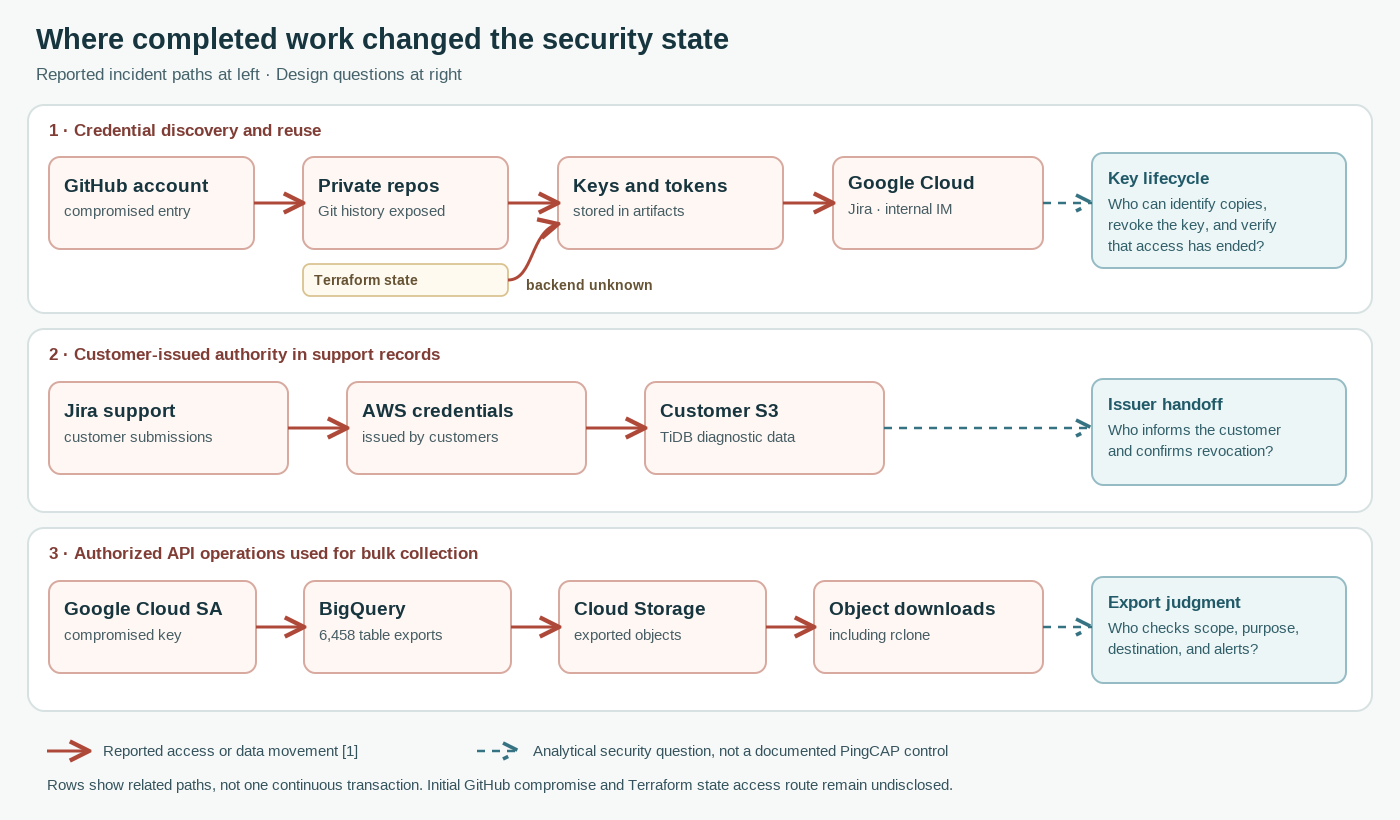
The attacker entered through a compromised GitHub account and obtained access to private repositories, although NebuSec did not report how that account was compromised or which login protections applied. The repositories and Terraform state contained keys and tokens that opened access to Google Cloud, Jira, and an internal messaging environment used for TiDB alerts. Investigators found service-account private keys in Git commit history, plaintext credentials in Terraform state, and other API tokens in source code or configuration files; they recorded authentication through eight compromised Google Cloud service accounts. [1] Rather than gaining new privileges by exploiting Google Cloud IAM, the attacker exercised authority already attached to legitimate identities.
Those steps matter when assessing controls. Human login MFA, code review, and cloud IAM govern different operations: MFA on an engineer’s interactive session does not necessarily stop direct API authentication with a stolen service-account key, and approval of infrastructure code does not establish that credentials retained by the resulting workflow are securely stored.
2.2 The bulk export from BigQuery
On September 23–24, the attacker used a compromised Google Cloud service account to submit BigQuery extract jobs. NebuSec identified google.cloud.bigquery.v2.JobService.InsertJob operations that exported 6,458 internal tables to Cloud Storage as compressed .json.gz objects; this number does not represent customer production databases. The attacker later explored Cloud Storage and downloaded objects, including through rclone between October 2 and October 5, using ordinary object-access operations. [1] Google Cloud documents the separate permissions needed to export source tables, create jobs, and write objects to the destination bucket. [5]
Data extraction is an intended warehouse operation, so the existence of export permissions alone does not establish a vulnerability. The relevant questions are which identities held the combined permissions, how broadly they applied, and what limited data movement outside the identity’s intended task. PingCAP removed excessive cross-project permissions during containment, but that later change does not identify which historical grant enabled each export; the earlier IAM configuration and job records would be needed to determine that.
2.3 Customer support became another access path
The attacker also reached Jira, where support tickets contained credentials that customers had supplied during ordinary troubleshooting. Among them were AWS keys that the attacker used to access several S3 buckets containing TiDB diagnostic data. [1] This path crossed a different authority boundary from the BigQuery exports: the customers had issued credentials for resources in their own AWS environments, and sharing those credentials with support had placed an existing authentication capability in another organization’s records. Anyone who subsequently obtained a usable copy could exercise its permissions, so a support ticket became a means of reaching a different security domain without any change to the customer’s AWS policy.
2.4 Containment and disclosure
| Date (UTC) | Documented event |
|---|---|
| September 9–10 | Compromised credentials used to explore cloud resources |
| September–early October | Credentials from repositories and infrastructure files used to reach Google Cloud, Jira, and internal systems |
| September 23–24 | 6,458 BigQuery tables exported to Cloud Storage |
| October 2–5 | Cloud Storage data downloaded, including through rclone |
| October 7 | PingCAP detects the incident and begins disabling affected credentials |
| October 10 | Additional Cloud Storage access logging enabled; excessive cross-project permissions removed |
| October 12–14 | Four vulnerabilities discovered during source-code review, patched, and retested |
| October 19 | PingCAP publishes its initial incident report |
| October 21 | NebuSec publishes its investigation |
| October 23 | CEO Max Liu publishes a further statement and customer guidance |
Sources: NebuSec and PingCAP. [1][2][3]
PingCAP and NebuSec report that all identified compromised credentials were invalidated and identified unauthorized access paths were closed. PingCAP separately advised customers to rotate credentials shared with support; these public statements do not establish that every customer-issued key had been revoked. [1][3] The four newly identified source-code vulnerabilities had potential implications for production data, but investigators found no evidence that the attacker had exploited them before they were fixed. The observed intrusion therefore remains a case of credentials and data obtained from supporting systems, rather than demonstrated exploitation of the production database engine.
3. The Controls PingCAP Had Already Built
PingCAP’s published SOC 3 report covers the TiDB Managed Cloud Services system from May 1, 2024, through April 30, 2025. [4] It assigns oversight of security and internal controls to the CISO, secure development to Engineering, service operations and anomaly monitoring to SRE, corporate-system administration to IT, and customer-issue resolution and escalation to Customer Success. It also describes role-based access controls, multifactor authentication, user-access reviews, encryption, static code analysis, peer-reviewed changes, and security monitoring.
The report also described categories of supporting tools associated with the managed service, including version control, monitoring, analytics, internal messaging, ticketing, and orchestration. Its audit covered a defined system and historical period; it did not establish the exact 2026 configuration of every affected GitHub repository, Jira project, or BigQuery dataset, or the operating effectiveness of controls at excluded cloud subservice organizations. Within that scope, however, it provides a concrete example of how PingCAP connected a business operation to a security procedure.
3.1 A production change had an observable authorization process
The report’s manual production-change process makes one responsibility transfer visible. An engineer creates a ticket for the proposed change and obtains approval before implementation; commands executed through AWS Systems Manager are logged to a dedicated S3 bucket, and management reconciles the logs against approved tickets. A command without a matching ticket indicates a potentially unauthorized change requiring investigation. [4, p. 9] The procedure therefore connects authorization, execution, and review, instead of merely saying that production changes should be approved.
The report describes a second transfer when an employee leaves: HR or the departing employee creates a termination ticket, and access must be revoked within two business days. Both procedures specify the event that starts security work, the party expected to act, and a condition against which completion can be checked.
3.2 A support ticket had a different documented purpose
Customer Success was also responsible for resolving customer issues and escalating them as needed, but resolving a support request does not necessarily resolve the status of a credential submitted with it. A Jira ticket containing a customer-issued AWS key could be assigned, investigated, and closed for its business purpose while the key remained valid. The public SOC 3 description does not identify a procedure that necessarily starts when such a credential enters a ticket and ends only after its authority has been removed.
The incident establishes the narrower point that customer-provided AWS credentials remained in material accessible to the attacker and were used against AWS resources. To explain why, one would need to know whether the keys were detected when submitted, whether an alert or revocation request was assigned, whether the issuer was contacted, and whether validity was checked before the case closed. Those records would distinguish a missing control from a detection failure, unfinished action, or incorrect completion decision.
3.3 What the records establish—and what they do not
| Area | Documented control or event | What remains unresolved |
|---|---|---|
| Production changes | Approval tickets, SSM logs, management reconciliation | Not implicated as the observed intrusion path |
| GitHub | Peer review, branch protection, static analysis | Historical secret-scanning coverage, alerts, and credential revocation |
| Terraform | Infrastructure managed through reviewed code changes | State storage, access scope, and credential detection at the time |
| Customer support | Ticket handling and escalation responsibilities | Credential detection, isolation, issuer notification, and revocation tracking |
| Google Cloud | IAM and security monitoring responsibilities | Historical effective permissions and alert results for the bulk exports |
| Incident response | Identified credentials revoked, permissions reduced, additional logging enabled | Whether earlier controls had detected any of the activities |
The unresolved entries identify evidence needed to explain the observed operations; they do not assert that the corresponding controls were absent.
4. Where Operational Work Changed Security State
The incident shows three ways in which legitimate systems gave an attacker access to another resource or enabled data movement. Figure 1 maps the paths reported by NebuSec and sets beside each the security question it raises. The first two concern credentials retained after development or support work, with Jira also dividing observation from revocation authority across organizations. The BigQuery path is different: the service account could submit an allowed extract job, while whether the job served that identity’s intended purpose required a separate judgment. The diagram’s questions are analytical prompts, not findings about PingCAP’s controls.
4.1 Terraform: the approved operation and its sensitive artifact
Infrastructure-as-code makes changes reproducible and reviewable, while Terraform state records the resources managed by those changes and can contain sensitive values, including credentials. Google Cloud recommends separating state from source control, restricting access to its backend, and avoiding secrets in state where possible. [6] A reviewed pull request can therefore deploy the intended infrastructure successfully while leaving a usable service-account key in an artifact accessible beyond the intended operators. Approval of the code establishes authority to make the change; it does not establish the confidentiality or continued validity of every credential retained by the workflow.
At PingCAP, keys in Git history and plaintext Terraform state helped the attacker reach additional cloud services. The unpublished state-storage configuration, secret-detection coverage, and credential-rotation history would show whether those artifacts went unnoticed or whether a detected exposure failed to produce effective action.
4.2 Jira: deleting information and revoking authority are separate operations
The support case is the clearest cross-organization example because the credential belonged to a customer’s AWS account. If PingCAP’s support system detected an access key in a submission, it could isolate or redact the text, restrict the ticket, or notify a security administrator. Those actions would reduce exposure inside PingCAP but would not necessarily invalidate the key; unless PingCAP had delegated authority over the customer’s account, revocation required the customer or another authorized party to act.
Removing the string from the visible ticket and removing its power to authenticate are therefore different completion conditions. The ticket did not create AWS privileges, but it placed a copy of an existing credential where more people could obtain it, changing the effective set of credential holders without changing the issuer’s IAM policy. The customer could control that policy while lacking visibility into copies held by the support provider; the provider could see a copy while lacking the authority to revoke it.
A complete handoff would identify the issuer, request replacement or revocation, and verify an appropriate end state. The observed result in this case is that the attacker exercised authority carried by credentials in Jira.
4.3 BigQuery: a successful data operation is not a security decision about its purpose
BigQuery exports involve a different boundary. Google Cloud separates permission to export source tables from permission to create extract jobs and write objects to Cloud Storage. A service account may legitimately combine those capabilities for an analytical pipeline: for example, roles/bigquery.dataViewer includes bigquery.tables.export, while job creation and storage writes require additional permissions. [5]
The concern is whether those combined permissions reach more resources than the identity’s intended task requires and whether the volume or destination of an export departs from expected activity. IAM can permit an extract job without deciding whether it serves the caller’s business purpose. In this incident, the attacker exported 6,458 tables through the documented API; PingCAP later removed excessive cross-project permissions and enabled additional Cloud Storage access logging. Those actions warrant examination of both access scope and bulk-export monitoring, but public records do not identify the grant behind every job or show which alerts, if any, fired. Broad grants, missing detection, and alerts that were not acted upon remain different explanations.
4.4 The difference between copying data and preserving its protection
NebuSec reported that support data had also been copied into BigQuery alongside other customer and operational records. The ingestion pipeline has not been published, and there is no evidence that the particular AWS key abused through Jira was reproduced in BigQuery. The general architectural concern nevertheless remains: after a data pipeline is approved, it may keep ingesting new records into a destination with different permissions, retention rules, and monitoring from the source.
Google Cloud documents one example of that distinction: column-level policy tags are generally not propagated to a table derived from query results or to a Cloud Storage export. [7] This does not show that PingCAP used policy tags or lost them in the incident. It shows why permission to copy data cannot, by itself, establish that every protection applied to the source survives at the destination.
5. The Same Work After Other Breaches
The distinction between operational completion and security completion is not unique to PingCAP. Earlier incidents provide unusually concrete evidence of what can happen when the two diverge.
5.1 Okta, 2023: a support file retained authentication authority
In 2023, an attacker accessed files associated with 134 customers in Okta’s support case management system. Some were HTTP Archive (HAR) files that customers had supplied to diagnose authentication problems, but those files also contained reusable session tokens. Okta confirmed that the attacker used the tokens to hijack sessions belonging to five customers. [8] The same file thus served as troubleshooting evidence in one workflow and as a source of authentication authority in another.
The investigation had a second handoff problem. Okta initially examined events linked to support cases, while the attacker downloaded files through a different interface that produced different event types and identifiers. The suspicious downloads were not identified until investigators connected those records to the activity they were trying to explain. [8] The case illustrates how retaining a credential in a legitimate support artifact can be compounded by logs that do not make every way of accessing that artifact equally visible to investigators.
5.2 Cloudflare, 2023: the rotation campaign finished, but valid credentials remained
Cloudflare’s response to the same Okta incident shows that assigning and carrying out a security task can still leave authority behind. It began a large credential-rotation effort, but excluded one service token and three service accounts because they were mistakenly believed to be unused. The attacker later used some of those credentials to reach Jira, Confluence, and Bitbucket, while another exposed account reached a separate AWS environment. [9] The error was in the criterion for finishing the rotation: an account could be unnecessary for current work and still accept authentication.
Cloudflare’s subsequent remediation was extensive. It rotated more than 5,000 credentials, searched for secrets that might have been left in Jira tickets or source code, and examined and deleted HAR files uploaded to its wiki. [9] That work matters to the later comparison because it demonstrates an ability to investigate credentials in business records; it does not establish that every system containing similar records was thereafter covered by the same recurring process.
5.3 Cloudflare, 2025: a different support system contained the same class of information
In August 2025, attackers used compromised Salesloft Drift integration credentials to access Cloudflare’s Salesforce environment, which served customer support and internal case management. On August 17, they used the Salesforce Bulk API to extract support-case text; Cloudflare said that attachments and files were not included in this export. [10] The text could still contain configuration details, passwords, or API tokens that customers had supplied during troubleshooting. Cloudflare found 104 Cloudflare-issued API tokens in the affected support-case data, rotated all of them, and reported no suspicious activity associated with those tokens.
Two years earlier, Cloudflare had searched Jira, source code, and wiki-hosted HAR files for secrets during another incident. The 2025 response found the same general class of information in Salesforce, a different business system reached through a new integration. That sequence does not establish that Cloudflare lacked ongoing secret detection in Salesforce before the breach, or that the earlier campaign was meant to cover every future system. It shows the narrower operational limit: completing a search and rotation against a known set of records does not by itself make that work recur whenever another service begins holding similar material.
5.4 The vendor’s containment did not immediately become the customer’s investigation
The 2025 report also documents a delay between vendor containment and customer investigation. Salesloft revoked Drift-to-Salesforce connections across its customer base on August 20; Cloudflare said it learned of its own involvement on August 23 and expanded its investigation after receiving further information. [10] Salesloft could close the compromised integration, but only Cloudflare could inspect its support records and revoke Cloudflare-issued tokens found there. Revoking the OAuth connection could prevent its further use, while leaving data already exported and any credentials inside that data untouched.
The attacker had completed the initial export on August 17, so notification on August 20 would not have prevented that extraction. The timing nevertheless shows why containment at one organization cannot complete the downstream review at another: each holds different information and authority, and the second task begins only when the affected party can identify what needs examination.
5.5 CircleCI, 2023: the exposed secrets belonged to other systems
CircleCI’s December 2022 intrusion adds the problem of who can revoke an exposed secret. An attacker stole an engineer’s authenticated session and reached production systems containing customer environment variables, tokens, and keys; CircleCI disclosed the incident in January 2023. [11] It could revoke credentials it controlled and coordinate rotation with some integrated providers, but other secrets belonged to systems operated by customers. CircleCI explicitly said it could not determine whether those third-party credentials had been used against the external systems that accepted them.
During remediation, CircleCI worked with AWS to notify affected customers, released tools to help identify secrets needing rotation, and added an updated_at field to its Contexts API so customers could verify when stored variables had changed. Those measures helped identify and perform the work, but replacing a value in CircleCI does not prove that its old value has been revoked by the issuer. [11] The provider storing the credential and the system recognizing it as authority remain separate, just as they were when customer-issued AWS keys remained in PingCAP support material.
6. What Makes a Security Responsibility Executable?
Across these cases, the unfinished work took different forms. Okta retained tokens in diagnostic files and initially missed downloads recorded through another interface; Cloudflare’s 2023 rotation excluded four credentials misclassified as unused, while its 2025 response had to examine a new support system for sensitive text. CircleCI could identify customer secrets without controlling every system that accepted them. PingCAP’s support system likewise held customer-issued credentials, alongside sensitive artifacts in its development and analytics systems. The shared problem is not necessarily a missing handoff: it is that completion inside one workflow does not prove the resulting security state is acceptable. A handoff is one response when observation and corrective authority belong to different parties; when the same identity can perform a technically allowed bulk export, the response instead depends on defining its intended purpose and reviewing departures from it.
The useful test is to follow the operation that changes the security state and ask who can recognize that change, decide whether it is acceptable, act with the required authority, and verify the result.
6.1 The five conditions
- Trigger: Which event requires a security decision? Examples include a customer submitting an AWS key, an infrastructure workflow producing state that contains credentials, or a service account beginning an unusual bulk export.
- Observation: How does the organization learn that the event occurred? Content inspection, scanning of infrastructure artifacts, IAM events, and correlated cloud audit logs observe different parts of these workflows.
- Assignment: Does the observation create a task for a named owner? An alert with no party responsible for its resolution may leave the underlying condition unchanged.
- Authority: Can that owner correct the condition? A Jira administrator may remove a credential from a ticket but cannot necessarily revoke it in a customer’s AWS account. Likewise, an integration vendor can close its OAuth connection without revoking credentials contained in data already exported from a customer’s system.
- Verification: What shows that the security condition has actually changed? Deleting a string does not invalidate its leaked copies; classifying an account as unused does not show it cannot authenticate; closing a support ticket does not establish that every secret in it has expired.
These questions are a way to test whether an assigned responsibility has become an executable and verifiable operation, rather than a replacement for established security standards.
6.2 The distinction is visible in products that implement the handoff
GitHub’s secret-scanning partner program offers one concrete implementation of such a transfer. When it detects a supported provider credential in public repository content, GitHub notifies the issuer, which can validate the string and decide whether to revoke it, replace it, or contact its owner. [12] The observer and issuer are different parties, but a specific event produces a notification to the party capable of acting. This mechanism does not cover every credential format or storage location; its relevance here is the explicit connection between detection and authority.
6.3 The engineering organization trap
The trap is to let each team define completion inside the tool it operates without giving anyone the whole state needed for the next decision. In the Jira example, a customer can revoke its AWS key but may not know where copies remain in a support system. A support agent can see that a key arrived but cannot necessarily disable it; a security team may not know it was submitted; and the customer’s AWS administrator may not know that support received it. Expertise at every desk would still be insufficient if no event connects these partial views into an assigned task. The question is not simply whether a senior engineer would make the right call, but whether the facts that require a call ever reach someone whose job includes making it.
PingCAP’s SOC 3 report describes a contrasting production-change process within its audited scope: a request and approval, an execution record, and a reconciliation step that makes an unmatched command something to investigate. [4, p. 9] That process creates an opportunity for judgment and a way to check the result. A corresponding design for credentials in support records or infrastructure artifacts would need an observable event, a named owner, access to the issuer when revocation is needed, and evidence that the old credential can no longer authenticate. The records needed to test whether those steps occurred for the affected 2026 workflows are set out in §6.4.
Once a decision is assigned, senior judgment still matters. A reviewer should ask whether a workload needs a persistent Google Cloud service-account key at all; Google’s guidance prefers other methods where possible and calls for justification and lifecycle controls when user-managed keys remain necessary. [13] Likewise, a support owner should ask whether troubleshooting requires a customer to submit AWS credentials, given AWS’s preference for temporary credentials where possible. [14] An approved exception needs an owner, an expiry condition, and proof of closure, because approving urgent work does not authorize indefinite credential retention. BigQuery asks a different question: the relevant owner must define the identity’s legitimate export purpose, scope, volume, and destination, then connect those expectations to grants, audit records, and investigation of unusual jobs. That is a judgment about allowed operations, not automatically a transfer of revocation responsibility to another organization. These are design proposals, not claims about PingCAP’s unpublished controls.
6.4 What would distinguish the competing explanations at PingCAP?
For PingCAP’s customer AWS keys, four possible explanations remain consistent with the published facts.
- No applicable process existed to detect and track external credentials submitted through support.
- A process existed but did not detect the affected keys.
- A detection or notification occurred, but the required action was not completed.
- The case was treated as resolved although the credentials remained valid.
Ticket-processing rules, detection results, alerts, customer notices, and confirmation of revocation would distinguish these explanations for the AWS keys. Terraform requires a different set of records: backend configuration, access permissions, scanning history, and credential issuance and revocation. BigQuery requires historical IAM grants, extract jobs, storage destinations, and alerts to test whether technically authorized jobs departed from the identity’s expected work. Those records could reveal missing tasks, tasks that stalled, incorrect closure decisions, or controls that operated as designed but were too narrow for the observed activity. The published findings establish the attacker-used paths, not which explanation applies to each one.
7. Conclusion
PingCAP’s intrusion was serious even though investigators found no evidence that the attacker accessed the contents of live customer TiDB databases. Customer information in the systems around those databases was copied; cloud credentials preserved in development artifacts and AWS keys retained in support records gave the attacker additional authority. The company’s earlier SOC 3 report described a security management system with assigned responsibilities and detailed procedures, including a manual production-change process in which requests were approved, commands were logged, and execution was reconciled against authorization. A command without an approved ticket would require investigation.
The three PingCAP paths demand different security decisions. Git history and Terraform state preserved usable authority after development work; customer-issued AWS keys in Jira placed revocation outside the support provider’s control; and the BigQuery exports were technically permitted jobs whose volume, scope, and destination had to be evaluated against the service account’s intended work. The first two make credential discovery, ownership, and invalidation central. The third makes purpose, permission scope, and detection central. Treating all three as proof of one missing PingCAP handoff would outrun the evidence, but treating successful deployment, ticket resolution, or job completion as proof of a safe end state would miss what the intrusion exposed.
The comparable cases show distinct ways that gap can persist. Cloudflare’s 2023 rotation was performed yet left valid credentials classified as unused; its later support-system breach required a new search of customer-submitted information. CircleCI could identify secrets but needed their issuers to replace them. These examples make the article’s claim more precise: local completion is an unreliable certificate of system-wide security, and a handoff is necessary where the party that sees a problem cannot finish the correction. Senior judgment matters only after an event, a record, and an owner give someone the chance to exercise it. The practical test is whether the changed security state becomes visible to a person who can decide what it means, bring in the party with corrective authority when needed, and verify the result.
References
Incident Reports and Forensic Findings
[1] NebuSec. Investigating the PingCAP Security Incident: Credential Exposure and Cloud Data Collection. October 21, 2026. Independent investigation of credential exposure, cloud activity, data collection, and remediation.
[2] PingCAP. Security Update — October 2026. October 19, 2026. Initial disclosure, affected data categories, containment chronology, and remaining response work.
[3] Max Liu, PingCAP. A Note from Our CEO on Our Security Incident. October 23, 2026. Management statement, customer guidance, and security commitments.
Governance and Technical Documentation
[4] PingCAP (US), Inc. Independent Service Auditor’s SOC 3 Report for the TiDB Managed Cloud Services System. Audit period: May 1, 2024–April 30, 2025. System scope, organizational responsibilities, access controls, and change management.
[5] Google Cloud. Export Table Data to Cloud Storage. Required BigQuery export, job-creation, and Cloud Storage permissions.
[6] Google Cloud. Best Practices for Security — Terraform on Google Cloud. State protection, backend access restrictions, and sensitive information in state files.
[7] Google Cloud. Restrict Access with Column-level Access Control. Data-access policy behavior and limitations on propagation to derived data and exports.
Comparable Incidents
[8] Okta. Unauthorized Access to Okta’s Support Case Management System: Root Cause and Remediation. November 3, 2023. Support-file access, HAR session tokens, and investigation-log differences.
[9] Cloudflare. Thanksgiving 2023 Security Incident. February 1, 2024. Credential-rotation failure, Atlassian intrusion, and searches for secrets in internal materials.
[10] Cloudflare. The Impact of the Salesloft Drift Breach on Cloudflare and Our Customers. September 2, 2025. Salesforce compromise, support-case exports, credential identification, and response chronology.
[11] CircleCI. CircleCI Jan 4, 2023 Security Incident Report. January 12, 2023. Customer-secret exposure, external-provider coordination, and remediation tooling.
Credential Detection and Responsibility Transfer
[12] GitHub. Secret Scanning for Partners. Detection of supported provider credentials and direct notification to credential issuers.
Security Practice Documentation
[13] Google Cloud. Best Practices for Managing Service Account Keys. Authentication alternatives, key-exposure risks, and controls when user-managed keys are necessary.
[14] Amazon Web Services. Security Best Practices in IAM. Preference for temporary credentials over long-term access keys where possible.
Evidentiary Scope
This analysis is based on public incident reports, company statements, technical documentation, and PingCAP’s published SOC 3 report.
PingCAP’s SOC 3 report concerns a defined system and an audit period ending April 30, 2025. It does not establish the operational effectiveness of every control during the September–October 2026 intrusion, nor does it expose the complete configuration of PingCAP’s internal systems.
NebuSec’s findings distinguish customer-related information copied from internal systems from data stored in live customer TiDB databases. This article does not infer that the attacker accessed production database contents.
The exact secret-scanning configuration, Jira ticket-processing rules, Terraform backend permissions, historical IAM grants, BigQuery alerts, and customer credential-revocation records have not been published. The absence of these records from public reports is not evidence that the corresponding controls did not exist.
The comparative cases demonstrate different kinds of incomplete security work. They do not establish identical causes at Okta, Cloudflare, CircleCI, and PingCAP.
The distinction between the completion of ordinary operational tasks and the fulfillment of security obligations is the article’s analytical interpretation. The documented incidents provide concrete examples supporting that interpretation, while the exact cause of each unprevented transition at PingCAP remains subject to further evidence.
The practices in §6.3 draw on current provider guidance and the article’s analysis. They are design options and review questions, not evidence that PingCAP used or omitted a particular authentication, support, or export control during the incident.