An email attachment became code on a worker’s machine, then a route toward the shipbuilder’s network. The case is about how those successive permissions made a naval industrial target reachable.
Incident Analysis · APT28 · HOOKEDGE · Microsoft Office
Analysis based on publicly available information as of October 26, 2026.
Abstract
On July 24, 2026, a worker at an unnamed naval shipbuilder in a NATO member state opened a malicious Word attachment from Outlook. Symantec attributes the intrusion to Swallowtail, its name for APT28; the UK government has linked APT28 to Russia’s GRU military-intelligence Unit 26165. The assessments identify a group and unit, not the individual operator or the order behind this attack. The attachment’s macro became code on the employee’s workstation; a hidden browser and scripts then provided command execution, and an outbound SSH connection created a route back toward destinations that host could reach. The operator used that progression to survey the environment and gather authentication material. Symantec documents the foothold and network route, but not a successful login to a protected internal application or the theft of naval information. [1, 8]
That progression matters because the value of a shipbuilder is spread across people and systems, not confined to a design repository. NATO’s production work and European naval planning make capacity, suppliers, schedules, and maintenance plausible intelligence interests; earlier government disclosures establish APT28’s interest in the infrastructure around military support. An ordinary business workstation might provide a starting point for finding those relationships even if it holds no classified plans. The public sources do not connect this company to a named naval program or the earlier Ukraine-support campaign. [10, 11, 12]
The evidence boundary is sharp: the original message and attachment, the file’s origin metadata, the applicable Office settings, and the shipbuilder’s internal access logs are not public. The article can reconstruct the observed sequence of expanding capability and test possible trust decisions, but it cannot identify the lure, explain exactly why Word permitted VBA, or determine the intended collection target. [1, 2]
1. The Intrusion and Its Entry Point
1.1 Who carried out the operation?
Symantec’s October 20 report names its cluster Swallowtail and identifies it with APT28, Fancy Bear, and Forest Blizzard. Its three reported targets—a naval shipbuilder, a manufacturer of military aircraft engines, and a law-enforcement agency—were in two NATO member states whose names it withheld. The commonality is their relationship to state security and defense, not a disclosed shared contract, country, or single intelligence requirement. Symantec says the breadth is consistent with collection against European government and defense targets; that is an assessment of the pattern rather than evidence of what was taken from any one organization. [1]
The attribution has several levels. The UK previously linked APT28 to the GRU’s 85th Main Special Service Centre, Military Unit 26165, and a 2025 joint government disclosure described that unit’s interest in defense, maritime, logistics, and Ukraine-support networks. Recorded Future assessed earlier BlueDelta/HOOKEDGE activity as APT28 with moderate confidence, citing malware and operational overlap with HEADLACE alongside infrastructure and targeting. Symantec links the shipbuilder’s HOOKEDGE and subsequent activity to Swallowtail. Those public assessments make the group-level identification intelligible, but none identifies the individual who issued the July commands or discloses the task given to them. [1, 6, 8, 10]
This distinction sets the scale of the case: a reported intrusion into an employee workstation and an operator-built route toward internal services, with no identified shipbuilding program or protected application in the public record. The chronology shows what the operator did; the industrial context then explains why such an access route could matter. [1]
1.2 How did the document reach Word?
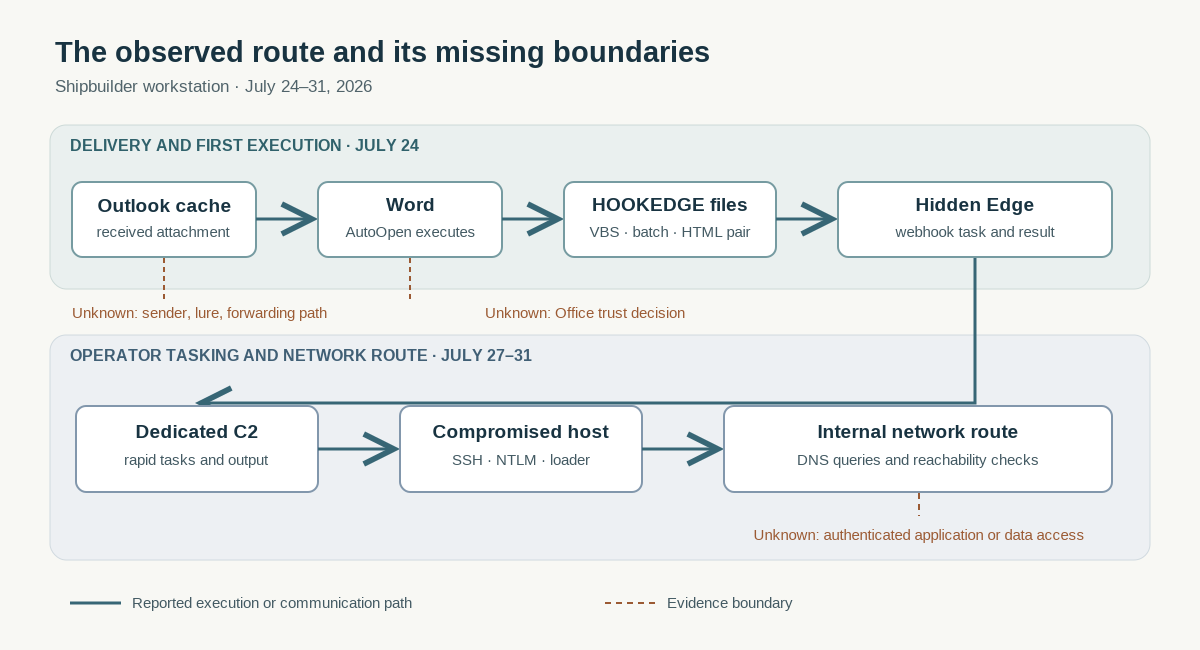
Symantec says the document was opened directly from Outlook’s attachment cache on the afternoon of July 24. That places a received email attachment at the entry point, but the report does not provide the message or its headers. The cache path identifies the route into Word, not the sender’s claim of authority or any handling before the recipient opened it. [1]
The recipient evidently treated the attachment as worth opening, yet its claimed authority cannot be reconstructed. An earlier HOOKEDGE document impersonated a Spanish government meeting agenda; later samples displayed generic Enable Content prompts and fake Word errors. These earlier-campaign techniques show the operators’ repertoire without establishing the shipbuilder’s lure or what its recipient did after opening the file. [6, 7]
Opening the attachment reached Word, but document opening and macro execution are distinct decisions. The observed AutoOpen execution means VBA was permitted at that moment; section 5 reconstructs the relevant Office checks and section 6 tests the explanations against records that would identify the actual decision. [1, 2, 9]
1.3 What executed on the workstation?
The obfuscated AutoOpen macro installed a four-file HOOKEDGE chain in the user’s profile. Its batch script launched a hidden Edge window to download tasks from the legitimate webhook.site service; the script then copied each downloaded task into a command file, executed it on the workstation, and returned the result. Edge supplied the retrieval path, while the batch script supplied operating-system execution. The first task, within minutes of opening the document, asked what the host was, who was using it, which network and proxy settings it had, and which external services it could reach. These were practical questions for an operator assessing whether a foothold was useful and how to maintain contact with it. A test of connectivity to a cloud service does not establish access to an account there. [1]
2. Attack Timeline
Symantec’s dated reconstruction supplies the chronology. The later campaign reports describe different victims and should not be read back into these rows. [1]
| Date | Observed activity |
|---|---|
| July 24, 2026 | Malicious Word document opened from Outlook’s attachment cache; AutoOpen macro executed |
| July 24 | HOOKEDGE installed; hidden Edge retrieved commands through webhook.site; system and network reconnaissance began |
| July 27 | Second-stage HOOKEDGE switched to a dedicated command-and-control IP address |
| July 27 | Operators placed an SSH private key on the host, initiated an outbound SSH connection with remote forwarding, and attempted to capture NTLM authentication material |
| July 28 | Internal hostname discovery continued; the SSH process was terminated |
| July 31 | Attackers executed a reflective loader, ld.exe, with an encrypted input file named Events.dat |
| Late August–September 24 | Loader and launcher artifacts remained observable; the last launcher activity was recorded on September 24 |
| October 20 | Symantec published the investigation |
The timeline represents observable activity rather than uninterrupted control. Symantec saw seven second-stage tasks within roughly 30 seconds on July 27, at two-to-eight-second intervals consistent with interactive work. It later saw beaconing and persistent artifacts, but cannot determine whether September activity was a scheduled launcher finding no task or renewed operator interest. The July 31 loader’s input file was not recovered, so the capabilities of whatever it decrypted cannot be inferred from the loader alone. [1]
3. A Campaign Meets a Naval Industrial Target
3.1 What the earlier government disclosures establish
In May 2025, the UK and allied governments described a GRU Unit 26165 campaign, active since 2022, against organizations involved in coordinating and transporting support to Ukraine and against defense, maritime, port, airport, and technology sectors in NATO states. The disclosed methods included spearphishing, credential attacks, and exploitation of mailbox permissions. The governments also reported targeting cameras near Ukrainian border crossings and military installations to observe aid movement. This is evidence that the unit has sought information about military support systems and the ordinary infrastructure around them, not evidence that the July 2026 shipbuilder supplied Ukraine or was part of that same operation. [10]
The distinction between a government’s attribution of a unit and Symantec’s attribution of this incident is essential. “APT28” groups activity by an assessed operator; it does not turn every later compromise into one continuous campaign with one objective. The October report’s three target types fit the broad defense-and-government interests seen elsewhere, but the common tasking, if any, is undisclosed. This article can therefore place the shipbuilder within a documented pattern of target categories without assigning it a particular operational mission. [1, 10]
3.2 Why the industrial setting matters
NATO says it is aligning Allied procurement demand and capability requirements with industry’s ability to plan and produce at scale. In January 2026, the European Defence Agency convened shipbuilders and seven states to discuss requirements for a future family of frigates. Those public examples show why shipbuilding participates in defense planning as well as fabrication; they do not place Symantec’s unnamed victim in either program. [11, 12]
For an intelligence service, this setting presents questions about procurement, constrained components and yards, delivery and maintenance schedules, and the companies and people connecting them. Business teams may coordinate suppliers, projects, invoices, and logistics over ordinary email and planning systems even when design files are more tightly held. An employee workstation can therefore be useful as a point from which to discover names and reachable services, without itself holding a classified blueprint. That is an inference about a shipbuilder’s possible information structure, not a claim about this victim’s repositories or what the intruder read. Symantec’s observed hostname discovery and SSH route show exploration toward that kind of organizational reach, while leaving the destination and outcome unresolved. [1, 11, 12]
3.3 What the HOOKEDGE history explains
The specific access tool had also been developing before the shipbuilder intrusion. LAB52 traced APT28-attributed “Operation MacroMaze” activity from September 2025 to January 2026 and analyzed a Spanish ministry agenda impersonation. Recorded Future described later HOOKEDGE campaigns against government, diplomatic, and defense-manufacturing organizations in Romania, Spain, and Türkiye. The progression from a topical diplomatic lure to more generic prompts, together with variants that kept a lightweight backdoor polling and made selected hosts more responsive, shows a reusable access pipeline rather than a tool built for one shipyard. [6, 7]
At the shipbuilder, the reusable first stage was followed by a consequential choice. Symantec reports a four-file document drop, whereas a Recorded Future sample from an earlier campaign dropped six files; on July 27 the shipbuilder’s operators moved from webhook.site to dedicated infrastructure and began quick, individual tasks. That is evidence of additional operational investment after the initial survey. It does not reveal whether the host was selected because of its user, its location in the network, a known shipbuilding project, or information found during reconnaissance. Earlier campaigns’ Spanish lure, canary fields, and polling schedule cannot fill in the shipbuilder’s missing email or justify a claim about its country. [1, 6, 7]
4. From Document Execution to Network Reach
4.1 The route through the workstation
The received attachment moved from Outlook’s cache into Word. Once Word permitted AutoOpen, code chosen by the attacker ran with the employee workstation’s available execution rights and installed HOOKEDGE files in the user profile. A hidden Edge window fetched the task, but a batch script executed the saved command file and uploaded its output; on July 27, a new launcher and second stage replaced webhook.site with a dedicated server. Each step depended on a different capability: Word’s permission to execute document code, the endpoint’s ability to start scripts and a browser, and the network’s permission to reach an external command channel. Symantec documents the resulting path, while the exact Office trust decision and endpoint control state remain unavailable. [1, 2, 5]
The first stage let the attackers ask whether this host was useful and reachable. The dedicated channel then supported seven tasks within about 30 seconds, followed by efforts to create a route toward internal destinations and gather authentication material. That tempo is consistent with interactive operation and marks a shift from installing a reusable implant to investigating this particular environment. For a naval manufacturer, such a machine could be valuable because it might expose identities and paths to ordinary production, procurement, and supplier systems. The observed tasks establish an attempt to discover that reach, not possession of those records. [1]
4.2 A route, authentication material, and access
The operator placed an SSH private key of their own choosing on the victim host and used Windows’ built-in SSH client to connect to their server. The resulting remote forward offered a route from that server back toward destinations the workstation could reach. This extended the practical reach of the workstation foothold, but the attacker-supplied key was not a shipbuilder credential and the network route conferred no automatic right to enter an internal application. Hostname lookups soon afterward show reconnaissance of possible destinations; the public report does not establish an authenticated visit to one. [1]
A separate PowerShell task induced the host to authenticate to a listener on its own loopback address and captured NTLM challenge-response material. This could support a later credential attack, but it is a different boundary from network reach: no successful crack, relay, or login is reported. July 31 brought ld.exe, a loader designed to decrypt and run another program in memory, with an encrypted file called Events.dat; because that file was not recovered, what actually ran is unknown. Together, these actions show an operator developing options beyond the initial endpoint while the public record stops before evidence of successful internal access or data collection. [1]
5. Word’s Macro Trust Checks
Word recognizes AutoOpen as an automatic macro name and calls it when an existing document opens if macro execution is permitted. The routine’s name explains the trigger without implying that a user intentionally ran a command or that a product vulnerability bypassed protection. The outstanding question is how this particular document passed the applicable trust checks. [9]
5.1 The 2022 change was a product-specific default
Microsoft changed the default for internet-origin macros in supported Windows Microsoft 365 Apps releases beginning in 2022, with the relevant enterprise channel rollout reaching early 2023. For affected files, the newer security warning does not simply offer the old Enable Content action. Microsoft distinguishes that rollout from perpetual-license products such as Office LTSC 2021 and Office 2019; those products could still follow their older notification model unless an administrator imposed a stricter policy. “Updated Office” therefore does not identify one universal macro rule. The shipbuilder’s edition, build, channel, and effective policy at the time are unpublished. [2]
5.2 Origin and trust are separate decisions
The newer internet-origin restriction depends on how Windows classifies the file, commonly recorded in Zone.Identifier Mark of the Web metadata. Microsoft’s zone mapping distinguishes Internet (ZoneId=3) and Restricted sites (4) from My Computer (0), Local intranet (1), and Trusted sites (2); it explicitly notes that a file with ZoneId=2 is not blocked by the newer default. The Outlook cache path alone reveals neither the original ZoneId nor whether the metadata survived handling. The original attachment and its metadata, rather than a copied file or hash, would establish whether the internet-origin restriction was reached. [2]
For an internet-classified file, Microsoft’s documented decision flow is ordered. Office first checks for a Trusted Location, then a valid signature from a Trusted Publisher, then applicable macro policies; in the updated Microsoft 365 Apps flow, it next checks whether the file was previously made a Trusted Document before applying the newer default block. Office LTSC 2021 and Office 2019 place that prior-trust check before policy instead. These paths have different owners and consequences, so treating them as interchangeable exceptions would obscure which decision authorized code. Microsoft’s default Word Trusted Locations do not include an ordinary Outlook attachment cache, though an organization could configure others. Protected View is another opening restriction: enabling editing does not by itself authorize VBA under the newer internet-macro rule. [2, 3, 4]
5.3 The next boundaries were Windows controls
Once VBA ran, the operation crossed further boundaries: scripts launched a browser, contacted an external service, and later invoked the installed SSH client. Microsoft Defender has rules that can restrict some Office-created processes and executable content, but Symantec did not publish this workstation’s enforcement state. The observed sequence establishes that the controls actually in force did not stop these steps; it does not identify a disabled rule or prove a bypass. This technical uncertainty matters because a document’s permission to run was only the first of several decisions that allowed an operator to keep working from the host. [1, 5]
6. Which Decision Authorized the Document?
Four overlapping classes of explanation remain consistent with the observed AutoOpen execution. They are diagnostic possibilities within Office’s ordered decision flow, not four mutually exclusive outcomes. [1, 2]
6.1 Four explanations for the same execution
| Explanation | Mechanism | Evidence needed |
|---|---|---|
| Non-applicability | The newer default did not apply to the deployed Office product or configuration | Office edition, version, channel, effective macro policies |
| Origin classification did not trigger the restriction | Mark of the Web was absent, or a present ZoneId classified the file outside the Internet and Restricted sites zones | Original file metadata, zone assignment, attachment-handling records |
| Authorized exception | Office correctly permitted execution under a trusted location, publisher, previous trust decision, or explicit policy | Trust configuration, signatures, policy and trust history |
| Enforcement defect | A prohibition should have blocked the document, but execution occurred anyway | Verified applicable prohibition, relevant metadata, absence of qualifying exceptions, reproducible behavior |
An older product default and permissive administrative policy might coexist, while a Trusted Location can authorize macros before later checks are reached. Successful execution therefore cannot itself be called a bypass of the newer default, and earlier HOOKEDGE Enable Content lures do not prove a click at the shipbuilder. An enforcement-defect claim would require a contemporaneous applicable prohibition, the original file’s zone classification, no qualifying trust path, and code execution despite those conditions. [1, 2, 6]
6.2 Who controlled those decisions?
Microsoft defined the product’s capabilities and defaults; administrators chose the deployed edition and policies; users might have been allowed to make particular trust decisions; Windows and Office implemented file-origin and policy checks. The attackers controlled the document’s code and, after it ran, the downloaded tasks. The missing records must therefore cover both the mail-to-document boundary and the document-to-code boundary:
| Record | What it would establish |
|---|---|
| Original message, headers, recipient, attachment and mail trace | Claimed sender, lure, delivery route, and whether the document was forwarded |
| Office edition, build, and update channel | Whether the newer default was applicable |
Original Zone.Identifier metadata | How the attachment’s origin was classified |
| Effective Word macro policies | Whether VBA was forbidden, conditionally allowed, or governed by older notification behavior |
| Trusted Location and publisher configuration | Whether a recognized trust exception applied |
| Trusted Document and user-interaction history | Whether a previous or user-authorized trust decision was relevant |
| Defender ASR policy and event records | Whether later process and script behavior was subject to active enforcement |
A later policy snapshot may not describe July 24, and moving the document for analysis may strip the Zone.Identifier file stream containing its origin classification. The mailbox and endpoint records could answer how this recipient received and opened the attachment; the Office and file-origin records could answer why AutoOpen was allowed. Neither question can be settled by the post-compromise command log alone. [1, 2]
7. What the Shipbuilder Case Establishes
The distinctive feature of the shipbuilder case is the connected expansion of authority. A received document crossed Word’s trust boundary and ran code on a worker’s machine; that code gained a task channel through normal browser and network functions; the operator then used the host’s outbound SSH capability to establish a route back toward internal destinations. None of those permissions alone supplied the next one, but together they let APT28-associated operators turn an ordinary employee endpoint into a position from which to explore a naval industrial organization. The July 27 return, faster command channel, hostname discovery, and credential collection show that the operator invested in precisely that expansion. [1]
Defense production and naval planning make suppliers, capacity, and delivery schedules plausible intelligence interests beyond protected ship designs, while earlier government disclosures show APT28’s interest in support networks around military activity. The public incident record does not establish which of those interests, if any, drove this operation. It establishes a more precise security lesson from this particular case: document execution, endpoint command execution, and network reach were composed into one attack path, but that path is not proof of authenticated access to shipbuilding systems or the acquisition of naval information. [1, 10, 11, 12]
References
Incident Investigation and Campaign Evidence
[1] Broadcom / Symantec Threat Hunter Team. “Swallowtail: Russian Espionage Group Targets Defense Firms in Two NATO Countries.” October 20, 2026. Primary forensic account of the shipbuilder intrusion and its limits.
https://www.security.com/blog-post/swallowtail-russia-nato-targets
[6] Recorded Future / Insikt Group. “BlueDelta Targets Defense and Diplomacy with HOOKEDGE.” August 2026. Research on earlier HOOKEDGE campaigns and the basis for its moderate-confidence BlueDelta attribution.
https://www.recordedfuture.com/research/bluedelta-targets-with-hookedge
[7] LAB52 / S2 Grupo. “Operation MacroMaze: new APT28 campaign using basic tooling and legit infrastructure.” February 13, 2026. Spanish research team’s analysis of earlier lures, macro variants, and webhook use.
[8] UK National Cyber Security Centre. “UK exposes Russian military intelligence hijacking vulnerable routers for cyber attacks.” April 7, 2026. Reports the UK’s prior link between APT28 and GRU Unit 26165; it does not attribute an individual in the shipbuilder case.
Defense and Industrial Context
[10] UK National Cyber Security Centre and international partners. “UK and allies expose Russian intelligence campaign targeting western logistics and technology organisations.” May 21, 2025. Describes Unit 26165’s targeting of defense, maritime, logistics, and Ukraine-support organizations; it does not identify the 2026 shipbuilder.
https://www.ncsc.gov.uk/news/uk-partners-expose-russian-intelligence-campaign
[11] NATO. “Increasing defence industrial production.” Updated July 8, 2026. Explains NATO’s defense production priorities and the relationship between Allied requirements and industry planning.
https://www.nato.int/en/what-we-do/deterrence-and-defence/natos-role-in-defence-industry-production
[12] European Defence Agency. “EDA hosts shipbuilders, signatory countries for new family of warships.” January 15, 2026. Illustrates the involvement of shipbuilders in developing future naval requirements; no link to this victim is reported.
Microsoft Office Security Model
[2] Microsoft Learn. “Macros from the internet are blocked by default in Office.” Product rollout, Mark of the Web, and macro-trust decision flow.
https://learn.microsoft.com/en-us/microsoft-365-apps/security/internet-macros-blocked
[3] Microsoft Support. “What is Protected View?” Restricted opening and Outlook attachment handling.
https://support.microsoft.com/en-us/office/collab-files/what-is-protected-view
[4] Microsoft Learn. “Trusted Locations for Office files.” Active-content behavior, default locations, and policy controls.
https://learn.microsoft.com/en-us/microsoft-365-apps/security/trusted-locations
[9] Microsoft Learn. “Auto Macros.” Word’s AutoOpen lifecycle.
https://learn.microsoft.com/en-us/office/vba/word/concepts/customizing-word/auto-macros
Endpoint Protection and Execution Controls
[5] Microsoft Learn. “Attack surface reduction (ASR) rules reference.” Office process-creation and executable-content rule scope.
https://learn.microsoft.com/en-us/defender-endpoint/attack-surface-reduction-rules-reference
Evidentiary Scope
Symantec’s forensic report is the source for victim-specific activity. Recorded Future and LAB52 document earlier campaigns; UK, NATO, and EDA sources establish wider operational and industrial settings. None of those contextual sources identifies the shipbuilder or proves its participation in a named program. The public record lacks the original message, attachment metadata, endpoint policy history, internal access logs, and encrypted loader payload. This article consequently makes no finding of a Word zero-day, a specific user prompt or click, a successful login to protected shipbuilding systems, or theft of naval engineering information.